Vibe Coding App
Vibe & No-Code Builders

Vibe & No-Code Builders

Vibe coding and no-code builders use AI to turn natural language descriptions, screenshots, or sketches into fully functional web and mobile applications; no programming knowledge required.

Bolt.newLovablev0Blink.newAnything.comBase44

The barrier to entry for building software has never been lower. In 2026, vibe and no-code builders have doubled in size and capability, transforming text prompts, screenshots, and sketches into fully functional applications. From browser-based builders like Lovable and Bolt.new, to mobile-native tools like A0.dev, to Google's new entries (Disco, Opal, Stitch), this category offers an AI builder for every creator. Whether you're a startup founder, marketer, designer, or developer in a hurry, you'll find the right tool below.

Category pages map the full market. If you want a curated shortlist with ranked picks, read Best Vibe & No-Code Builders.

What to know about Vibe & No-Code Builders

<strong>Lovable</strong> is the overall leader for prompt-to-app with stunning UI output and Supabase integration. <strong>Bolt.new</strong> is the fastest for prototyping, browser-based, 28 minutes to working prototype in benchmarks. <strong>A0.dev</strong> is the breakout mobile builder, generating production-quality React Native apps. <strong>Canva Code</strong> brings design-first building to Canva's massive user base. <strong>Google Disco</strong> enters with Gemini 3 power. For open-source control, <strong>VibeSDK</strong> and <strong>bolt.diy</strong> let you self-host. The community consensus: prototype fast in Lovable or Bolt.new, then graduate to <a href="/tools/cursor">Cursor</a> for production.

Top Vibe & No-Code Builders tools right now

If you want to start fast, try Bolt.new, Lovable and v0.

Choosing the Right Type of Builder

Not all AI builders work the same way. Understanding the different approaches helps you pick the right tool for your project, and avoid the frustration of hitting a wall halfway through.

Prompt-to-App Builders: Lovable, Bolt.new, Base44

These are the "magic" tools. You describe what you want in plain English, and they generate a full-stack application, frontend, backend, database, and authentication. Lovable produces the most polished UI and integrates tightly with Supabase. Bolt.new is the fastest, 28 minutes to a working prototype in benchmark tests. Base44 focuses on speed and simplicity for internal tools.

Best for: Non-technical founders validating MVPs, marketers building lead magnets, and developers who want to skip boilerplate scaffolding.

Mobile-Native Builders: A0.dev, Anything.com, Rork

Building for iOS and Android is a different challenge. A0.dev is the breakout star of 2026: it generates production-quality React Native code from natural language. Anything.com handles both web and native mobile development. Rork focuses specifically on mobile app constraints.

Best for: Anyone who needs an App Store or Play Store listing without learning Swift, Kotlin, or Flutter.

Design-to-Code: Canva Code, v0, Tempo, Figma Make

If you think visually, these tools start from design rather than text. Canva Code lets Canva's massive design community generate interactive web apps directly from Canva's editor. v0 by Vercel generates beautiful shadcn/ui components from descriptions: the highest code quality in the category. Tempo focuses on visual React development.

Best for: Designers, agencies, and teams where the visual output matters as much as the code.

The Google Wave: Disco, Opal, Stitch

Google has entered the vibe coding space with multiple tools. Google Disco is the most mature: a Gemini 3-powered app builder with Google Cloud integration. Google Opal focuses on mobile-first building. Google Stitch converts designs to code. All are early but backed by Google's AI muscle.

Open-Source & Self-Hosted: VibeSDK, bolt.diy

VibeSDK and bolt.diy give you the AI building experience without vendor lock-in. Self-hosted, open-source, and fully under your control. The tradeoff is more setup work, but you own the entire stack.

Base44 logo

Base44

Featured
Product HuntRated 4.5 out of 5(29)
Try Free

Pure natural-language AI app builder that generates a complete app, backend, database, auth, hosting, and integrations, from a single prompt. Ranked #1 in multiple 2025-2026 vibe-coding roundups for its end-to-end automation and beginner friendliness.

Hostinger Horizons logo

Hostinger Horizons

Featured
G2Rated 4.4 out of 5(782)
Try Free

AI-powered no-code platform that turns natural language prompts into fully functional websites and web apps. Includes hosting, SSL, CDN, custom domains, and one-click deployment. Supports text, voice, and image prompts with built-in SEO, e-commerce via Stripe, and backend integration through Supabase.

Lovable logo

Lovable

Featured
Product HuntRated 4.6 out of 5(163)
Try Free

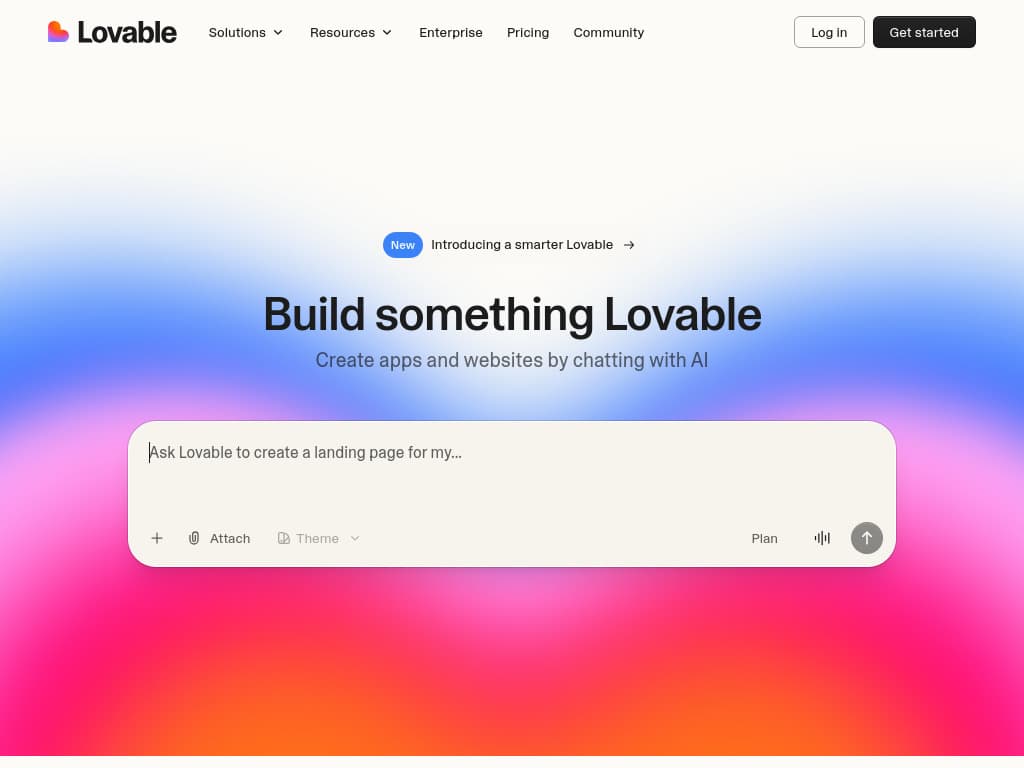
Prompt-first platform to build and iterate full-stack web apps through chat, producing real React/TypeScript/Tailwind code. Lovable 2.0 adds Lovable Cloud (built-in backend with auth and data persistence), real-time collaboration for up to 20 users, agentic mode for multi-step autonomous edits, AI connectors (Perplexity, ElevenLabs, Firecrawl, Miro), visual CSS editing, themes, built-in analytics, and domain purchasing. Targets non-developers, designers, indie hackers, and agencies who want speed for prototypes, MVPs, and small production apps.

Claude Design logo

Claude Design

New
Paid

Anthropic Labs' conversational design studio inside Claude. Powered by Claude Opus 4.7, it turns natural-language prompts into interactive prototypes, slides, one-pagers, and polished visuals. Ingests your GitHub repo to extract the project's design system, then hands off a structured implementation bundle to Claude Code for production code. In research preview for Pro, Max, Team, and Enterprise users at claude.ai/design.

enterprisebrowser-based
Google Stitch logo

Google Stitch

New
Try Free

Experimental Google Labs tool that turns prompts and images into UI designs, supports fast iteration with variants, and offers handoff via Paste to Figma plus front-end code export.

Retool logo

Retool

Try Free

Low-code platform for building internal tools, admin panels, and dashboards. Retool combines 90+ drag-and-drop UI components with JavaScript extensibility and AI app generation to connect any database or API.

enterprisefree-tierbrowser-based
Webflow logo

Webflow

Try Free

Professional no-code website builder and CMS with pixel-perfect design control. Webflow AI generates layouts and copy, while the visual canvas produces clean semantic HTML and CSS; no templates required.

Framer logo

Framer

Try Free

Design-to-website platform with an AI assistant that generates full sites from a prompt, lets you edit visually, and publishes instantly. Beloved by designers and marketers for pixel-perfect, interactive websites without writing code.

A0.dev logo

A0.dev

Try Free

Y Combinator-backed AI platform that generates complete React Native apps from text descriptions. Ship to App Store and Google Play with one click: the world's fastest iOS build process.

mobile
Canva Code logo

Canva Code

Paid

Canva Code is Canva's AI-powered code generator that transforms text prompts into interactive HTML/CSS/JavaScript widgets directly within the Canva design platform. Launched in partnership with Anthropic, it lets designers, marketers, and non-developers add calculators, timers, quizzes, and mini-apps to presentations, docs, and websites; no coding required.

browser-based
Bolt.new logo

Bolt.new

Product HuntRated 4.4 out of 5(40)
Try Free

AI-powered, browser-based full-stack app builder that turns natural language prompts into working applications. Built on StackBlitz WebContainers with Supabase integration, Figma/GitHub imports, and one-click deployment; no local setup required.

v0 logo

v0

Product HuntRated 4.9 out of 5(49)
Try Free

AI-powered design-to-code tool from Vercel. Focuses on generating beautiful UIs and frontend components. Works with Figma imports and allows element-level editing. Best for UI-first web projects.

Blink.new logo

Blink.new

Product HuntRated 5 out of 5(1)
Try Free

The 'world's first vibe coding platform' that builds full-stack apps and agents from natural language prompts. Excellent for MVPs and non-technical founders.

Anything.com logo

Anything.com

Product HuntRated 4.8 out of 5(17)
Paid

AI-powered vibe coding platform (formerly Create.xyz) that turns natural language prompts into production-ready web and native mobile apps with built-in backend services.

Tempo logo

Tempo

Product HuntRated 4.8 out of 5(51)
Try Free

AI-powered prompt-to-app platform that turns natural language into full-stack React applications with visual editing, multi-agent planning, and one-click deploys.

VibeSDK logo

VibeSDK

Try Free

Open-source AI "vibe coding" platform built on Cloudflare. Generate full-stack apps from prompts, sandboxed in WebContainers, and deploy instantly to Workers. The self-hosted alternative to Bolt.new.

open-sourcelocal-first
Bubble logo

Bubble

G2Rated 4.4 out of 5()
Try Free

Full-stack no-code platform for building and scaling web apps with a visual editor and optional AI features.

Softgen logo

Softgen

Product HuntRated 5 out of 5(3)
Paid

AI-based builder for creating full-stack web applications by describing your project.

Google Opal logo

Google Opal

Try Free

Google's experimental no-code tool that turns natural language into multi-step AI workflows. Think 'Zapier meets Gemini' but with a visual canvas.

Rork logo

Rork

Paid

AI tool that builds cross-platform native mobile apps (React Native) from your descriptions.

mobile
HeyBossAI logo

HeyBossAI

Paid

Personal AI engineer for non-coders to build apps, websites, and games using natural language.

Google Disco logo

Google Disco

Try Free

Google's experimental AI browser that turns open tabs into ephemeral apps. Uses Gemini 3 to create checklists, planners, and comparison tables instantly.

browser-based
Memex logo

Memex

Paid

Desktop-based builder for creating internal tools and projects locally using natural language.

Lazy AI logo

Lazy AI

Paid

No-code platform with pre-configured workflows for building apps and automations faster with AI.

Rocket logo

Rocket

Paid

AI platform that generates web and mobile apps from natural language prompts or Figma designs.

Mocha logo

Mocha

Paid

No-code builder that turns plain English ideas into apps with built-in databases and authentication.

WebSparks logo

WebSparks

Paid

AI app generator that can interpret text (and sometimes images/sketches) to produce full-stack apps.

Magically logo

Magically

Paid

AI builder that creates native mobile apps including backend and authentication from prompts.

mobile
Flatlogic logo

Flatlogic

Paid

AI agent that builds full-stack business apps (like CRMs/ERPs) with source code ownership.

YouWare logo

YouWare

Try Free

AI-powered vibe coding platform that turns natural language prompts into full-stack websites and apps. Features YouBase integrated backend, model switching between GPT-5-Codex and Claude 4.5 Sonnet, and one-click publishing to web and app stores.

LingGuang logo

LingGuang

Apple App StoreRated 4.6 out of 5(2622)
Try Free

Ant Group's multimodal vibe-coding assistant that ships Flash Apps, 3D visuals, and real-time scene insights from a single prompt.

Related Articles

The Complete Guide to AI App Builders

The "Vibe Coding" Movement in 2026

"Vibe coding" isn't just a buzzword: it represents a fundamental shift in who can build software. The term describes a workflow where you focus on what you want (the "vibe") and the AI handles how to build it. In 2026, this has moved from novelty to mainstream: Lovable hit $100M ARR in 8 months, and Google, Canva, and Hostinger have all entered the space.

The key difference from old-school no-code is that modern tools generate real, exportable code. You're not locked into a proprietary platform forever; you can start in Lovable, export to GitHub, and continue development in Cursor when the project outgrows the builder. This "graduate workflow" is the most recommended approach across developer communities.

Speed vs. Quality: The Tradeoff

Every benchmark study reaches the same conclusion: AI builders are fast but imperfect. Bolt.new produces working prototypes in 28 minutes. Lovable takes 35 minutes but with higher UI polish. However, code quality degrades over time: the 50th prompt produces worse code than the 5th. For anything you'll maintain long-term, plan to either rebuild or have a developer review the codebase.

Capabilities Comparison

  • UI Quality: Lovable and v0 produce the most polished output. Lovable's design decisions are surprisingly good for AI-generated interfaces.
  • Speed: Bolt.new is the fastest to a working prototype. Base44 is also notably quick for internal tools.
  • Backend Integration: Lovable (Supabase, Lovable Cloud), Bolt.new (Supabase), and Replit (any database) handle full-stack best.
  • Mobile: A0.dev (React Native), Anything.com (native), Google Opal (mobile-first).
  • Code Export: Most modern tools export clean React/Tailwind code. VibeSDK and bolt.diy give you full ownership from day one.
  • Code Quality: v0 scores highest (9/10 in benchmarks). Lovable at 7/10. Bolt.new at 6/10.

Pricing Landscape

Most tools offer free tiers for experimentation. Lovable starts at $20/month (credit-based). Bolt.new is similar at ~$20/month (token-based, often better value for heavy usage). v0 starts at $20/month. Canva Code is included in Canva Pro. VibeSDK and bolt.diy are free and open-source.

For heavy usage, Bolt.new's token-based model typically offers better value than credit-based tools. For budget-conscious builders, the free tiers of Bolt.new, Lovable, and Replit are surprisingly capable for small projects.

Security Considerations

A May 2025 study found security vulnerabilities in roughly 10% of AI-generated apps, mostly around authentication edge cases and input validation. If you're shipping anything that handles user data, payments, or authentication, human security review is non-negotiable. Use the builder to get to a working prototype fast, then have a developer audit the critical paths before going to production.

Community Recommendations

The consensus across Reddit, YouTube, and developer forums: Lovable for "MVPs you plan to keep," Bolt.new for "quick experiments you might throw away," and A0.dev for "the best mobile builder." The most common workflow advice: prototype fast, validate the idea, then rebuild properly if it has legs.

The Graduate Workflow

The most recommended approach across developer communities is the "graduate workflow": start fast in a vibe builder, then move to a professional IDE when the project has legs. Specifically:

  1. Validate, Build a working prototype in Bolt.new (fastest) or Lovable (best UI) in under an hour.
  2. Test with users, Deploy the prototype and get real feedback. Most ideas die here, and that's a good thing. You spent hours, not weeks.
  3. Graduate, Export the code to GitHub and continue development in Cursor or another professional IDE. Clean up the codebase, add proper error handling, and harden security.
  4. Scale, Deploy to Vercel, Netlify, or your preferred hosting platform for production traffic.

This workflow combines the speed advantage of vibe builders with the quality and control of professional development tools. It's how many successful indie products were launched in 2026.

For a curated editorial guide with specific recommendations by audience, see our Best Vibe & No-Code AI App Builders guide. For cross-category comparison with IDEs and enterprise tools, see our Best AI App Builders blog guide.

Frequently Asked Questions

Can I export the code from these builders?

Yes. Most modern tools like Lovable, Bolt.new, and v0 export standard React/Tailwind code to GitHub. Open-source tools like VibeSDK and bolt.diy give you full code ownership from the start. Traditional no-code tools like Bubble do NOT export code, you're locked into their platform.

What is 'vibe coding'?

Vibe coding is a modern approach where you describe what you want in natural language and AI handles the implementation. It's different from old-school no-code because the AI generates real, exportable code rather than visual blocks. The term was popularized in 2025 and now describes an entire category of tools.

Lovable vs Bolt.new: which should I choose?

Lovable produces more polished UI and is better for MVPs you plan to maintain long-term. Bolt.new is faster for quick prototypes and experiments. For heavy usage, Bolt.new's token-based pricing often offers better value. Many builders use both: Bolt.new to validate, Lovable to build the real thing.

Can I build a mobile app with these tools?

Yes. A0.dev generates production-quality React Native code. Anything.com builds native mobile apps. Google Opal is a new mobile-first option. For simpler cases, any web builder (Lovable, Bolt.new) can create a Progressive Web App (PWA) that works on mobile browsers.
Are these tools good for complex apps?

They're excellent for MVPs, internal tools, and simple CRUD applications. For highly complex business logic, code quality degrades after many prompts. The recommended approach is to use builders for the first 80%, then graduate to a professional IDE like Cursor for refinement and long-term maintenance.
Is AI-generated code secure enough to ship?

For internal tools and low-traffic MVPs, generally yes. For anything handling user data, payments, or authentication, you need human security review. Studies have found vulnerabilities in roughly 10% of AI-generated apps, mostly around auth edge cases and input validation. Build fast, but always audit critical paths before production.

Find the best Vibe & No-Code Builders tool for your workflow

Use this category page as a curated shortlist of Vibe & No-Code Builders tools. You can explore each tool’s features on its tool page, then compare options via their alternatives pages. If you want to browse everything, head back to All Tools.

Popular starting points in this category include Bolt.new, Lovable and v0.

Stay Updated with Vibe Coding Insights

Every Friday: new tool reviews, price changes, and workflow tips; so you always know what shipped and what's worth trying.

No spam, ever
Unsubscribe anytime