Agentic Engineering Tools 2026: The Stack, Layer by Layer, With Prices

TL;DR
- Four layers, not one tool. A coding agent you drive, an orchestration framework when one agent is not enough, a data and memory layer, and observability so you can see what the agents did.
- Coding agents are a $20 decision. Claude Code rides on Claude Pro ($20/mo), Cursor Pro is $20/mo, Codex is included in ChatGPT Plus ($20/mo).
- Orchestration is free. LangGraph (MIT), CrewAI open source, AutoGen and MetaGPT (MIT) all cost $0. You pay for tokens and for the hosted layer around them.
- The paid layer is observability and hosting: LangSmith Plus $39/seat, LlamaCloud Starter $50/mo, CrewAI Enterprise custom.
- Most solo devs need layer one only. Multi-agent costs about 7x the tokens of a single session, per Anthropic's own docs.
Quick Answer: Our Picks
- 1.Claude Code best for the daily coding agent. Terminal agent with subagents and hooks, included in every paid Claude plan from $20/mo, so the agent itself costs nothing extra.
- 2.Cursor best for agent inside the editor. Agent loop in a VS Code shell at $20/mo Pro, $40/user Teams, with MCP, skills and hooks on the Pro tier.
- 3.OpenAI Codex CLI best for ChatGPT subscribers. Included in every ChatGPT plan from Free to Enterprise, with a $20 Plus tier and API-key pay-per-token as the escape hatch.
- 4.LangGraph best for durable multi-agent graphs. MIT-licensed agent runtime for single, multi-agent and hierarchical control flows, free to run, paid only if you add LangSmith.
- 5.CrewAI best for role-based crews fast. Free Basic plan with a visual editor and 50 workflow executions a month; Enterprise adds SSO and RBAC at custom pricing.
- 6.AutoGen best for event-driven agent systems. Microsoft's open-source framework with Core, AgentChat and a no-code Studio, Python 3.10 and up.
- 7.MetaGPT best for software-company role play. MIT-licensed framework that assigns product, architect and engineer roles to agents for end-to-end builds.
- 8.LlamaCloud best for document ingestion and memory. Free tier with 10K credits, Starter $50/mo, Pro $500/mo, priced per action at 1,000 credits for $1.25.
Full breakdown of all 9 picks below.
How We Rank
- Official pricing page fetched on 23 August 2026; no price is quoted from memory or a third party
- Each tool placed in one layer of the stack so the list reads as a toolchain, not a popularity contest
- Open-source licence and hosted tier separated, because that is where the real cost sits
- Tools we could not price live (Devin) are named but not ranked
Last verified August 23, 2026 by Zane.
Agentic engineering tools are not one category. Every list you will find for this keyword mixes a terminal agent, a Python framework and a vector database as if they competed with each other. They do not. They stack. So this roundup is organised as a stack: four layers, what each one is for, who makes it, and the exact price on the official page as of 23 August 2026.
If you want the concept first, read what agentic engineering is. This page is the shopping list.
The stack in one table
| Layer | What it does | Tools | Entry price (official page, 23 Aug 2026) |
|---|---|---|---|
| 1. Coding agent | Plans, edits, runs and tests code in your repo | Claude Code, Cursor, Codex, Devin | $20/mo (Claude Pro, Cursor Pro, ChatGPT Plus) |
| 2. Orchestration | Runs several agents against one goal | LangGraph, CrewAI, AutoGen, MetaGPT | $0, all open source |
| 3. Data and memory | Ingests documents, indexes, retrieves | LlamaIndex / LlamaCloud | $0 (10K credits), Starter $50/mo |
| 4. Observability | Traces, evals, cost per run | LangSmith | $0 Developer seat, Plus $39/seat |
Two things stand out. The frameworks everybody argues about cost nothing. And the thing people forget to budget for, observability, is the only line with a per-seat price.
Layer 1: coding agents
This is the layer you use every day, and the one where the price is basically settled at $20.
Claude Code
Anthropic's terminal agent. It is not sold on its own: the pricing page says "Claude Code is included in all paid plans." Pro is "$20 if billed monthly" ($17/mo annual), Max is "From $100 Per month" with "5x or 20x more usage than Pro", and Team seats are "$20 Per seat / month if billed annually. $25 if billed monthly." The full breakdown, including the 5-hour and weekly usage windows, is in our Claude Code pricing guide.
Why it anchors the stack: subagents, hooks and MCP are built in, so a lot of what people reach for a framework to do (parallel workers, pre and post-processing) is already in the CLI.
Cursor
The agent inside an editor. From the live pricing page: "Hobby Free" with "Limited Agent requests", "Individual $20 / mo. Pro" with "MCPs, skills, and hooks", and "Teams $40 / user / mo." Pro+ and Ultra exist but their prices sit behind a toggle the server HTML does not expose, so we do not quote them. Head-to-head with Claude Code is a separate piece: Claude Code vs Cursor.
Codex
OpenAI's agent, and the cheapest entry if you already pay for ChatGPT. The Codex pricing page: "Codex are included in your ChatGPT Free, Go, Plus, Pro, Business, Edu, or Enterprise plan." Tiers are "Free ... $0 /month", "Go ... $8 /month", "Plus ... $20 /month", "Pro Choose 5x or 20x higher rate limits than Plus. From $100 /month", and "Business ... $20 / user / month*" with the footnote "*2+ users, billed annually. $25 per user per month when billed monthly." There is also an API-key route: "Pay only for the tokens Codex uses, based on API pricing."
Devin
Cognition's cloud agent, the one you brief like a contractor and check on later. Its pricing page rate-limited our fetch (HTTP 429), so no figure here; see the Devin card for the last verified numbers.
Layer 2: orchestration frameworks
You reach for this layer when one agent cannot finish the job: long-horizon tasks, parallel workstreams, or a pipeline where a planner hands to a coder hands to a reviewer. All four below are free. What differs is the control model.
| Framework | Maker | Licence / price | Control model (official wording) |
|---|---|---|---|
| LangGraph | LangChain | "MIT-licensed open-source library and is free to use" | "an agent runtime and low-level orchestration framework"; "single, multi-agent, hierarchical" flows |
| CrewAI | CrewAI Inc | Basic "Free", Enterprise "Custom" | Role-based crews; "Visual editor and AI copilot", "50 workflow executions/month" on Basic |
| AutoGen | Microsoft | Open source, pip install | "Core An event-driven programming framework for building scalable multi-agent AI systems"; AgentChat on top; Studio for no-code |
| MetaGPT | FoundationAgents | MIT | "Assign different roles to GPTs to form a collaborative entity for complex tasks" |
LangGraph
The low-level option. LangChain describes it as "an agent runtime and low-level orchestration framework" and answers its own FAQ plainly: "Is LangGraph open source? Is it free? Yes. LangGraph is an MIT-licensed open-source library and is free to use." You write the graph, you own the state, and the paid product is the observability layer around it (LangSmith, below), not the framework.
CrewAI
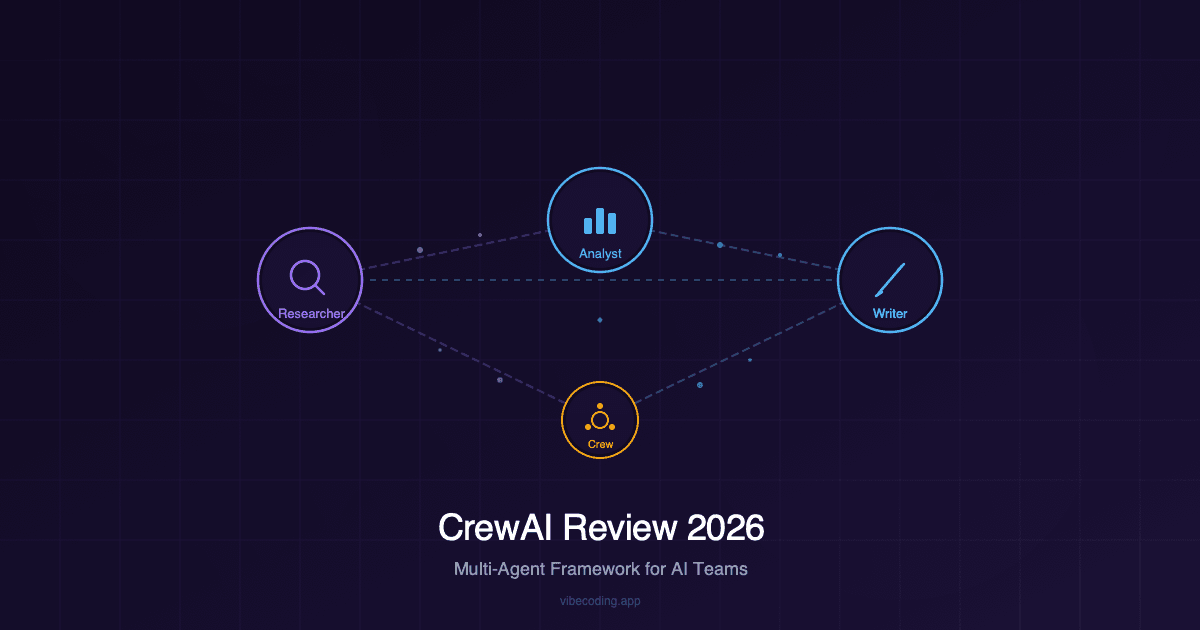
The fast option. The pricing page lists "Basic Free" with "Visual editor and AI copilot", "GitHub integration" and "50 workflow executions/month", then "Enterprise Custom" with "Everything in Free, plus: Governance from the start: SSO, RBAC". CrewAI says it is used by 65% of the Fortune 500; that is the vendor's number. The 50-execution cap is the thing to notice: the free tier is for building, not running. We reviewed it in depth in the CrewAI review.
AutoGen
Microsoft's framework, three layers deep: "Core An event-driven programming framework for building scalable multi-agent AI systems", "AgentChat A programming framework for building conversational single and multi-agent applications. Built on Core. Requires Python 3.10+." and "Studio An web-based UI for prototyping with agents without writing code." Nothing to pay, and the event-driven core is the right shape when agents need to react to each other rather than run in a fixed sequence.
MetaGPT
The software-company simulation. The repo (now under FoundationAgents, the old geekan URL redirects) calls itself "The Multi-Agent Framework: First AI Software Company, Towards Natural Language Programming" and explains the idea in one line: "Assign different roles to GPTs to form a collaborative entity for complex tasks." MIT licence. Best for greenfield builds where product, architect and engineer roles map cleanly; weakest on an existing codebase, where a layer-1 agent with repo context does better.
A common community framing is LangGraph for durable production graphs and CrewAI for fast role-based prototyping. Treat that as opinion, and an easy one to test: both are free, so build the same three-agent crew in each over a weekend.
Layer 3: data and memory
Agents are only as good as what they can retrieve. LlamaIndex is the open-source framework; LlamaCloud is the hosted ingestion service with the price tag.
From the LlamaCloud pricing page: "Free $0 /month ... Includes 10K credits", "Starter $50 /month ... Includes 40K credits Pay-as-you-go up to 400K credits", "Pro $500 /month ... Includes 400k credits", and Enterprise custom. The unit that matters: "1,000 credits = $1.25", consumed per action such as parsing, indexing or extracting.
If your agents work on a codebase rather than a document pile, this layer often collapses into the coding agent's own retrieval plus an MCP server. We covered why naive grep fails at scale in context engineering for coding agents.
Layer 4: observability and evaluation
The layer nobody budgets for and everybody needs by week two. LangSmith is the reference product, and it works with or without LangGraph.
From the LangSmith pricing page: "Developer For solo users getting started. $0 / seat per month then pay as you go" with "Up to 5k base traces / mo, then pay-as-you-go"; "Plus For teams building and deploying agents. $39 / seat per month then pay as you go" with "Up to 10k base traces / mo"; "Enterprise Custom pricing". Usage is metered in two units: "1 LCU = $1.50" for compute and "1 LSU = $1.00" for storage.
The free Developer seat is enough to answer the only question that matters in month one: what did the agent actually do, and what did it cost.
one brief.
// what shipped · what broke · what to watch.
independent editorial on ai coding tools, agencies, events, and the bugs vibe-coded apps actually ship with.
no spam · unsubscribe anytime
Pricing reality check
Everything above, in one place, so you can total a stack.
| Tool | Free tier | First paid tier | Team tier |
|---|---|---|---|
| Claude Code | none (chat only on Free) | Pro $20/mo, $17 annual | Team $20 to $25/seat |
| Cursor | Hobby, limited agent requests | Pro $20/mo | Teams $40/user/mo |
| Codex | included in ChatGPT Free | Go $8/mo, Plus $20/mo | Business $20 to $25/user |
| LangGraph | MIT, free | none | none |
| CrewAI | Basic, 50 executions/mo | Enterprise, custom | Enterprise, custom |
| AutoGen | open source | none | none |
| MetaGPT | MIT, free | none | none |
| LlamaCloud | $0, 10K credits | Starter $50/mo | Pro $500/mo |
| LangSmith | Developer $0, 5k traces | Plus $39/seat | Enterprise, custom |
What the table hides is tokens. Anthropic's own cost docs put enterprise API usage at "around $13 per developer per active day and $150-250 per developer per month", and note that "Agent teams use approximately 7x more tokens than standard sessions when teammates run in plan mode." A multi-agent layer on top of a $20 plan can cost more in tokens than every subscription in this table combined. Price the loop, not the licence.
Starter stacks by team size
Solo founder or indie dev. One coding agent on a $20 plan. MCP servers for GitHub and your database. LangSmith Developer seat at $0 if you want to see traces. Total: $20/mo plus tokens. No framework. You will know when you need one, because a task will refuse to fit in one session.
Two to ten people. Coding agents on team seats (Claude Team $20 to $25, Cursor Teams $40, or Codex Business $20 to $25 per user). LangGraph or CrewAI for the one or two workflows that are genuinely multi-step and repeatable (release notes, triage, migration scripts). LangSmith Plus at $39/seat for whoever owns those workflows, not for everyone. Total for five people: roughly $140 to $240/mo in seats plus $39 to $78 in observability, plus tokens.
Enterprise. This is where the custom tiers earn their keep: CrewAI Enterprise for SSO and RBAC, LangSmith Enterprise, Claude Enterprise at $20/seat plus API-rate usage. The question to ask each vendor is not the seat price but whether per-user spend limits exist, because the 7x multiplier is the line item that surprises finance.
MCP: how the layers talk
Model Context Protocol is the glue. It gives an agent one way to discover and call tools, and it is the reason a solo dev can skip layer 2 for a long time: a Postgres MCP server, a GitHub MCP server and a browser MCP server give a single coding agent most of what a hand-built crew used to provide. Claude Code has it built in and Cursor lists "MCPs, skills, and hooks" on its Pro tier. The servers worth installing first are in our best MCP servers for coding roundup, and the broader workflow patterns live in the AI dev workflows hub.
When multi-agent is the wrong call
The honest part of any agentic engineering tools list. Multi-agent is the right shape for long-horizon, parallelisable work with clear hand-offs: migrate 40 services, triage a backlog, generate and review a test suite. It is the wrong shape for most feature work on an existing codebase, where one agent with full repo context and a human in the loop beats three agents passing partial context around, at a seventh of the token bill.
Where this article's recommendation is wrong: if your work is dominated by document processing rather than code, layer 3 becomes layer 1 and LlamaCloud's credit pricing matters more than any coding agent. And if you are already paying for ChatGPT Pro or Claude Max, the "add a framework" advice inverts: you have the token budget, and LangGraph or AutoGen is the cheap way to spend it well. The wider workflow design question is covered in multi-agent software development workflow.
FAQ
What are agentic engineering tools? Tools that let AI agents plan, call tools, edit code and complete multi-step engineering tasks with limited human steering. Four layers: coding agent, orchestration, data and memory, observability.
What is the best multi-agent framework in 2026? No single winner. LangGraph for low-level durable graphs, CrewAI for role-based crews fast, AutoGen for event-driven systems, MetaGPT for software-company role play. All free, so try two.
How much do agentic engineering tools cost? Frameworks $0. Coding agents about $20/mo. Observability $39/seat (LangSmith Plus). Hosted ingestion from $50/mo (LlamaCloud Starter). Tokens on top, and for multi-agent that is the big number.
Is CrewAI production-ready? It sells an Enterprise tier with SSO and RBAC and claims 65% of the Fortune 500 as users (vendor figure). The free plan stops at 50 workflow executions a month, so production means Enterprise.
LangGraph vs CrewAI? Control versus speed. LangGraph if you want to own the graph and run it for years; CrewAI if you want a crew running this afternoon with a visual editor.
Do I need multi-agent at all? Probably not yet. Anthropic's docs put agent teams at approximately 7x the tokens of a normal session. Earn the complexity with a task that one agent genuinely cannot finish.
What does MCP do here? One protocol for agents to find and call tools. Wire a server once, every coding agent on the team can use it.
Can I run it all locally? The frameworks yes (pip installs), with a local model behind them. You lose the hosted coding agents and hosted observability.
How do I evaluate a coding agent? Success rate on your repo, tokens per successful change, human interventions per task, and full traces of what it did. LangSmith's free seat covers the last one.
Where does a solo developer start? One $20 coding agent, MCP servers for your existing tools, nothing else until a task breaks the single-agent model.
How we ranked these
Every price on this page was read from the vendor's official pricing page on 23 August 2026; nothing is from memory or a third-party roundup. Tools are grouped by layer rather than ranked against each other across layers, because a coding agent and a vector store do not compete. Open-source licence and hosted tier are listed separately, since that split is where the actual cost lives. Devin is named but unranked because its pricing page blocked our fetch. Prices change; the date is the caveat.
Browse the cards, including pricing history and alternatives, in the tools directory.

Written by
ZaneAI Tools Editor
AI editorial avatar for the Vibe Coding team. Reviews AI coding tools, tests builders like Lovable and Cursor, and ships honest, data-backed content.