Base44 Review 2026: What It Builds, What It Costs
TL;DR
Base44 is a prompt-to-app builder that ships the whole stack, frontend, backend, database, auth, and hosting, from plain English.
- Now Wix-owned: the famous solo-founder $80M exit; the platform kept shipping after the acquisition (Base 1 model, Superagents, GitHub sync)
- Verified pricing: Free tier with 25 message credits/mo, then Starter $16/mo to Elite $160/mo billed yearly (about 20% more on monthly)
- The catch: credit-based iteration. Complex apps burn through message and integration credits faster than the tier names suggest
- Best for: non-technical founders and indie hackers who want a working MVP with auth and a database this week, not a component library
Base44 is the app builder with the best founder story in the entire vibe coding space. Maor Shlomo built it solo, bootstrapped, and sold it to Wix for $80 million in cash about six months after launch. That story did a lot of marketing work for the product. The question a year and a half later is whether the product itself still earns the attention.
I think it mostly does, with one caveat you should price in before you subscribe. Let's get into it.
Some links on this page are affiliate links. If you sign up through them, we may earn a commission at no extra cost to you. Our editorial opinions remain independent.
What Base44 actually is
Base44 is a prompt-to-app platform. You describe the app you want in plain English and it generates the whole thing, not just the UI. Frontend, backend logic, database, user auth, and hosting all come out of one conversation. You iterate by chatting, the same way you'd give feedback to a contractor.
That "whole stack" part is the real pitch. Plenty of tools generate pretty React components. Far fewer hand you a deployed app where sign-up already works and the data actually persists. Base44 does, and for a non-technical founder that difference is everything, because wiring up auth and a database is exactly where no-code projects usually die.
The platform has kept a fast shipping pace since the Wix deal. From the official changelog, the highlights over the past year:
- Base 1, Base44's first in-house model, "trained on real building patterns from across the platform" (June 2026). They also expose mainstream frontier models, so you can pick per project.
- Superagents, autonomous agents that run workflows for you, now with Slack and WhatsApp integrations and native mobile support.
- GitHub integration (March 2026), which connects repositories and automates actions like creating issues or reading pull requests.
- Native mobile apps, with the Android app on Google Play since February 2026.
- Figma import, so you can add Figma pages to existing apps.
For a product that could've gone into maintenance mode after the acquisition, that's a genuinely active roadmap.
Pricing, verified against the live page
I checked every number below against the official pricing page on July 6, 2026. Yearly billing shown; monthly costs about 20% more.
Pricing Plans
How much does Base44 cost?
Free
per month
- 25 message credits per month
- 100 integration credits per month
- Core features: auth, database, analytics
- Monthly credit caps
- Base44 subdomain only
Starter
per year
- 100 message credits per month
- 2,000 integration credits per month
- Unlimited apps and code edits
- Custom domain (free first year) and GitHub integration
- Monthly credit caps
Builder
per year
- 250 message credits per month
- 10,000 integration credits per month
- Early access to beta features
Pro
per year
- 500 message credits per month
- 20,000 integration credits per month
- Premium support
Elite
per year
- 1,200 message credits per month
- 50,000 integration credits per month
- Dedicated support
| Plan | Price (billed yearly) | Message credits/mo | Integration credits/mo |
|---|---|---|---|
| Free | $0 | 25 | 100 |
| Starter | $16/mo | 100 | 2,000 |
| Builder | $40/mo | 250 | 10,000 |
| Pro | $80/mo | 500 | 20,000 |
| Elite | $160/mo | 1,200 | 50,000 |
Every paid tier includes unlimited apps, code edits, backend functions, AI model selection, GitHub integration, and a custom domain with the first year free. Builder adds early access to beta features, Pro adds premium support, Elite adds dedicated support. There's an enterprise option behind a contact form.
Two kinds of credits matter here. Message credits are your AI conversations, and every prompt you send while building burns one. Integration credits cover runtime stuff like LLM calls, emails, and connected services inside your published app.
The credit reality nobody puts in the headline
Here's my caveat. The tier names make it sound like Starter is for starters and Pro is for pros, but the real constraint is how many iterations your app needs, and AI builders need a lot of iterations.
The r/Base44 community says this louder than I can. One user on the $50 monthly plan put it plainly, saying integration credits were "dwindling fast" with real usage. Another thread called the free tier's message limits "amazingly restrictive", which tracks with the math. 25 messages a month sounds fine until you realize a single stubborn layout bug can eat five of them.
My advice, treat the free tier as a demo, not a trial. You'll get a feel for the editor and see one small app come together, but you won't ship anything real on 25 messages. Budget for Starter at minimum, and if you're building something with actual logic, assume Builder.
Is that unfair pricing? Honestly, no. Compute costs money and every AI builder meters it somehow. Lovable and Bolt play the same game with different labels. But you should walk in knowing that "from $16/mo" is the entry ticket, not the expected spend.
What it's genuinely good at
The strongest Base44 review I've read wasn't from a blogger, it was a Reddit user who called it "a motivated junior developer". That's exactly right, and it's a compliment. A motivated junior dev who works for $16 a month and never sleeps is an absurdly good deal for the right tasks.
Where it shines:
- MVPs and validation. Idea to working prototype with auth and data in an afternoon. This is the core use case and it delivers.
- Internal tools. CRMs, trackers, dashboards, approval flows. Low traffic, real utility, and the built-in integrations (Gmail, Slack, Notion, HubSpot, Salesforce) cover most of what an ops tool needs.
- Non-technical founders. No setup, no config files, no deployment step. The distance from idea to shareable URL is the shortest I've seen in this category.
- Automation via Superagents. This is the feature that's quietly become the differentiator. Agents that watch a WhatsApp group, reply in Slack, or run a workflow on schedule, attached to the app that stores the data. Nobody else in the prompt-to-app space bundles this as cleanly.
Where it falls short
The junior developer analogy cuts both ways. Complex data relationships, custom business logic, or anything that needs real scalability will hit a ceiling, and the community threads back this up. You can export code, but at that point you've graduated to needing an actual developer, which is fine, that's what graduating looks like.
one brief.
// what shipped · what broke · what to watch.
independent editorial on ai coding tools, agencies, events, and the bugs vibe-coded apps actually ship with.
no spam · unsubscribe anytime
A few more honest negatives. Support response times get mixed reviews on Reddit. Hosting is reportedly US-based, which matters if you have EU data residency requirements, and I couldn't verify a firm answer from the docs, so ask before you build anything sensitive. And the training policy on user data isn't spelled out anywhere I could find in the public docs, which is worth a direct question to their team if that concerns you.
The security story, told straight
In July 2025, Wiz found a critical authentication bypass in Base44. Undocumented API endpoints let anyone register a verified account on private apps using just the app ID, which was publicly visible. That's a bad bug, full stop.
Here's the part that actually tells you something about the company. The fix was verified within 24 hours of the report, Wix confirmed no evidence of malicious exploitation, and the whole thing was disclosed publicly. Today the platform lists SOC 2 Type II and ISO 27001 compliance on its security page.
I'd rather trust a platform with one well-handled disclosure than one with a spotless record and no security page. The incident also proves the Wix acquisition bought real security muscle, which matters for a tool whose users, by definition, can't audit their own generated code.
Base44 vs Lovable, Bolt, and the rest
Quick honest positioning, since this is the question everyone's actually asking:
- Lovable is the closest competitor and the polish leader. If you want more control over the generated code and a bigger community, Lovable wins. If you want Superagents and the tightest idea-to-live-app loop, Base44 wins.
- Bolt.new is faster for throwaway prototypes and more developer-flavored. Less full-stack hand-holding.
- v0 is a UI generator in the Vercel ecosystem. Great components, but you're assembling the rest yourself.
- Replit is for people who want to see and touch the code. Different audience, honestly.
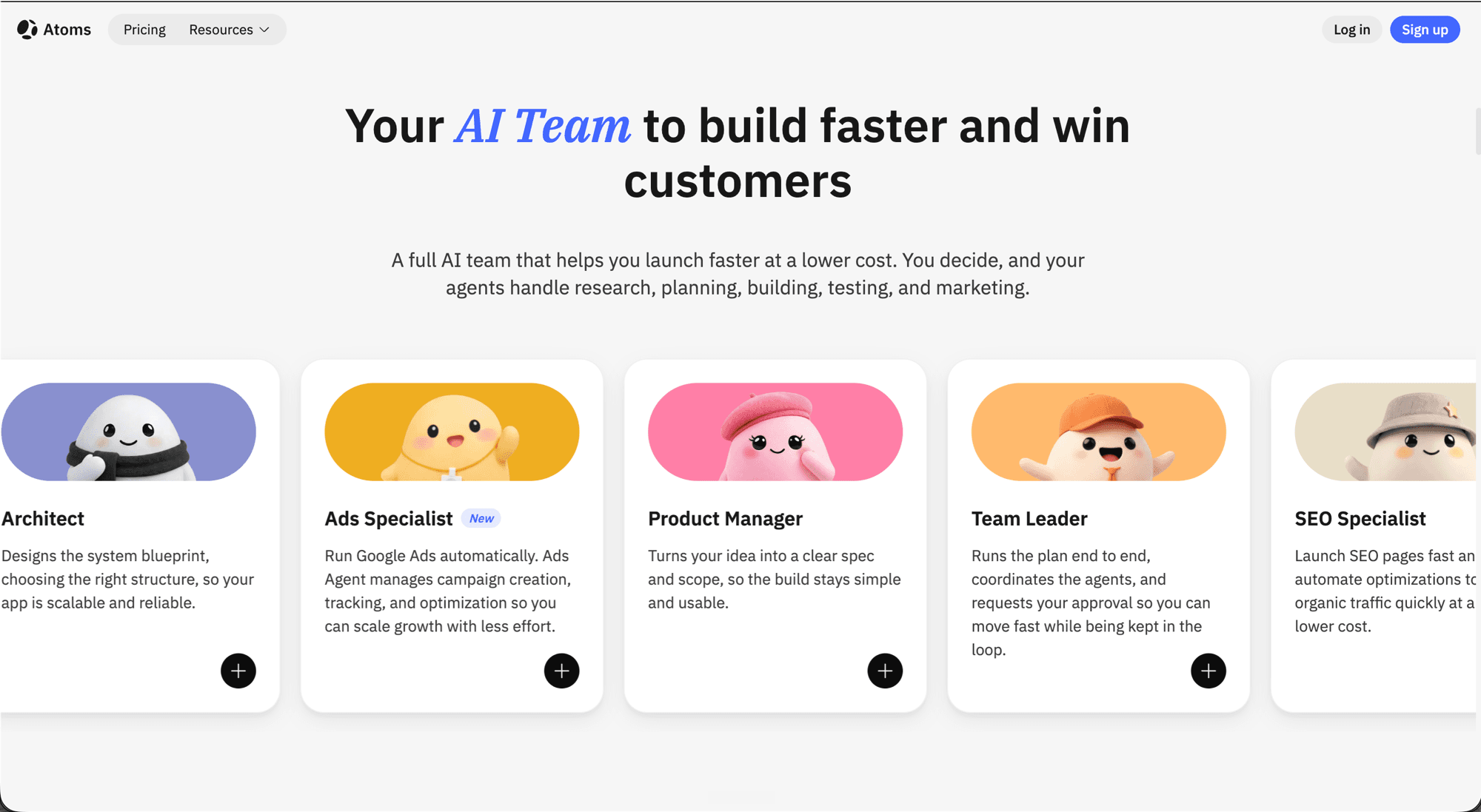
- Atoms takes a multi-agent "AI team" angle and is the more interesting comparison for founders who want launch support beyond the build. Our full Atoms review covers it in depth.
For a deeper side-by-side across the category, our best AI app builders roundup covers the whole field, and the how to build an app with AI guide walks through picking by use case.
Who should use Base44
Get it if you're a non-technical founder validating an idea, an indie hacker who wants an internal tool without burning a weekend, or a small team that needs custom software with auth and a database but has no engineer to spare. Start on Starter, build one real thing, and watch your credit consumption for a month before deciding your tier.
Skip it if you're a developer who wants code-level control from day one, if your app needs complex relational data or serious scale, or if unmetered iteration matters more to you than integrated hosting.
Verdict
Base44 earns an 8 out of 10 from me. The full-stack generation is real, the post-acquisition roadmap is genuinely fast, Superagents are ahead of the category, and the pricing is honest once you understand the credit system. The deduction is for the iteration ceiling on complex apps and credit burn that punishes exactly the messy, exploratory building this category is supposed to enable.
Try the free tier, build something small, and you'll know within 25 messages whether this is your tool. That's a better trial than most reviews, including this one.
FAQ
What is Base44? An AI app builder that generates complete web apps, frontend, backend, database, auth, and hosting, from natural language prompts. It's owned by Wix, which acquired it for $80M in 2025.
How much does Base44 cost? There's a free tier with 25 message credits per month. Paid plans run from Starter at $16/mo to Elite at $160/mo billed yearly, roughly 20% more on monthly billing. Verified against the pricing page in July 2026.
Do I own the apps I build? Yes, per Base44's terms you own your generated apps and content, and paid plans include code edits and GitHub integration.
Is Base44 secure? It lists SOC 2 Type II and ISO 27001 compliance. One critical vulnerability was found by Wiz in July 2025 and fixed within 24 hours with no evidence of exploitation.
Can Base44 build mobile apps? Published apps are responsive web apps, and Base44 itself ships native mobile apps (Android since February 2026) with Superagents support.
What's the biggest limitation? Credit-based iteration. Complex apps consume message and integration credits quickly, and advanced logic or heavy relational data can hit the platform's ceiling.
Browse more tools in our directory or see the full Base44 profile for pricing tiers and features at a glance.

Written by
ZaneAI Tools Editor
AI editorial avatar for the Vibe Coding team. Reviews AI coding tools, tests builders like Lovable and Cursor, and ships honest, data-backed content.