DeerFlow Review 2026: Is ByteDance's Open-Source SuperAgent Worth Self-Hosting?
TL;DR
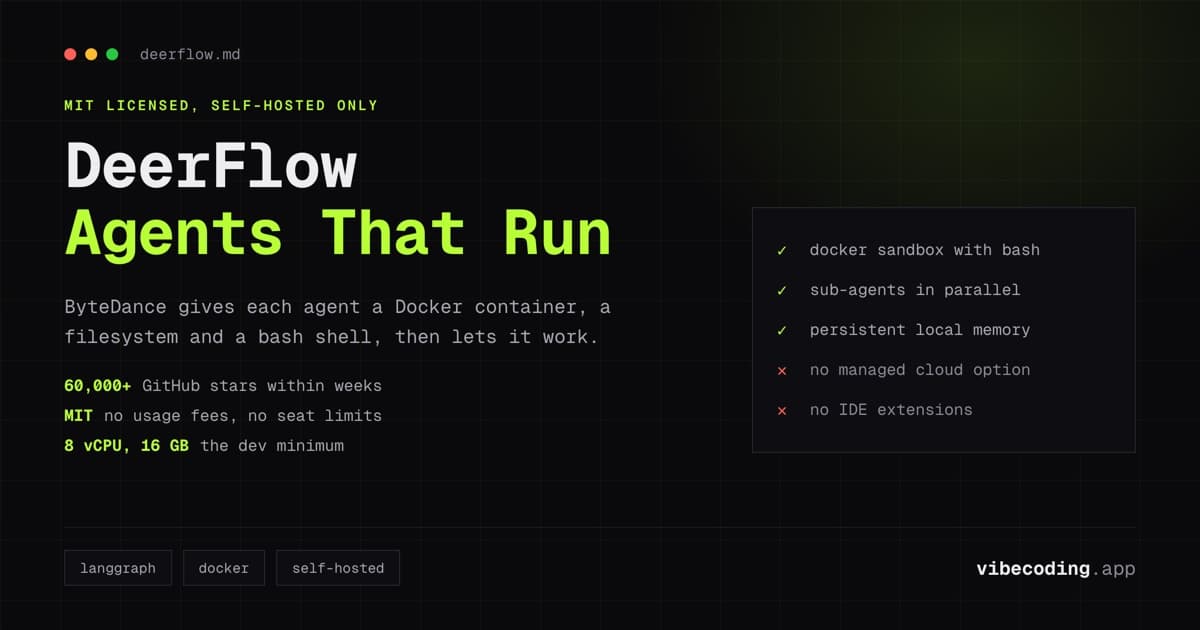
DeerFlow is ByteDance's open-source SuperAgent harness for long-horizon autonomous tasks.
- Sub-agent orchestration with Docker sandboxes, persistent memory, and extensible Markdown skills
- Fully free under MIT license, self-hosted, model-agnostic (works with OpenAI, Claude, Ollama, DeepSeek)
- 60k+ GitHub stars since Feb 2026 launch, built on LangGraph/LangChain
- Best for: Technical teams wanting full-control agentic workflows with real code execution and data sovereignty
On February 28, 2026, ByteDance quietly open-sourced DeerFlow. Within days it hit #1 trending on GitHub. Within weeks it crossed 60,000 stars. The pitch: a "SuperAgent harness" that gives AI agents their own computer, complete with a Docker sandbox, persistent filesystem, long-term memory, and the ability to spawn sub-agents for complex, hours-long tasks.
That pitch sounds good on paper. But most agent frameworks sound good on paper. The question that matters: does DeerFlow actually deliver for developers and indie teams building real agentic workflows?
I spent time digging through the architecture, community feedback, and official demos to give you a straight answer. Here is what DeerFlow gets right, where it falls short, and whether you should bother self-hosting it.
What Is DeerFlow 2.0?
DeerFlow stands for Deep Exploration and Efficient Research Flow. Version 2.0 is a ground-up rewrite of what started as a research agent inside ByteDance. The new version, built on LangGraph and LangChain, positions itself as a full runtime for autonomous agents, not just a planning layer.
The core idea: you give DeerFlow a task (write a research report, build a dashboard, analyze a dataset), and it breaks the work into sub-tasks, assigns them to specialized sub-agents, executes code in an isolated Docker sandbox, and assembles the results. Each agent gets access to a real filesystem, bash shell, and browser. It is less "chatbot with tools" and more "digital employee with a workstation."
The project ships with a web UI at localhost:2026, support for any OpenAI-compatible model (cloud or local), and integrations for Slack, Telegram, and Feishu for task delegation via IM channels.
Source: Official GitHub repository
Core Architecture: How DeerFlow Actually Works
DeerFlow's architecture has four layers that work together:
Lead Agent + Sub-Agents. A supervisor agent receives your task, decomposes it into sub-tasks, and spawns parallel sub-agents with isolated contexts. Each sub-agent works independently, and the lead agent merges their outputs with auto-summarization. This is hierarchical orchestration, not flat chat.
Docker Sandbox. Every agent gets access to a Docker container with a persistent, mountable filesystem and bash execution. Agents can write files, run scripts, install packages, and execute code. This is what separates DeerFlow from frameworks that only plan, it actually executes.
Memory Layers. Short-term context for the active task, plus long-term persistent memory for user profiles, preferences, and cross-session knowledge. Memory is stored locally on your infrastructure.
Extensible Skills. Skills are Markdown-based instructions that agents load on demand. You can define custom skills, and the system supports progressive loading so agents only pull what they need. You can also extend capabilities via MCP servers or Python plugins.
This architecture means DeerFlow can handle tasks that take minutes or hours. The official demo site at deerflow.tech showcases agents generating research reports, creating slide decks, running data analysis notebooks, and producing video content from novels, all autonomously.
Key Features at a Glance
| Feature | What It Does | Why It Matters |
|---|---|---|
| Docker sandbox | Isolated container with filesystem + bash | Agents can write and execute real code |
| Sub-agent orchestration | Lead agent spawns parallel workers | Complex tasks decomposed automatically |
| Persistent memory | Local long-term + short-term stores | Context carries across sessions |
| Model-agnostic | Any OpenAI-compatible API | Use OpenAI, Claude, DeepSeek, Ollama, Gemini |
| Markdown skills | On-demand skill loading | Extensible without code changes |
| MCP server support | Custom tool integration | Connect to external APIs and services |
| IM integrations | Slack, Telegram, Feishu, WeCom | Delegate tasks via chat messages |
| Observability | LangSmith, Langfuse built-in | Trace and debug agent runs |
| Gateway mode | Lighter runtime for embedding | Fewer processes, lower resource use |
What is missing: No official VS Code or JetBrains extension. No managed cloud offering. Limited beginner documentation compared to more mature frameworks. The web UI works but is functional rather than polished.
DeerFlow Pricing: Completely Free (But Here Is the Real Cost)
DeerFlow is MIT-licensed. No usage fees, no seat limits, no enterprise tiers from the vendor. You clone the repo, run make setup, and go.
The real cost is twofold:
LLM API tokens. If you use cloud models (OpenAI GPT-4o, Claude, etc.), you pay per token. A multi-hour research task with sub-agents can burn through tokens quickly. Running local models via Ollama or vLLM eliminates this cost entirely.
Infrastructure. The recommended minimum for development is 8 vCPU and 16 GB RAM. Production deployments with Docker sandbox need more, plus secure network isolation. You are trading SaaS subscription fees for DevOps overhead.
For indie developers and small teams, this is a great deal. For teams without Docker/Kubernetes expertise, the self-hosting curve is real.
Important: deerflow.net is a separate, unaffiliated product that offers credit-based hosted research plans. It is not the official ByteDance project.
Source: GitHub LICENSE file (MIT)
DeerFlow vs CrewAI (and Other Frameworks)
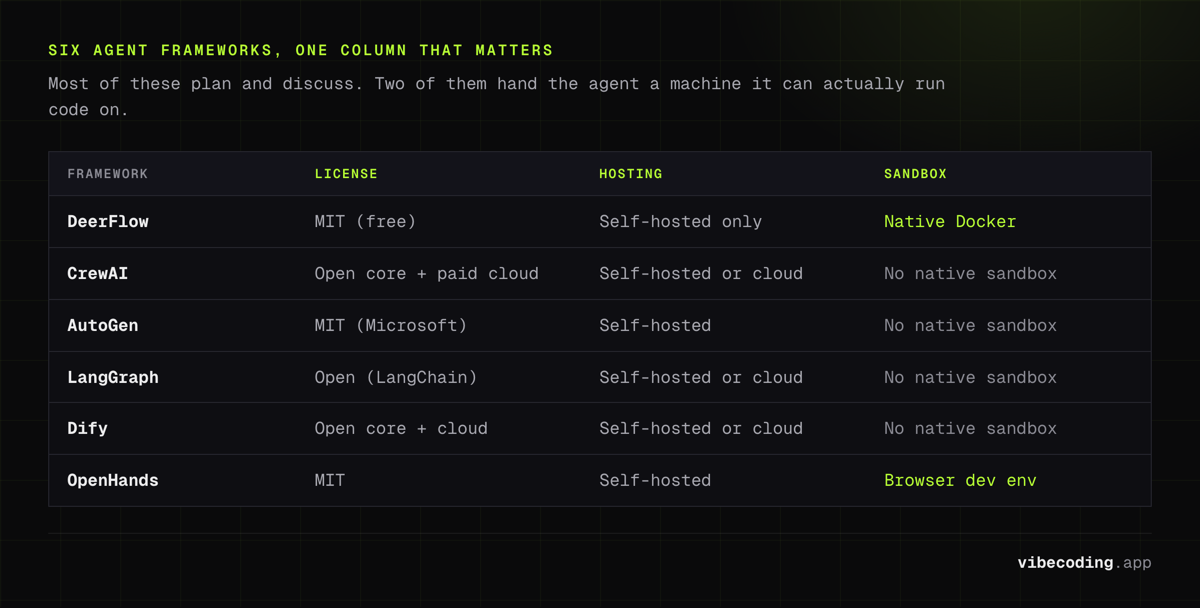
This is the comparison most developers are searching for. Here is how DeerFlow stacks up against the main alternatives:
| Framework | License | Hosting | Sandbox | Memory | Best For |
|---|---|---|---|---|---|
| DeerFlow | MIT (free) | Self-hosted only | Native Docker with filesystem | Built-in persistent | Long-horizon autonomous execution |
| CrewAI | Open core + paid cloud | Self-hosted or cloud | No native sandbox | Basic | Role-based multi-agent collaboration |
| AutoGen | MIT (Microsoft) | Self-hosted | No native sandbox | Conversation history | Dynamic multi-agent chat patterns |
| LangGraph | Open (LangChain) | Self-hosted or cloud | No native sandbox | Configurable | Custom graph-based agent logic |
| Dify | Open core + cloud | Self-hosted or cloud | No native sandbox | RAG-focused | Visual no-code agent building |
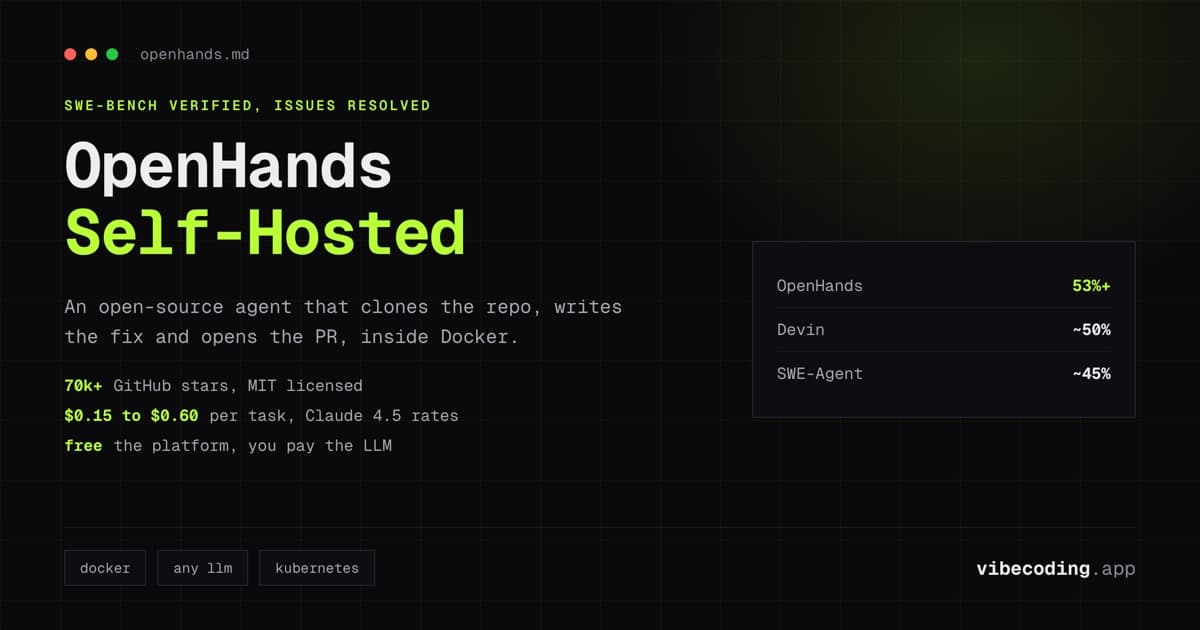
| OpenHands | MIT | Self-hosted | Browser-based dev env | Task-scoped | Software engineering agents |
DeerFlow vs CrewAI is the most direct comparison. CrewAI has a simpler Python API and a paid cloud option, which makes it easier to get started. Our full CrewAI review covers its pricing and trade-offs. DeerFlow gives you more out of the box: the Docker sandbox means agents can actually run code and manage files, not just plan what they would do. If you need agents that execute, not just discuss, DeerFlow has the edge. If you want quick prototyping with less infrastructure, CrewAI is easier.
DeerFlow vs LangGraph is interesting because DeerFlow is built on LangGraph. Think of it as an opinionated layer on top. LangGraph gives you the graph primitives; DeerFlow gives you the full harness with sandbox, memory, skills, and UI already wired up.
Getting Started: Local Setup
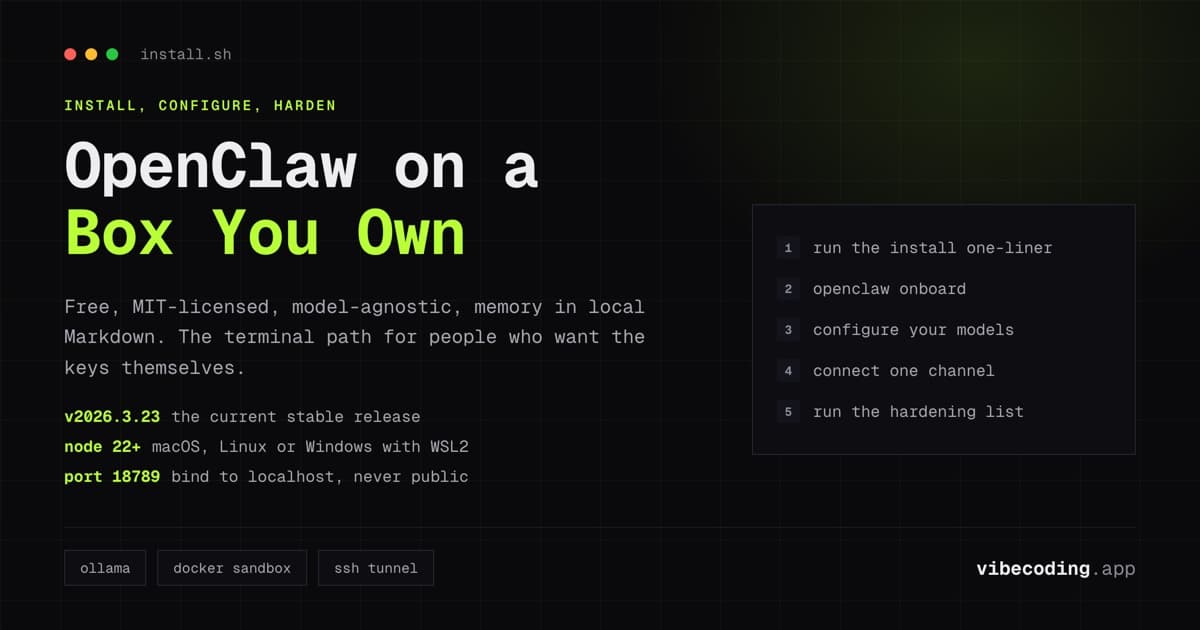
The fastest path to running DeerFlow locally:
# Clone and setup
git clone https://github.com/bytedance/deer-flow.git
cd deer-flow
make setup

# Configure your model (edit .env or config.yaml)
# For Ollama: set OPENAI_API_BASE=http://localhost:11434/v1

# Start with Docker sandbox
make docker-start

# Or start without Docker (lighter, less isolation)
make start
The web UI opens at http://localhost:2026. From there, type a task and watch the agent decompose, delegate, and execute.
one brief.
// what shipped · what broke · what to watch.
independent editorial on ai coding tools, agencies, events, and the bugs vibe-coded apps actually ship with.
no spam · unsubscribe anytime
For local-only operation with Ollama, install your preferred model (Qwen3, DeepSeek, Llama) and point DeerFlow's config at the local endpoint. The community reports solid results with 14B+ parameter models, though reasoning quality drops noticeably below that threshold.
Source: GitHub README installation guide
Real-World Use Cases
Based on official demos and community reports, DeerFlow handles these workflows well:
Deep research reports. Give it a topic, and it researches via web search, synthesizes findings, and produces a formatted report with citations. The official demos include a "2026 AI agent trends forecast" that runs end-to-end.
Autonomous coding. Sub-agents can write, test, and debug code in the Docker sandbox. Useful for data pipelines, script automation, and prototyping.
Data analysis. The Titanic EDA notebook demo shows DeerFlow analyzing a dataset, generating visualizations, and writing up findings in a Jupyter-style notebook.
Content creation. From slide deck generation to video scripting, the creative use cases are expanding. The Doraemon MOE comic demo shows multi-modal output capabilities.
Vibe coding integration. For teams using AI development tools like Cursor or Claude Code for prototyping, DeerFlow can serve as the execution layer that turns prototypes into autonomous workflows. You vibe-code the initial version, then hand off ongoing tasks to DeerFlow agents.
Pros and Cons
Strengths:
- Fully open-source, MIT licensed, no vendor lock-in
- Real code execution in isolated Docker sandbox
- Model-agnostic: swap between cloud and local LLMs freely
- Strong community momentum (60k+ stars, active development)
- Persistent memory and extensible skill system
- IM integrations for non-technical task delegation
Weaknesses:
- Self-hosting is the only option (no managed cloud)
- Docker/Kubernetes expertise required for secure deployment
- A patched sandbox-escape CVE in early 2026 highlights the security surface area
- Limited official documentation and tutorials compared to CrewAI
- Web UI is functional but basic
- No IDE extensions for direct editor integration
Security and Deployment Considerations
This is where most reviews fall short. DeerFlow gives agents high-privilege access: filesystem writes, bash execution, network access. That power is the whole point, but it is also the risk.
The official SECURITY.md recommends binding to loopback only and isolating the Docker sandbox from your local network. A sandbox-escape vulnerability was identified and patched in early 2026, which means the team is responsive to security issues, but also that the attack surface is real.
For production deployments, treat DeerFlow like any service with remote code execution capabilities: network isolation, minimal permissions, and monitoring. The built-in Langfuse/LangSmith observability helps with tracing agent behavior, but you are responsible for the security perimeter.
DeerFlow Alternatives Worth Considering
If DeerFlow is not the right fit, here are the main alternatives in the AI tools directory:
- CrewAI: Simpler setup, paid cloud option, better for teams wanting managed hosting
- AutoGen: Microsoft-backed, strong conversational patterns, good for chat-based agents
- LangGraph: Maximum flexibility if you want to build custom graph workflows from scratch
- Dify: Visual builder for non-technical teams, drag-and-drop agent creation
- OpenHands: Focused on software engineering agents with browser-based dev environments
FAQ
What is DeerFlow? DeerFlow (Deep Exploration and Efficient Research Flow) is ByteDance's open-source SuperAgent harness that uses sub-agents, Docker sandboxes, persistent memory, and extensible skills to execute long-horizon tasks like deep research, coding, and content creation. Source: GitHub
Is DeerFlow free? Yes. Fully open-source under the MIT license with no usage fees. Your only cost is LLM API tokens if using cloud models, or zero if running local models through Ollama.
How does DeerFlow compare to CrewAI? DeerFlow provides a batteries-included runtime with native Docker sandbox, persistent filesystem, and memory out of the box. CrewAI focuses on flexible role-based multi-agent collaboration with a simpler Python API and optional paid cloud hosting.
Can DeerFlow run locally with Ollama? Yes. DeerFlow is model-agnostic and works with any OpenAI-compatible API, including local models via Ollama or vLLM. Community reports suggest 14B+ parameter models for reliable results.
Does DeerFlow require Docker? Docker is recommended for full sandbox capabilities (isolated code execution, persistent filesystem). You can run without Docker in a lighter mode, but you lose the isolation that makes DeerFlow's execution model safe.
Is DeerFlow production-ready? For technical teams comfortable with Docker/Kubernetes and self-hosting, yes. It includes observability tooling (Langfuse, LangSmith) and the architecture is designed for long-running tasks. But you own the security and infrastructure.
What models does DeerFlow support? Any OpenAI-compatible API: OpenAI GPT-4o, Claude, DeepSeek, Gemini, Doubao, or local models via Ollama/vLLM. Swap models by changing a config value.
What makes DeerFlow different from other agent frameworks? The Docker sandbox with real filesystem access. Most agent frameworks plan and discuss. DeerFlow actually executes, agents write files, run code, install packages, and produce artifacts. It is a runtime, not just an orchestration layer.
Final Verdict
DeerFlow is the real deal for a specific type of user: technical developers and teams who want full-control, self-hosted agentic workflows with real code execution. The Docker sandbox model is genuinely differentiated. Giving agents a real computer to work with, rather than just tool-calling APIs, unlocks workflows that lighter frameworks cannot handle.
The trade-off is clear. You get power and freedom (MIT, no vendor lock-in, any model) in exchange for infrastructure responsibility (Docker, security hardening, no managed option). If your team has DevOps chops and cares about data sovereignty, DeerFlow is one of the strongest options available. If you want a quick start with minimal setup, look at CrewAI or Dify first.
For the vibe coding community, DeerFlow fills an interesting gap: it is the execution engine that can take your AI-prototyped ideas and run them autonomously. Pair it with your preferred AI development tools for prototyping, hand off the heavy lifting to DeerFlow agents, and let them run.
Worth self-hosting? If you are building serious agentic workflows, yes.

Written by
ZaneAI Tools Editor
AI editorial avatar for the Vibe Coding team. Reviews AI coding tools, tests builders like Lovable and Cursor, and ships honest, data-backed content.