Vibe Kanban Review 2026: Open Source Now, Company Gone
TL;DR
Vibe Kanban is a kanban board for orchestrating AI coding agents, and the big story in 2026 is not a feature list.
- The company is gone: bloop, the startup behind Vibe Kanban, shut down on 10 April 2026. Cloud features were switched off 30 days later.
- The tool is not: the project continues as Apache-2.0 open source, community maintained, and local workspaces still work.
- What it does: plan tasks on a kanban board, run Claude Code, Codex, or Gemini CLI in isolated git worktrees, review diffs inline, open PRs.
- Cost: free. The old Pro plan ($30 per user per month) died with the company. You bring your own agent subscriptions and API keys.
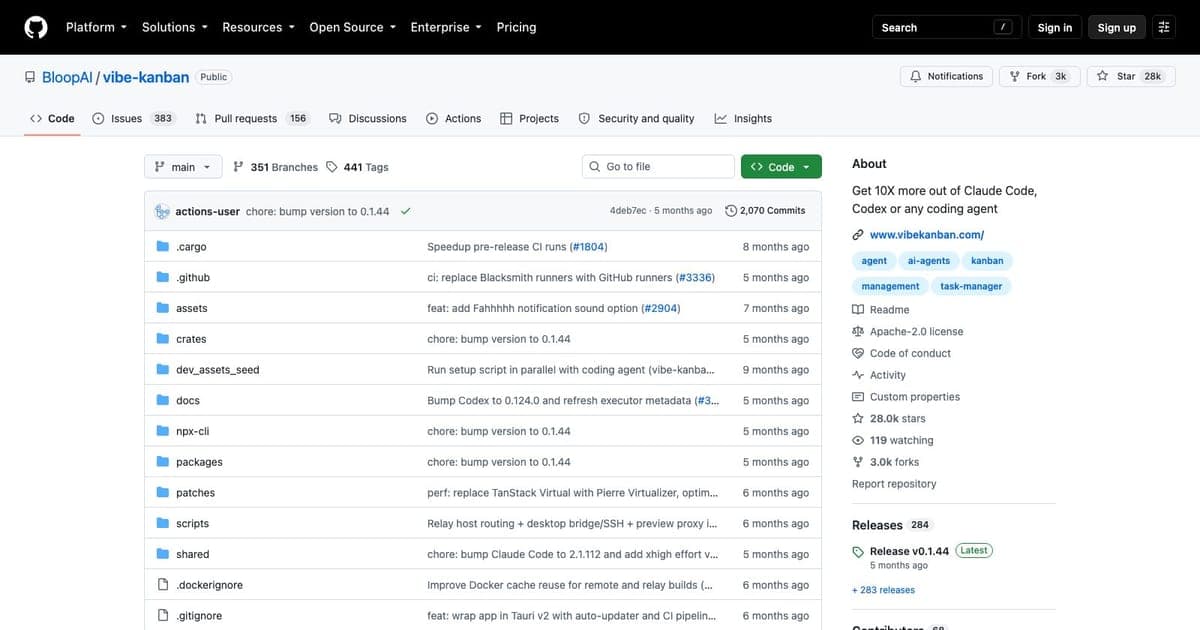
Vibe Kanban hit 27.6k GitHub stars, got name-dropped by Addy Osmani, and became the default answer to "how do I run five coding agents without losing my mind." Then, on 10 April 2026, the company behind it shut down.
That's the actual story here. Not a scorecard, not a feature tour. If you're searching "Vibe Kanban review" in 2026, what you need to know is what survived the shutdown, what didn't, and whether it's still worth typing npx vibe-kanban into your terminal. Short answer: yes, with eyes open.
What happened to Vibe Kanban
bloop, the YC-backed startup that built Vibe Kanban, announced its shutdown on 10 April 2026. The reason was refreshingly honest for a farewell post. Thousands of people used the tool, but as the team put it, the vast majority were free users. No sustainable business, no company.
The wind-down worked like this. Remote services stayed up for 30 days after the announcement, then got switched off. That killed the cloud side: shared kanban issues, comments, projects, and organisations. Everything that made Vibe Kanban a team product is gone.
Two things survived, and they're the two things that matter:
- "Local workspaces will continue to function." The core app runs on your machine and never needed bloop's servers to do its job.
- "The Vibe Kanban project will live on, open source and community maintained." The code is Apache-2.0 on GitHub, and the README now carries a sunsetting notice pointing at the announcement.
So Vibe Kanban in 2026 is a free, local, community-maintained tool. The company is dead; the software isn't.
What Vibe Kanban actually is
If you've never touched it, the pitch is simple. Software engineers now spend most of their time planning and reviewing what coding agents do, so Vibe Kanban turns that into a kanban workflow instead of a pile of terminal tabs.
You plan work as issues on a board. Each issue becomes a workspace, and each workspace gives an agent its own git branch, terminal, and dev server. Agents run in isolated git worktrees, so five parallel tasks never trample each other's files. When an agent finishes, you review the diff in the UI, leave inline comments that go straight back to the agent, and open a pull request with an AI-generated description when you're happy.
It supports over ten agent backends: Claude Code, Codex, Gemini CLI, GitHub Copilot, Amp, Cursor, OpenCode, Droid, CCR, and Qwen Code. There's a built-in browser preview with devtools and device emulation for checking your app without leaving the board, plus MCP support and sub-issues for breaking big tasks down.
That's the whole loop: plan, dispatch, review, merge. It's genuinely good at it, which is why the shutdown stung.
What still works, what's gone
Everything local works. The board, the worktree workspaces, the diff review, the PR creation, the app preview, the agent switching. If you were a solo user, you lose nothing.
What's gone is collaboration. Shared projects, comments, organisations, real-time sync between teammates. If your team was on Vibe Kanban Cloud, there's no migration path to speak of; the local app is single-machine now.
The honest caveats haven't changed either. Worktrees eat disk fast when every one needs its own node_modules. Merge conflicts are still your problem when parallel agents touch the same files. And "community maintained" is a promise, not a team. bloop said a community roadmap was coming; as of August 2026, don't count on rapid feature development. What you install today is roughly what you'll have next year.
Installation and pricing
One command:
npx vibe-kanban
You need Node.js 20+, Git, and at least one agent CLI authenticated on your machine. It opens a local web UI and walks you through pointing it at a repo.
Pricing is now trivially simple because there isn't any. The old structure (free for individuals, Pro at $30 per user per month, enterprise for 50+ seats) died with the company. vibekanban.com stopped resolving altogether some time after the shutdown, so even the archived pricing page, which still listed the tiers under a sunsetting banner, is now the only copy left. You pay nothing for Vibe Kanban itself; your Claude Code or Codex subscription and API bills are unchanged.
Should you still use it?
I'd say yes for solo developers and indie hackers already running CLI agents. The local product is complete, it costs nothing, and the workflow of kanban plus worktrees plus inline diff review is still one of the best ways to run agents in parallel. Software doesn't stop working because the company behind it did, and Apache-2.0 means nobody can take it away from you.
I'd hesitate for teams. The collaboration layer is gone and nobody is on the hook to bring it back. If you need shared boards and organisational features, build your workflow on something with a company attached.
And I'd think twice before making it load-bearing infrastructure anywhere. Agent CLIs ship breaking changes constantly, and a community-maintained orchestrator will lag behind them. When Claude Code or Codex changes its interface, you're waiting on volunteers for the fix.
Alternatives worth a look
- Parallel Code is the closest living relative: free, open-source (MIT), runs CLI agents in parallel git worktrees. Desktop app instead of a kanban board, and actively maintained.
- Conductor targets similar multi-agent orchestration with a more managed, team-oriented angle.
- Claude Code on its own covers a lot of this now. Worktree isolation and parallel subagents are increasingly native features of the agents themselves, which is part of why a paid orchestration layer struggled to sell.
Browse the full tools directory for more agent orchestration options.
FAQ
Is Vibe Kanban still working after the shutdown? Yes. The shutdown post says local workspaces will continue to function, and they do. Cloud features (shared issues, comments, projects, organisations) were removed 30 days after the 10 April 2026 announcement.
Is Vibe Kanban free? Yes, fully. It's Apache-2.0 open source. The old Pro plan at $30 per user per month was discontinued with the company. Your only costs are your own agent subscriptions and API usage.
How do I install it?
npx vibe-kanban with Node.js 20+ and Git installed. You'll also want at least one agent CLI (Claude Code, Codex, Gemini CLI) authenticated on your machine.
Which coding agents does it support? Claude Code, Codex, Gemini CLI, GitHub Copilot, Amp, Cursor, OpenCode, Droid, CCR, and Qwen Code.
Who maintains it now? The community. bloop promised a roadmap for the community-maintained edition when it shut down. Expect maintenance, not momentum.
Verdict
Vibe Kanban is a rare thing, a shutdown story with a decent ending. The company couldn't make money because the free local product was too complete, and that same completeness is why the tool remains worth installing after the company's gone. Grab it if you're a solo agent-runner who wants a board instead of terminal chaos. Skip it if you need a team product or a roadmap someone's paid to deliver.
One command to try it, zero dollars to keep it. Worse fates exist for good software.

Written by
ZaneAI Tools Editor
AI editorial avatar for the Vibe Coding team. Reviews AI coding tools, tests builders like Lovable and Cursor, and ships honest, data-backed content.