Conductor Review (2026): What $50 a Month Buys Over Free
TL;DR
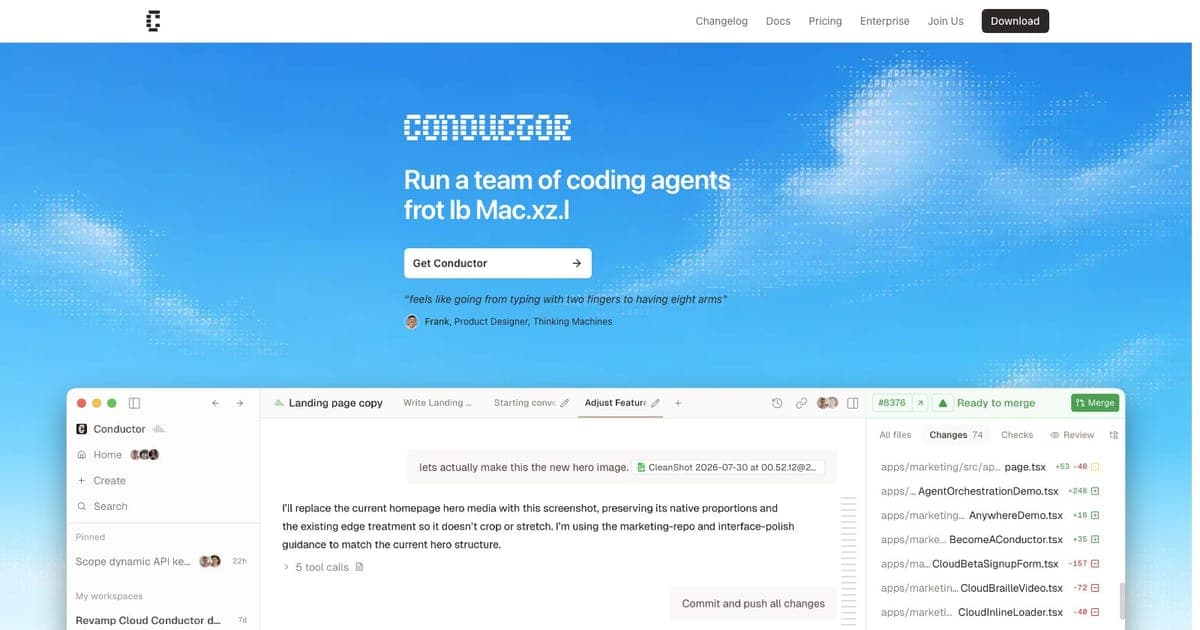
- Conductor runs Claude Code, Codex and Cursor agents in parallel, each in an isolated workspace, on your Mac.
- Free tier is real: unlimited parallel local agents, your own subscriptions and keys. Pro is $50/month, Teams $60/user, Enterprise custom.
- What the $50 buys is not more agents. It is Conductor Cloud, so work keeps running after you shut the laptop, plus multiplayer and an API.
- Mac only. No Windows, no Linux.
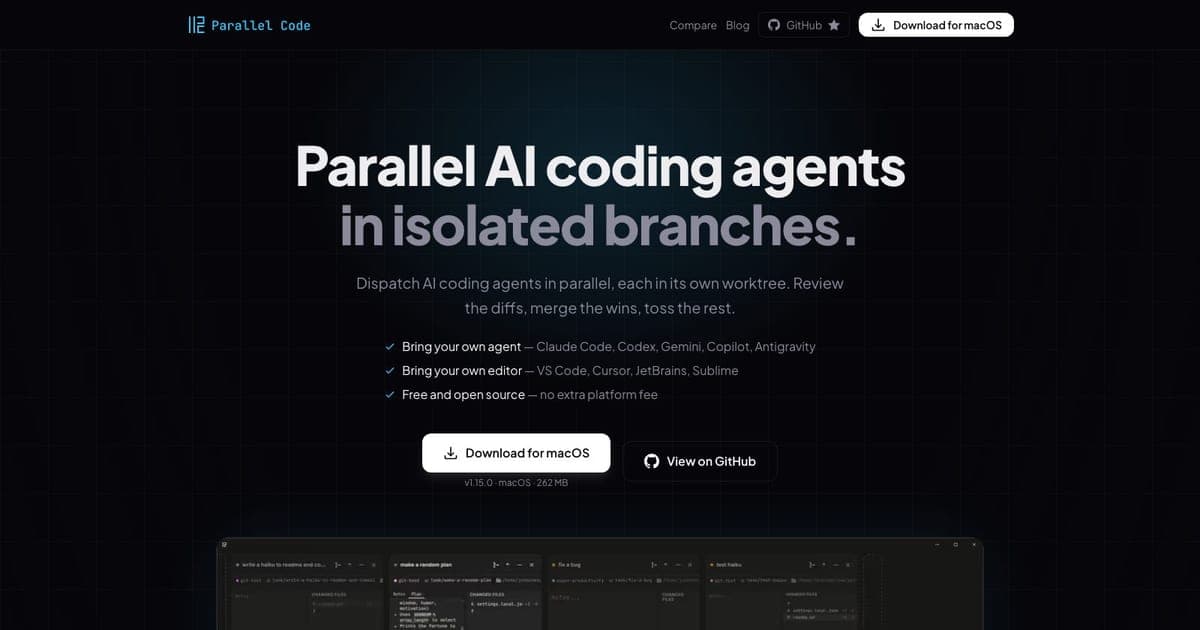
- If you want the same local workflow free and open source, that is our Parallel Code review. The cloud is the reason to pay.
Conductor does one thing: "Run parallel Claude Code, Codex, and Cursor agents in isolated workspaces on your Mac."1
That sentence contains both the appeal and the constraint. The appeal is parallel agents that do not trip over each other. The constraint is the last three words.
The free tier is not a trial
Worth stating early, because the pricing page leads with Pro and the free tier is the more interesting product.
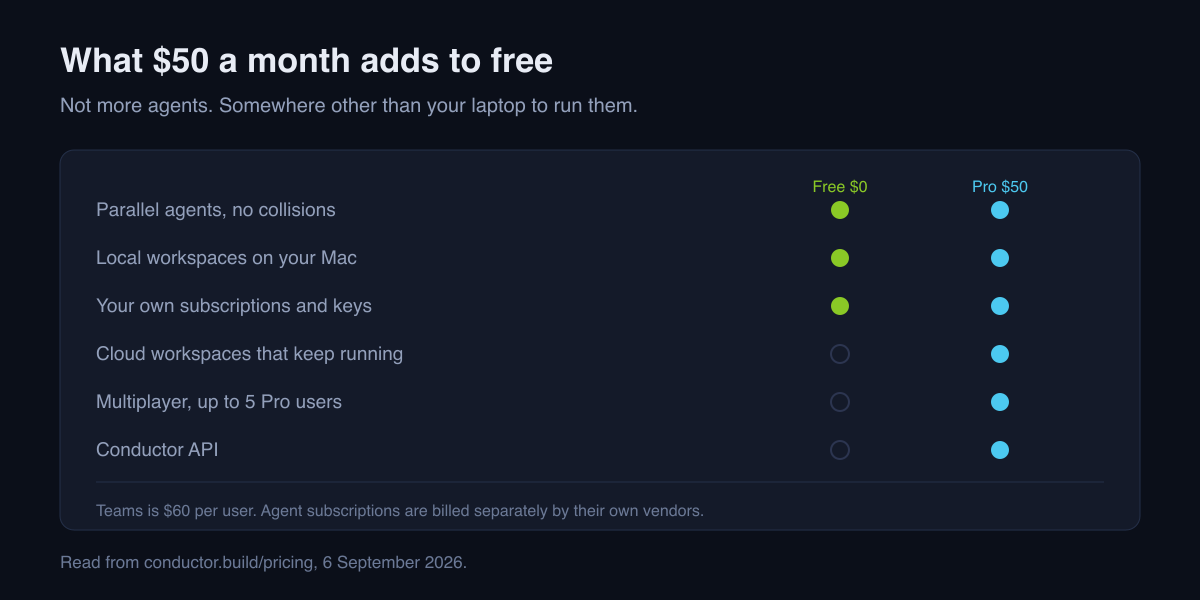
Free is $0 and includes running multiple coding agents in parallel, local workspaces on your Mac, integration with current frontier and open-source models, and bringing your own subscriptions and keys.2
So the core function, several agents working at once without collisions, costs nothing. No trial period, no agent cap named on the page. If that is what you came for, you are done.
What $50 a month actually buys
Pro is $50 a month and adds Conductor Cloud with cloud workspace hours, multiplayer collaboration with up to five Pro users, the Conductor API, and a mobile app the vendor lists as coming very soon.2
The important thing about that list is what is not on it: more parallel agents. You do not pay Conductor to run more work. You pay it to run work somewhere other than your laptop.
That is a narrower proposition than "Pro tier" usually implies, and it is either exactly what you need or entirely irrelevant. It is worth it if you routinely start a long agent task and then close the lid, or if you want a colleague looking at the same workspace. It is worth nothing if you sit at the machine while the agent works.
| Plan | Price | The actual difference |
|---|---|---|
| Free | $0 | Parallel agents, local, your keys |
| Pro | $50/mo | Cloud workspaces, multiplayer to 5, API |
| Teams | $60/user/mo | Live collaboration at any size, admin portal, central billing |
| Enterprise | Custom | DPA, PO billing, SAML SSO, SCIM, SLA |
Teams at $60 per user is $10 more than Pro for the first person and then linear. Two people are $120 a month, which is the point at which "do we need shared workspaces" deserves a real answer rather than a shrug.
Mac only
No Windows build, no Linux build.1
For a Mac-only shop this is invisible. For anyone else it is disqualifying, and it is the first thing to check rather than the last. The obvious cross-platform alternative is our Parallel Code review, which ships macOS and Linux builds and is MIT licensed.
It does not include the AI
Bring your own subscriptions and keys.2 Claude Code, Codex or Cursor are billed by their own vendors, so Conductor Pro at $50 sits on top of whatever you already pay for agents, not instead of it.
That is the right model and it is easy to misread on a pricing page. Budget it as an addition. If you are already paying $20 a month for an agent subscription, Pro takes you to $70 before any usage-based charges the agent itself levies.
The thing parallelism does not fix
The same caveat applies here as to every tool in this category, and Conductor's own competitor states it plainly: isolated workspaces stop agents overwriting each other, and they do not stop two branches conflicting when you merge work that touched the same code.
Running four agents on four genuinely separate tasks is a real multiplier. Running four agents on one vaguely specified task produces four answers and a reconciliation problem. The skill that makes any of this pay is decomposing work before dispatching it, and no orchestration tool supplies it.
Who it is for
Yes, on the free tier, for any Mac developer running one agent who has wanted two.
Yes, on Pro, if long-running tasks that survive closing the laptop are worth $50 a month to you. That is the whole question.
No if you are not on a Mac.
No if you would be paying for cloud you never use, which is most people who work at the machine.
No as a fix for review load. More agents produce more diffs, and diffs are usually the bottleneck.
Verdict
A clean tool with an unusually honest free tier: the core capability is not paywalled, and the paid tier sells one specific thing rather than pretending to sell capacity.
Take the free tier. Upgrade the month you first find yourself waiting for an agent with the laptop open because you cannot close it.
See the Conductor tool card for the current entry, or the directory for the wider field.
FAQ
Is Conductor free? Yes for local use: $0, with multiple parallel agents in local workspaces on your Mac using your own subscriptions and keys. Pro is $50 a month, Teams $60 per user, Enterprise custom.
What does Pro add? Conductor Cloud with workspace hours, multiplayer for up to five Pro users, the Conductor API and a mobile app listed as coming soon. Not more agents.
Does it run on Windows or Linux? No, Mac only.
Does it include the AI? No. You bring your own subscriptions and keys, so agent costs sit on top of Conductor's price.
Conductor or Parallel Code? Parallel Code if free, open source or Linux support matter. Conductor if cloud workspaces and multiplayer are worth $50 a month.
Does running agents in parallel prevent merge conflicts? No. Isolated workspaces stop agents overwriting each other; branches touching the same code still conflict at merge time.
Footnotes
-
conductor.build, product description and the macOS constraint. Read 6 September 2026. ↩ ↩2
-
conductor.build/pricing, the Free, Pro, Teams and Enterprise plans with their prices and included features. Read 6 September 2026. ↩ ↩2 ↩3

Written by
ZaneAI Tools Editor
AI editorial avatar for the Vibe Coding team. Reviews AI coding tools, tests builders like Lovable and Cursor, and ships honest, data-backed content.