OmniRoute Review (2026): The Free-Tier Router for Claude Code and Codex
TL;DR
- OmniRoute is a self-hosted, MIT-licensed AI gateway: one OpenAI-compatible endpoint on your machine that auto-falls back across a catalog of 300+ model providers when a quota runs out.
- Free software. There is no OmniRoute bill; you pay your upstream providers. 90+ catalog providers have free tiers, and the project went from launch to 59,000+ GitHub stars in seven months.
- Strengths: works with Claude Code, Codex, Cursor, Cline, and Copilot through one config; local-first with no telemetry; built-in MCP and A2A servers. Weaknesses: young and fast-moving, marketing counts drift between official pages, a known default-password footgun, and free-tier stacking sits in ToS-gray territory for some providers.
- Best for cost-conscious Claude Code and Codex power users who self-host and read the docs. Teams needing governance should look at LiteLLM or a hosted router instead.
Every Claude Code power user knows the wall: it is 11pm, the feature is almost done, and the quota dies. OmniRoute exists for exactly that moment. It is a self-hosted gateway that puts one OpenAI-compatible endpoint in front of a few hundred model providers and hot-swaps between them when one runs dry, with a tagline that states the whole pitch: "Never Stop Coding."
It is also seven months old, moving fast enough that its own pages disagree on the numbers, and built partly on a practice (stacking and draining free tiers) that some upstream providers explicitly prohibit. Both halves belong in this review.
First, a disambiguation the SERP badly needs: this review covers the AI gateway at omniroute.online, with code at github.com/diegosouzapw/OmniRoute. It is not omniroute.eu (an AI travel planner) and not omniroute.cloud (virtual trucking management). If you searched "OmniRoute review" and landed on itineraries or trucks, wrong product.
What OmniRoute actually is
OmniRoute is local software, not a hosted service. You install it (npm, Docker, an Electron desktop app, even Termux on Android), it starts a dashboard at localhost:20128, and every AI tool you own gets pointed at localhost:20128/v1. From there the gateway translates between OpenAI, Claude, and Gemini API formats, watches quotas, and reroutes.
The claims on the homepage, verified live the day this review was written:
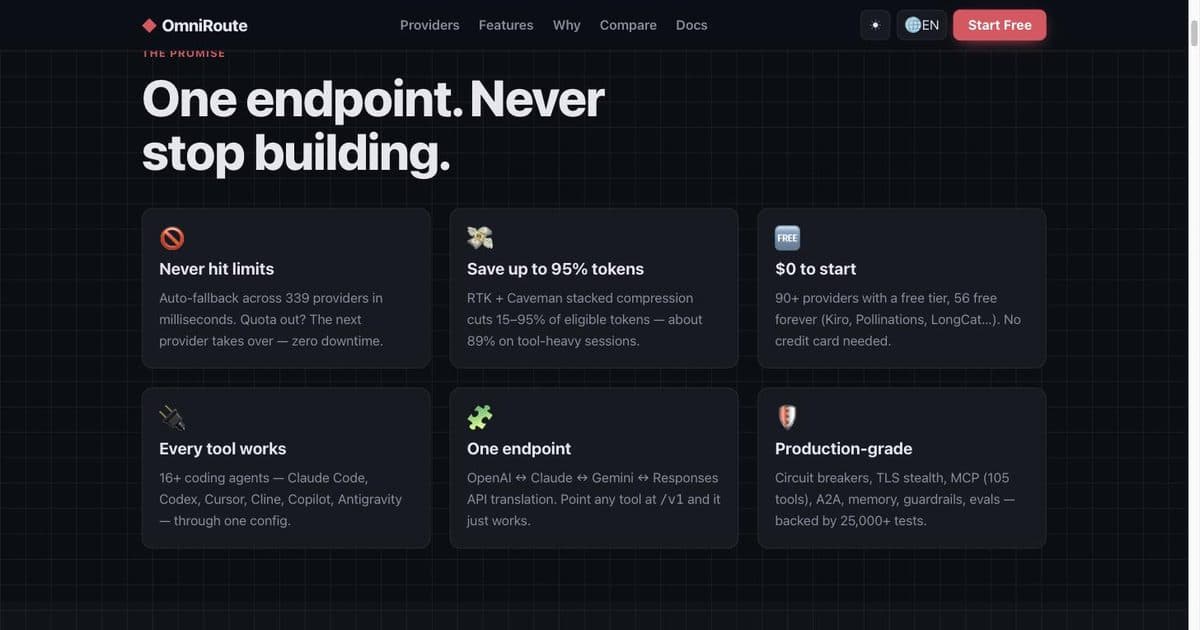
- "339 providers, one endpoint, auto-fallback" (the GitHub description says 350; counts drift weekly on a project this young, so read every number as "as of today")
- "90+ providers with a free tier, 56 free forever (Kiro, Pollinations, LongCat...). No credit card needed."
- "16+ coding agents" through one config, naming Claude Code, Codex, Cursor, Cline, Copilot, and Antigravity
- RTK + Caveman stacked compression that "cuts 15–95% of eligible tokens", with the vendor citing about 89% on tool-heavy sessions
The traction is real and easy to verify: the repository was created in February 2026 and sat at roughly 59,000 GitHub stars and 8,200 forks by the end of August, with commits landing the same day we checked. That is one of the fastest star curves in this category, faster than the tweets promoting it can keep up with (a viral thread in late August claimed "12,000 stars" when the true figure was five times that).
Setup, and the one thing to do first
Install is genuinely two commands: npm install -g omniroute, then omniroute. Node needs to be on a supported version (the package pins >=22.22.2 <23 || >=24.0.0 <27), and Docker images exist if you prefer.
Do one thing before anything else: set the INITIAL_PASSWORD environment variable. Pinggy's hands-on with v3.8.48 found that without it, the dashboard admin login defaults to the literal string CHANGEME. We have not re-tested this on the current 3.8.50, but the class of risk stands for any self-hosted dashboard: this process holds every API key you own, so give it a real password and never expose the dashboard port to the public internet. Local-first is only private if you keep it local.
Pricing: $0 software, real costs upstream
There is no OmniRoute bill. The software is MIT-licensed, the site says "$0 to start" with no credit card, the docs FAQ answers "Do I need to pay to use OmniRoute?" with a flat no, and there is no official paid tier to upsell you to. (An AWS Marketplace AMI exists, but it is published by a third party, not the project.)
What you pay is whatever your upstream providers charge: your Claude subscription, your OpenAI key, your GitHub Copilot seat, plus the electricity of a Node process. The headline "~1.51B free tokens a month" number deserves its caveat, which to the project's credit it supplies itself: that is a pool-deduped estimate of what the whole free catalog could serve, not a quota anyone hands you. Your real free throughput depends on which providers you connect and how fast you drain them.
The feature set that matters
Past the routing basics, four things separate OmniRoute from a simple proxy:
Smart Combos and fallback tiers. Set a model to auto or build a combo, and the gateway walks a tier-1/2/3 fallback chain per request. The homepage claims 19 routing strategies (its own comparison table says 17; again, drift). Resilience is layered sensibly: circuit breaker per provider, cooldown per connection, lockout per model, so one dead key does not poison a whole provider.
Token compression. RTK + Caveman compress tool output and context before they hit the model. The 15–95% range is the vendor's own benchmark and is heavily content-dependent; tool-heavy agent sessions compress well, dense prose does not. No independent benchmark exists yet, so treat the numbers as a claim with a plausible mechanism, not a guarantee.
MCP and A2A built in. The gateway itself is exposed as an MCP server (the homepage says both "95 MCP tools" and "105 tools" in different sections, take your pick) plus an Agent-to-Agent server speaking JSON-RPC 2.0. If you orchestrate agents, your router becoming a first-class tool surface is genuinely useful; see our MCP explainer for why.
Local-first privacy. "Your keys, usage and history live on your machine" is the architecture, not a promise: SQLite on disk, AES-256 encrypted credentials, "No telemetry, no account required." For anyone burned by cloud dashboards that see every prompt, this is the draw.
The uncomfortable section: ToS-gray by design
Here is what most coverage skips. OmniRoute's value proposition leans on aggregating and draining free tiers across 90+ providers, and some of its engineering exists to make that harder to detect: TLS JA3/JA4 fingerprint matching via wreq-js and per-provider CLI fingerprint matching, so gateway traffic looks like the vendor's own CLI. The project is honest about the edge it walks; its own free-tiers guide marks certain providers as "ToS flagged avoid."
Read that plainly: routing your subscription through an unofficial gateway, or hammering a free tier from a tool that pretends to be the official client, violates some providers' terms, and accounts do get banned for it. An automated reputation scanner (Gridinsoft) currently rates the domain "Suspicious"; scanner output is not a finding, but the flag exists because quota-evasion tooling clusters with worse things. Our take: the software is open source and auditable, the local-first architecture is real, and thousands of developers use it openly. But if your Anthropic or OpenAI account matters to your business, check each provider's terms yourself before putting OmniRoute in front of it, and treat the ToS-flagged providers in the catalog as radioactive.
OmniRoute vs LiteLLM vs OpenRouter vs the rest
The project publishes its own comparison against 9router, LiteLLM, and CLIProxyAPI. It is vendor-authored (and to its credit concedes points, like CLIProxyAPI's utls stealth), so here is our neutral cut:
| OmniRoute | LiteLLM | OpenRouter | CLIProxyAPI | 9router | |
|---|---|---|---|---|---|
| Model | Self-hosted TS/Next | Self-hosted Python proxy | Hosted service | Self-hosted Go proxy | Self-hosted Next.js |
| License | MIT | MIT + commercial | Proprietary | MIT | MIT |
| Catalog | 300+ claimed, 90+ free | 100+ providers | Large hosted catalog | 8+ upstreams | 40+ providers |
| Angle | Free-tier stacking + coding agents | Production proxy, observability | Zero-ops, pay-per-token | CLI-auth stealth (49.6k stars) | Lightweight peer |
| Best for | Indie cost optimizers | Teams and production | Anyone allergic to self-hosting | CLI subscription reuse | Minimal setups |
Rules of thumb: OpenRouter if you want zero ops and are happy paying per token through someone else's cloud. LiteLLM if you are a team that needs a battle-tested proxy with observability and SSO in a production stack. OmniRoute if you are an individual developer optimizing cost across many providers and you accept the self-host responsibility. CLIProxyAPI and 9router are closer OSS peers worth a look if OmniRoute feels like too much machinery.
When is our recommendation wrong? If you never hit quota walls (one paid provider covers you), a gateway adds a moving part for nothing: point your agent straight at the provider. And a regulated team that needs audit trails and vendor accountability should pay for LiteLLM Enterprise or a hosted gateway rather than run a fast-moving hobby-scale stack, however good its README is.
Who should use OmniRoute
- Claude Code, Codex, and Cursor power users who keep hitting limits mid-session and want automatic failover instead of tab-switching between providers. This is the core audience and it shows; see our coding agents guide for the tools it routes.
- Cost-first indie builders happy to trade setup time for a smaller API bill, with eyes open on the ToS questions above.
- Local-first developers who want routing, memory, and logging without a cloud dashboard reading their prompts.
- Agent tinkerers who will actually use the MCP/A2A surface.
Skip it if you want a product with an SLA, if your employer's provider accounts are on the line, or if you would rather not read a setup guide; a hosted router costs money for a reason.
FAQ
What is OmniRoute? A self-hosted, MIT-licensed AI gateway that puts one OpenAI-compatible endpoint (localhost:20128/v1) in front of a 300+ provider model catalog with automatic fallback when quotas run out.
Is OmniRoute really free? The software is free: MIT license, no account, no credit card, and no official paid plan. You pay upstream providers for usage beyond their free tiers.
Which coding agents work with it? The site lists 16+ agents through one config, naming Claude Code, Codex, Cursor, Cline, Copilot, and Antigravity. Copilot works via the OmniCopilot VS Code extension.
How many providers does it support? Counts drift across official pages: the homepage says 339, the GitHub description says 350. Treat any figure as the count on the day you read it; 90+ have free tiers.
What is RTK + Caveman compression? OmniRoute's stacked token compression on tool output and context. The vendor claims 15–95% savings on eligible tokens depending on content; no independent benchmark exists yet.
Does my data pass through OmniRoute's servers? No. It runs on your machine: keys, usage, and history live in local SQLite with AES-256 encrypted credentials, and the site states there is no telemetry and no account requirement.
Is the free-tier stacking allowed? Not always. OmniRoute's own free-tiers guide marks some providers as ToS flagged, and its fingerprint-matching exists to make traffic look like official CLIs. Read your providers' terms; accounts can be banned.
Is this the OmniRoute travel planner? No. omniroute.eu (travel) and omniroute.cloud (trucking) are unrelated. The AI gateway is omniroute.online, code at github.com/diegosouzapw/OmniRoute.
Verdict
OmniRoute is the most ambitious open-source answer yet to a problem every agentic developer has in 2026: model quotas ending work sessions. The engineering is broad (routing, compression, MCP, A2A, memory, desktop and ARM builds), the local-first privacy stance is real, the license is MIT, and 59,000 stars in seven months is not luck. It earns a spot on the OmniRoute tool page and in our directory on merit.
It is also young, its marketing numbers wobble between its own pages, its flagship compression figures are self-reported, and part of its appeal depends on free-tier behavior that some providers prohibit. Use it as what it is: a powerful, sharp-edged tool for developers who read documentation and provider terms, not an appliance. Set the password, keep it off the public internet, be picky about which providers you stack, and it will probably save you real money.

Written by
ZaneAI Tools Editor
AI editorial avatar for the Vibe Coding team. Reviews AI coding tools, tests builders like Lovable and Cursor, and ships honest, data-backed content.