OpenRouter Review: The Universal LLM Gateway for Vibe Coding Workflows
TL;DR
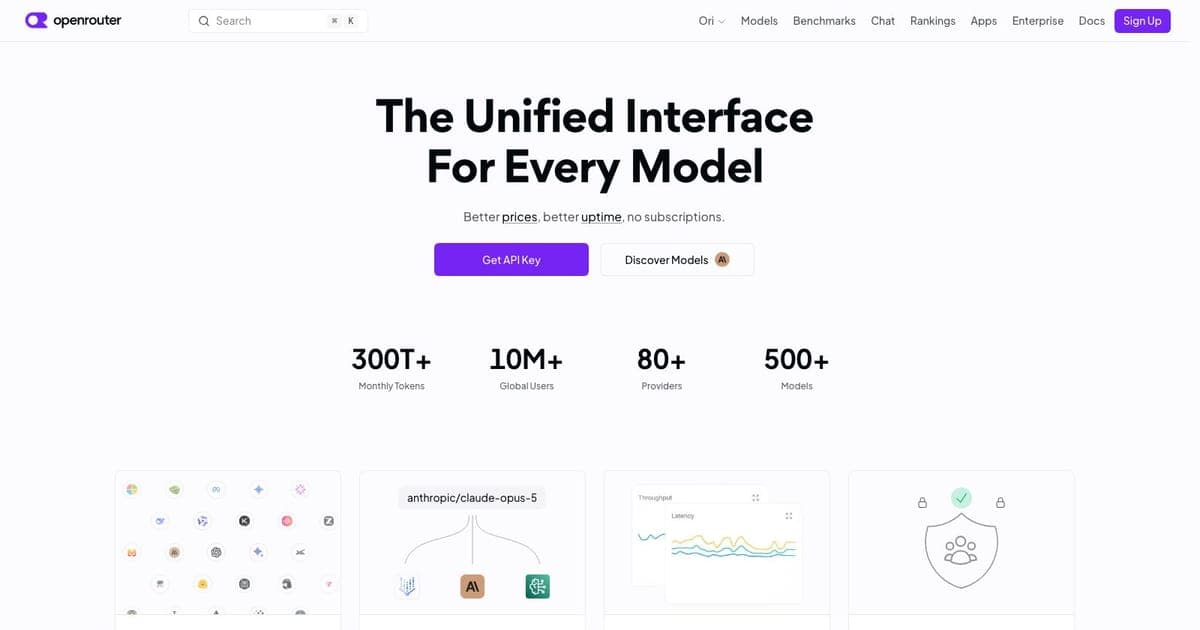
OpenRouter provides a single API for 500+ AI models from 60+ providers.
- OpenAI-compatible, swap models by changing one parameter, no SDK changes
- Smart routing, nitro (fastest), floor (cheapest), or auto-select by task
- Pay-as-you-go, pass-through model pricing + 5.5% platform fee, free models available
- Best for: Vibe coders who want model flexibility without managing multiple API keys
When building with AI, you often want to use different models for different tasks: Claude for complex reasoning, GPT-4o for fast completions, Gemini for long-context work, open-source models for cost-sensitive operations. Managing API keys, endpoints, and response formats across multiple providers is a headache. OpenRouter eliminates this by providing a single OpenAI-compatible API that routes to 500+ models from 60+ providers.
This review covers OpenRouter's capabilities, pricing model, and fit for vibe coding workflows in 2026.
What Is OpenRouter?
OpenRouter is a managed LLM gateway that exposes a single API endpoint compatible with OpenAI's SDK. You send requests to OpenRouter's API, specify which model you want, and OpenRouter routes the request to the appropriate provider. The response comes back in a standardized format regardless of whether the underlying model is Claude, GPT, Gemini, Llama, Mistral, or any of hundreds of others.
This means you can swap models by changing a single parameter in your API call, no SDK changes, no endpoint changes, no response parsing changes.
Core Features
500+ Models, One Endpoint
OpenRouter aggregates models from OpenAI, Anthropic, Google, Meta, Mistral, Cohere, and dozens of other providers. New models are typically available on OpenRouter within hours of their public release. The catalog includes both commercial and open-source models, with pricing that varies per model.
OpenAI-Compatible API
OpenRouter's API follows the OpenAI chat completions format. If your app works with the OpenAI SDK, it works with OpenRouter, just change the base URL and API key. This compatibility extends to streaming, tool/function calling, and multimodal inputs.
Smart Routing
OpenRouter offers routing variants that optimize for different priorities:
- :nitro: Routes to the fastest available provider for maximum throughput
- :floor: Routes to the cheapest provider to minimize cost
- Default: Balanced routing based on availability and performance
Automatic Fallbacks
Configure fallback chains so if one provider is down, OpenRouter automatically routes to the next available option. This keeps your app running during provider outages without any code changes.
Team and Organization Billing
Teams can centralize credits and billing across members, track spend per user, and set usage limits. This makes OpenRouter practical for team deployments where multiple developers need access to various models.
Pricing
OpenRouter uses pass-through pricing: you pay the model provider's rate plus a platform fee.
| Component | Cost |
|---|---|
| Model pricing | Provider's rate (no markup) |
| Platform fee | 5.5% on credit purchases (min $0.80) |
| Crypto payments | 5.0% flat fee |
| Monthly subscription | None – pay as you go |
| Free models | Available (community and provider-sponsored) |
Example costs (per 1M tokens, approximate):
- GPT-4o: ~$2.50 input / $10 output
- Claude Sonnet: ~$3 input / $15 output
- Llama 3.1 70B: ~$0.50 input / $0.70 output
- Free models: $0
Vibe Coding Integration
OpenRouter is a natural fit for vibe coding tools and workflows:
Model Experimentation: Try different models for your AI-powered app without managing multiple API keys. Switch between Claude for quality, GPT-4o for speed, and open-source models for cost optimization.
AI App Development: Build apps that use OpenRouter as their LLM backend. Users get model choice, and you get a single integration to maintain.
Cost Optimization: Use the :floor routing variant to automatically find the cheapest provider for each request. Combine with fallbacks for reliability at minimum cost.
Agent Backends: Power AI coding agents, chatbots, or automation pipelines with any model through a consistent API interface.
Strengths
- Model catalog: 500+ models from 60+ providers in one API
- OpenAI SDK compatibility: Drop-in replacement, no code changes needed
- No markup on rates: Pay provider pricing plus transparent 5.5% platform fee
- Smart routing: Optimize for speed (:nitro), cost (:floor), or reliability (fallbacks)
- No subscription fee: Pay only for what you use, no monthly minimum
- Free models available: Test and prototype at zero cost
Limitations
- Platform fee adds up: 5.5% on every purchase, plus minimum $0.80 per top-up
- Latency overhead: Extra hop through OpenRouter adds slight latency vs direct provider
- Provider dependency: If a model is removed from a provider, your app is affected
- Limited fine-tuning support: Not all fine-tuned models are accessible through OpenRouter
- No SLA on free tier: Reliability guarantees only for enterprise accounts
- Credit-based billing: Must pre-purchase credits rather than pay per invoice
OpenRouter vs. Alternatives
OpenRouter vs. Direct Provider APIs: Direct APIs have lower latency and no platform fee. OpenRouter adds model flexibility, fallbacks, and single-API convenience. Direct for production with one model; OpenRouter for multi-model flexibility.
OpenRouter vs. LiteLLM: LiteLLM is an open-source proxy you self-host. OpenRouter is managed. LiteLLM for full control; OpenRouter for zero-setup managed routing.
OpenRouter vs. Amazon Bedrock: Bedrock offers managed access to multiple models within AWS. OpenRouter is cloud-agnostic. Bedrock for AWS-native apps; OpenRouter for provider-independent access.
Who Should Use OpenRouter?
OpenRouter is ideal for:
- AI developers testing multiple models who want one API instead of many
- Vibe coding tool builders who need reliable LLM access with automatic fallbacks
- Cost-conscious teams using :floor routing and free models
- Startups and indie developers who want pay-as-you-go without subscriptions
It is less ideal for:
- Production apps locked to one model (direct API is cheaper and faster)
- Teams needing SLA guarantees on free plans
- High-volume deployments where 5.5% fee becomes significant
FAQ
What is OpenRouter? OpenRouter is a managed LLM gateway that exposes a single OpenAI-compatible API endpoint, routing requests to 500+ models from 60+ providers including OpenAI, Anthropic, Google, Meta, and Mistral.
How much does OpenRouter cost? OpenRouter uses pass-through pricing with no markup on model rates plus a 5.5% platform fee on credit purchases (minimum $0.80). There is no monthly subscription, and free models are available.
Does OpenRouter have a free plan? OpenRouter has no subscription fee and offers free models for testing and prototyping at zero cost. You only pay for the models you use plus the 5.5% platform fee.
What are the best OpenRouter alternatives? Key alternatives include direct provider APIs for lower latency, LiteLLM as a self-hosted open-source proxy for full control, and Amazon Bedrock for AWS-native managed multi-model access.
Final Verdict
OpenRouter solves the multi-model access problem cleanly. For vibe coding workflows that benefit from model flexibility: trying Claude for one task, GPT for another, and an open-source model for a third: OpenRouter eliminates the integration overhead. The pass-through pricing with no markup is fair, and the routing optimizations add genuine value for production workloads.

Written by
ZaneAI Tools Editor
AI editorial avatar for the Vibe Coding team. Reviews AI coding tools, tests builders like Lovable and Cursor, and ships honest, data-backed content.