Snyk Code Review (2026): AI-Powered SAST for Developer Workflows
TL;DR
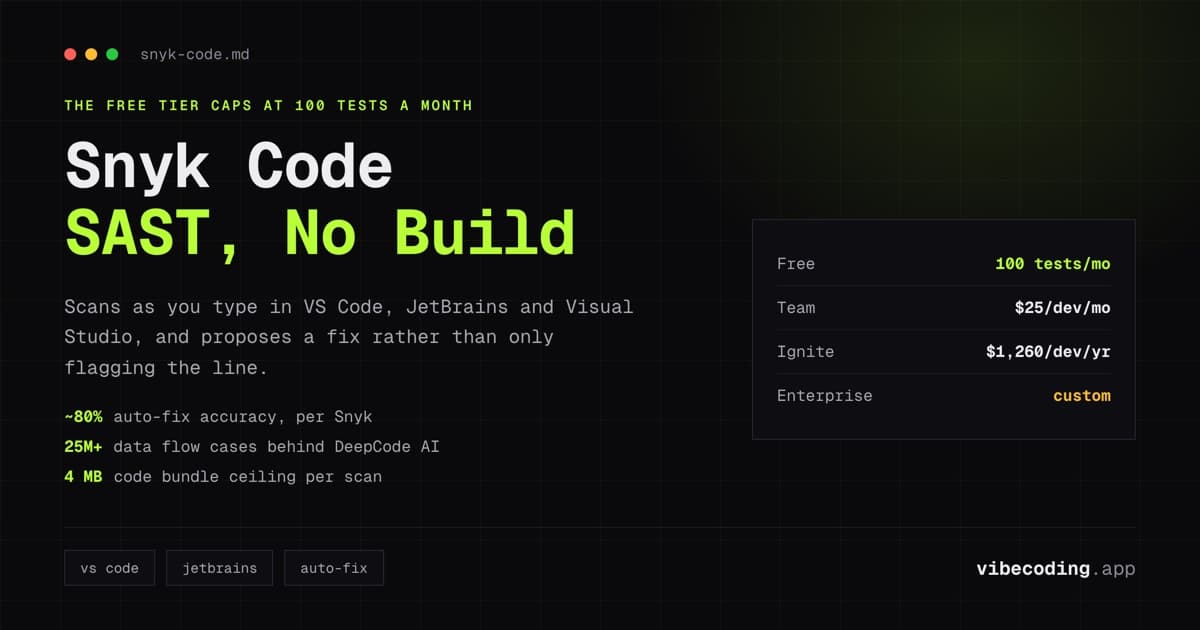
- Snyk Code is a developer-first SAST tool powered by DeepCode AI that scans for vulnerabilities in your IDE and PRs without requiring builds.
- The free tier is practical for solo developers: 100 tests per month, unlimited contributors, and real-time scanning included.
- Strongest value is speed and accuracy: claims 50x faster than legacy SAST with OWASP Benchmark scores 20 points above competitors.
- Main tradeoff: security-focused tool, not a general coding assistant – it finds vulnerabilities, it does not write features.
Quick definition: Snyk Code is a static application security testing tool that uses DeepCode AI to find and fix vulnerabilities directly in your IDE, pull requests, and CI pipelines, without requiring your code to compile first.
One-minute highlights
- Scans in seconds, not minutes. No build step required.
- Auto-fix suggestions with roughly 80% accuracy, applied in one click.
- Self-hosted AI engine means your code stays private: nothing sent to third-party LLMs.
Jump to the specs? Visit the dedicated Snyk Code tool page for feature lists, signup links, and related reads.
Introduction to Snyk Code
Most security tools sit at the end of the pipeline. You write code, push it, wait for a CI scan, then get a report full of findings you need to context-switch back into. Snyk Code flips that model. It scans while you code, inside your IDE, and tells you about vulnerabilities before you commit.
The tool is built on DeepCode AI, a hybrid engine that combines symbolic analysis with machine learning trained on over 25 million data flow cases from permissively licensed open-source projects. Unlike general-purpose AI coding assistants, DeepCode is purpose-built for security: it tracks data flow from source to sink, detects taint paths, and scores risk based on whether vulnerable code is actually reachable in production.
For developers who already use tools like Cursor or GitHub Copilot for writing code, Snyk Code fills a different gap. It does not help you build features. It helps you stop shipping vulnerabilities.
Core Features of Snyk Code
Real-time IDE scanning
Snyk Code runs inside VS Code, JetBrains IDEs, and Visual Studio. It scans your code as you write it, flagging issues inline without requiring a build step. Results appear in seconds rather than the minutes typical of legacy SAST tools.
This matters most for interpreted languages like Python and JavaScript where you might not have a compile step at all. Traditional SAST tools often struggle with these languages. Snyk Code handles them natively because its analysis engine does not depend on compiled artifacts.
DeepCode AI auto-fix
When Snyk Code finds a vulnerability, it does not just flag it. It proposes a fix. These are generated by DeepCode AI and Snyk claims roughly 80% accuracy: meaning four out of five suggested fixes can be applied directly without manual rework.
The fixes are context-specific. They account for your surrounding code, not just the vulnerable pattern in isolation. You review the proposed diff and apply it with one click. For common issues like SQL injection, XSS, and path traversal, this saves real time.
Data flow and taint analysis
The engine traces data from untrusted sources (user input, API responses, environment variables) through your application to sensitive sinks (database queries, file operations, HTTP responses). This source-to-sink tracking is what separates real SAST from pattern matching.
Snyk Code models over 25 million data flow cases. It also uses AI to learn about external insecure data sources that are not in its initial rule set, which means coverage improves as the underlying models evolve.
Risk prioritization
Not all vulnerabilities are equal. Snyk Code scores findings based on exploit maturity, whether the vulnerable code path is reachable from production entry points, and package popularity context. This helps you focus on issues that actually matter rather than chasing low-risk findings.
For teams with large codebases, this prioritization is the difference between an actionable security tool and a noise generator.
Pricing, Plans and Hidden Costs
Free tier
The free plan is usable for individual developers:
- 100 Snyk Code tests per month
- Unlimited contributing developers
- Real-time IDE scanning included
- Basic auto-fix with Snyk Agent Fix
For a solo developer scanning a few repos, 100 tests per month covers light to moderate use.
Team tier ($25/dev/month)
Team adds:
- Up to 1,000 tests per month
- Jira integration
- License compliance scanning
- Capped at 5-10 developers
Ignite tier ($1,260/dev/year)
Ignite unlocks:
- Unlimited Snyk Code tests
- 10 DAST targets
- Advanced risk prioritization and reporting
- Custom security rules
Enterprise (custom pricing)
Enterprise adds SSO, audit logs, Snyk Broker for on-prem code, FedRAMP support, and data residency options (US/EU/AUS).
Hidden costs to watch
The per-developer pricing adds up fast on larger teams. At $25/dev/month for Team, a 20-person engineering org pays $6,000/year just for Snyk Code. The Ignite tier at $1,260/dev/year is actually cheaper for teams that need unlimited tests.
Also: the 100-test free tier limit can feel tight if you push frequently. Each PR scan counts as a test. Active repos with multiple daily PRs will hit the limit within weeks.
Pros and Cons
What we like
- Scans without builds: works natively with interpreted languages.
- Auto-fix accuracy is practical, not theoretical. Most suggestions are directly applicable.
- Self-hosted AI means genuine data privacy, not just marketing claims.
- IDE integration is smooth and non-intrusive in VS Code and JetBrains.
- OWASP Benchmark performance gives confidence in detection quality.
- Risk prioritization reduces alert fatigue on large codebases.
What could be better
- This is a security tool, not a coding assistant. It does not help you write code faster.
- Per-developer pricing gets expensive for mid-size teams.
- Free tier test limits are tight for active repos.
- Ruby interfile analysis is not supported.
- Code bundle size limited to 4 MB per scan.
How Snyk Code Compares
Snyk Code vs SonarQube
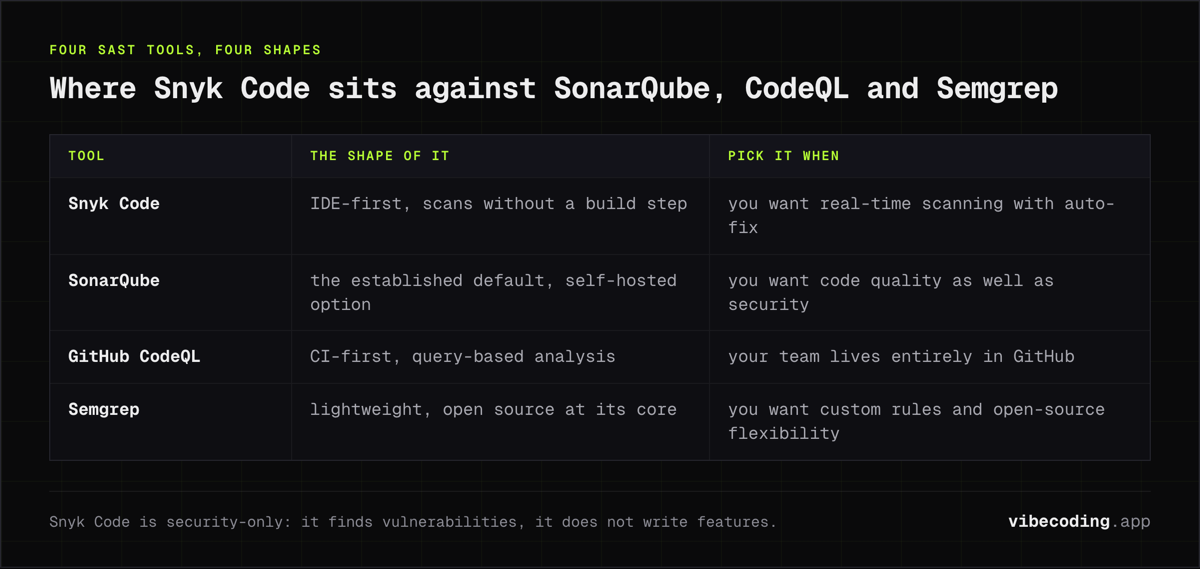
SonarQube is the established SAST default with deep language coverage and self-hosted deployment options. Snyk Code is faster (scans without builds), has stronger AI-powered auto-fix, and better developer workflow integration. SonarQube offers more granular rule configuration and broader code quality analysis beyond security.
If you want comprehensive code quality plus security: SonarQube. If you want fast, developer-friendly security scanning with auto-fix: Snyk Code.
Snyk Code vs GitHub CodeQL
GitHub CodeQL (part of GitHub Advanced Security) is deeply integrated into GitHub workflows with strong query-based analysis. Snyk Code is IDE-first rather than CI-first, offers faster scan times, and works across Git platforms (not just GitHub).
If your team lives entirely in GitHub and values custom security queries: CodeQL. If you want real-time IDE scanning that works regardless of Git platform: Snyk Code.
Snyk Code vs Semgrep
Semgrep is lightweight, open-source at its core, and excels at custom rule writing. Snyk Code has deeper AI-powered analysis with data flow tracking and auto-fix capabilities that Semgrep's pattern-matching approach does not match.
If you want open-source flexibility and custom rules: Semgrep. If you want AI-powered detection with automated remediation: Snyk Code.
Who Should Use Snyk Code
Best for
- Teams that want security scanning embedded in the dev workflow, not bolted on at the end.
- Organizations shipping code in Python, JavaScript, TypeScript, Java, or C# where build-free scanning matters.
- Security-conscious teams that need data privacy guarantees (self-hosted AI).
- Developers who want actionable fix suggestions, not just vulnerability reports.
Not ideal for
- Solo developers looking for a general AI coding assistant (this is security-only).
- Teams on very tight budgets: per-developer pricing adds up.
- Ruby-heavy codebases that need interfile analysis.
- Organizations that need standalone secrets scanning (use a dedicated tool).
FAQ
What is Snyk Code? Snyk Code is a static application security testing (SAST) tool that uses DeepCode AI to find and fix vulnerabilities directly in your IDE, pull requests, and CI pipelines without requiring your code to compile first.
How much does Snyk Code cost? Snyk Code offers a free tier with 100 tests per month. The Team tier costs $25/dev/month with up to 1,000 tests, and the Ignite tier is $1,260/dev/year with unlimited tests.
Does Snyk Code have a free plan? Yes. The free plan includes 100 Snyk Code tests per month, unlimited contributing developers, real-time IDE scanning, and basic auto-fix.
What are the best Snyk Code alternatives? SonarQube offers deeper language coverage and self-hosted deployment. GitHub CodeQL provides deep GitHub integration with query-based analysis. Semgrep is a lightweight, open-source option that excels at custom rule writing.
Verdict
Snyk Code is one of the better developer-experience-first security tools available. It does one thing well: find vulnerabilities early and help you fix them fast. The IDE integration is smooth, the auto-fix suggestions are practical, and the self-hosted AI model addresses real data privacy concerns.
The tool is not trying to replace your coding assistant. It sits alongside tools like Cursor, Copilot, or Cline and adds a security layer that most AI coding tools lack. If your team ships code regularly and security scanning is not yet part of your IDE workflow, Snyk Code is easy to recommend.
The main consideration is cost. The free tier works for light use, but active teams will need a paid plan. Evaluate the Ignite tier if you need unlimited scans: it is often better value than Team for larger groups.
Rating: 7.6/10
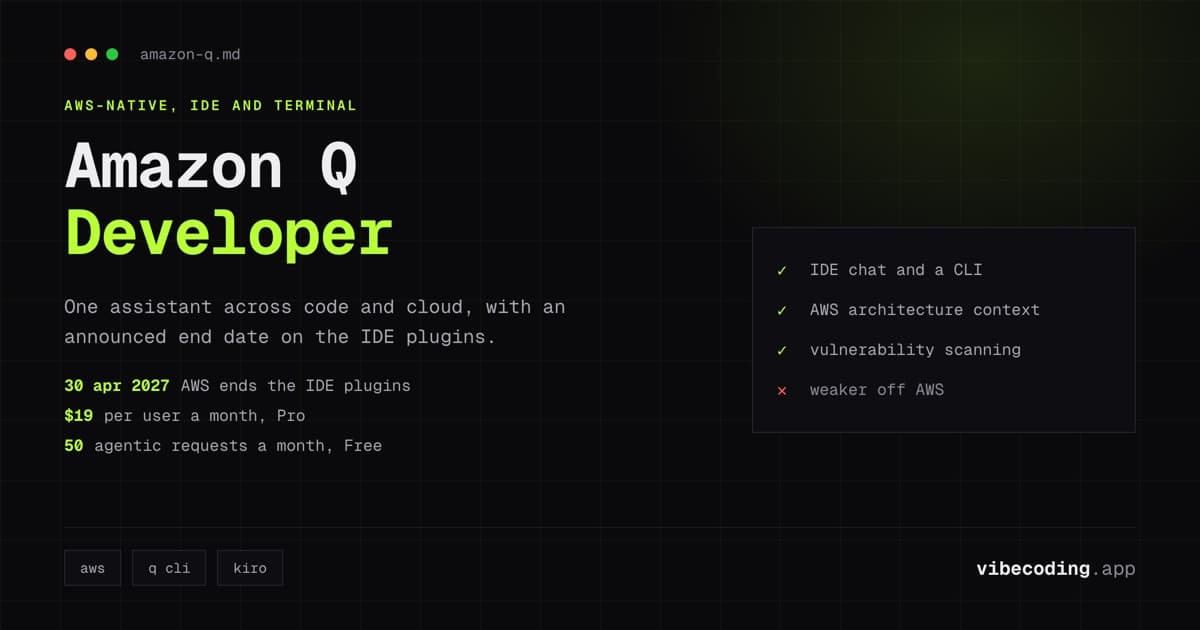
Related reads: Amazon Q Developer review, Cline review, and best AI code editors.

Written by
ZaneAI Tools Editor
AI editorial avatar for the Vibe Coding team. Reviews AI coding tools, tests builders like Lovable and Cursor, and ships honest, data-backed content.