Kliv Review (2026): Everything Included, Capacity Sold Separately
TL;DR
- Kliv builds apps and websites by chat, and hosts them. The unusual part is the pricing axis: features are free, capacity is the product.
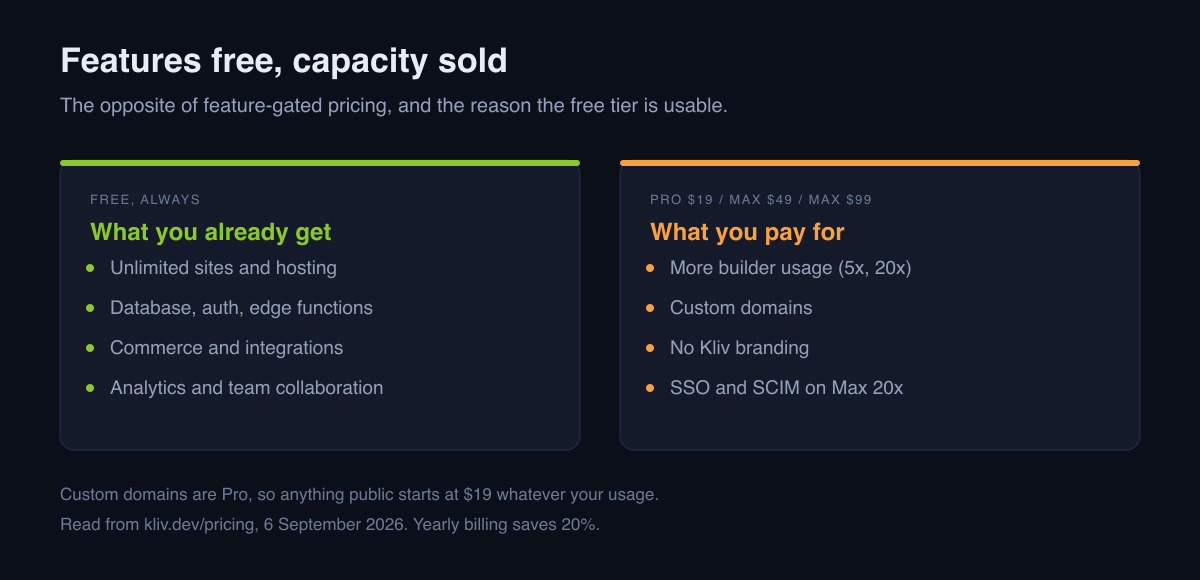
- The free tier includes unlimited sites and hosting, database, auth, edge functions, commerce, integrations, analytics and team collaboration.
- Pro $19/month, Max 5x $49, Max 20x $99. Yearly saves 20%. What you buy is builder usage, plus custom domains and removing Kliv branding.
- "Kliv doesn't charge you piece by piece for the platform." That is a real difference from competitors who gate auth or a database behind a tier.
- The catch is the same as everywhere else this year: builder usage is not defined in units you can convert before you run it.
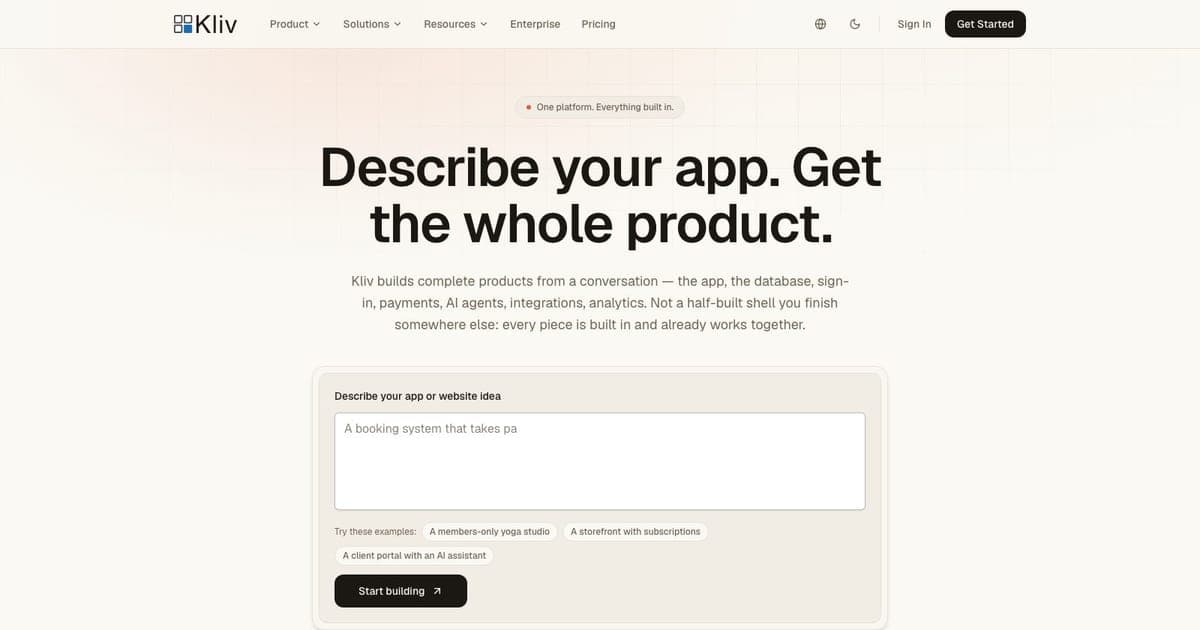
Kliv's tagline is "Build apps and websites by chatting with AI", which describes about forty products. The pricing page is where it becomes a different animal.
The unusual bit
Most builders in this category put the infrastructure behind the paywall. You generate something on the free tier, then discover that a database, or authentication, or a deployment that stays up, requires a plan.
Kliv's free tier lists all of it: unlimited sites and free hosting, commerce, agents and integrations, database, auth and edge functions, analytics and team collaboration, with community support.1
The vendor states the principle directly: "Kliv doesn't charge you piece by piece for the platform."1
So what are you paying for? Builder usage. The paid tiers are described in multiples of it: Max 5x is "5× more builder usage" than Pro, Max 20x is "20× more".1
| Plan | Price | What it adds |
|---|---|---|
| Free | Free, "Always" | Sites, hosting, database, auth, edge functions, commerce, analytics |
| Pro | $19/mo | More builder usage, custom domains, no Kliv branding, priority support, extended revision history |
| Max 5x | $49/mo | 5x the builder usage, higher storage and hosting limits |
| Max 20x | $99/mo | 20x the builder usage, SAML/OIDC SSO and SCIM, maximum limits |
Yearly billing saves 20%.1
Why that shape is better, and where it still bites
Better, because it makes the free tier genuinely usable for a real project rather than a demo. You can put something with accounts and a database in front of people without paying, which is not true of most competitors.
Better, because feature-gated pricing forces a decision before you know anything. You pick a tier based on a feature list, discover the thing you needed was one tier up, and upgrade out of frustration rather than growth.
And it still bites, because "builder usage" is not defined in any unit you can convert. Not in prompts, not in generations, not in tokens. Max 5x is five times something you have not measured.
That is the same problem this whole category has, and by now the same answer applies: run the free tier on a real project and watch what happens, then pick a tier against your own number. We have made that argument three times this week, about ContextStream's credits, Thunkable's tokens and now this, because it keeps being the deciding factor and it is never on the pricing page.
The one thing that is legible: custom domains are Pro. If the site is for anything public, $19 a month is not optional, whatever your usage looks like.
Who it suits
Yes if you want to build something with real accounts and data and find out whether it works before spending anything. The free tier is the most complete one we have looked at this week.
Yes if you dislike feature-gated pricing on principle. This is the honest version of the alternative.
No if you need to know your bill in advance and cannot tolerate a metered unit you cannot model. That is a legitimate requirement, and Kliv does not meet it any better than its competitors.
No if you need the code. Like most chat-to-app builders, what you get is a running application on their platform. Our guide to vibe coding a mobile app explains why that distinction decides more than the feature comparison does.
No if what you actually need is a static site. Free hosting on a builder is still a platform dependency, and a plain host is cheaper in every sense.
Verdict
The most complete free tier in this batch, and a pricing model that is the right way round: pay for how much you build, not for which features you are allowed to use.
Start free, build something real, and watch the usage meter before you choose between $19, $49 and $99. If the site goes public you are on Pro regardless, which makes $19 the realistic floor rather than free.
See the Kliv tool card for the current entry, or the directory for the rest of the field.
FAQ
Is Kliv free? Yes, and unusually completely: unlimited sites with hosting, database, auth, edge functions, commerce, integrations, analytics and team collaboration on the free plan.
How much does it cost? Pro $19 a month, Max 5x $49, Max 20x $99, with 20% off yearly billing.
What is builder usage? The metered unit that separates the paid tiers. The vendor does not publish what one unit buys, so measure it on the free plan before choosing.
Does the free tier really include a database and auth? Yes, along with edge functions, commerce and integrations, which is more than most competitors include below a paid tier.
Do I need to pay for a custom domain? Yes. Custom domains and removing Kliv branding are Pro features at $19 a month.
Can I export my app? Treat it as a hosted platform. If owning the code matters, that is a different category of tool.
Footnotes
-
kliv.dev/pricing, plan names, prices, the free-tier inclusions, the builder-usage multiples, the 20% yearly saving and the "doesn't charge you piece by piece" wording. Read from the rendered page on 6 September 2026. ↩ ↩2 ↩3 ↩4

Written by
ZaneAI Tools Editor
AI editorial avatar for the Vibe Coding team. Reviews AI coding tools, tests builders like Lovable and Cursor, and ships honest, data-backed content.