Superpowers Review (2026): Discipline for Agents, at the Price of Ceremony

TL;DR
- Superpowers is an open-source skills framework for coding agents. It registers one SessionStart hook that makes a library of skills discoverable, then pushes the agent through brainstorming, planning, TDD, subagent review and worktree isolation.
- 282,239 GitHub stars, MIT licensed, v6.3.0. Free.
- Disclosure: we run it. It has been installed across our repositories since 9 July 2026, currently on 6.3.0. This is a first-hand review, and that is also a bias worth knowing about.
- What it buys is discipline the agent will not otherwise apply. What it costs is tokens and questions before any code appears.
- It is the wrong tool for a small task. On a one-line fix the ceremony costs more than the fix.
Disclosure first: we use this. Superpowers has been installed across our repositories since 9 July 2026 and is currently running at version 6.3.0. That makes this one of the few reviews on this site written from daily use rather than from a vendor page, and it also means we are not a neutral party. Read it with both facts in mind.
What it is
An open-source skills framework and a development methodology, aimed at making coding agents behave like careful engineers rather than eager ones.1
Mechanically it is modest: one SessionStart hook that makes a library of composable skills discoverable to the agent. What that unlocks is a set of structured workflows the agent is then expected to follow, covering brainstorming before building, an explicit plan, test-driven development with proper red-green-refactor cycles, delegation to subagents for review, and git worktree isolation for parallel work.1
282,239 stars, MIT licensed, v6.3.0.2 Free, with the caveat below about tokens.
What it actually changes
The interesting thing about Superpowers is that it does not make the agent smarter. It makes it slower in a specific, deliberate way.
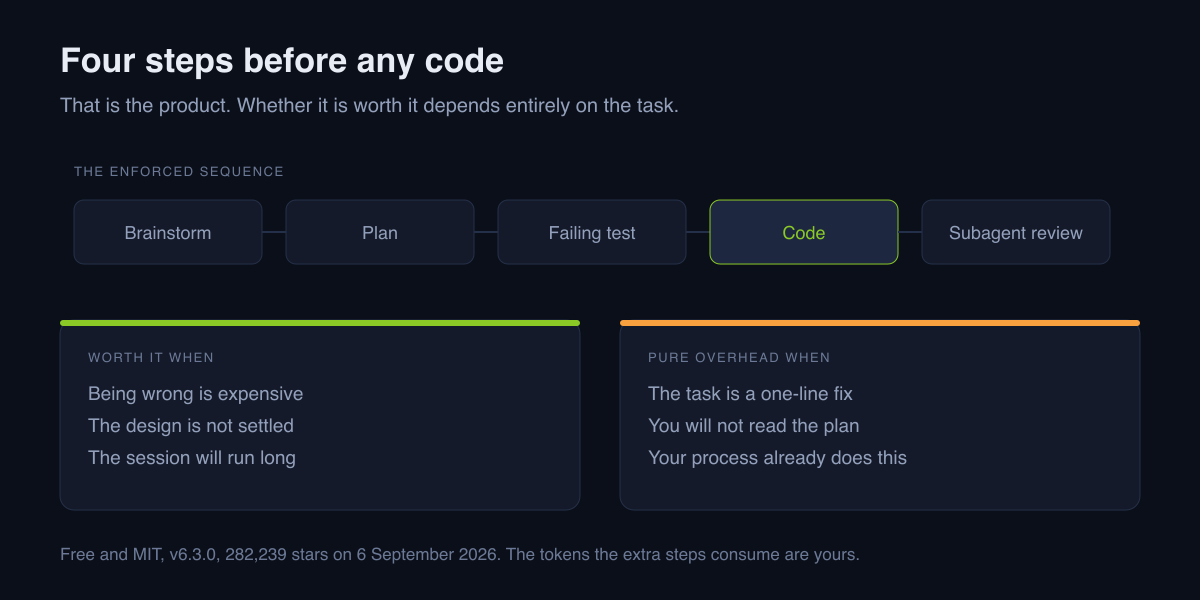
Without it, ask an agent to build something and it starts building. With it, the agent asks what you are actually trying to do, proposes an approach, waits for you to agree, writes a failing test, and only then writes code.
That sequence is not novel; it is what a disciplined engineer does. The observation the project is built on is that agents do not do it by default and will not start doing it because you asked nicely in a prompt. A skill file the agent loads every session is more durable than an instruction it forgets.
That is also why the framework generalises. Its most useful export is not any individual skill but the pattern: write your procedures down where the agent reads them, rather than re-explaining them.
The cost, stated plainly
Every one of those steps is tokens, and tokens are money and latency.
On a task with real design content the trade is obviously good: the questions surface the thing you had not decided, and the plan is cheaper to correct than the code. On a small task it is obviously bad. Asking three clarifying questions before changing a string is ceremony, and it is the criticism that comes up most often about this project.
Our own use bears that out. It earns its keep on work where being wrong is expensive, and it is overhead on the small stuff, which is why the sensible posture is to have it available rather than mandatory.
Does it fight your other tooling
This was our main worry when adopting it, and the answer in two months has been no.
The hook is passive: it makes skills discoverable rather than taking control of the session. In our repositories it has coexisted with spec-driven development workflows and with plan mode without interfering with either.3 An agent that is already following a specification does not get dragged out of it.
That matters more than it sounds. A framework that seizes the session is a framework you uninstall the first time it gets in the way of something urgent.
Reading the star count
282,239 stars is an enormous number, larger than any tool we have reviewed this week including our DeepSeek Harness review at 213,415.
The same caution applies to both: stars measure interest, not suitability. They tell you a lot of people opened the page and thought the idea was good. They tell you nothing about whether the methodology fits how you work, and this project is more opinionated than most, which means it fits some people badly.
Who it is for
Yes if your agent produces code that works and that you would not have written. Structure is the fix for that, and this is structure.
Yes if you have found yourself explaining the same conventions every session. That is exactly the problem skill files solve.
Yes if you are running long autonomous sessions, where the compounding cost of an early wrong turn is highest.
No for quick fixes and small edits. Use the agent directly.
No if you will not read the plans it produces. The value is in the review step; skipping it leaves you with the cost and none of the benefit.
No if your existing workflow already enforces this. Adding a second methodology on top of a working one buys nothing and costs tokens.
Verdict
The clearest expression we have seen of the idea that the way to improve agent output is to constrain the process rather than to write better prompts. It is free, it is honest about being opinionated, and in our own use it has been additive rather than intrusive.
Install it, use it on the work that matters, and do not feel obliged to run it on a typo. The point of a skills framework is that the skills are there when you reach for them, and the discipline it encodes is worth having even if you end up writing your own version of it.
If you want the concept without the framework, our piece on agentic engineering versus prompt engineering covers why persistent procedures beat one-off instructions.
See the Superpowers tool card for the current entry.
FAQ
What is Superpowers? An open-source skills framework and methodology for AI coding agents. One SessionStart hook makes a library of skills discoverable, then structured workflows cover brainstorming, planning, TDD, subagent review and worktree isolation.
Is it free? Yes, MIT licensed, currently v6.3.0 with 282,239 GitHub stars. You still pay your agent vendor for the extra tokens it consumes.
Does it slow you down? On small tasks, yes, deliberately. It front-loads questions and planning, which is valuable on work that would otherwise go wrong and pure overhead on a one-line fix.
Does it conflict with other workflows? Not in our experience. The hook is passive and has coexisted with spec-driven work and plan mode in our repositories since July 2026.
Which agents does it work with? It is built around Claude Code's plugin and skill model and distributed through the official plugin marketplace; the methodology generalises to other agents that support skill files.
Should I use it for everything? No. Have it available and reach for it on work where being wrong is expensive.
Footnotes
-
github.com/obra/superpowers, project description, the SessionStart hook and skill-discovery model, and the brainstorming, planning, TDD, subagent-review and worktree workflows. ↩ ↩2
-
Star count, fork count, MIT licence and release v6.3.0 read from the GitHub API on 6 September 2026. ↩
-
First-hand: installed at user scope across this author's repositories on 9 July 2026, updated to 6.3.0, and run in every session since alongside spec-driven workflows and plan mode. ↩

Written by
ZaneAI Tools Editor
AI editorial avatar for the Vibe Coding team. Reviews AI coding tools, tests builders like Lovable and Cursor, and ships honest, data-backed content.