Thunkable Review (2026): What It Actually Costs to Publish
TL;DR
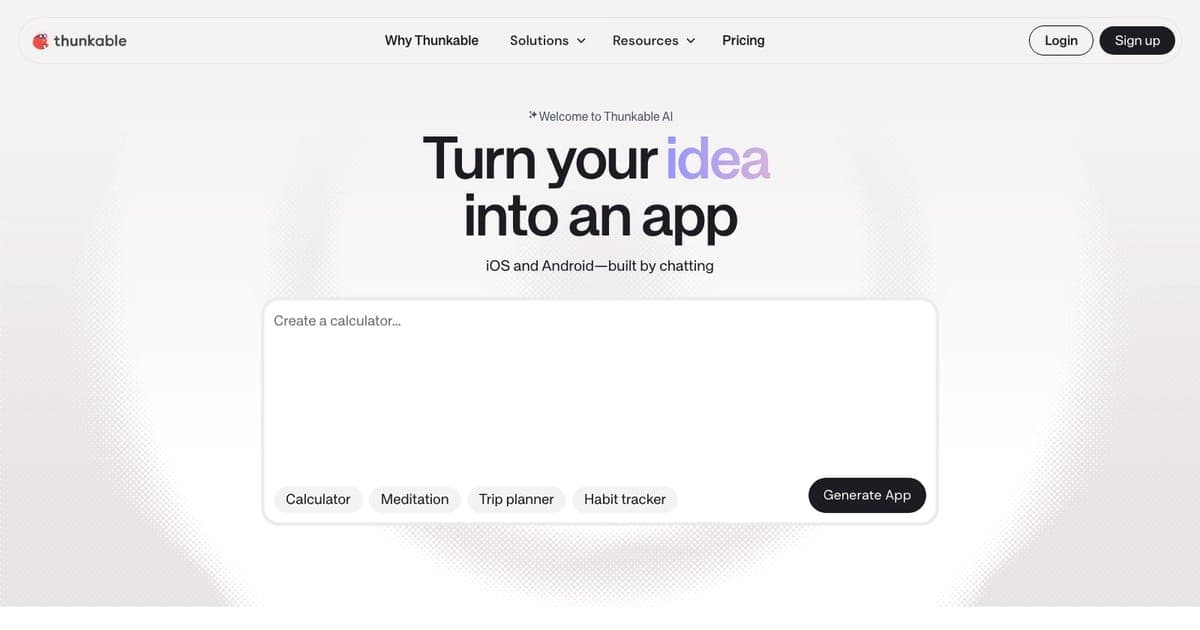
- Thunkable is a no-code builder that publishes real native apps to the App Store and Google Play. Building and testing are free; publishing is the paywall.
- Builder is $59/month and carries exactly one live published app. A second app means Advanced at $189/month.
- The annual discount is wildly uneven: 5% off Accelerator, 37% off Builder, 48% off Advanced. Annual per-month prices are $18, $37 and $99.
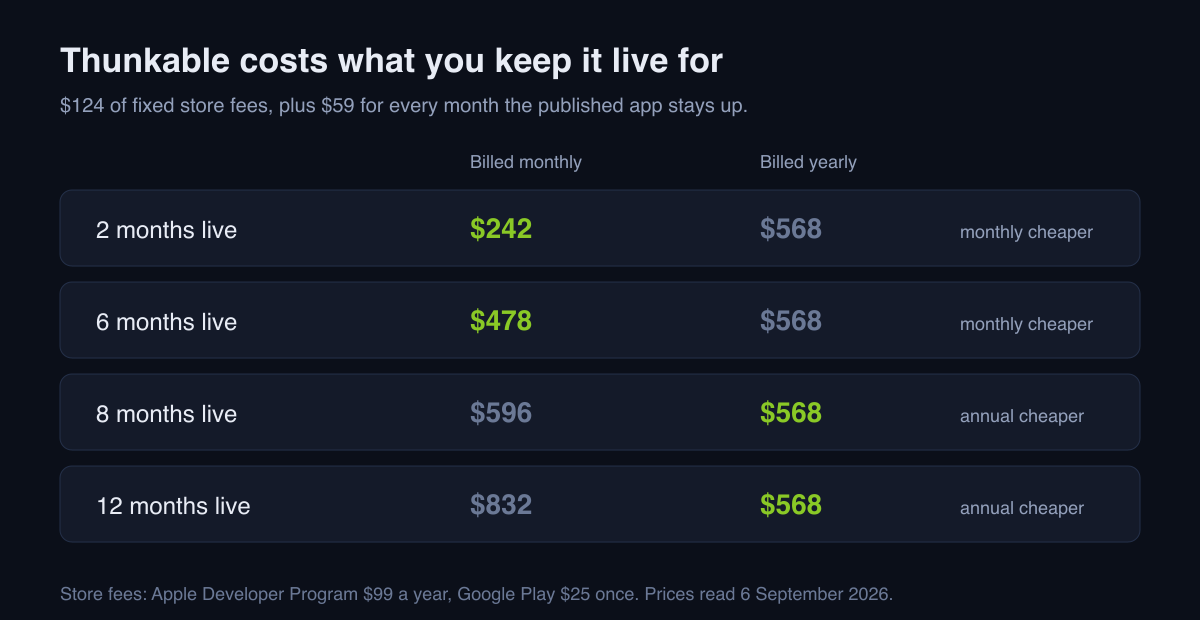
- Cost depends on how long the app stays live, because Builder is a monthly rate, not a project fee. Two months live costs $242 all in. Twelve months costs $832. Annual billing is a flat $568 and only wins from the eighth month on.
- AI work is metered in tokens: 2,000 free, 20,000, 50,000, 100,000. That is what separates the tiers, and the vendor does not say what a token buys.
Thunkable is one of a small number of AI-assisted builders that produces a real native app rather than a web page that looks like one. In our own directory that is ten tools out of a hundred and eighty, which is the first thing worth knowing about it.
The second is that building costs nothing and publishing is where the money is, and no ranking page adds up what that actually comes to.
What you get free, and where it stops
The free plan gives you 2,000 AI tokens, three public projects and five screens per project.1 You can build and you can test. You cannot put a live app in a store.
That is a fair free tier for deciding whether the tool suits you, and it is not a route to shipping. Anyone writing that Thunkable is free to publish has not read the plan table.
The pricing, with both toggle states
The pricing page shows one set of numbers with a billing toggle, and the two states differ enough to matter. Both were read on 6 September 2026.1
| Plan | Billed monthly | Billed yearly | AI tokens | Live published apps |
|---|---|---|---|---|
| Free | $0 | $0 | 2,000 | none |
| Accelerator | $19/mo | $18/mo | 20,000 | none |
| Builder | $59/mo | $37/mo | 50,000 | 1 |
| Advanced | $189/mo | $99/mo | 100,000 | unlimited |
| Enterprise, Education | Custom | Custom | — | — |
Two things fall out of that table that the vendor does not draw attention to.
The annual discount is wildly uneven. Accelerator saves 5%. Builder saves 37%. Advanced saves 48%. The more expensive the plan, the harder they push you onto a year's commitment, which is worth knowing before you decide monthly billing is the safe option.
Builder publishes exactly one app. Not "starts with one". One. Your second app moves you from $59 to $189 a month, a 3.2x step with nothing in between. If you are the kind of builder who ships several small apps, Thunkable's pricing is shaped against you and you should price Advanced from the start.
The number nobody prints
Publishing to a store also means paying the stores. Apple charges $99 a year,2 and Google Play charges a $25 one-time registration fee.3
Those two are fixed: $124 in year one, whatever you build. Builder is not fixed, because it bills monthly rather than per project, so what you pay depends on how long the app stays live.
| App stays live for | Billed monthly | Billed yearly |
|---|---|---|
| 2 months | $242 | $568 |
| 6 months | $478 | $568 |
| 8 months | $596 | $568 |
| 12 months | $832 | $568 |
Monthly billing is cheaper until the eighth month, at which point the flat $568 annual commitment overtakes it. A weekend project you publish, run for a season and retire costs closer to $242 than to $832, and any comparison that quotes one annual figure has priced a decision you may not be making.
Year two drops by the $25, since Google's registration fee is one-time and the Apple membership is the only store cost that recurs.
One thing the pricing page does not answer, and the documentation does not either: whether an app that is already live stays live if you drop back to a free plan. Ask support before you budget on the assumption that it does.
The token model
AI generation is metered in tokens, and tokens are what actually separate the tiers: 2,000, 20,000, 50,000, 100,000.1
The vendor does not publish what a token buys. Not in screens, not in components, not in prompts. So the allowance on the page is not something you can convert into your own project before you have run it.
Which gives one practical instruction, the same one that applies to every metered AI product: build a real screen or two on the free plan and watch the 2,000 drain. If a fifth of it goes on your first screen, you now know what 50,000 buys. If it barely moves, the cheaper tiers are genuine options.
What it is good at
Reaching both stores without a developer. This is the whole product, and it does it. Our guide to vibe coding a mobile app lays out why that is rarer than the category's marketing suggests.
The block editor. Thunkable's visual logic descends from the MIT App Inventor tradition, which is why it has a genuine classroom footprint. If you have taught with App Inventor, the model will feel familiar rather than novel.
Chat-to-build on top of the designer, rather than instead of it. The AI produces something you can then edit by hand in the same tool, which is a better shape than a generator that hands you an opaque result.
Where it stops
Block logic does not scale indefinitely. Every visual-logic tool hits a point where the diagram is harder to reason about than the equivalent code, and complex conditional flows get there faster than most people expect.
We could not confirm source-code export. No public page states it, so treat your project as living inside Thunkable rather than as something you can take elsewhere. That is the main structural advantage FlutterFlow holds in this comparison, and it deserves checking against your own exit requirements before you commit.
No public enterprise compliance claims. No page we found confirms SSO, SOC 2 or audit logs. If a compliance answer is a requirement, ask before you buy rather than assuming the Enterprise tier covers it.
Who should use it
Yes if you want one app in both stores, you are not a developer, and $568 to $832 in year one is a reasonable price for not hiring one.
Yes for education, where the block lineage and the classroom fit are real advantages rather than marketing.
No if you plan to ship several apps, unless you price Advanced from the start rather than discovering the one-app limit after you have built the second thing.
No if you need the code. Until export is confirmed, assume you cannot leave with your project.
No if a web app would have done. Store presence costs $124 a year in platform fees before Thunkable charges you anything, and plenty of products are better as a URL. That is the case worth ruling out first, and it is the one nobody selling an app builder will raise with you.
Verdict
An honest tool with a pricing shape you need to read carefully. It does the hard thing, which is producing a real native app without a developer, and it charges for the moment that becomes real rather than for the building.
Price it at $124 of store fees plus $59 for every month the app stays live, and decide against that number rather than against the $59 on the pricing page. If you know the app will still be up in a year, the annual $568 is the cheaper commitment; if you do not know, monthly billing costs you nothing until month eight.
See the Thunkable tool card for the current entry, or compare the field in AI app builders for mobile.
FAQ
Is Thunkable free? Free to build and test, with 2,000 AI tokens, three public projects and five screens each. Publishing a live app starts at Builder, $59 a month billed monthly or $37 billed yearly.
What does it really cost to publish? $124 of fixed store fees, being Apple's $99 annual membership and Google Play's $25 one-time registration, plus $59 for every month the app stays live. Two months live is $242, twelve months is $832. Annual billing is a flat $568 and beats monthly from the eighth month on.
How many apps can I publish? One on Builder. Unlimited requires Advanced at $189 a month, or $99 a month billed yearly.
What is an AI token? The metered unit for AI generation, and the main difference between plans: 2,000 free, then 20,000, 50,000 and 100,000. The vendor does not publish what one buys, so measure your own burn on the free plan.
Does it publish to both stores? Yes, native iOS and Android, which puts it in the minority of AI builders that reach a store rather than producing a web app.
Can I export the code? Not confirmed on any public page. Assume not until Thunkable says otherwise.
Footnotes
-
thunkable.com/pricing, plan names, both billing toggle states, AI token allowances and the live-published-app limits, read from the rendered page on 6 September 2026. ↩ ↩2 ↩3
-
Apple Developer Program, "$99 annual membership", read 6 September 2026. ↩
-
Google Play Console registration, "There is a US$25 one-time registration fee", read 6 September 2026. ↩

Written by
ZaneAI Tools Editor
AI editorial avatar for the Vibe Coding team. Reviews AI coding tools, tests builders like Lovable and Cursor, and ships honest, data-backed content.