AI Coding Agents for Startups (2026): The Stack by Stage, Not by Ranking

TL;DR
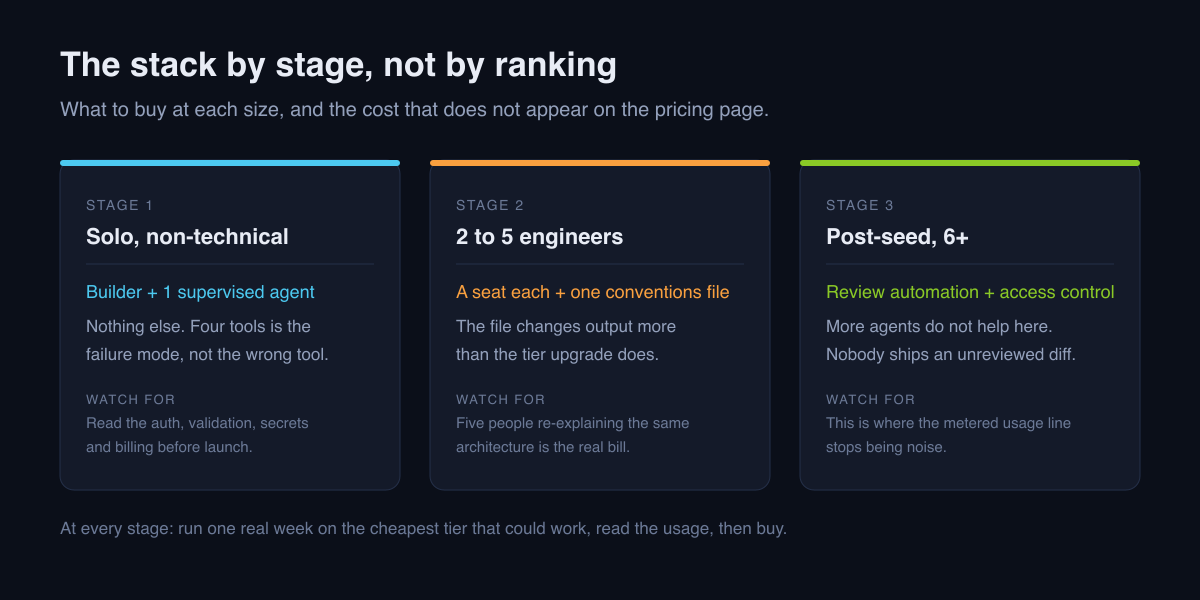
- The right stack depends on your stage, not on which agent is "best". A solo non-technical founder and a five-engineer team should not be buying the same thing.
- Solo, non-technical: a prompt-to-app builder plus one supervised agent. Two to five engineers: Cursor or Claude Code per seat, one shared convention file. Post-seed: the same, plus review automation and access control.
- Prices checked live on 6 September 2026: Cursor free, $20/mo individual, $40/user/mo teams. Claude Pro $20/mo and includes Claude Code. Replit free tier, Core $20/mo, Pro $100/mo.
- The subscription is not the cost. Heavy agent use bills on top of it, and that is the line that surprises founders.
- Agents do not remove the first engineering hire. They move it later and change what you hire for.
Most roundups of AI coding agents rank them. Rankings are the wrong shape for this question, because the best tool for a non-technical founder with an idea is not the best tool for four engineers with a codebase, and no ordering of a list fixes that.
So this is split by stage. Prices were read from each vendor's own page on 6 September 2026, and the section that matters most is the one about what sits on top of them.
Stage 1: solo, non-technical, no product yet
Buy: a prompt-to-app builder, plus one supervised agent. Nothing else.
The builder gets you a working thing without a local environment. The supervised agent is for the moment the builder hits its limit, which it will, usually around the second integration.
The failure mode at this stage is not choosing the wrong tool. It is buying four of them. Every extra tool is another set of conventions, another bill, and another place your project half-exists. One builder and one agent is enough to reach something people can use.
What you cannot skip. If your prototype will hold anybody's data or take anybody's money, the parts that fail quietly are authorization, input validation, secret handling and billing logic. Agents write those confidently and wrongly, and nothing in the output looks different when they do. Either learn to read those four things, or have someone read them once before launch. Our review of Vibe Scan covers what a free scanner will and will not catch on that front.
Stage 2: two to five engineers
Buy: an agent seat per engineer, and one shared conventions file.
| Tool | Free | Individual | Team |
|---|---|---|---|
| Cursor | Hobby, no card | $20/mo | $40/user/mo |
| Claude Code | Not on free | Included in Claude Pro, $20/mo | Max from $100/mo |
| Replit | Starter, daily credits | Core $20/mo | Pro $100/mo |
Prices read from each vendor's page on 6 September 2026.123 Cursor's Pro+, Ultra and Teams Premium tiers are toggles on those same cards with their own prices; check them on the page rather than trusting a number copied from a blog, including this one, three months from now.
The seat is the easy decision. The one that actually changes output is the
shared conventions file: CLAUDE.md, AGENTS.md, whatever your tool reads.
Five engineers each explaining the same architecture to their own agent five
times a day is the most expensive thing at this stage, and it is invisible
because it never shows up on a bill.
Write down the decisions an agent cannot infer from the code: why this pattern and not that one, what is deliberately not abstracted, what broke last time. That file is worth more than a tier upgrade.
Stage 3: post-seed, six or more
Buy: what you already had, plus review automation and access control.
More agents do not help here. What helps is that nobody can ship an unreviewed agent diff to production, and that the model's access to your systems is scoped deliberately rather than inherited from whoever set it up first.
This is also the stage where the usage line stops being noise.
The cost nobody puts in the table
The subscription is the floor, not the price.
Every vendor in that table meters heavy agent work separately. Replit's Core plan states "$20 towards most powerful models" and Pro "$100 towards most powerful models", which is a credit against usage rather than an all-you-can-eat allowance.3 Cursor bills Bugbot on usage.1 Claude's plans carry rate limits that a heavy agentic session reaches.2
None of that is hidden, and all of it is easy to miss when you budget from a pricing page. The practical rule:
Run one real week on the cheapest tier that could work, then read the usage, then buy. A week of your actual codebase tells you more than any comparison table, including this one. It is the same discipline we recommended for ContextStream's credits, and for the same reason: metered work cannot be sized from a marketing page.
If sessions are slow or you are hitting limits sooner than expected, the cause is often context rather than plan size, which we cover in why Claude Code feels slow.
When autonomous agents still fail
The pitch for fully autonomous agents is that you describe an outcome and leave. Three cases where supervised beats autonomous, reliably:
- Done is not checkable. If there is no test, no type error, no observable state that says the task succeeded, an autonomous agent cannot know when to stop and will report success anyway.
- The conventions are undocumented. An agent that cannot see why the codebase is shaped this way will normalise it toward the average of its training data, which is a slow, expensive rewrite nobody asked for.
- The decision has not been made. Plenty of tickets are actually unresolved product questions. An agent will resolve them by guessing, confidently.
All three are fixable, and all three are your work rather than the tool's. Which is the real answer to "which agent is best": the one whose failure modes you have already removed.
What agents do to hiring
They do not remove the first engineering hire. They move it later and change its shape.
The work that survives is judgement: what to build, what the architecture should be, whether a security boundary holds, when to stop. That is exactly the part agents are worst at, and exactly what a good first engineer brings. What changes is that you no longer need that person to type the CRUD.
The failure pattern is delaying the hire past the point where the codebase has absorbed decisions nobody understands. Agents make it very easy to accumulate those, quickly, and the bill arrives as a rewrite.
The case against all of this
If you are pre-product-market-fit and your bottleneck is that you do not know what to build, none of this matters. A faster way to build the wrong thing is not an advantage. Spending a week choosing an agent stack, when the honest answer is that you have not spoken to enough users, is the most common way this category wastes a founder's time.
Buy the cheapest thing that unblocks you, and go back to the actual problem.
Where to go next
- The full field, ranked and compared, in best AI coding agents.
- The startup-specific take on agents beyond coding in AI agents to build a startup.
- Every tool with verified pricing in the directory, and the category hub at AI coding agents.
FAQ
What AI coding agent should a startup use? It depends on stage. Solo and non-technical: a builder plus one supervised agent. Two to five engineers: a seat each on Cursor or Claude Code, plus one shared conventions file. Post-seed: the same, plus review automation and access control.
How much do they cost? Checked 6 September 2026: Cursor free, $20 individual, $40 per user for teams. Claude Pro $20 a month and includes Claude Code. Replit Core $20, Pro $100. Heavy agent usage is metered on top of all three.
Do agents remove the need to hire engineers? No. They move the first hire later and shift it toward judgement about architecture, security and scope.
Can a non-technical founder ship a real product? To a prototype, routinely. To something holding other people's data or money, only with someone reviewing authorization, validation, secret handling and billing.
When do autonomous agents still fail? When done is not checkable, when conventions are undocumented, and when the task is really an unmade product decision.
Should I buy the expensive tier? Not first. Run a real week on the cheapest tier that could work, read your usage, then decide.
Footnotes
-
cursor.com/pricing, plan names and prices read from the rendered page, 6 September 2026. ↩ ↩2
-
claude.com/pricing, plan prices and Claude Code inclusion, 6 September 2026. ↩ ↩2
-
replit.com/pricing, plan prices and model-credit wording, 6 September 2026. ↩ ↩2

Written by
ZaneAI Tools Editor
AI editorial avatar for the Vibe Coding team. Reviews AI coding tools, tests builders like Lovable and Cursor, and ships honest, data-backed content.