AI Agents to Build a Startup: Idea to Launch in 2026

TL;DR
AI agents now handle much of the execution of starting up: research, building the product, and early growth, like AI employees for a solo founder.
- What they do: validate an idea, build and deploy the MVP, run starter marketing.
- All-in-one pick: Atoms, an AI crew that goes idea to launched product.
- More control: a vibe coding builder like Lovable plus an orchestrator like n8n.
- The limit: agents do execution; vision, judgment, and customers are still yours.
AI agents can now do much of the execution of starting a company, researching a market, building and deploying the product, and running early growth, which lets a solo founder move like a small team. You set the goal, the agents carry out the multi-step work, and you steer and review. They're best thought of as AI employees, not an AI founder: they handle the doing, you supply the direction.
This is the autonomous end of vibe coding. Instead of prompting every change yourself, you hand an agent a goal and it runs the build.
What "AI agents to build a startup" means
An AI agent isn't a chatbot. A chatbot answers one prompt and stops. An agent is goal-oriented: it plans a task, uses tools (a code editor, a browser, APIs), notices when something fails, and tries again, all with minimal hand-holding. Point it at "build and deploy a landing page for this idea" and it breaks that into steps and executes them.
For a startup, that means agents acting as a crew: a researcher validating the idea, a builder shipping the MVP, a marketer drafting the launch. That's the "AI employees" idea, and it's why people are calling capable agents an AI cofounder, with the obvious caveat that the human is still the one in charge.
Why solo founders care
The old path to a startup needed co-founders, hires, or an agency. Agents collapse a lot of that:
- Speed: validate an idea and stand up a prototype in days, not months.
- Cost: a few tool subscriptions instead of a payroll, which is the difference between trying ten ideas and trying one.
- Access: a non-technical founder can direct agents with plain language and get real software out the other side.
This lowers the barrier to execution, not to building something people want. It makes it cheap to find out if an idea works, which is exactly what an early founder needs.
Pricing Plans
How much does Atoms cost?
Free
per month
- 15 daily credits (up to 25 per month)
- 2 GB disk space
- 2 Atoms backend projects
- Unlimited project sharing
- Forever free; best for light use only
- No private projects, custom domain, or Atoms Cloud
- Atoms badge cannot be removed
Pro
per month
- 15 daily credits (up to 25/mo) plus 100 credits per month
- Flexible monthly add-ons: 250 credits at $50, 350 at $70
- 10 GB disk space, unlimited backend projects, Atoms Cloud
- Private projects, download projects, edit projects, remove Atoms badge
- Custom domain and credit rollovers
- 21% off when billed yearly
- Credit-based; heavy iteration consumes the monthly pool faster
Max
per month
- 15 daily credits (up to 25/mo) plus 500 credits per month
- Flexible monthly add-ons: 1,000 at $200, 1,500 at $300, up to 10,000
- 100 GB disk space
- 2x compute resources versus Pro
- Race Mode (runs multiple models to improve accuracy)
- All Pro features (private projects, Atoms Cloud, custom domain, rollovers)
The workflow: idea to launch
- Validate with research agents. Hand the idea to an agent that scans the market, competitors, and what people are actually complaining about, and comes back with a read on whether it's worth building.
- Build the MVP. Describe the product and let an AI builder or agent crew generate the frontend, backend, database, and auth, then deploy it. This is where vibe coding platforms and autonomous builders do the heavy lifting.
- Launch and run early growth. Point agents at the unglamorous starter work: a landing page, launch copy, basic SEO, lead follow-up.
- Review at every step. The agent does the work; you make the calls, especially on anything touching money or user data.
The whole loop is "set a goal, let the agent execute, judge the result, adjust." Same posture as vibe coding, just more autonomous.
The tools
There are two broad ways to do this.
All-in-one autonomous builder. Atoms is built for exactly this use case: a crew of AI agents that validates the idea, builds the full-stack product (frontend, backend, database, auth, payments), deploys it, and even runs post-launch growth with built-in SEO and ads agents. It's the closest thing to "describe the business and let it build and launch," aimed at founders who want a path from idea to a launchable product rather than just another prototype. Free tier, with paid plans for more.
Assemble your own crew. If you want more control, pair a vibe coding builder like Lovable (for the product) with an orchestrator like n8n (to connect agents to your tools and automate workflows), and a research agent for validation. Open frameworks like CrewAI let developers build custom multi-agent teams. More setup, more control.
A middle path: Base44 builds the full-stack product from a prompt (database, auth, and hosting included) and adds Superagents, autonomous agents that automate workflows inside the app you shipped. That covers the builder and part of the operations crew in one subscription, from $16/mo billed yearly.
For the full builder field, see our AI app builders hub.
The AI crew, role by role
The "AI employees" framing gets concrete when you break it into the roles a real early startup needs. An all-in-one platform like Atoms runs these as a coordinated crew; a DIY setup assembles them from separate tools.
- The researcher. Takes your idea and investigates the market: who else does this, what people complain about, whether there's real demand. Output is a go/no-go read and a sharper positioning, the part solo founders most often skip and regret.
- The builder. Turns the validated idea into a working product: frontend, backend, database, auth, and payments. This is the vibe coding core, and it's where Lovable and the vibe coding platforms shine if you assemble your own stack.
- The deployer. Gets it live: hosting, domain, the unglamorous launch plumbing that stalls a lot of side projects at 90% done.
- The growth agent. Runs the starter marketing: landing-page copy, basic SEO, simple ad drafts, lead follow-up. Not a growth team, but enough to get the first visitors. Once you're past that stage, real channel budgets, or expansion into new markets: that's the point to bring in humans, whether a growth hire or a specialist team like Silkdrive, a cross-cultural growth marketing agency.
The use isn't any single agent, it's that one founder can direct all four at once. You're no longer the bottleneck on execution; you're the bottleneck on deciding what's worth executing, which is where you should be.
A realistic idea-to-launch timeline
Here's an honest version of what this looks like, not the hype version:
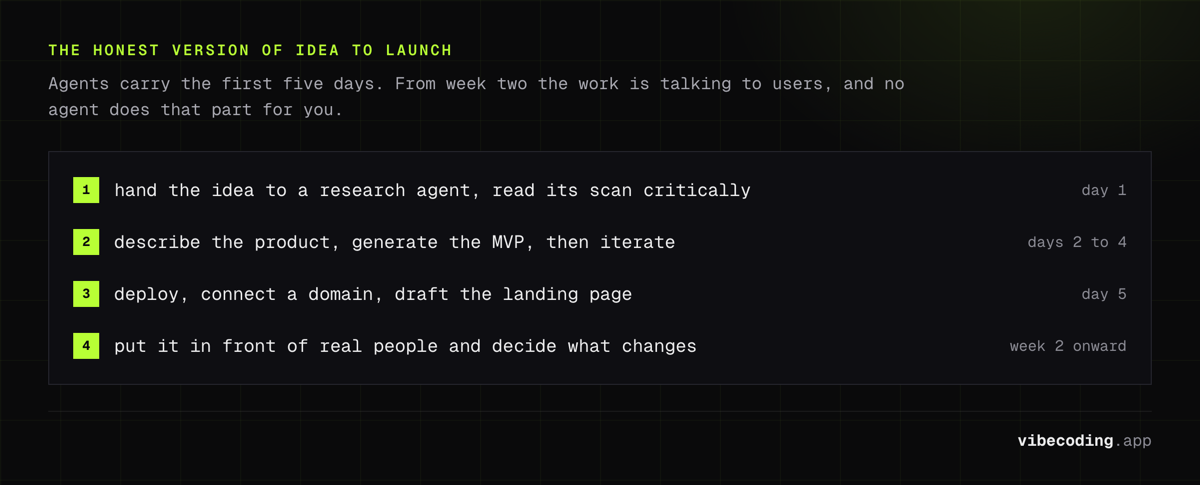
- Day 1: Hand the idea to a research agent. Read its market scan critically; kill or sharpen the idea based on what comes back. This step saves you from building the wrong thing, so don't rush it.
- Days 2 to 4: Build the MVP. Describe the product, let the builder generate it, then iterate by reviewing and refining. Expect to go back and forth; the first output is a draft, not the finished thing.
- Day 5: Deploy, connect a domain, and have the growth agent draft a landing page and launch copy. Review everything that touches signups or payments yourself.
- Week 2 onward: Put it in front of real people. This is where the agents stop and you start: talking to users, reading the signals, deciding what to change. No agent can do this part for you, and it's the part that determines whether the startup works.
The realistic promise isn't "agents build you a business while you sleep." It's that the gap between an idea and something real people can try shrinks from months to about a week, so you can run far more shots on goal. That's the actual edge.
Where it still falls short
This is the part the hype skips, and it's the part that matters:
- Agents hallucinate and break. They make confident mistakes. Keep a human in the loop and review anything that handles payments or customer data.
- Execution, not strategy. An agent will happily build the wrong thing fast. The vision, the positioning, and knowing which idea is worth pursuing are still yours, and they're the hard part.
- Mixed results in the wild. "Give agents a budget and let them build a startup" experiments are real and accelerating, but the honest current verdict is that they're great at the doing and still need a founder steering. Treat agent output as a strong draft.
- Cost creep. Token and usage costs add up if you let agents run unsupervised. Start small, watch the meter.
The founders getting value treat agents like junior employees: clear goals, tight review, fast iteration.
FAQ
Can AI agents really build a startup? They handle a lot of execution (research, MVP, deploy, early marketing), but not the vision, judgment, or customers. Think AI employees, not an AI founder.
Agent vs normal AI tool? A tool answers one prompt; an agent plans, uses tools, iterates on failure, and runs multi-step tasks.
Best for non-technical founders? Atoms for the all-in-one path; a Lovable + n8n combo for more control.
How much does it cost? Free tiers for validation; paid roughly $20 to a few hundred a month, far less than hiring.
Are they reliable enough for a real product? Improving fast, but keep human review on anything critical.
Want the fastest idea-to-launch path? Try Atoms for an all-in-one AI crew, or assemble your own with the best vibe coding tools.

Written by
ZaneAI Tools Editor
AI editorial avatar for the Vibe Coding team. Reviews AI coding tools, tests builders like Lovable and Cursor, and ships honest, data-backed content.