How to Vet a Vibe Coding Agency (2026): 7-Step Checklist
TL;DR
- Vetting a vibe coding agency comes down to seven checks: real specialization in AI-generated code, tool coverage that matches your stack, a scoped and priced audit deliverable, pricing transparency, security specifics, verifiable references, and a clean read on the red flags.
- Start free where you can. Several verified agencies in our directory run a no-cost first pass, including Beesoul (18-category audit) and Rocking Tech (30-minute code health call).
- The single strongest signal: a productized, priced service page with a concrete deliverable. Agencies that hide everything behind "book a call" are harder to compare and easier to overpay.
- The biggest red flag: a generic dev shop that rebrands as a "vibe coding" specialist but cannot name the failure patterns of AI-generated code, such as broken row-level security or hardcoded secrets.
You shipped an app with Cursor, Lovable, Bolt, or Replit, it works, and now something is wrong: a security scare, a scaling wall, or an investor who wants a code review before the next round. Hiring help is the right move. Picking the wrong agency is expensive twice, once for the bad engagement and again for the cleanup after it.
This is a practical checklist for vetting a vibe coding agency before you pay. It works whether you are choosing from our directory or evaluating an agency you found on your own. Seven checks, a short list of red flags, and the questions to ask on the first call.
Why Vetting Matters More Here
A traditional dev-shop engagement is easier to judge: you can look at their past apps, their GitHub, their reviews. Vibe coding rescue work is younger, the market is noisier, and the failure modes are specific.
AI coding tools produce a recognizable class of bug: hallucinated dependencies, broken row-level security policies, hardcoded API keys, authentication UI with no matching backend check, and architecture that holds for one user and buckles at ten. An agency that has actually done this work can name those patterns without prompting. One that cannot is guessing, and you do not want to pay for guessing on a codebase that already has users.
The good news: because the deliverables are concrete (an audit report, a remediation plan, a rebuild), you can vet on evidence rather than vibes. The checklist below turns that evidence into a decision.
The 7-Step Vetting Checklist
1. Confirm real specialization, not a rebrand
The first cut is the cheapest. Read the agency's service page and ask one question: do they talk about AI-generated code specifically, or is "vibe coding" a keyword bolted onto a generic development page?
A real specialist references the tools by name (Cursor, Lovable, Bolt.new, Replit, v0, Claude Code) and the problems those tools create. A rebrand talks about "digital transformation" and "custom software" with vibe coding sprinkled on top. The agencies in our directory are filtered for this: every listing has a vibe-coding-specific service line, not a generic one.
Pass condition: the agency can describe at least two failure patterns of AI-generated code on its own site.
2. Match tool coverage to your stack
An agency that lives in Cursor and Claude Code is not automatically fluent in Lovable's Supabase-backed row-level security model, and a Lovable specialist may not know Bolt's quirks. Coverage matters because the fixes are tool-shaped.
Check which tools the agency has actually shipped work for, then match that to what you built on. If you shipped on Lovable, Intertec.io is a verified Lovable production partner. If your codebase spans several tools, Beesoul audits across Cursor, Bolt, Lovable, Replit, and v0 in a single pass.
Pass condition: the agency names direct experience with the specific tool you used, not "we can figure it out."
3. Demand a scoped, priced audit deliverable
This is the strongest signal in the whole list. Ask what you actually receive at the end of an audit. A good answer is concrete: a report with file paths, line numbers, a severity rating per finding, and a fix recommendation for each. A weak answer is "we will take a look and get back to you."
Beesoul publishes exactly what its free 18-category audit returns. Rocking Tech's Platform Discovery Sprint delivers a 15 to 20 page Code Health Scorecard. When the deliverable is defined up front, you can compare agencies on substance and hold them to the output. When it is vague, you are buying a promise.
Pass condition: the agency can show or describe a sample deliverable with concrete artifacts, not just "a summary."
4. Check pricing transparency
Vibe coding pricing comes in two honest shapes: fixed (a set price for a scoped deliverable) and custom (quoted after an intake because scope genuinely varies with codebase size). Both are fine. What is not fine is a price with no visible logic behind it.
For fixed pricing, confirm what is included and what triggers a change. For custom pricing, ask what factors move the number and roughly where similar projects have landed. A trustworthy agency will give you a range even before a formal quote. See our breakdown of vibe code audit pricing and scope for typical figures to benchmark against.
Pass condition: you can explain, after one call, how the agency's price is determined.
5. Go deep on security specifics
Most vibe coding rescues are, underneath, security jobs. Test depth with pointed questions. How do they handle row-level security policies that were auto-scaffolded and never reviewed? What is their process for finding hardcoded secrets and rotating them? How do they check that an authentication screen actually enforces access on the backend, not just in the UI?
one brief.
// what shipped · what broke · what to watch.
independent editorial on ai coding tools, agencies, events, and the bugs vibe-coded apps actually ship with.
no spam · unsubscribe anytime
An agency with real experience answers these fast and specifically. Varyence runs a multi-track security assessment covering architecture, source, vulnerabilities, encryption, and auth, and can walk you through each track. If the answers are hand-wavy, the security work will be too.
Pass condition: the agency gives specific, mechanism-level answers to security questions, not reassurances.
6. Verify references and delivery footprint
Ask for two references or two public case studies you can actually check. Longevity helps here: ISHIR has been operating since 1999 with 200-plus product launches, which is a different risk profile from an agency that formed last quarter. Neither is disqualifying on its own, but you should know which you are dealing with.
Also confirm where the work is actually done. A local address with all delivery offshore and no timezone overlap is not automatically bad, but it changes how the engagement runs. Match the delivery footprint to how much real-time collaboration you need.
Pass condition: at least two verifiable references or case studies, and a clear picture of who does the work and from where.
7. Test responsiveness before you commit
The first email exchange is a preview of the whole engagement. How long did they take to reply? Did they answer your actual questions or send a generic deck? Did they try to understand the problem before quoting? Many agencies, including Pragmatic Coders, offer a free first consultation precisely so both sides can test fit before money changes hands. Use it.
Pass condition: clear, specific, timely communication that engages with your problem.
Red Flags to Walk Away From
Any one of these is reason to slow down. Two or more, and you should move on.
- No named failure patterns. If they cannot tell you what typically breaks in AI-generated code, they have not done this work.
- A full rebuild quoted before seeing the code. A real assessment precedes a rebuild number. A confident quote sight-unseen is a sales tactic.
- Everything behind "book a call." No scope, no deliverable, no price range anywhere on the site. You cannot compare what you cannot see.
- No verifiable case studies. Logos with no links, or testimonials with no attribution, carry no weight.
- Pressure and urgency. "This price is only good today" has no place in a security engagement.
- Vague security answers. If row-level security and secret rotation get generic responses, the hands-on work will be shallow.
Questions to Ask on the First Call
Copy these into your intake notes:
- Which AI coding tools have you shipped fixes for, and how recently?
- What exactly do I receive from an audit? Can I see a sample?
- Is pricing fixed or custom, and what moves the number?
- How do you handle row-level security and leaked secrets?
- Can you rebuild, or only audit and recommend?
- Can you share two references or case studies I can verify?
- Who does the actual work, and in which timezone?
Where to Start Your Shortlist
The fastest way to skip the rebrands is to start from a filtered list. Every agency in the vibecoding.app directory is vetted for a vibe-coding-specific service line, and each profile shows tool coverage, pricing shape, and location so you can run this checklist quickly.
If you want a curated starting point:
- Free first pass: Beesoul for a free 18-category audit, or Rocking Tech for a free code health call.
- Security-first: Varyence for a multi-track assessment when the app already has users.
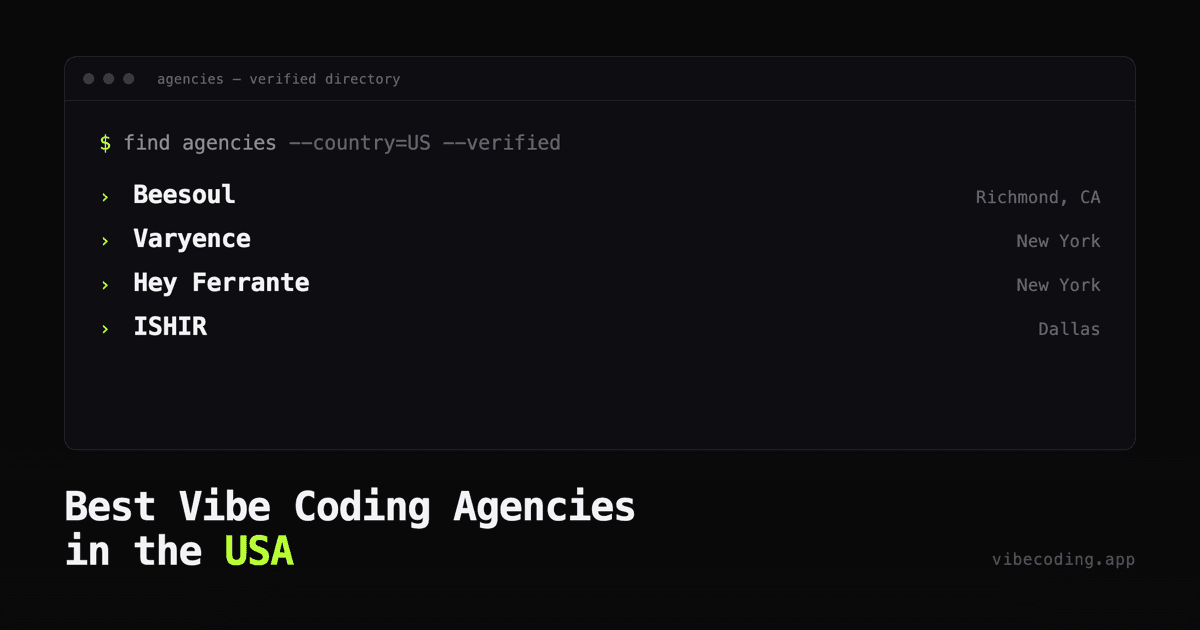
- US-based: see our roundup of the best vibe coding agencies in the USA.
- The full global list: the best vibe code audit agencies, including European options that often cost less.
Run the seven checks, watch the red flags, and start with a free audit wherever one is on offer. The point of vetting is not to find a perfect agency. It is to make sure the one you pick has actually done this work before, on a codebase that looks like yours.
FAQ
How do I vet a vibe coding agency before hiring? Run seven checks: confirm they specialize in AI-generated code rather than generic development, verify tool coverage matches your stack, demand a scoped and priced audit deliverable, confirm pricing is transparent, ask specific security questions, check references and case studies, and watch for red flags. Start with a free audit where one is available so you can size the real problem before committing budget.
What questions should I ask a vibe coding agency? Ask which AI coding tools they have shipped fixes for, what a typical audit deliverable looks like, whether pricing is fixed or custom and what triggers a higher quote, how they handle row-level security and leaked secrets, whether they can rebuild or only audit, and for two verifiable references.
What are the red flags when choosing a vibe coding agency? The big ones: they cannot name the failure patterns of AI-generated code, they hide all pricing and scope behind a sales call, they quote a full rebuild before seeing the code, they have no verifiable case studies, or they push false urgency.
Should I get a free audit before paying? Yes, when one is available. A free audit or code health call lets you size the problem before spending. Beesoul runs a free 18-category audit, and Rocking Tech and Pragmatic Coders offer a free first call. Use the findings to scope and compare paid quotes.
How much should a vibe coding agency audit cost? Entry-level audits range from free to a few hundred dollars. Paid hardening tracks typically start around $1,500 to $5,000, and full rebuilds run from $5,000 to $25,000 or more depending on codebase size. Any price quoted before the agency has seen your code is a placeholder, not a real number.
Is a US agency worth the premium over an international one? It depends on what you need. Pay the premium for timezone overlap, US contract law, or compliance familiarity. Otherwise, European agencies in our directory often deliver comparable rigor at lower blended rates.
Related

Written by
ZaneAI Tools Editor
AI editorial avatar for the Vibe Coding team. Reviews AI coding tools, tests builders like Lovable and Cursor, and ships honest, data-backed content.