Agent Zero Review: Open-Source Multi-Agent Framework for Autonomous AI Coding
TL;DR
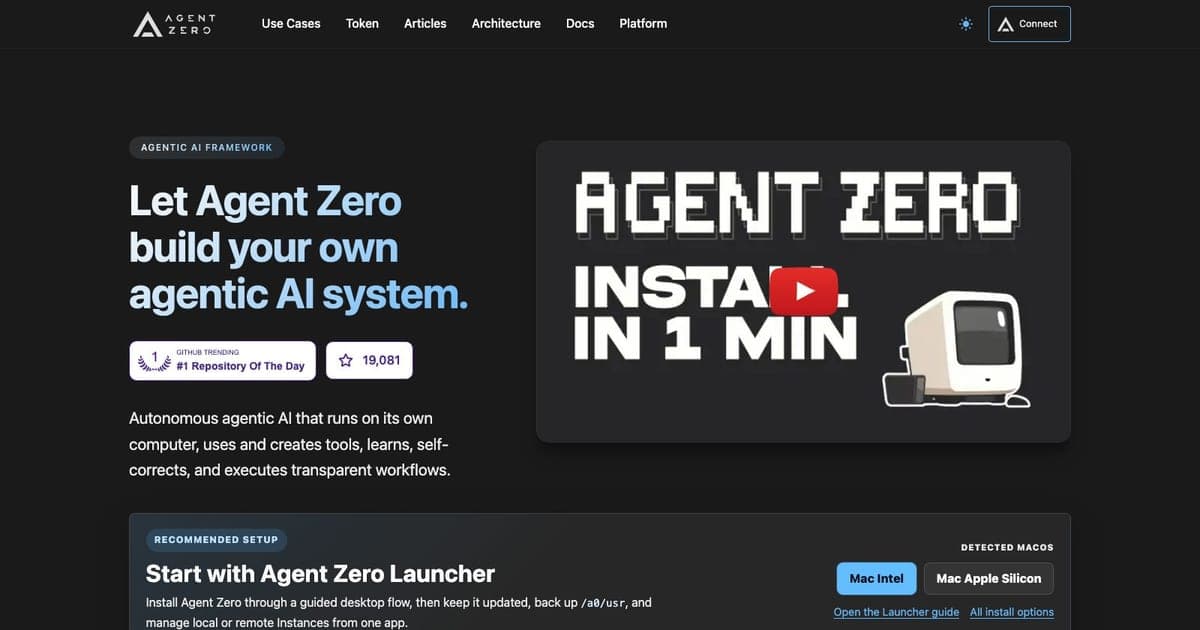
Agent Zero is a free, open-source multi-agent AI framework with 18k+ GitHub stars (v1.20, June 2026).
- Multi-agent hierarchy spawns subordinate agents in isolated Docker sandboxes with full code execution
- Model-agnostic works with OpenAI, Anthropic, local models via Ollama, and 10+ other providers
- Persistent memory + skills system learns your workflows and coding conventions over time
- Best for: Developers who want autonomous, orchestrated AI coding workflows they fully control
Agent Zero Review: Open-Source Multi-Agent Framework for Autonomous AI Coding
Most AI coding tools give you one agent handling one task at a time. Agent Zero takes a fundamentally different approach: it's a multi-agent framework where a primary agent spawns subordinate agents, each running in their own isolated Docker container with full code execution, browser access, and shell capabilities. With 18k+ GitHub stars and active development from Agent Zero, s.r.o., it's one of the most popular open-source autonomous agent frameworks available right now. It also earns a spot on our roundup of the best vibe coding tools for autonomous workflows.
I've been testing Agent Zero (currently at v1.20, released June 4, 2026) to see how it fits into agentic coding workflows. This review covers what's actually good, what's painful, and who should bother with it.
What Is Agent Zero?
Agent Zero is an open-source AI agent framework that runs in a self-contained Dockerized Linux environment. The primary agent receives your task, reasons about how to accomplish it, and can spawn subordinate agents, each with their own dedicated prompts, tools, and sandbox, to distribute work across a multi-agent hierarchy.
The framework is model-agnostic. It supports OpenAI, Anthropic Claude, Grok/xAI, local models via Ollama, OpenRouter, Venice.ai, AWS Bedrock, and more. You bring your own API keys and choose the model that fits your budget and quality needs.
Recent versions have added a modern web UI with dark mode, real-time streaming, and a file browser. The v1.x series shipped a Plugin Hub (now featuring 100+ community plugins with AI-driven security scans), a skills system, Git-based project management directly in the interface, and Time Travel: snapshot history that lets you compare files, inspect a past state of a workspace, and roll back when an agent run goes sideways.
Core Features
Multi-Agent Hierarchy
Agent Zero's defining feature is subordinate agent spawning. When the primary agent encounters a complex task, it creates child agents with specialized roles: one for research, one for coding, one for testing. Each subordinate gets its own prompt, toolset, and execution context.
For multi-agent dev loops, this enables patterns like: "Build a REST API" where the primary agent decomposes the task into schema design, route implementation, test writing, and documentation, then assigns each to a subordinate agent running in parallel.
Dockerized Sandbox
Every agent session runs in an isolated Docker container with a full Linux environment. Agents can execute Python, Node.js, and Bash code, install packages, run test suites, and browse the web without touching your host system. This sandboxing means agents can experiment freely without risk to your actual machine.
The container-based approach also ensures reproducibility. Agent environments are consistent regardless of your host OS.
Plugin Hub and Skills
The v1.x release cycle matured Agent Zero's extensibility. The Plugin Hub now ships with 100+ community plugins covering development frameworks, memory systems, tools, UI extensions, and workflow automation, with AI-driven security scans on submissions. The skills system (using a SKILL.md format) allows agents to learn and store reusable procedures, so they get better at your specific tasks over time.
Time Travel and A0 CLI Connector
v1.x also added two practical workflow features. Time Travel keeps a snapshot history of every workspace so you can see what changed, inspect a past state, and roll back when an agent run goes off the rails. The A0 CLI Connector is a terminal-native bridge that lets agents reach files and workflows on your host machine outside the Docker container, useful when you want autonomous agents to touch real project repos rather than a sandboxed copy. Recent releases also added OpenAI Codex OAuth, so you can sign in with an OpenAI account and use an existing Codex plan instead of managing a raw API key.
Persistent Memory
Agent Zero includes a memory system that stores knowledge from past interactions. It uses AI-filtered loading, so when an agent needs context, the system retrieves only relevant memories instead of dumping everything. An auto-consolidation feature merges related memories over time.
In practice, this means Agent Zero remembers your project structure, coding conventions, and past decisions across sessions.
Browser and Private Search
Agents can autonomously navigate websites, extract data, read documentation, and research topics without leaving the framework. The search engine is private and self-hosted, so your queries don't leak to third-party search providers.
MCP Server Support
Version 0.9.3 added streamable HTTP MCP server support, allowing Agent Zero to expose its capabilities to other AI tools and integrate into broader agentic ecosystems.
Setup: What It Actually Takes
The official docs promise setup in minutes. The Docker pull and run genuinely takes 10-30 minutes:
docker pull agent0ai/agent-zero
docker run -p 50001:80 \
  -v $(pwd)/agentzero_data:/app/data \
  -v $(pwd)/agentzero_projects:/app/projects \
  agent0ai/agent-zero
Then open http://localhost:50001 and you're in the web UI.
But the honest setup experience for most first-timers is longer. Community reports from GitHub discussions and Reddit are consistent: the real time sink is everything around the Docker container.
Common friction points:
- Docker Desktop installation and configuration (WSL2 on Windows can eat an hour alone)
- LLM provider API key setup (Gemini free tier routing issues, invalid model IDs, LiteLLM proxy config)
- Choosing and configuring the right model for your use case
- Volume mount configuration for persistent data across container restarts
- Port conflicts if you're running other local dev tools
If you stick to the Docker method and have a straightforward LLM provider like OpenRouter or a direct OpenAI key, you can realistically be up and running in under an hour. Going the local model route with Ollama adds more time depending on your model choice and download speed.
Running Agent Zero with Local Models
One of Agent Zero's strengths is running fully offline with local LLMs via Ollama. Point the settings to http://host.docker.internal:11434 and pick your model.
The catch: good autonomous agent performance requires a strong model. For serious coding tasks, you want 70B+ parameter models. That means real hardware:
| Component | Minimum | Recommended |
|---|---|---|
| GPU | RTX 3090 (24GB VRAM) | RTX 4090 (24GB) or 2x RTX 3090 |
| RAM | 32GB | 64GB DDR5 |
| CPU | 8-core (Ryzen 7 / i7) | 16-thread modern processor |
| Storage | 500GB NVMe SSD | 1TB+ NVMe |
| Build cost | ~$2,000 | ~$3,000 |
Apple Silicon users: an M3 Max with 48GB+ unified memory works but expect slower inference than NVIDIA GPUs.
For the models themselves, the current open-source leaders for coding (as of mid-2026) include DeepSeek V3.2, GLM-4.7 Thinking, and Qwen3, all of which work well with Agent Zero via Ollama. If you don't want to invest in hardware, cloud APIs through OpenRouter or direct provider keys work fine, and that's what most users actually do.
Pricing
Agent Zero itself costs nothing.
| Component | Cost |
|---|---|
| Agent Zero framework | Free (open source) |
| Docker runtime | Free |
| Cloud LLM usage | Varies by provider |
| Local LLM via Ollama | $0 (hardware cost only) |
| OpenRouter free tier | $0 (rate-limited) |
Your only ongoing cost is LLM inference. Running local models with sufficient hardware makes the entire stack free after the initial hardware investment.
Vibe Coding Integration
Agent Zero fits into vibe coding workflows as an orchestration layer for complex multi-step tasks:
Task decomposition: Describe a high-level goal and let Agent Zero break it into subtasks, assign them to subordinate agents, and reassemble the results. This is the same pattern used in multi-agent vs single-agent approaches.
Research + implementation: The browser integration means Agent Zero can research solutions, read documentation, and implement code in a single workflow with no manual context switching.
Autonomous testing: Spawn a subordinate agent specifically for test writing and execution. The sandbox environment means tests run in isolation with full dependency control.
Learning workflows: The memory and skills systems mean Agent Zero improves at your specific development patterns. Repeated tasks get faster and more accurate over time.
Strengths
- Multi-agent orchestration with subordinate agent spawning for distributed tasks
- Dockerized sandbox for safe, isolated code execution and experimentation
- Plugin + skills system for extensibility and learned procedures
- Persistent memory that improves accuracy over time
- Model-agnostic across 10+ providers including fully local operation
- Modern web UI with file browser, real-time streaming, and mobile support
- MCP server support for integration into broader agentic ecosystems
- Active development from a dedicated company with frequent releases
Limitations
- Setup friction is real, especially for first-timers configuring Docker, LLM providers, and models
- Resource intensive: Multiple agents in Docker containers consume significant RAM and CPU
- No managed hosting: Self-hosted only, you maintain everything
- Evolving APIs: Framework is actively changing, expect breaking changes between versions
- Learning curve: Multi-agent orchestration concepts take time to internalize
- Security surface: Agent Zero follows instructions literally, including destructive ones, so Docker isolation is not optional
- No team features: Single-user framework, not built for collaborative team use
Agent Zero vs. Alternatives
The autonomous agent framework space has gotten crowded. Here's how Agent Zero compares to the main alternatives:
Agent Zero vs. CrewAI: CrewAI uses role-based multi-agent collaboration ("researcher + writer + editor" crews) with structured task delegation. It's easier to set up and has huge adoption, but it doesn't give agents full system-level execution in a sandbox. Agent Zero wins on raw autonomous power; CrewAI wins on ease and structure.
Agent Zero vs. Open Interpreter: The closest direct rival. Open Interpreter gives an LLM full access to your computer for code execution and terminal commands. Simpler to set up than Agent Zero, but limited multi-agent support. If you want single-agent code execution autonomy, Open Interpreter is lighter. For orchestrated multi-agent workflows, Agent Zero.
Agent Zero vs. LangGraph: LangGraph (from the LangChain ecosystem, 24k+ stars) offers graph-based orchestration for stateful, controllable agent workflows. More production-ready and developer-oriented, but it's a "build your own graph" toolkit rather than an out-of-the-box autonomous computer. Different tools for different jobs.
Agent Zero vs. AutoGen (Microsoft): AutoGen excelled at conversational multi-agent frameworks with messaging and debate loops, but Microsoft has since folded it into the new Microsoft Agent Framework (Semantic Kernel + AutoGen, RC released February 2026). The AutoGen README now points new users at Agent Framework, and the standalone repo has gone quiet. If you want a maintained Microsoft-backed stack, look at Agent Framework; if you want a fully community-owned, Docker-isolated execution stack, Agent Zero.
Agent Zero vs. Devin: Devin is commercial, polished, turnkey. Agent Zero is free, open-source, customizable. Devin if you want it to just work and have budget; Agent Zero if you want full control and don't mind setup investment.
Agent Zero vs. Paperclip: Paperclip treats agents as a company with a CEO delegating to Engineers and QA, and ships with a React dashboard and per-agent token budgets out of the box. Agent Zero is a single-agent-plus-subordinates model with deeper execution capabilities. Paperclip for team-style orchestration and oversight; Agent Zero for deep autonomous execution. More on the company-layer approach in our Paperclip review.
Who Should Use Agent Zero?
Agent Zero is a good fit for:
- Developers building autonomous AI workflows who want a customizable multi-agent orchestration platform
- Privacy-conscious teams that need self-hosted, sandboxed agent execution with no cloud dependency
- AI framework tinkerers who want to modify agent behavior, build plugins, and experiment with multi-agent patterns
- Local-first enthusiasts running open-source LLMs on their own hardware
It's less ideal for:
- Developers wanting a simple coding assistant (Cursor or Claude Code is more practical)
- Teams needing managed, production-ready agents (Devin is more polished)
- Non-technical users (requires Docker, CLI, and multi-agent concepts)
- Anyone who wants something working in 5 minutes (honest setup takes longer)
FAQ
What is Agent Zero? Agent Zero is a free, open-source multi-agent AI framework (18k+ GitHub stars, v1.20 as of June 2026) where a primary agent can spawn subordinate agents, each running in isolated Docker containers with full code execution, browser access, and shell capabilities.
Is Agent Zero free? Yes, completely free and open source. Your only cost is LLM inference from your chosen provider. Running local models via Ollama makes the entire stack free.
How long does Agent Zero take to set up? The Docker pull and run takes 10-30 minutes. Real-world first-time setup often takes longer due to Docker configuration and LLM provider setup. Community reports range from a couple hours to a full day for first-timers.
Can Agent Zero run completely offline with local models? Yes, via Ollama integration. For strong coding performance with 70B+ parameter models, you'll need a capable GPU (RTX 4090 or equivalent) and 64GB RAM.
What are the best Agent Zero alternatives? CrewAI for role-based multi-agent teams, Open Interpreter for simpler local code execution, LangGraph for production-grade workflow orchestration, and Devin for a commercial turnkey autonomous coding agent.
Final Verdict
Agent Zero has matured significantly since its early days. The Plugin Hub with 100+ community extensions, the skills framework, Time Travel snapshots, the A0 CLI Connector, Codex OAuth, and a modern web UI make it feel like a real platform rather than an experimental toy. With 18k+ stars, 61 releases shipped, and a dedicated Czech company (Agent Zero, s.r.o.) behind it, the project has momentum that some rival open-source agent frameworks lost in 2026.
The honest trade-off: you pay for that power with setup complexity and a real learning curve. If you're comfortable with Docker, enjoy configuring AI systems, and want to experiment with multi-agent patterns on your own terms, Agent Zero gives you more control and flexibility than any commercial alternative. For straightforward terminal-based coding assistance, simpler tools exist (the Claude Code CLI is a good single-agent comparison point). But for orchestrating complex, autonomous workflows where you own every layer of the stack, Agent Zero is hard to beat in the open-source space.

Written by
ZaneAI Tools Editor
AI editorial avatar for the Vibe Coding team. Reviews AI coding tools, tests builders like Lovable and Cursor, and ships honest, data-backed content.