Tabnine Review (2026): The Privacy-First AI Coding Assistant
TL;DR
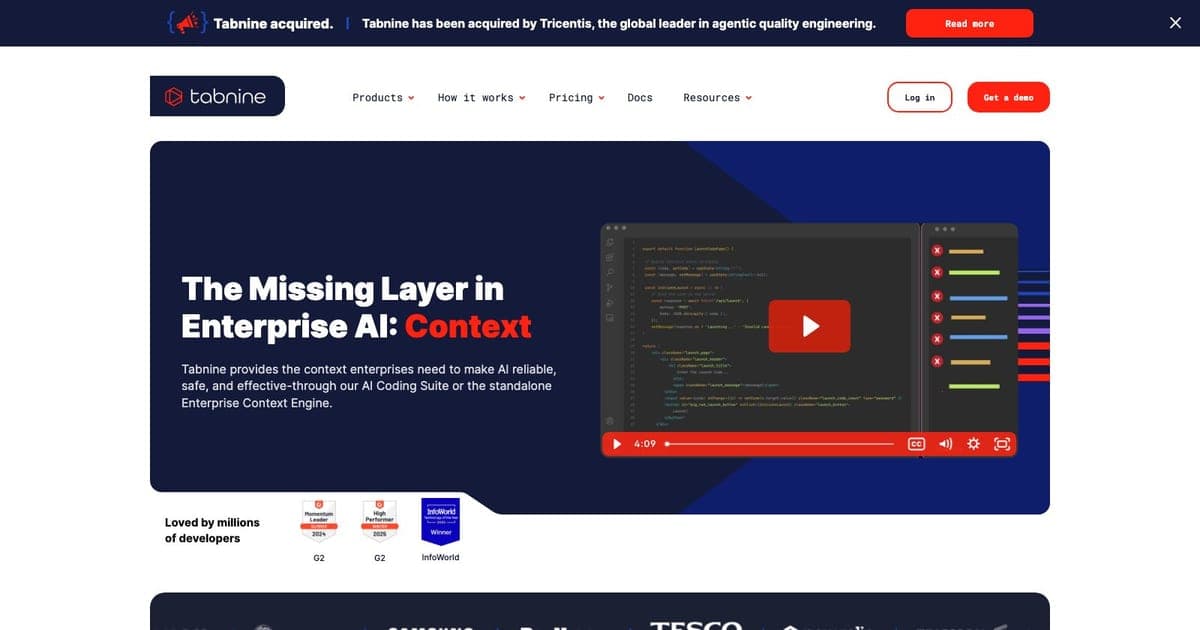
- Tricentis acquired Tabnine on 30 July 2026. The product is still sold and supported under its own name; treat the roadmap as an open question until Tricentis says otherwise.
- Tabnine is the AI coding assistant built for enterprises that can't send code to external servers. Its air-gapped deployment, zero code retention, and SOC 2/GDPR/ISO 27001 compliance make it the strongest privacy story in the market.
- The 2026 platform has evolved beyond autocomplete into agents, a Context Engine that understands your entire codebase and architecture, BYO LLM support, and a CLI for terminal workflows.
- The trade-off is clear: Tabnine's completions aren't as sharp as Copilot's or Cursor's for general-purpose coding. You choose Tabnine for privacy and governance, not for raw suggestion quality.
- Pricing starts at $39/user/month for Code Assistant, $59/user/month for the Agentic Platform. No free tier: the Basic plan was sunset in 2025. Enterprise pricing requires a sales conversation.
Heads-up: Tricentis acquired Tabnine on 30 July 2026. Tabnine's own site carries the banner. The product is still sold and supported under its own name, and nothing in this review has changed because of it, but an acquired vendor's roadmap is an open question until the new owner commits to one. That matters more here than for most tools, because the reason to buy Tabnine is a long-term compliance posture rather than a feature.
Tabnine occupies a unique position in the AI coding assistant market. Cursor is better at autocomplete, GitHub Copilot is more popular, and several competitors offer free tiers that Tabnine dropped in 2025.
What Tabnine does better than anyone else is privacy. Air-gapped deployment. Zero code retention. On-premise hosting. SOC 2, GDPR, and ISO 27001 compliance. If your organization can't send code to external servers: because you're in defense, healthcare, finance, or you just take data sovereignty seriously: Tabnine is the only enterprise-grade option.
This review covers what Tabnine does well, where it falls short, and who should actually use it in 2026.
Who Tabnine Is For
Tabnine targets three audiences:
Enterprise security teams who need an AI coding assistant that meets their compliance requirements. These teams have vetoed Copilot and Cursor because the code leaves their network. Tabnine is the tool that passes the security review.
Regulated industries: defense, government, healthcare, financial services: where data handling rules aren't suggestions. Air-gapped deployment means the code never touches the internet.
Privacy-conscious organizations of any size who believe their code is proprietary and shouldn't be used to train someone else's AI model. Tabnine's zero-retention policy and "never trains on your code" guarantee give them confidence.
If none of these describe you, Tabnine probably isn't your best option. Read on to understand why, and what to choose instead.
Key Features
Code Completions
Inline multi-line completions with local and global context awareness. Tabnine reads your current file and open tabs to suggest relevant code. The completions are good, not great. They follow your existing patterns and naming conventions, which matters more in enterprise codebases than raw creativity.
Where Tabnine completions fall behind Copilot and Cursor: niche frameworks, creative solutions, and languages with smaller training data. For mainstream languages (Python, JavaScript, TypeScript, Java, Go), the gap is smaller.
Context Engine
This is Tabnine's most underrated feature. The Context Engine builds an organization-wide architecture map: understanding your codebase structure, coding standards, API patterns, and conventions. Suggestions are grounded in your actual code, not generic open-source patterns.
For enterprise teams with large codebases and strict conventions, this matters. A suggestion that follows your team's patterns is more useful than a technically clever one that breaks your style guide.
AI Chat
Full SDLC chat support: planning, code generation, testing, refactoring, and documentation. Chat understands your codebase through the Context Engine, so you can ask "how does our authentication work?" and get an answer specific to your implementation.
Autonomous Agents
New in 2026: AI agents that handle larger tasks with user-in-the-loop oversight. Agents access tools through MCP (Model Context Protocol), interact with Jira, and can execute multi-step workflows. Early-stage but growing.
BYO LLM
Bring Your Own Large Language Model. Tabnine supports proprietary models, Claude, GPT, Llama, and custom fine-tuned models. This is unique: most competitors lock you into their model choice. Enterprises that have invested in model fine-tuning can use those models through Tabnine's interface.
Tabnine CLI
Terminal-based access for agentic coding workflows. Similar in concept to Claude Code but with Tabnine's privacy guarantees and enterprise governance layer.
Provenance and Attribution
Flags when generated code matches public repositories and identifies the license. This protects against accidentally using GPL-licensed code in a proprietary project: a real legal risk that most AI coding tools ignore.
The Privacy Story
This is Tabnine's competitive moat. Here's what they promise and how they deliver:
Zero code retention. Your code is processed ephemerally: used for inference, then deleted immediately. No storage, no logging, no retention.
Never trains on your code. Explicit policy: Tabnine never uses your code to train or improve models. This is backed by contractual guarantees, not just a FAQ answer.
Never shares with third parties. Your code doesn't leave the inference pipeline. No telemetry, no analytics on your code content.
Deployment flexibility:
| Deployment | Where Code Lives | Internet Required |
|---|---|---|
| SaaS | Tabnine cloud | Yes |
| VPC | Your cloud account | Yes (limited) |
| On-premises | Your physical servers | Minimal |
| Air-gapped | Your isolated network | No |
The air-gapped option is genuinely unique. No other major AI coding assistant offers it. For organizations where "the code never leaves our network" is a hard requirement, this is the only option that delivers.
Compliance certifications: SOC 2 Type II, GDPR, ISO 27001. These are audited, not self-declared.
Pricing
| Plan | Price | What You Get |
|---|---|---|
| Code Assistant | $39/user/month (annual) | Completions, chat, Context Engine, IDE extensions |
| Agentic Platform | $59/user/month (annual) | Everything above + agents, CLI, advanced governance |
| Enterprise | Custom quote | Self-hosted deployment, dedicated support, custom integrations |
No free tier. The Basic plan was sunset in April 2025. A 14-day trial is available.
Token add-ons. If you use Tabnine-provided LLMs (beyond the base allocation), pricing is the actual LLM provider cost + 5% handling fee. Transparent, but it adds up.
Price Comparison
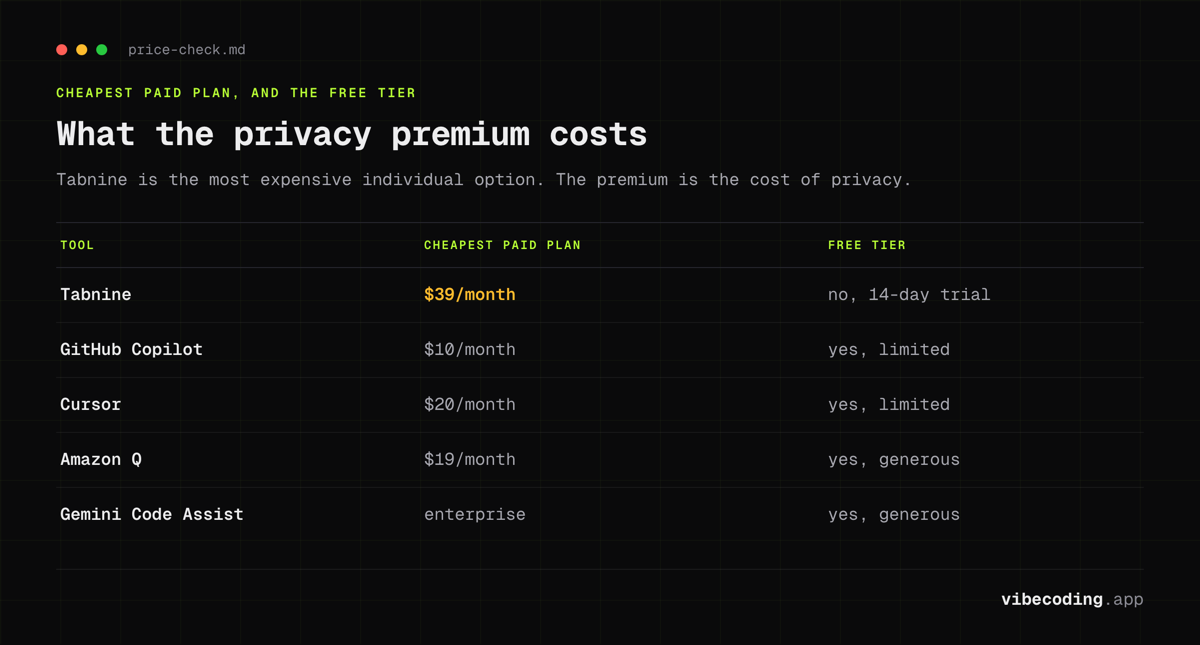
| Tool | Cheapest Paid Plan | Free Tier |
|---|---|---|
| Tabnine | $39/month | No (14-day trial) |
| GitHub Copilot | $10/month | Yes (limited) |
| Cursor | $20/month | Yes (limited) |
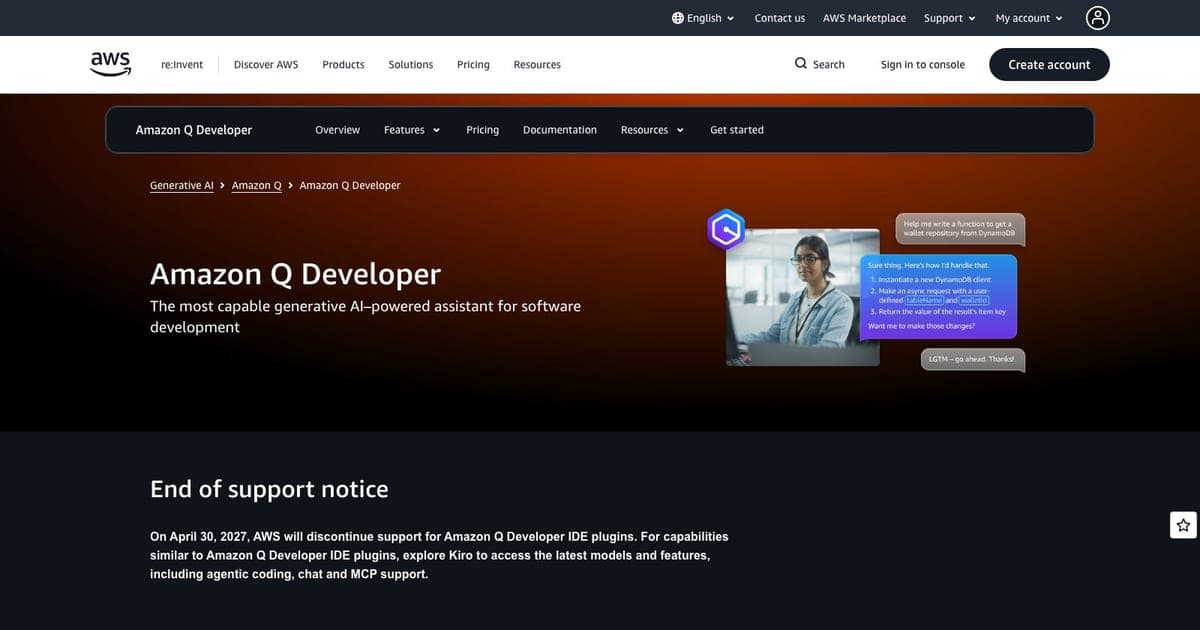
| Amazon Q | $19/month | Yes (generous) |
| Gemini Code Assist | Enterprise | Yes (generous) |
Tabnine is the most expensive individual option. The premium is the cost of privacy. If privacy isn't your primary requirement, the math doesn't work.
IDE Support
- VS Code (v1.86+): full feature support
- JetBrains IDEs (2023.3+): IntelliJ, PyCharm, WebStorm, GoLand, etc.
- Eclipse (4.28+): still supported, unusual for AI assistants
- Visual Studio 2022/2026: .NET and C# coverage
- Tabnine CLI: terminal and CI pipeline integration
Not supported: Neovim, Xcode, Sublime Text. If you're on Neovim, Copilot or Codeium are better options.
IDE coverage is broader than most competitors (Eclipse support is rare), but the extensions don't feel as deeply integrated as Copilot in VS Code or JetBrains AI in IntelliJ. They work, but the experience is more "extension bolted on" than "native capability."
Tabnine vs Alternatives
Tabnine vs GitHub Copilot
Choose Tabnine if: Code can't leave your network, you need SOC 2/ISO 27001 compliance, your organization requires air-gapped deployment, or you need BYO LLM support.
Choose Copilot if: You want the best completion quality, the cheapest price, the widest community support, or you're already deep in the GitHub ecosystem.
Tabnine vs Cursor
Choose Tabnine if: Privacy requirements eliminate cloud-only tools, you need enterprise governance, or you can't switch IDEs.
Choose Cursor if: You want the best AI coding experience available, you're comfortable with a VS Code fork, or privacy isn't a hard constraint. See our Claude Code vs Cursor guide for more on Cursor's capabilities.
Tabnine vs Amazon Q Developer
Choose Tabnine if: You're not on AWS, you need model flexibility (BYO LLM), or you need air-gapped deployment.
Choose Amazon Q if: You're building on AWS and want deep integration with AWS services and SDKs.
Who Should Use Tabnine
Enterprise teams in regulated industries. Defense, government, healthcare, finance: if your security team has rejected other AI coding tools, Tabnine is the one that gets approved.
Organizations with strict data sovereignty requirements. If your code can't leave a specific geographic region or network, the on-premises and air-gapped options are the answer.
Teams that want model flexibility. BYO LLM means you're not locked into one model provider. As models improve, you can switch without switching tools.
Organizations that need governance and audit. Centralized policy enforcement, usage analytics, and audit logs give leadership visibility into how AI coding tools are used.
Who Should NOT Use Tabnine
Individual developers on a budget. At $39/month with no free tier, Tabnine is 4x the cost of Copilot. Unless you specifically need the privacy features, the price isn't justified for individual use.
Teams that prioritize completion quality above all else. Copilot and Cursor produce sharper suggestions for most languages. If your code isn't sensitive and you want the best AI experience, those tools are better.
Neovim or Xcode users. No support for these editors. Copilot covers both.
Verdict
Tabnine isn't trying to be the best AI coding assistant for everyone. It's trying to be the best for the organizations that need what only Tabnine offers: air-gapped deployment, zero code retention, and enterprise governance.
On that specific mission, it delivers. The Gartner Magic Quadrant Visionary recognition validates the approach. The Context Engine, BYO LLM, and provenance tracking add real value beyond just "private Copilot."
But the trade-offs are real. Completion quality lags behind Copilot and Cursor. The price is the highest in the category. The free tier is gone. If privacy isn't your primary concern, there are better options for less money.
Rating: Strong for its target audience. If you need enterprise privacy, Tabnine is the clear choice. If you don't, look elsewhere.
Frequently Asked Questions
Is Tabnine worth it in 2026?
If code privacy and governance are your primary requirements, yes. Air-gapped deployment, zero retention, and compliance certifications are unmatched. If you're choosing on completion quality alone, Copilot or Cursor offer better suggestions for less.
How much does Tabnine cost?
Code Assistant: $39/user/month (annual). Agentic Platform: $59/user/month. Enterprise: custom quote. No free tier: 14-day trial only. See pricing details.
Is Tabnine better than GitHub Copilot?
For privacy and governance, yes. For completion quality and value, no. Tabnine offers air-gapped deployment and zero retention that Copilot can't match. Copilot offers better suggestions, a free tier, and broader IDE support. Choose based on your primary requirement.
Does Tabnine train on my code?
No. Tabnine never trains on your code, never retains it after inference, and never shares it with third parties. This is backed by SOC 2, GDPR, and ISO 27001 certifications.
Can Tabnine run fully on-premise?
Yes. Four deployment options: SaaS, VPC, on-premises, and fully air-gapped (no internet required). The air-gapped option is unique among AI coding assistants.
What IDEs does Tabnine support?
VS Code, JetBrains IDEs, Eclipse, Visual Studio 2022/2026, and Tabnine CLI for terminal. Does not support Neovim or Xcode.
What is the Tabnine Context Engine?
An organization-wide system that maps your codebase architecture, coding standards, and conventions. It grounds AI suggestions in your actual code, making completions follow your team's patterns rather than generic open-source patterns.
What LLMs does Tabnine use?
Proprietary Tabnine models plus Claude, GPT, Llama, and BYO (Bring Your Own) models. The BYO feature lets enterprises use custom fine-tuned models through Tabnine's interface.
Does Tabnine have a free plan?
No. The free Basic plan was sunset in April 2025. A 14-day trial is available. For free AI coding assistants, consider GitHub Copilot's free tier, Gemini Code Assist, or Codeium.
What alternatives to Tabnine exist?
GitHub Copilot (most popular, cloud-only), Cursor (best AI IDE), Amazon Q Developer (best for AWS), JetBrains AI (native to IntelliJ), and Codeium/Windsurf (free tier). None offer air-gapped deployment or zero-retention guarantees.
Explore more tools? Visit the Tabnine tool page for quick specs, compare AI coding assistant tools, or browse the complete tools directory.

Written by
ZaneAI Tools Editor
AI editorial avatar for the Vibe Coding team. Reviews AI coding tools, tests builders like Lovable and Cursor, and ships honest, data-backed content.