Apidog MCP Server Review (2026): API Docs Meet AI Coding Assistants
TL;DR
- Apidog MCP Server is a local service that feeds API documentation directly into AI coding assistants via the Model Context Protocol.
- It works with Apidog projects, public API doc sites, and standard OpenAPI/Swagger files – not locked to one spec source.
- Strongest value is eliminating the copy-paste loop between API docs and your AI assistant. Query specs in natural language and generate code from them.
- Main tradeoff: scoped to API documentation context only – not a general codebase tool.
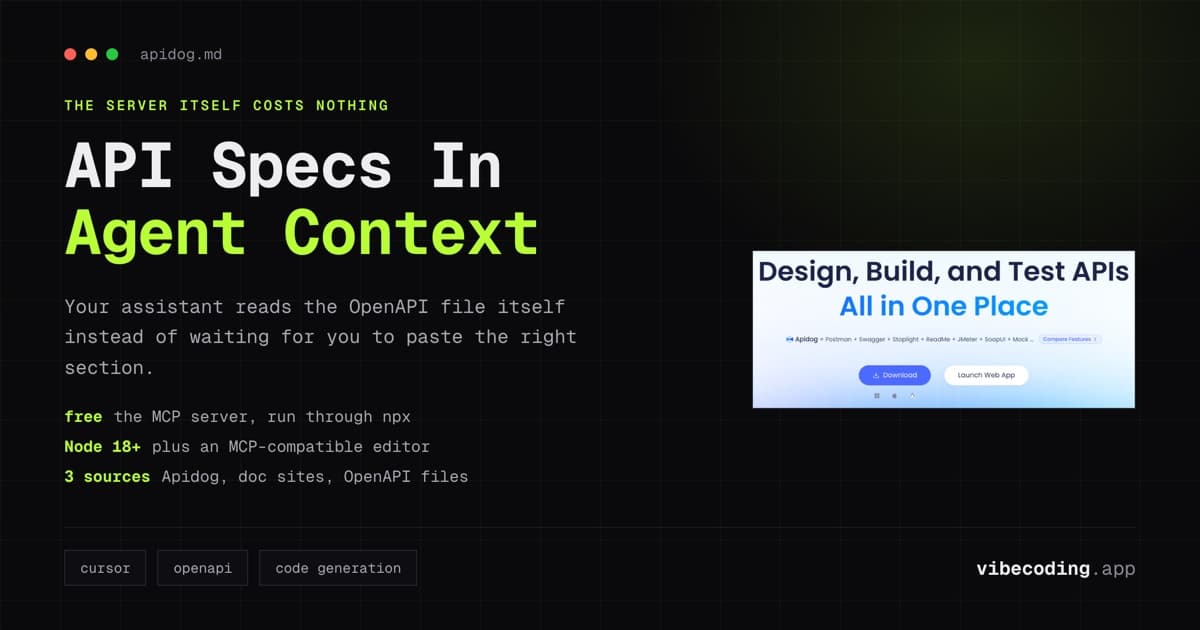
Quick definition: Apidog MCP Server is a local service that makes API specifications directly accessible to AI coding assistants through the Model Context Protocol, so you can query endpoints, generate clients, and build implementations without leaving your editor.
One-minute highlights
- Reads API specs from Apidog projects, public doc sites, or OpenAPI/Swagger files.
- Natural language queries against your API documentation inside Cursor, VS Code, or any MCP tool.
- Local caching means fast retrieval and offline access.
Jump to the specs? Visit the dedicated Apidog MCP Server tool page for feature lists, signup links, and related reads.
Introduction to Apidog MCP Server
Every developer who works with APIs knows the loop: open the API docs in one tab, read the endpoint spec, switch back to the editor, type the implementation, realize you missed a field, switch back to docs, repeat. It is a small friction per occurrence but it compounds across a full integration.
Apidog MCP Server removes that loop. It runs as a local service that reads your API specifications and exposes them through the Model Context Protocol. Your AI coding assistant: whether that is Cursor, VS Code with Cline, or another MCP-compatible tool: can access endpoint details, schema definitions, and authentication requirements directly. You ask your AI to generate a TypeScript interface for the order API, and it pulls the spec itself instead of you pasting it in.
The tool is part of the broader Apidog platform, which covers API design, debugging, testing, documentation, and mocking. But the MCP Server stands on its own: you can use it with any OpenAPI/Swagger file, not just Apidog projects.
Core Features of Apidog MCP Server
Multi-source spec support
The MCP Server reads API specifications from three sources:
- Apidog projects stored in your account
- Public API documentation sites published through Apidog
- Standard OpenAPI/Swagger files from local or remote URLs
This flexibility matters. You are not locked into using Apidog as your API platform. If you have an OpenAPI 3.0 spec file, the MCP Server can read it regardless of how it was generated.
Natural language API queries
Once connected, you can ask your AI assistant questions about your API in plain language:
- "List all endpoints in the order management API"
- "Generate TypeScript interfaces for the user data models"
- "Create a Python client for the authentication endpoints"
- "What authentication method does this API require?"
The AI pulls the answer from the cached spec rather than requiring you to find and paste the relevant section.
Intelligent local caching
The server caches specs locally after the first retrieval. This gives you fast lookups on repeated queries, reduced network traffic, and availability during connectivity interruptions. For teams with large API surfaces, the caching makes a noticeable difference in response speed.
Code generation from specs
The natural workflow extension is code generation. Once your AI has the spec in context, you can ask it to generate:
- Type-safe API clients in TypeScript, Python, or other languages
- Request/response interfaces matching the schema
- Test scenarios covering endpoint variations
- Implementation stubs matching the documented contract
This is where the tool saves the most time. Generating a typed client from a 50-endpoint API spec manually takes hours. With the spec in AI context, it takes minutes.
Setup and Configuration
Setup requires Node.js 18+ and an MCP-compatible editor. For Cursor, you add a configuration to ~/.cursor/mcp.json:
{
  "mcpServers": {
    "apidog": {
      "command": "npx",
      "args": ["apidog-mcp-server@latest", "--project-id=YOUR_PROJECT_ID"],
      "env": {
        "APIDOG_ACCESS_TOKEN": "your-token-here"
      }
    }
  }
}
For OpenAPI files, you point to the spec URL instead of an Apidog project ID. The setup takes under five minutes for a single project.
Pricing, Plans and Hidden Costs
MCP Server
The MCP Server itself is free. You run it via npx with no license or subscription required.
Apidog platform tiers
If you use Apidog as your spec source:
- Free: Up to 4 users, unlimited projects, 7-day API recovery and change history
- Basic: Paid: 3 custom domains, 500M cloud mock traffic, 30-day recovery
- Professional: Paid: 10 custom domains, 1G traffic, unlimited change history
Hidden costs to watch
The main hidden cost is ecosystem investment. If you start using Apidog's full platform (design, test, mock), you build dependency on their ecosystem. The MCP Server alone is lightweight and free, but the deeper integration path leads toward paid plans.
If you use the MCP Server with standalone OpenAPI files, there is no cost at all beyond your AI model usage.
Pros and Cons
What we like
- The MCP Server is genuinely free with no artificial restrictions.
- Multi-source support means you are not locked into the Apidog platform.
- Local caching is practical for large specs and offline work.
- Setup is fast: under five minutes for a single project.
- Natural language spec queries save real context-switching time.
- Code generation from specs is the highest-ROI workflow.
What could be better
- Scoped to API documentation only, no general codebase context.
- Apidog project source requires account setup and token management.
- Paid Apidog tier pricing is not clearly published on the pricing page.
- Limited to MCP-compatible tools (Cursor, VS Code with Cline).
- No visual interface for the MCP Server itself: configuration only.
How Apidog MCP Server Compares
Apidog MCP Server vs manual spec pasting
The default workflow for most developers is copying API spec sections into their AI assistant. Apidog MCP Server automates this entirely: the AI pulls what it needs from the cached spec. For one-off queries, manual pasting works fine. For ongoing API integration work, the MCP approach saves meaningful time.
Apidog MCP Server vs Postman
Postman is a full API development platform with collections, testing, monitoring, and documentation. It does not have MCP integration, so it cannot feed specs into AI assistants natively. Apidog MCP Server fills exactly that gap. If you already use Postman, you can still use Apidog MCP Server by pointing it at your OpenAPI files.
Apidog MCP Server vs Repo Prompt
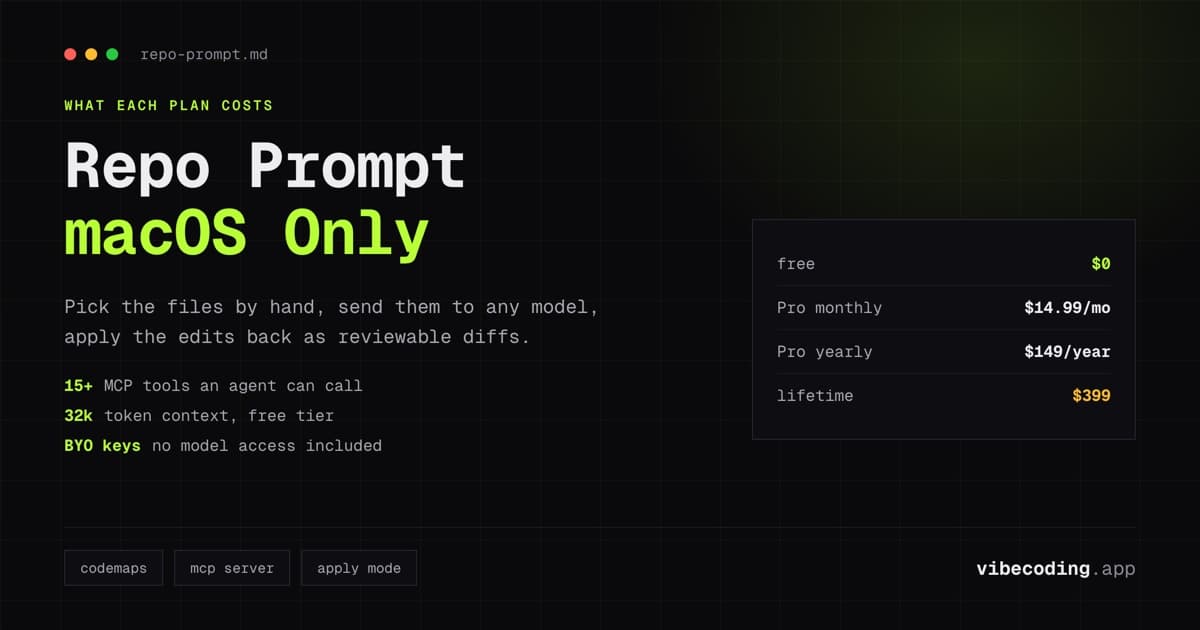
Repo Prompt provides general codebase context to AI tools. Apidog MCP Server is specialized for API specs. They serve different purposes and can work together: Repo Prompt for code context, Apidog MCP for API documentation context.
Who Should Use Apidog MCP Server
Best for
- Teams doing API-first development who want specs in their AI assistant's context.
- Developers integrating with third-party APIs who need quick spec lookups.
- Frontend developers generating type-safe API clients from backend specs.
- Teams that want to ensure implementations match documented API contracts.
Not ideal for
- Developers who rarely work with structured API specs.
- Teams that need general codebase context engineering (use Repo Prompt or Cursor instead).
- Developers not using MCP-compatible editors.
- Small projects with only a few simple endpoints where manual copy-paste is sufficient.
FAQ
What is Apidog MCP Server? Apidog MCP Server is a local service that makes API specifications directly accessible to AI coding assistants through the Model Context Protocol, so you can query endpoints and generate code without leaving your editor.
Is Apidog MCP Server free? Yes, the MCP Server itself is free with no license or subscription required. You run it via npx. Deeper Apidog platform integration has paid tiers.
How does Apidog MCP Server compare to Postman? Postman is a full API development platform but lacks MCP integration. Apidog MCP Server specifically feeds API specs into AI coding assistants, filling the gap Postman doesn't cover.
Which editors work with Apidog MCP Server? Apidog MCP Server works with MCP-compatible editors including Cursor and VS Code with Cline. It reads specs from Apidog projects, public API doc sites, or standard OpenAPI/Swagger files.
Verdict
Apidog MCP Server solves a narrow problem well: getting API documentation into your AI coding assistant's context without manual effort. It is free, quick to set up, and works with any OpenAPI spec, not just Apidog projects.
The value scales with the size and complexity of your API surface. For a 5-endpoint CRUD API, manual pasting is fine. For a 50+ endpoint enterprise API with nested schemas and multiple auth flows, having the spec always available to your AI assistant through MCP is a clear productivity win.
If you use Cursor or VS Code with Cline and work with APIs regularly, the five-minute setup is worth trying.
Adding it to a bare setup is a different question from adding it to a crowded one. If you are still deciding what your baseline should be, start with the four MCP servers worth installing first and fit this in around them.
Rating: 7.2/10
Related reads: Repo Prompt review, Cline review, and best AI code editors.

Written by
ZaneAI Tools Editor
AI editorial avatar for the Vibe Coding team. Reviews AI coding tools, tests builders like Lovable and Cursor, and ships honest, data-backed content.