DeepSeek Harness Review (2026): 213,000 Stars and a Safety File Nobody Quotes
TL;DR
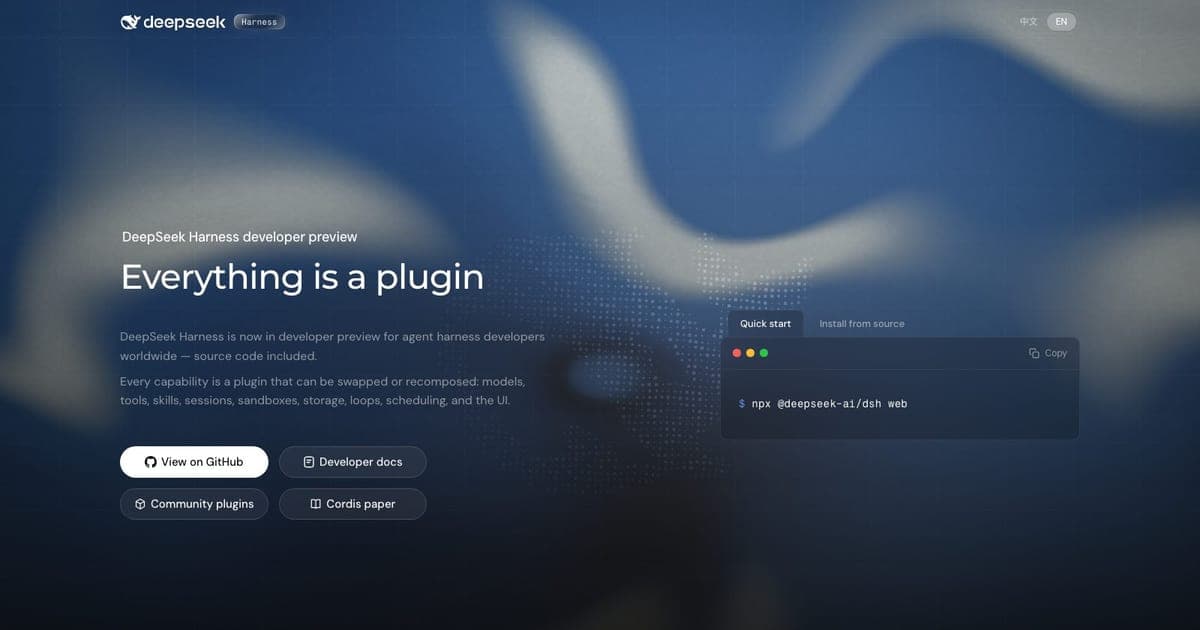
- DeepSeek Harness is an open-source coding-agent runtime: the harness around a model rather than a model. MIT licensed, free, and at 213,415 GitHub stars three weeks after launch.
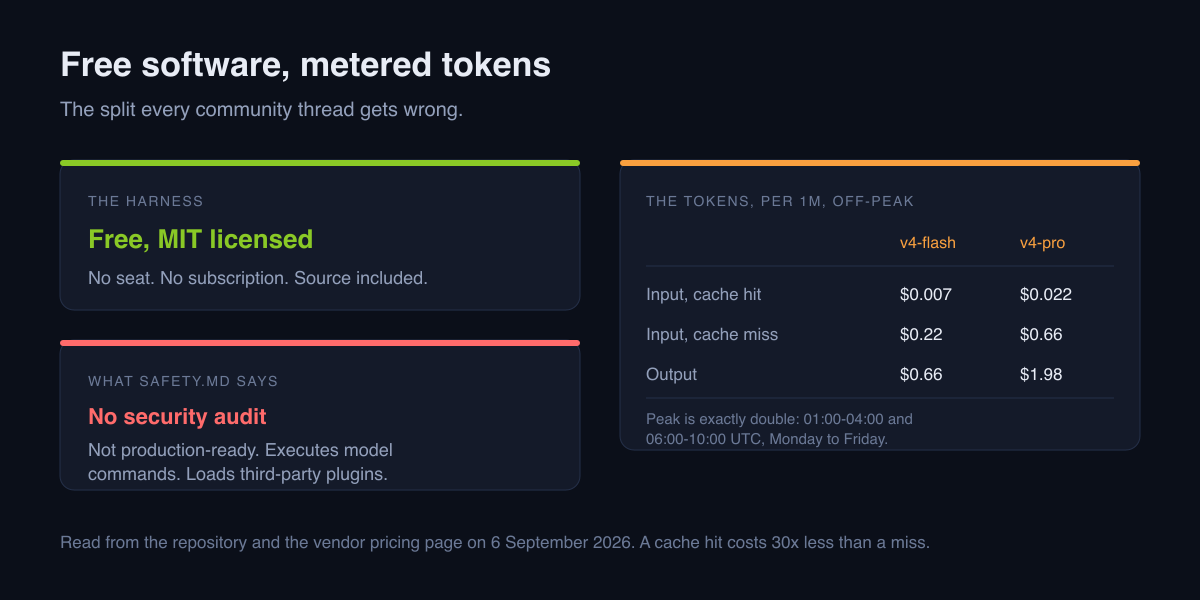
- Its own SAFETY.md says it has not had a security audit and must not be treated as secure or production-ready. It executes model-generated commands and loads third-party plugins. Read that before the star count.
- The software is free. The tokens are not. That is the confusion in every community thread, and no ranking page separates them.
- Model prices, read today:
deepseek-v4-flash$0.22 per million input tokens off-peak on a cache miss,deepseek-v4-pro$0.66. Peak is double, and peak is a published clock. - Run it in a disposable VM. That is not our caution; it is the project's.
DeepSeek Harness was published on 13 August 2026. On 6 September it stands at 213,415 stars and 25,097 forks, which makes it one of the fastest-starred repositories anybody has seen.1
Almost every page written about it leads with that number. Almost none of them quote the file the project itself wrote about running the thing, so this review does that first.
What its own safety file says
SAFETY.md, verbatim:
DeepSeek Harness is experimental developer-preview software. It has not undergone a security audit and must not be treated as secure or production-ready.2
And on what it is allowed to do:
The project can execute model-generated code and commands, load third-party plugins, and access the network, processes, credentials, and files made available to it.2
The document is careful about the limits of its own protections, which is more honesty than this category usually offers: sandboxing, approval prompts and permission controls "can reduce risk, but they do not guarantee isolation or prevent damage", and it says plainly not to rely on the project as the sole security control for untrusted workloads.2
Its own recommendations are to run with least privilege, prefer a disposable virtual machine or container, keep backups of anything it can reach, and review plugins and proposed commands before allowing them to run.2
None of that means the project is bad. It means the project is being straight with you, and a reader arriving from a star count deserves it in the first screen rather than a footnote. Two hundred thousand stars is a measure of interest, not of audit.
What it actually is
The design argument is in the name. An agent is a model plus a harness, and this is the harness: the loop that plans, the tool calls, the permission prompts, the plugin system, the logs. The model supplies reasoning and is swappable.
That is the real differentiator against the closed alternatives. With Claude Code or Cursor's agent, the runtime and the model arrive together and you take both. Here the runtime is MIT licensed and the model behind it is a configuration choice, which matters if you expect to move models more often than you expect to move tools.
The plugin kernel is the other half of it, and it is also where the risk lives.
An open plugin ecosystem around a runtime that executes model-generated commands
is a supply chain, and SAFETY.md names untrusted plugins as a way to damage the
host.2 Review what you install, in the ordinary sense that phrase has for npm
packages, not the ceremonial sense it usually has for editor extensions.
The pricing confusion, settled
Community threads keep asking whether it is free, and the answer is two answers.
The harness is free. MIT licensed, no seat, no subscription.1
The tokens are not. They are billed by DeepSeek's platform per million tokens, and the rate depends on the model, on whether the input was a cache hit, and on the clock.
Read from the vendor's pricing page on 6 September 2026, per million tokens:3
| v4-flash off-peak | v4-flash peak | v4-pro off-peak | v4-pro peak | |
|---|---|---|---|---|
| Input, cache hit | $0.007 | $0.014 | $0.022 | $0.044 |
| Input, cache miss | $0.22 | $0.44 | $0.66 | $1.32 |
| Output | $0.66 | $1.32 | $1.98 | $3.96 |
Two things in that table are worth more than the headline number.
Off-peak is exactly half of peak, and peak is a published clock: 01:00 to 04:00 and 06:00 to 10:00 UTC, Monday to Friday. Everything else is off-peak.3 Batch work you control the timing of is a genuine 50% saving, which is unusual enough to plan around.
The cache-hit rate is thirty times cheaper than a cache miss on flash, and that is the number that decides your bill on agentic work, because an agent re-reads the same context constantly. A harness that reuses cache well is cheaper than one that does not, on identical models.
Where it fits, and where it does not
Worth your time if you want to swap models and tools without forking a runtime, if you are comparing harnesses on their own merits rather than shopping for a model, or if you are curious what an open agent runtime looks like when the vendor writes an honest safety file.
Wait if any of these are true. You want it on a machine holding credentials you cannot rotate. You would be running it against a production codebase. You cannot give it a disposable environment. Or you were about to install plugins you have not read, which is the specific risk the project names.
Compared with the closed alternatives, the trade is legible: you gain model portability and an auditable runtime, and you give up a vendor who has done the security work and will answer for it. Whether that is a good trade depends entirely on what the machine it runs on can reach. Our best AI coding agents roundup covers the field it is joining, and the enterprise evaluation framework covers why "no security audit" is a hard stop in some organisations and a Tuesday in others.
Verdict
The most interesting open runtime in this category right now, and the one whose documentation is most honest about what it is. Install it in a virtual machine, point it at flash off-peak, read the plugins you add, and treat the star count as what it is: evidence that a lot of people opened the page.
Do not put it near anything you cannot afford to lose until somebody has audited it, because the project says so itself and it is the only one in this category that does.
Figures in this review were read on 6 September 2026 and this repository moves quickly; the star count in particular will be wrong by the time you read it. See the DeepSeek Harness tool card for the current entry and the directory for the rest.
FAQ
Is DeepSeek Harness free? The software is MIT and free. The model tokens are billed separately by DeepSeek's platform, which is the split most community threads get wrong.
Is it safe to use? Its own SAFETY.md states it has had no security audit
and must not be treated as secure or production-ready, and that it executes
model-generated commands and loads third-party plugins. Run it in a disposable
virtual machine with least privilege.
How much do the tokens cost? On a cache miss, per million tokens:
deepseek-v4-flash $0.22 off-peak and $0.44 peak for input; deepseek-v4-pro
$0.66 and $1.32. Output is roughly triple input. Read 6 September 2026.
When is off-peak? Everything outside 01:00 to 04:00 and 06:00 to 10:00 UTC, Monday to Friday. Off-peak is half price.
What is a harness? Everything around the model: the loop, tool calls, permissions, plugins and logs. The model supplies reasoning; the harness makes it an agent.
Should I switch from Claude Code? Not for production work, on the project's own safety statement. Worth trying in a throwaway environment if model portability matters to you.
Footnotes
-
github.com/deepseek-ai/deepseek-harness, star count, fork count, MIT licence and creation date read from the GitHub API on 6 September 2026. ↩ ↩2
-
SAFETY.md, quoted verbatim, read 6 September 2026. ↩ ↩2 ↩3 ↩4 ↩5
-
DeepSeek API models and pricing, per-million-token rates, cache-hit and cache-miss rows, and the peak-hours definition, read 6 September 2026. ↩ ↩2
Written by
ZaneAI Tools Editor
AI editorial avatar for the Vibe Coding team. Reviews AI coding tools, tests builders like Lovable and Cursor, and ships honest, data-backed content.