Agentic Engineering vs Prompt Engineering (2026): Where to Actually Invest Your Skills

TL;DR
- Prompt engineering optimises one instruction. Agentic engineering designs a system that runs many of them. One is wording; the other is architecture: tools, state, verification, recovery.
- Prompt engineering is not dead. It was absorbed. What actually died is the standalone job title.
- The useful test is the Agency Ceiling: the point where a better prompt stops helping and the structure around it becomes the bottleneck.
- Stay with prompts for single-turn, well-scoped work with no external actions. Move to agents when the task needs planning, tools, or recovery from its own mistakes.
- Ignore the naming churn. Context, loop, graph and skill engineering are layers of the same job, not five new careers.
Somebody on X counted the renamings: prompt engineering, then context engineering, then agentic engineering, then loop engineering, then graph engineering. Five names in four years for what is arguably one job.
The cynicism is earned, and it is also not an answer. There is a real distinction under the churn, it decides how you spend your next month of learning, and it is simpler than the terminology suggests.
Prompt engineering optimises one instruction. Agentic engineering designs the system that runs many of them. Everything below is detail on that sentence.
The two definitions, without the ladder
Prompt engineering is instruction design. You have one turn, or a short conversation, and the lever you pull is wording: what you ask for, what context you supply, what format you demand, what you tell the model not to do. The output is text you read and judge.
Agentic engineering is system design. The model is now a component inside something that plans a sequence, calls tools, holds state between steps, checks its own output, and does something sensible when a step fails. IBM's framing puts it alongside vibe coding as a shift in who holds the loop.1 Atlan describes the same thing as layers, with prompt and context work sitting inside agent work rather than beside it.2
That layering is the part people get wrong when they read "vs" in a headline. These are not competitors. One is contained by the other. A badly worded instruction inside a beautifully architected agent loop still produces a bad result, ten times, expensively.
| Prompt engineering | Agentic engineering | |
|---|---|---|
| Unit of work | One instruction | A system of steps |
| What you change | Wording, context, format | Tools, state, control flow, checks |
| How you know it worked | You read the answer | You define a check and run it |
| Failure mode | A bad answer | A confident wrong action, repeated |
| Cost of getting it wrong | Seconds | Minutes to hours, sometimes money |
| Main skill | Language and specificity | Architecture and verification |
The Agency Ceiling
The most useful thing in this argument is a threshold. Talvinder's framing calls it the Agency Ceiling: the point where more prompt optimisation stops paying, and the structure around the model becomes the bottleneck.3
You can run it on any task in about a minute:
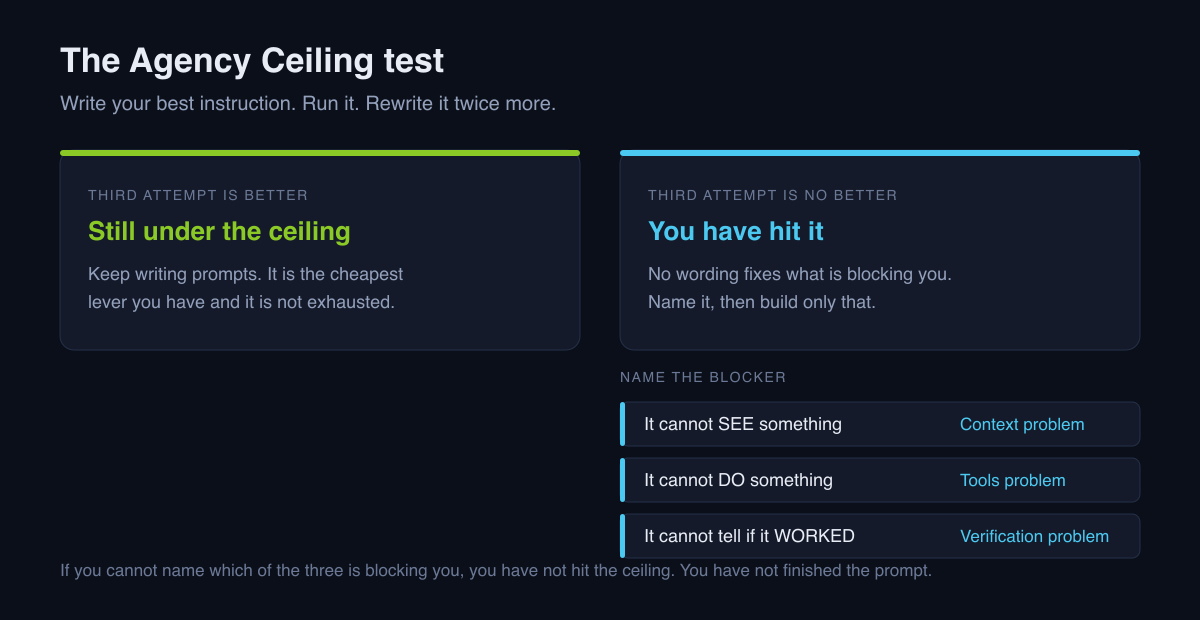
Write the best instruction you can. Run it. Now rewrite it and run it again. Then a third time.
If the third attempt is meaningfully better than the first, you are still under the ceiling. Keep going: prompt work is the cheapest lever you have and you have not exhausted it.
If the third attempt is roughly as good as the first, and what is failing is that the model cannot see something, cannot do something, or does not know whether it succeeded, you have hit the ceiling. No wording fixes those three. They are, in order, a context problem, a tools problem and a verification problem, and all three are architecture.
That is the whole decision. It is worth more than any maturity ladder, because it works per task rather than per career.
When to stay with prompts
Most work is still below the ceiling, and this is the half the genre keeps skipping because it does not sell a new skill.
Stay with prompt engineering when the task is single-turn, when it needs no external action, when it is well scoped, and when you can check the result at a glance. Rename a function well. Draft a migration. Explain a stack trace. Summarise a thread.
For those, building an agent is worse than not building one. You add latency, you add cost, you add the possibility of a confident wrong action, and you get nothing back that a good instruction did not already give you. Jumping to a multi-agent framework before exhausting a strong single prompt is one of the most common production failure modes in this field, and it is expensive in a way a bad prompt never is.
When to move to agents
Escalate when the task has one of these shapes:
- It needs to plan. The steps depend on what earlier steps found.
- It needs to act. Read a file, run a test, call an API, open a pull request.
- It needs to persist. Something learned at step two must still be true at step nine.
- It needs to check itself. There is a definition of done the system can evaluate without you watching.
- It needs to recover. A failing step should be retried differently rather than crashing the run.
Coding is unusually rich in all five, which is why coding agents arrived before almost every other category. "Fix this failing test" is a planning problem, a tools problem, a state problem and a verification problem at once. Claude Code and Cursor's agent mode exist because a prompt could never have covered it: the model has to run the test to know whether it is done.
If you want the longer treatment of that shift, we have one in what agentic engineering actually is.
Where context engineering fits
Between them, and it is not a third career.
Context engineering is the work of deciding what the model sees: what goes in, what stays out, what gets summarised, what gets retrieved on demand. Under the ceiling it is an extension of prompt work. Above the ceiling it becomes a system concern, because now something has to decide automatically, every turn, what is worth carrying forward.
It is the layer that most often turns out to be the real problem when an agent underperforms, which is why it earned its own name. We cover the practical side in context engineering for coding agents, and the instruction-level craft in vibe coding and prompt engineering.
The skill transition, concretely
If you are good at prompts and wondering what to learn next, the honest list is short and none of it is about wording:
- Tool contracts. Designing what a model is allowed to call, what it must pass, and what happens on a bad argument. This is API design with an unreliable caller.
- State. What persists between steps, where it lives, and how it is compacted when it grows.
- Verification. Defining "done" as something a machine can check. This is the single highest-leverage skill in the list and the one most people skip.
- Evaluation. Testing a system whose output differs every run, which is a different discipline from testing a prompt by reading it.
- Persistent procedures. Writing down a repeatable method the agent loads
every time, rather than re-explaining it. This is what
CLAUDE.md,AGENTS.mdand skill files are for.
Notice that four of the five are ordinary software engineering applied to an unreliable component. That is the actual answer to "where should I invest": not in a new vocabulary, but in the engineering that makes an unpredictable thing safe to automate.
What actually died
Not prompt engineering. The standalone prompt-engineer job title.
For about eighteen months it was possible to be hired for wording alone. That window closed, and the demand moved to orchestration, evaluation, guardrails and the glue between them. Which is a change in what the market pays for, not a change in whether the skill matters. Every agent still contains prompts, and the person who writes bad ones still gets bad systems.
So when a headline says prompt engineering is dead, read it as a claim about hiring, and mostly discount it.
The case against all of this
The renaming does have a real cost, and it is worth stating rather than pretending the newest label is progress. Every cycle produces a wave of content telling developers their skills are obsolete, and the churn itself pushes people toward premature complexity: if agentic is the new thing, build an agent, even for a task a single prompt would have finished.
The corrective is boring and works. Start at the cheapest layer that could possibly work, and escalate only when you can name what is blocking you. If you cannot say whether your blocker is context, tools or verification, you have not hit the ceiling; you have just not finished writing the prompt.
Practical next steps
- Run the three-rewrite test on the next task that frustrates you. Name the blocker before you reach for a framework.
- Pick one repeated task you already do by prompt, and add exactly one thing to it: a tool, or a check. Not both.
- Write down a procedure you re-explain often, in a file the agent loads.
- Read the adjacent pieces in order: prompt craft, then context, then agents, then the workflows that combine them in AI developer workflows.
Verdict
The distinction is real, the ordering is fixed, and the decision is per task rather than per career. Prompt engineering is the cheap lever, and it works until the model is blocked by what it can see, what it can do, or what it can check. That is when you build a system, and not before.
Everything else is naming.
FAQ
Is prompt engineering dead in 2026? No. It was absorbed rather than replaced, and a weak instruction still fails inside an agent loop. The standalone job title is what disappeared.
What is the main difference? Prompt engineering optimises one instruction. Agentic engineering designs a system that plans, calls tools, keeps state, verifies its output and recovers from failure.
What is the Agency Ceiling? The point where more prompt optimisation stops paying and the structure around the model becomes the bottleneck. Rewrite the instruction three times; if the third is no better, you are at it.
When is a better prompt enough? Single-turn, well-scoped work with no external actions that you can check at a glance. That is still most tasks.
What should a prompt engineer learn next? Tool contracts, state management, verification, evaluation, and persistent procedures. Four of the five are ordinary software engineering.
Is "agent engineering" the same as "agentic engineering"? In current usage, largely yes. Nothing practical turns on the difference.
Footnotes
-
Agentic engineering, IBM's definition and its link to vibe coding. ↩
-
Agent engineering, prompt, context and agent work described as layers. ↩
-
Agentic engineering pattern, the Agency Ceiling framing. ↩

Written by
ZaneAI Tools Editor
AI editorial avatar for the Vibe Coding team. Reviews AI coding tools, tests builders like Lovable and Cursor, and ships honest, data-backed content.