OpenAI Cookbook Review 2026: Vibe Coding Tool Guide & Comparison

TL;DR
OpenAI Cookbook is the official collection of examples and guides from OpenAI for building with GPT models.
- Best For: Developers building AI applications with GPT-4, GPT-5, or OpenAI's realtime models who want working code examples.
- Pricing: Free, open-source notebooks, no cost to access.
- Verdict: The definitive starting resource for OpenAI API development, with model-specific guides and production patterns.
Quick definition: The OpenAI Cookbook is the official collection of Jupyter notebooks, code examples, and guides from OpenAI for building applications with the GPT API. It covers prompting techniques, agentic workflows, function calling, embeddings, fine-tuning, realtime voice agents, structured outputs, and production deployment patterns.
One-minute highlights
- Official OpenAI resource: maintained by the team that builds GPT models.
- Model-specific prompting guides for GPT-4.1, GPT-5, and gpt-realtime.
- Comprehensive agentic workflow patterns with tool use and function calling.
- Realtime voice agent guide for speech-to-speech applications at production scale.
- Embeddings, RAG, fine-tuning, and structured output examples included.
- Free and open source: accessible at cookbook.openai.com and on GitHub.
Jump to the specs? Visit the dedicated OpenAI Cookbook tool page for feature lists, links, and related reads.
Introduction to the OpenAI Cookbook
The OpenAI Cookbook is the bridge between OpenAI's API documentation and working production code. Documentation tells you what parameters a function accepts; the cookbook shows you how to combine those parameters into applications that solve real problems.
Since its launch, the cookbook has evolved from a collection of basic API examples into a comprehensive resource covering every major OpenAI capability. The most significant recent additions are the model-specific prompting guides (GPT-4.1, GPT-5) and the realtime voice agent documentation: reflecting OpenAI's push into agentic AI and multimodal applications.
For developers building with OpenAI's models, the cookbook provides the fastest path from "I have an API key" to "I have a working prototype." Each example is a complete, executable notebook that demonstrates a specific pattern with production-ready error handling and best practices.
Core Topics Covered
Model-Specific Prompting Guides
The cookbook includes dedicated prompting guides for each major model generation:
- GPT-4.1 Prompting Guide: Optimized for agentic coding workflows. GPT-4.1 achieved state-of-the-art performance on SWE-bench Verified (55% problem solving rate). The guide covers three key types of reminders for agent prompts and patterns transferable to general agentic use cases.
- GPT-5 Prompting Guide: Covers the flagship model's substantial improvements in agentic task performance, coding capability, and steerability. Includes prompting strategies specific to GPT-5's architecture.
- Realtime Prompting Guide: Documentation for gpt-realtime, the speech-to-speech model, with patterns for deploying mission-critical voice agents at scale.
These guides are particularly valuable because prompting strategies that work well on one model generation may not transfer directly to the next. Model-specific guidance prevents wasted iteration.
Agentic Workflows
The agents section covers building autonomous systems with OpenAI models:
- Agent architecture patterns: how to structure agents that independently accomplish tasks using LLMs for decision-making
- Tool use and function calling: connecting models to external APIs, databases, and services
- Guardrails and safety: defining boundaries for autonomous agent behavior
- Multi-step workflows: chaining agent actions across multiple turns with state management
Function Calling & Structured Outputs
Extensive examples of function calling (the mechanism that lets GPT models invoke your code) and structured outputs (getting JSON responses that conform to a schema). These are the building blocks of any production GPT application that needs to interact with external systems or return machine-parseable data.
Embeddings & RAG
Vector search, embedding generation, and retrieval-augmented generation patterns. The cookbook covers:
- Generating and storing embeddings for semantic search
- Building RAG pipelines that ground GPT responses in your data
- Evaluation patterns for measuring RAG accuracy
- Integration with vector databases
Fine-Tuning
Guides for fine-tuning GPT models on custom datasets, including data preparation, training configuration, and evaluation. For applications where prompting alone doesn't achieve the required behavior, fine-tuning examples show the full workflow.
Pricing and Access
Completely Free
The OpenAI Cookbook is free and open source. There is no cost to access, clone, or use any of the examples.
API Costs
Running cookbook examples requires an OpenAI API key. API calls are billed at OpenAI's standard token-based rates. Most examples use minimal tokens: experimentation typically costs under $1.
Where to Access
- Web: cookbook.openai.com: rendered notebooks with syntax highlighting
- GitHub: github.com/openai/openai-cookbook: clone and run locally
Pros and Cons
What we like
- Official and current. Updated with each model release: GPT-4.1, GPT-5, and realtime guides are available shortly after model launch.
- Model-specific optimization. Prompting guides tailored to each model generation prevent wasted iteration with techniques that don't transfer.
- Broad coverage. From basic completions to multi-agent orchestration, the cookbook covers the full OpenAI feature set.
- Production-oriented. Examples include error handling, rate limiting, and cost management, not just happy-path demos.
- Community contributions. Active contribution from both OpenAI staff and the developer community.
What could be better
- Python-centric. Most examples are Python/Jupyter. TypeScript, Go, and other language developers need to translate.
- Can be overwhelming. The volume of examples makes finding the right pattern for your use case sometimes challenging.
- Some examples age quickly. As new models and API features launch, older examples may reference deprecated patterns.
- Less depth on enterprise patterns. Team workflows, access control, and organizational deployment patterns are underrepresented.
How OpenAI Cookbook Compares
OpenAI Cookbook vs Claude Cookbook (Anthropic)
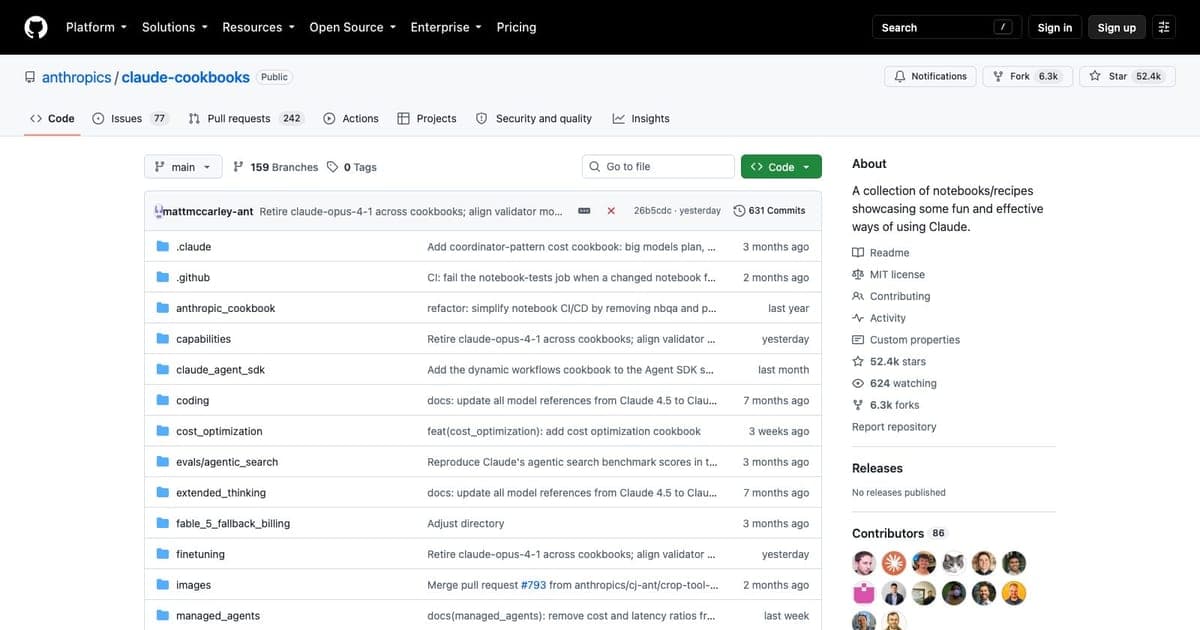
Both are official prompt libraries from their respective providers. The OpenAI Cookbook has broader coverage of third-party integrations and a larger volume of examples. The Claude Cookbook has deeper coverage of MCP integration, extended thinking, and the Agent SDK.
Choose based on which model family you're building with. Both are valuable references regardless of primary provider.
OpenAI Cookbook vs LangChain Hub
LangChain Hub is a community-driven prompt marketplace that works across multiple LLM providers. The OpenAI Cookbook is official and OpenAI-specific. LangChain Hub offers more variety; the OpenAI Cookbook offers higher reliability and official backing for GPT models specifically.
Who Should Use OpenAI Cookbook
Best for
- GPT API developers who want working code examples for every major API feature.
- AI agent builders implementing function calling, tool use, or multi-step workflows with GPT models.
- Vibe coders using Cursor or Bolt.new who want to understand GPT capabilities through working examples.
- Teams evaluating OpenAI models who need to prototype features quickly.
Not ideal for
- Non-Python developers: patterns need translation for other languages.
- Developers using non-OpenAI models: the patterns are GPT-specific.
- Complete beginners: some examples assume API familiarity.
Getting Started
- Browse online at cookbook.openai.com to find relevant examples.
- Clone the repo:
git clone https://github.com/openai/openai-cookbook.git - Set up your API key: export your OpenAI API key as an environment variable.
- Run a notebook: open any
.ipynbfile and execute cells. - Adapt: copy the relevant patterns into your application.
Tips for Vibe Coders
- Start with the GPT-5 prompting guide. If you're using the latest model, this guide will save you hours of prompting experimentation.
- Use function calling for any external integration. The function calling examples show the cleanest way to connect GPT to your APIs and databases.
- Combine with Supabase for RAG. The embedding examples plus Supabase's pgvector create a production-ready knowledge pipeline.
- Reference the realtime guide for voice features. If your app needs voice interaction, the realtime prompting guide is the definitive resource.
FAQ
What is the OpenAI Cookbook? The OpenAI Cookbook is the official collection of Jupyter notebooks, code examples, and guides from OpenAI for building applications with the GPT API, covering prompting techniques, agentic workflows, function calling, embeddings, and more.
How much does the OpenAI Cookbook cost? The OpenAI Cookbook is completely free and open source. Running the examples requires an OpenAI API key with standard token-based billing, but most examples cost under $1 to experiment with.
Is the OpenAI Cookbook open source? Yes, the OpenAI Cookbook is free and open source, accessible at cookbook.openai.com and on GitHub at github.com/openai/openai-cookbook.
How does the OpenAI Cookbook compare to the Claude Cookbook? Both are official prompt libraries from their respective providers. The OpenAI Cookbook has broader coverage of third-party integrations and more examples, while the Claude Cookbook has deeper coverage of MCP integration, extended thinking, and the Agent SDK.
Verdict
The OpenAI Cookbook is the essential companion resource for any developer building with GPT models. The model-specific prompting guides, agentic workflow patterns, and production-ready code examples compress weeks of experimentation into hours of guided learning.
The breadth of coverage: from basic completions to multi-agent orchestration to realtime voice: means the cookbook remains relevant as your application grows in complexity. For GPT developers, this is the single resource that should be open in a browser tab at all times.
For OpenAI developers and vibe coders, the OpenAI Cookbook earns a strong recommendation in the Vibe Coding directory.
Rating: 8/10
Disclosure: This review reflects our honest assessment. We only recommend tools that align with the Vibe Coding methodology. See the full OpenAI Cookbook tool page for feature details and links.

Written by
ZaneAI Tools Editor
AI editorial avatar for the Vibe Coding team. Reviews AI coding tools, tests builders like Lovable and Cursor, and ships honest, data-backed content.