Microsoft Semantic Kernel Review 2026: Vibe Coding Tool Guide & Comparison

TL;DR
Microsoft Semantic Kernel is an open-source AI orchestration SDK for building AI agents and multi-agent systems with enterprise-grade features.
- Best For: Enterprise developers and .NET teams building AI applications that need prompt management, plugin architecture, and security compliance.
- Pricing: Free and open source (MIT). LLM API costs are separate.
- Verdict: The strongest choice for enterprise AI orchestration, especially for C#/.NET teams already in the Microsoft ecosystem.
Quick definition: Microsoft Semantic Kernel is a free, open-source AI orchestration SDK that lets developers build AI agents and multi-agent systems. It provides a model-agnostic plugin architecture, prompt templating engine, built-in memory system, RAG support, and enterprise-grade security features: available for C#, Python, and Java.
One-minute highlights
- Model-agnostic: works with OpenAI, Azure OpenAI, Hugging Face, and local models.
- Plugin architecture: reusable AI skills combining traditional code and natural language prompts.
- Prompt templating with variable injection, conditional logic, and function calling.
- Enterprise-grade security: prompt injection detection, content filtering, audit logging.
- Built-in memory and vector database integration for RAG patterns.
- Multi-language: C#, Python, and Java SDKs: C# is the most mature.
Jump to the specs? Visit the dedicated Semantic Kernel tool page for feature lists, setup links, and related reads.
Introduction to Semantic Kernel
Most AI development frameworks are Python-first, targeting the data science community. Semantic Kernel takes a different approach: it's designed for enterprise software developers who need to integrate AI into production applications with the same rigor they apply to any other system component.
Built by Microsoft and open-sourced under the MIT license, Semantic Kernel provides the SDK layer between your application code and LLM providers. It handles prompt management, function orchestration, memory, and security: the infrastructure concerns that become critical when AI moves from prototype to production.
With 27,000+ GitHub stars as of early 2026, Semantic Kernel has become one of the most adopted AI development frameworks in the enterprise space. Its integration with Azure OpenAI Service and the broader Microsoft ecosystem makes it the natural choice for organizations already invested in Microsoft's platform.
Core Features
Plugin Architecture
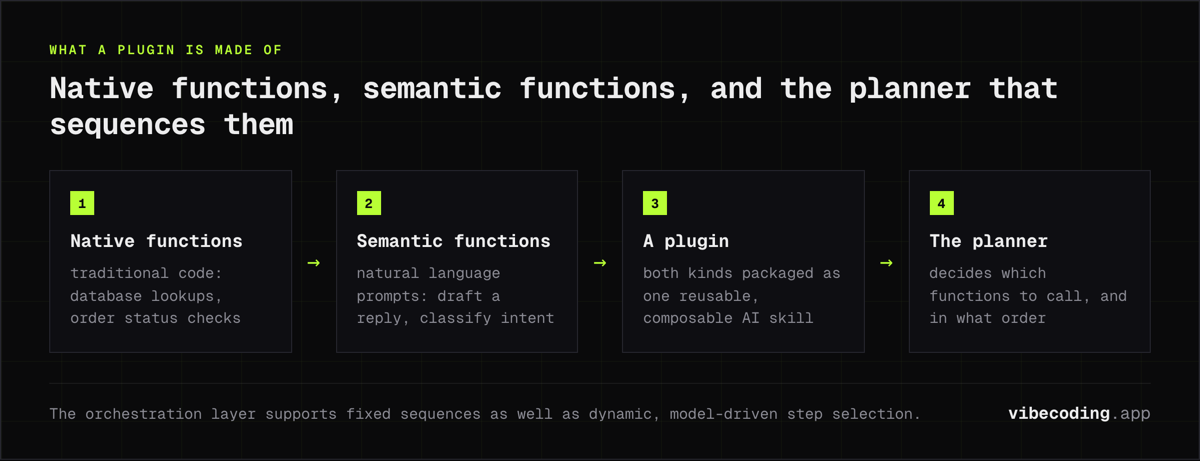
Semantic Kernel's plugin system is the foundation of its design. Plugins are collections of reusable functions: both "native" (traditional code) and "semantic" (natural language prompts). This combination lets you build AI capabilities that blend deterministic code execution with LLM reasoning.
For example, a customer service plugin might include native functions for database lookups and order status checks alongside semantic functions for generating natural language responses and classifying customer intent. The orchestrator combines them into a workflow.
Prompt Templating
The prompt templating engine goes beyond simple string interpolation. Templates support variable injection, conditional logic, function calling within prompts, and versioning. You can manage prompts as code: version-controlled, tested, and deployed through your existing CI/CD pipeline.
This matters at scale. When multiple teams contribute prompts and AI behaviors, having a structured templating system prevents the chaos of prompt strings scattered across codebases.
AI Orchestration
Semantic Kernel's planner creates complex workflows by combining plugins, functions, and LLM calls. You can define multi-step processes where the orchestrator decides which functions to call, in what order, based on the user's request.
The orchestration layer supports both deterministic workflows (fixed sequences) and dynamic planning (LLM-driven step selection). This flexibility covers use cases from simple chatbots to complex multi-agent systems.
Memory System
Built-in memory management with vector database integration. Semantic Kernel can maintain conversation context, store and retrieve long-term knowledge, and implement RAG patterns using backends like Pinecone, Qdrant, Weaviate, or Azure Cognitive Search.
Enterprise Security
For regulated industries, Semantic Kernel provides:
- Prompt injection detection: Guards against adversarial inputs that attempt to override system instructions.
- Content filtering: Integration with Azure's content safety systems for inappropriate content detection.
- Audit logging: Track all AI interactions for compliance and debugging.
These aren't bolted-on features: they're part of the SDK's core design, reflecting Microsoft's enterprise customer requirements.
Pricing and Costs
Software Cost
Free and open source under the MIT license. No license fee for any usage.
LLM API Costs
You pay your chosen LLM provider's standard rates. Azure OpenAI Service has enterprise pricing; OpenAI has standard API rates. Local models via Hugging Face have zero API cost.
Azure Integration
While Semantic Kernel works with any OpenAI-compatible provider, the tightest integration is with Azure OpenAI Service. Enterprise customers often pair Semantic Kernel with Azure's managed infrastructure for compliance and scalability.
Pros and Cons
What we like
- Enterprise-first design. Security, compliance, and audit features built into the core SDK, not afterthoughts.
- C# is a first-class citizen. For .NET teams, this is the only major AI framework with native C# support at production quality.
- Plugin architecture scales. Reusable, composable AI skills that work across projects and teams.
- Model-agnostic. Not locked to a single LLM provider, swap models without rewriting application logic.
- Microsoft backing. Active development, comprehensive documentation, and long-term support commitment.
What could be better
- C# bias. Python and Java SDKs exist but are less mature than the C# version. Python developers may prefer LangChain.
- Steeper learning curve. The plugin/planner/memory architecture has more concepts to learn than simpler frameworks.
- Enterprise complexity. The framework's enterprise features add overhead that small projects don't need.
- Azure affinity. While model-agnostic, the tightest integration is with Azure: non-Azure users miss some convenience features.
How Semantic Kernel Compares
Semantic Kernel vs LangChain
LangChain is Python-first with a larger community of third-party integrations. Semantic Kernel is C#-first with stronger enterprise features. LangChain is better for rapid prototyping in Python; Semantic Kernel is better for production C#/.NET applications with compliance requirements.
Semantic Kernel vs AutoGen
AutoGen (also from Microsoft) focuses on multi-agent conversations. Semantic Kernel focuses on AI orchestration within applications. They can be used together: Semantic Kernel for the application layer, AutoGen for multi-agent coordination.
Who Should Use Semantic Kernel
Best for
- Enterprise development teams building AI features into production applications with security and compliance requirements.
- .NET/C# developers who want native AI orchestration in their language ecosystem.
- Azure-invested organizations who want tight integration with Azure OpenAI Service and Azure infrastructure.
- Teams managing AI at scale who need plugin architecture, prompt versioning, and audit logging.
Not ideal for
- Solo developers building quick prototypes: LangChain or direct API calls are simpler for small projects.
- Python-only teams: while Python SDK exists, LangChain has a larger Python ecosystem.
- Non-enterprise use cases: the enterprise features add complexity that small projects don't benefit from.
Getting Started
- Install:
dotnet add package Microsoft.SemanticKernel(C#) orpip install semantic-kernel(Python). - Configure: Set up your LLM provider (Azure OpenAI, OpenAI, or local).
- Create a plugin: Define native and semantic functions.
- Build a workflow: Use the planner to orchestrate plugins.
- Add memory: Connect a vector database for context retention.
Tips for Vibe Coders
- Use Semantic Kernel if you're in the .NET ecosystem. It's the only AI framework with first-class C# support.
- Start with the Python SDK for prototyping, C# for production. If your team uses both languages, prototype in Python and deploy in C#.
- Use the plugin marketplace. Community plugins can accelerate development: check the GitHub repo for contributed plugins.
- Pair with Azure OpenAI for enterprise deployments. The integrated security, compliance, and scaling features are the strongest in the market.
FAQ
What is Microsoft Semantic Kernel? Microsoft Semantic Kernel is a free, open-source AI orchestration SDK that lets developers build AI agents and multi-agent systems with a model-agnostic plugin architecture, prompt templating, memory system, and enterprise-grade security features.
Is Semantic Kernel free? Yes. Semantic Kernel is free and open source under the MIT license with no license fee for any usage. LLM API costs from your chosen provider are separate.
Is Semantic Kernel open source? Yes. Semantic Kernel is open-sourced under the MIT license by Microsoft, with 27,000+ GitHub stars and SDKs available for C#, Python, and Java.
What are the best Semantic Kernel alternatives? LangChain is a Python-first alternative with a larger community of third-party integrations. AutoGen (also from Microsoft) focuses on multi-agent conversations and can be used alongside Semantic Kernel.
Verdict
Microsoft Semantic Kernel is the enterprise AI orchestration SDK. Its plugin architecture, prompt templating, built-in security, and C# support make it the natural choice for organizations building production AI applications: especially those already in the Microsoft/Azure ecosystem.
For solo developers and Python-first teams, LangChain may be a faster path to prototypes. But when the requirements include compliance, audit logging, prompt injection detection, and team-scale prompt management, Semantic Kernel delivers what enterprise customers actually need.
Rating: 7/10
Disclosure: This review reflects our honest assessment. We only recommend tools that align with the Vibe Coding methodology. See the full Semantic Kernel tool page for feature details and setup links.

Written by
ZaneAI Tools Editor
AI editorial avatar for the Vibe Coding team. Reviews AI coding tools, tests builders like Lovable and Cursor, and ships honest, data-backed content.