Claude Cookbook (Anthropic) Review 2026: Vibe Coding Tool Guide & Comparison
TL;DR
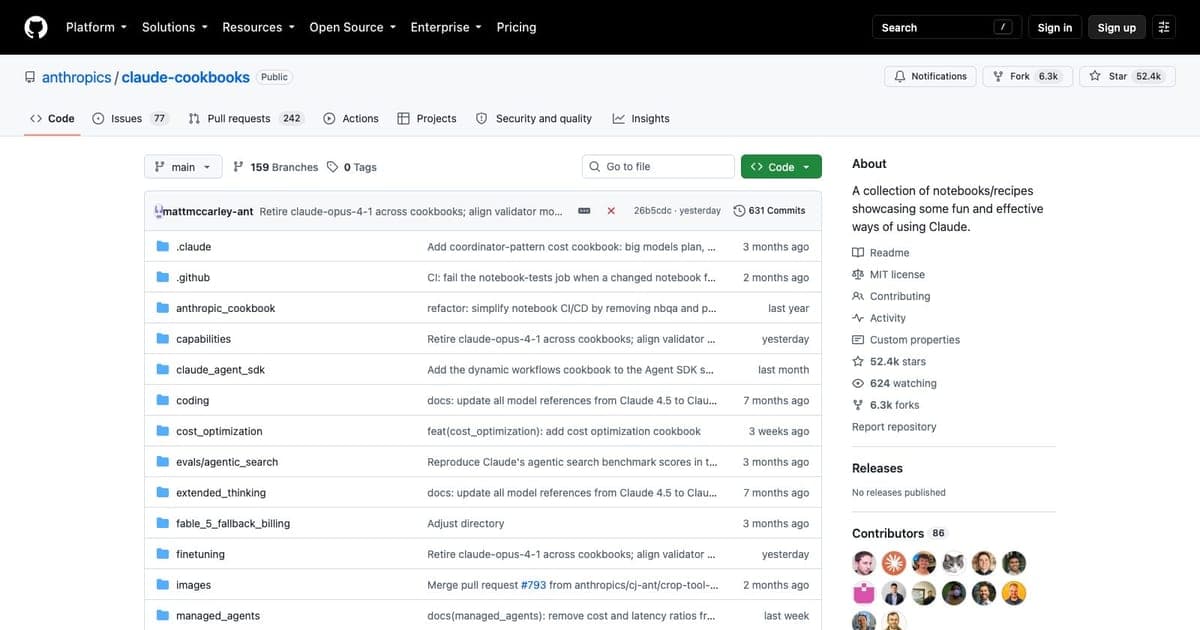
Claude Cookbook is Anthropic's official collection of executable notebooks and code recipes for building with the Claude API.
- Best For: Developers building AI applications with Claude who want working code examples for tool use, agents, RAG, and production patterns.
- Pricing: Free, open-source notebooks, no cost to access or use.
- Verdict: The single best starting point for Claude API development, with production-ready patterns you can copy directly into your projects.
Quick definition: The Claude Cookbook is Anthropic's official collection of executable Jupyter notebooks and code recipes that demonstrate how to build with the Claude API. It covers tool use, agent patterns, MCP integration, extended thinking, RAG, prompt caching, multimodal capabilities, and production-ready patterns.
One-minute highlights
- Official Anthropic resource: maintained by the team that builds Claude.
- Executable Jupyter notebooks with working code you can run immediately.
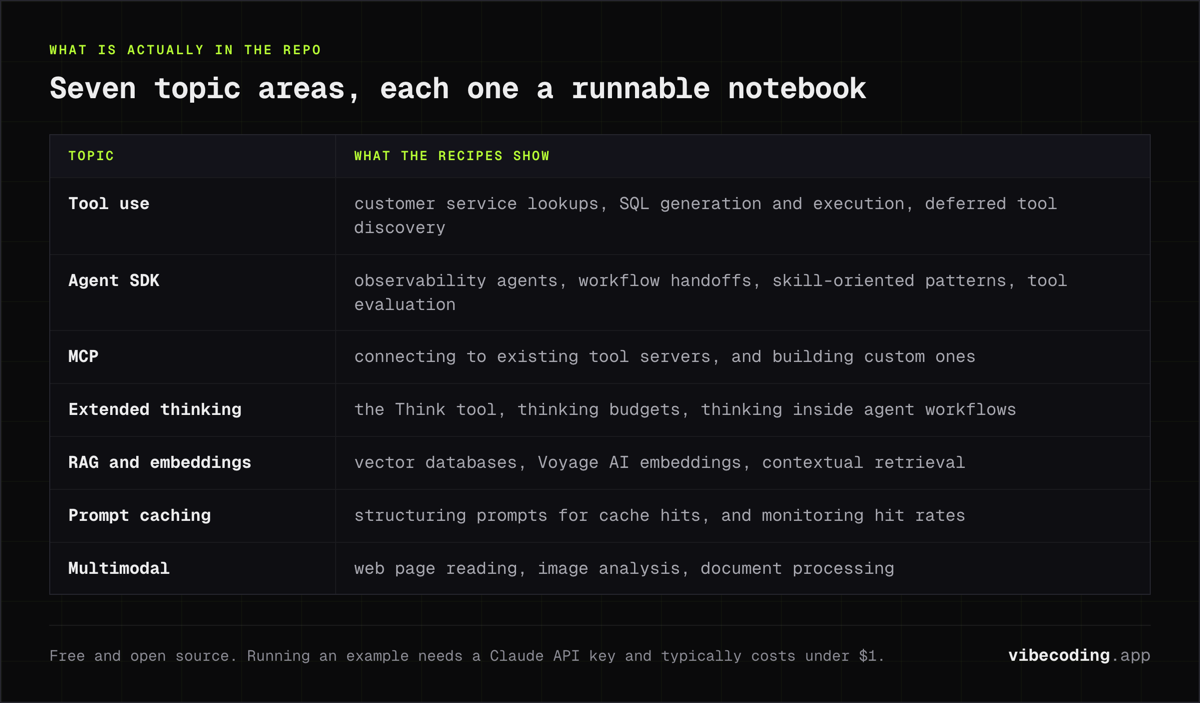
- Covers the full spectrum: tool use, agents, MCP, extended thinking, RAG, embeddings, multimodal.
- Claude Agent SDK patterns including observability, workflow orchestration, and skill design.
- Free and open source, no cost to access, clone, or adapt.
Jump to the specs? Visit the dedicated Claude Cookbook tool page for feature lists, links, and related reads.
Introduction to the Claude Cookbook
When you start building with a new API, the documentation tells you what's possible. The cookbook shows you how to actually do it. The gap between "Claude supports tool use" and "here's working code that implements a tool-using agent" is where the Claude Cookbook lives.
Anthropic maintains this collection of Jupyter notebooks and code guides as the official companion to the Claude API documentation. Each recipe is a working, executable example, not pseudocode or conceptual diagrams, but code you can run in your environment immediately.
For developers building AI applications with Claude, the cookbook eliminates the cold-start problem. Instead of piecing together API features from documentation examples, you clone the cookbook, find the pattern closest to what you need, and adapt it. This is particularly valuable for newer API features like the Agent SDK, MCP integration, and extended thinking, where documentation alone doesn't convey the practical nuances of implementation.
The cookbook is hosted both on GitHub (for cloning and local execution) and on the Claude platform (platform.claude.com/cookbook) for browsable, rendered notebooks.
Core Topics Covered
Tool Use Patterns
The cookbook provides extensive examples of Claude's tool use capabilities: the mechanism that lets Claude call external functions, APIs, and services during a conversation. Examples include:
- Customer service agents that look up orders and process returns
- Calculator integrations for precise mathematical operations
- SQL query generation and execution against databases
- Dynamic tool discovery with deferred loading for large tool sets
- Memory and context management using tool calls
These aren't toy examples. The patterns are structured for production use, with error handling, retry logic, and schema validation.
Agent SDK Patterns
The Claude Agent SDK section covers building autonomous agents, including:
- The observability agent pattern: agents that monitor, log, and self-diagnose
- Workflow orchestration: chaining multiple agent steps with handoffs
- Skill-oriented patterns: defining agent capabilities as modular skills
- Tool evaluation: testing and benchmarking agent tool use accuracy
- Budget management for extended thinking: controlling compute costs
MCP Integration
Model Context Protocol (MCP) examples show how to connect Claude to external tool servers. MCP tool definitions use a schema format similar to Claude's native tool format, making integration straightforward. The cookbook covers both connecting to existing MCP servers and building custom ones.
Extended Thinking
Extended thinking gives Claude a "thinking" phase before responding, improving reasoning on complex tasks. The cookbook demonstrates how to use the Think tool to create dedicated space for structured thinking, manage thinking budgets, and integrate thinking into agent workflows.
RAG and Embeddings
Retrieval-Augmented Generation examples cover:
- Vector database integration (connecting Claude to knowledge bases)
- Embedding generation with Voyage AI
- Wikipedia integration for knowledge-grounded responses
- Contextual retrieval patterns for accurate, cited answers
Prompt Caching
Practical techniques for prompt caching: reducing costs and latency by caching frequently used prompt prefixes. The cookbook shows how to structure prompts for maximum cache hit rates and monitor cache performance.
Multimodal Capabilities
Examples of Claude's vision capabilities, including web page reading, image analysis, and document processing.
Pricing and Access
Completely Free
The Claude Cookbook is free and open source. There is no cost to access, clone, or use any of the notebooks.
API Costs
Running the cookbook examples requires a Claude API key, and API calls are billed at Anthropic's standard rates. Most cookbook examples use minimal tokens, so experimentation costs are typically under $1.
Where to Access
- Platform: platform.claude.com/cookbook: rendered notebooks with syntax highlighting
- GitHub: github.com/anthropics/claude-cookbooks: clone and run locally
Pros and Cons
What we like
- Official and authoritative. Maintained by Anthropic: the patterns reflect how Claude is designed to be used, not how someone guesses it should be used.
- Executable, not theoretical. Every recipe is a working notebook. Run it, see results, adapt it. No translation from pseudocode required.
- Covers the full feature set. Tool use, agents, MCP, extended thinking, RAG, caching, multimodal: comprehensive coverage of Claude's capabilities.
- Production-oriented patterns. Error handling, retries, schema validation, and cost management are baked into examples.
- Updated with new features. When Anthropic ships new capabilities, cookbook recipes follow quickly.
What could be better
- Python-centric. Most examples are Python/Jupyter. TypeScript and other language developers need to translate patterns.
- Organization could be clearer. Finding the right recipe sometimes requires browsing multiple directories. A better categorization would help.
- Some examples assume familiarity. Not all recipes are beginner-friendly, some assume knowledge of embeddings, vector databases, or agent architecture.
- Limited testing guidance. How to test and validate AI application behavior is underrepresented compared to building patterns.
How Claude Cookbook Compares
Claude Cookbook vs OpenAI Cookbook
Both are official prompt libraries from their respective AI providers. The OpenAI Cookbook covers GPT-4 patterns while the Claude Cookbook covers Claude patterns. The Claude Cookbook has stronger coverage of tool use, MCP, and agent patterns: reflecting Anthropic's investment in agentic AI. The OpenAI Cookbook has broader third-party integration examples.
Choose based on which model family you're building with. If you use both, both cookbooks are valuable references.
Claude Cookbook vs LangChain Hub
LangChain Hub is a community-driven prompt marketplace. The Claude Cookbook is an official, curated collection. LangChain Hub has more variety but less quality control; the Claude Cookbook has fewer entries but higher reliability and official backing.
Choose LangChain Hub for breadth across multiple models. Choose Claude Cookbook for depth and reliability with Claude specifically.
Who Should Use Claude Cookbook
Best for
- Claude API developers who want working code examples for every major API feature.
- AI agent builders implementing tool use, MCP, or multi-step agent workflows with Claude.
- Vibe coders using Claude Code or Cursor who want to understand Claude's capabilities through working examples.
- Teams evaluating Claude who need to prototype features quickly before committing to a full implementation.
Not ideal for
- Non-Python developers: patterns need translation for TypeScript, Go, or other languages.
- Complete beginners: some recipes assume API familiarity and AI development knowledge.
- Developers using non-Claude models: the patterns are Claude-specific (though concepts often transfer).
Getting Started
- Browse online at platform.claude.com/cookbook to find relevant recipes.
- Clone the repo:
git clone https://github.com/anthropics/claude-cookbooks.git - Set up your API key: export your Anthropic API key as an environment variable.
- Run a notebook: open any
.ipynbfile and execute cells to see the pattern in action. - Adapt for your project: copy the relevant code into your application and modify for your use case.
Tips for Vibe Coders
- Start with tool use examples. Tool use is the foundation of agentic Claude applications. Master these patterns first before moving to complex agent architectures.
- Use prompt caching for cost control. If your app has a system prompt or shared context, the caching recipes show how to reduce costs by 90%+ on repeated calls.
- Pair with Supabase for RAG. The embedding examples combined with Supabase's pgvector create a production-ready RAG pipeline.
- Study the Agent SDK patterns before building custom agents. The observability and workflow patterns prevent common mistakes in agent architecture.
FAQ
What is the Claude Cookbook? The Claude Cookbook is Anthropic's official collection of executable Jupyter notebooks and code recipes that demonstrate how to build with the Claude API, covering tool use, agents, MCP, extended thinking, RAG, and more.
Is the Claude Cookbook free? Yes, the Claude Cookbook is free and open source. Running the examples requires a Claude API key with standard billing, but most examples cost under $1 to run.
How does Claude Cookbook compare to OpenAI Cookbook? Both are official prompt libraries from their respective AI providers. The Claude Cookbook has stronger coverage of tool use, MCP, and agent patterns, while the OpenAI Cookbook has broader third-party integration examples.
What topics does the Claude Cookbook cover? The cookbook covers tool use, Agent SDK patterns, MCP integration, extended thinking, RAG and embeddings, prompt caching, and multimodal capabilities with working executable code.
Verdict
The Claude Cookbook is the single best resource for developers building with the Claude API. It bridges the gap between documentation and implementation with executable, production-oriented code recipes maintained by Anthropic themselves.
The patterns cover every major Claude capability: tool use, agents, MCP, extended thinking, RAG, caching, multimodal: with working code you can run immediately. For any developer starting a Claude-based project, cloning the cookbook should be step one.
The only real limitations are the Python-centric focus and occasional organization friction. Neither diminishes the value of having official, tested patterns for every major API feature.
For Claude developers and vibe coders, the Claude Cookbook earns a strong recommendation in the Vibe Coding directory.
Rating: 8.5/10
Disclosure: This review reflects our honest assessment. We only recommend tools that align with the Vibe Coding methodology. See the full Claude Cookbook tool page for feature details and links.

Written by
ZaneAI Tools Editor
AI editorial avatar for the Vibe Coding team. Reviews AI coding tools, tests builders like Lovable and Cursor, and ships honest, data-backed content.