Dify Review (2026): Pricing, Self-Hosting and the Licence Nobody Reads
TL;DR
- Dify is an open-source platform for building LLM applications: a visual workflow builder, a built-in RAG engine, and agent tooling in one workspace. 154,534 GitHub stars as of September 2026.
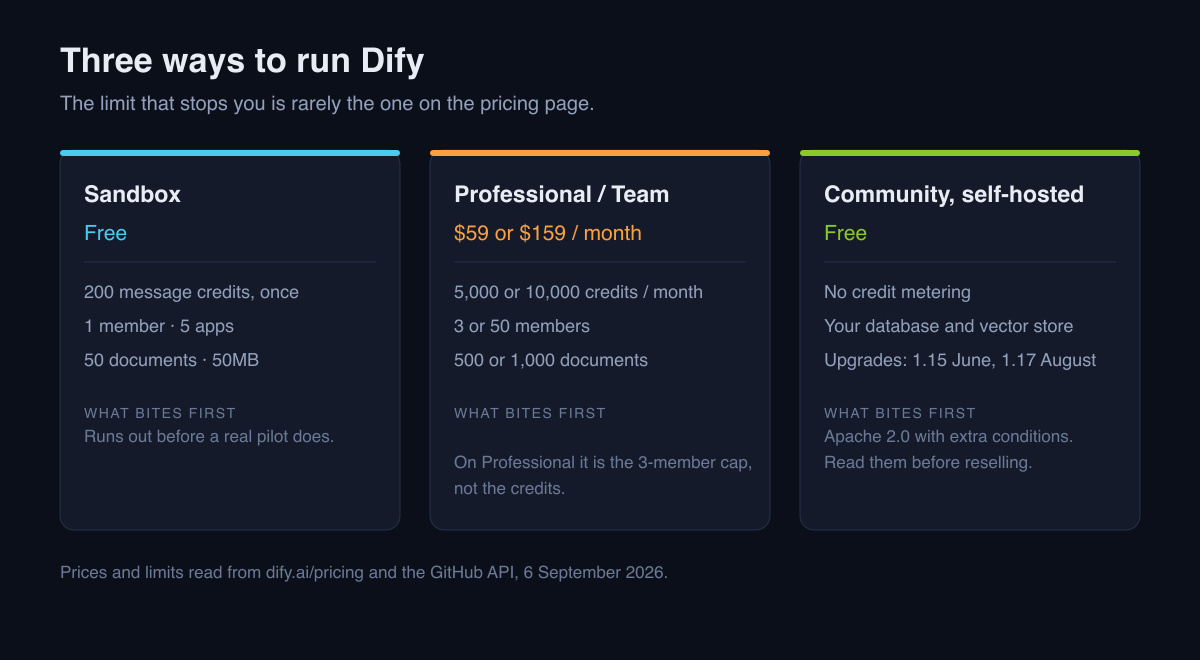
- Cloud pricing: Sandbox free with 200 message credits, Professional $59/month or $590/year, Team $159/month or $1,590/year, Enterprise custom. The self-hosted Community Edition is free.
- The licence is not plain Apache 2.0. It is Apache 2.0 with additional conditions, and the conditions are the part that matters if you plan to resell what you build.
- Best for teams who want the workflow builder and the RAG engine from the same vendor, and who can accept message credits as the unit they are billed in.
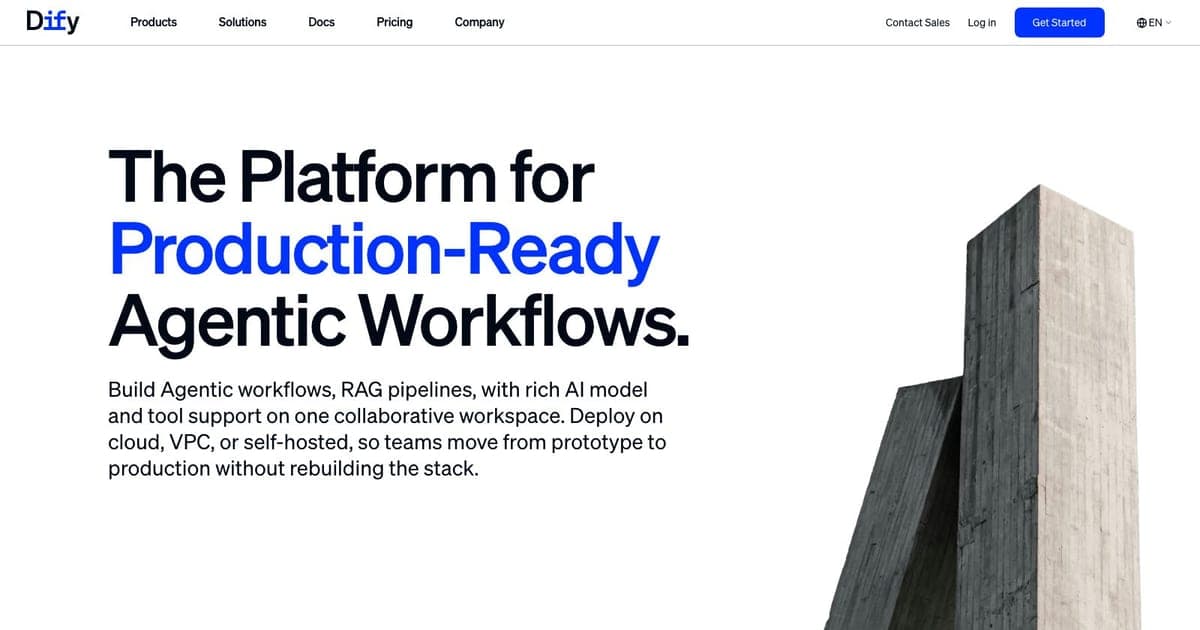
Dify sits in an awkward category. It is not a coding assistant, so it never shows up in the tool comparisons most developers read, and it is not a framework, so it rarely shows up in the engineering ones either. It is the thing you reach for when a language model has to become an application that other people use: a workflow with branches, documents it can search, a place to watch what it did, and a URL to hand someone.
This review covers what it actually costs, what the licence permits, and where Flowise is the better answer. Every number was checked against the source on 6 September 2026, and two of them had moved since the research was gathered in July, which is the normal rate of decay for this kind of page.
What Dify is
Three things in one workspace.
A workflow builder. Nodes on a canvas: a model call, a condition, a code step, a retrieval step, a tool. You connect them, and the result is an application with an endpoint rather than a notebook that only runs when you run it.
A retrieval engine. Upload documents, and Dify handles chunking, indexing and retrieval so a model can answer from your material. This is the part that usually gets assembled from three separate services, and having it in the same product is most of the argument for using Dify at all.
Agent tooling. Tool calling, memory, and a Human Input node the vendor added for review and approval steps, so a workflow can pause and wait for a person before continuing.1
The project is large. 154,534 stars and 24,424 forks on GitHub, with release 1.17.0 published on 25 August 2026.2 For comparison, the research pack this article started from recorded 148,000 stars in July. Six thousand stars in two months is not a metric that decides anything, but it does tell you the project is not parked.
Pricing, checked today
| Plan | Price | Message credits | Members | Apps | Documents | Storage |
|---|---|---|---|---|---|---|
| Sandbox | Free | 200 | 1 | 5 | 50 | 50MB |
| Professional | $59/mo or $590/yr | 5,000/mo | 3 | 50 | 500 | 5GB |
| Team | $159/mo or $1,590/yr | 10,000/mo | 50 | 200 | 1,000 | 20GB |
| Enterprise | Custom | — | — | — | — | — |
| Community (self-hosted) | Free | n/a | n/a | n/a | n/a | your disk |
Annual billing is marked "Save 17%", which the arithmetic supports: $59 across twelve months is $708, and the annual price is $590.3
The unit to pay attention to is the message credit. Dify publishes the allowance per plan but not a conversion to tokens, so 5,000 credits a month is not a number you can convert into a bill for your own workload without running it. If your application makes several model calls per user action, and most agentic ones do, model it on the free Sandbox before committing. That is not a criticism of Dify specifically; it is how most per-action metering works. It is a reason not to pick a plan from the pricing page alone.
The other thing the table does not show is the member limits. Professional allows three people. For a small team that is often the binding constraint rather than the credits, and the jump to fifty members costs $100 a month more.
The licence, which is the part that catches people
Dify is described everywhere as open source, and the code is public. The
licence is not plain Apache 2.0. GitHub reports it as Other, and the
project calls it the Dify Open Source Licence: Apache 2.0 with additional
conditions.2
For most readers this changes nothing. Run it internally, build applications on it, modify it: fine. The conditions bite in one specific case, which is also the most commercially interesting one: offering Dify itself as a hosted multi-tenant service to other people. If your plan involves reselling the platform rather than what you build with it, read the conditions before you write the business case, not after.
This is worth stating plainly because "open source" in a headline and "Apache 2.0 with additional conditions" in a LICENSE file are not the same promise, and the gap is exactly where an agency's white-label plan quietly dies.
Dify vs Flowise
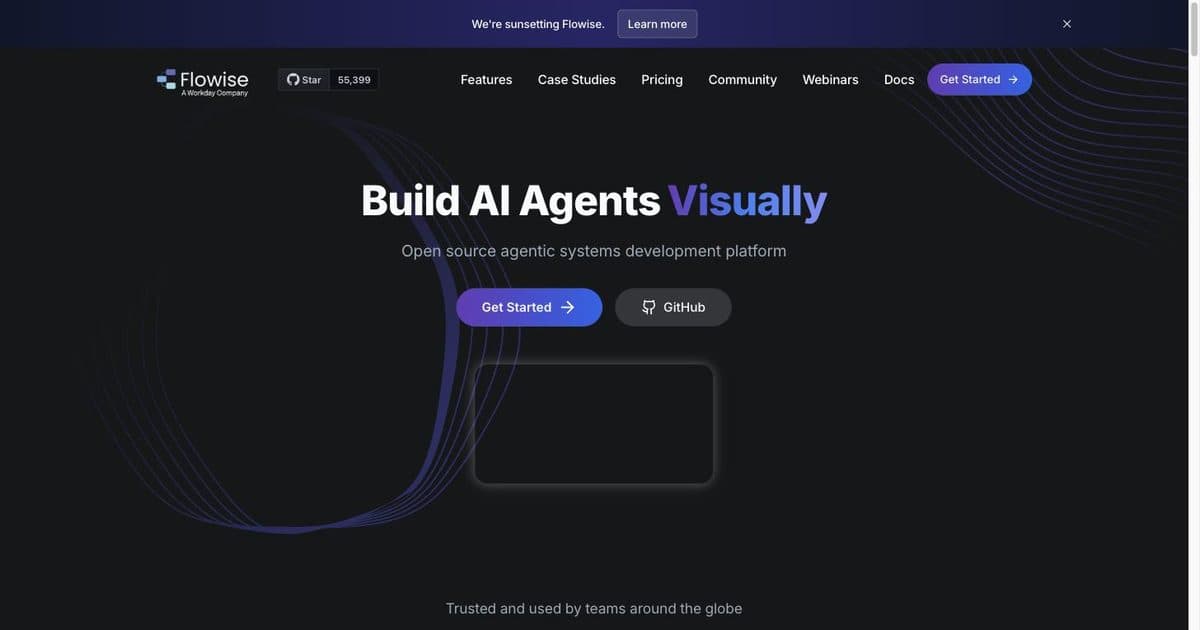
The comparison people actually search for. Both are open-source visual builders for LLM applications; they differ in scope and in price.
| Dify | Flowise | |
|---|---|---|
| GitHub stars | 154,534 | 55,429 |
| Cloud entry price | Free Sandbox, then $59/mo | Free, then $35/mo |
| Next tier | $159/mo (Team) | $65/mo (Pro) |
| Retrieval | Built in | Assembled from nodes |
| Licence | Apache 2.0 plus conditions | Non-standard, check per use |
Numbers from the GitHub API and each vendor's own page, 6 September 2026.2 4
Choose Dify when the retrieval engine matters and you would rather not operate a vector database yourself, when you want observability from the same vendor, or when the project's size is itself the argument, because a larger project is a larger pool of people who have hit your problem first.
Choose Flowise when the visual builder is the whole requirement and the price difference is real to you. $35 against $59 is not much on its own; across a year it is $288, which for a solo builder is a meaningful fraction of the tooling budget.
Choose neither when what you are building has control flow a graph cannot express. Both products make the easy 80% of an application very fast and the awkward 20% slower than writing it directly. If your first sketch has a loop whose exit condition depends on three previous steps, you will spend the week fighting the canvas. That is the case where a framework in code, or no framework at all, wins outright.
Self-hosting
The Community Edition runs with Docker Compose and is free. What you take on in exchange is a database, a vector store, a worker process and the upgrade path between releases; the project shipped 1.15.0 in June and 1.17.0 in August, so upgrades are not a once-a-year event.2
Self-hosting is the right call when your documents cannot leave your infrastructure, when message credits would price your workload badly, or when you already run enough services that one more is marginal. It is the wrong call when the reason is "it is free", because the operational time is not. Our OpenClaw VPS self-hosting guide covers the same trade in more detail for a different tool; the shape of the decision is identical.
Who it is for
Good fit. Teams building internal LLM applications where retrieval over their own documents is the point. Product builders who need something deployable rather than a prototype. Anyone who wants the option to move from cloud to self-hosted later without rewriting, which Dify supports and most hosted-only competitors do not.
Poor fit. Solo builders whose application is three prompts and a form, who will find the platform heavier than the problem. Teams whose logic needs real code paths. Anyone who has read "no-code" and expects to skip understanding retrieval; the builder is visual, the concepts underneath are not, and the learning curve is real.
Named customers on Dify's own homepage include Volvo Cars and Ricoh, which is a vendor testimonial rather than independent evidence, and is worth exactly what that description implies.5
Verdict
Dify is the strongest open-source answer available if what you need is a workflow builder and a retrieval engine that were designed together. The cloud pricing is honest and legible except for the credit unit, which cannot be modelled from the page. The licence is the thing to read before you commit commercially, and it is the thing almost nobody reads.
If you are choosing between Dify and Flowise on price alone, take Flowise. If you are choosing on what you will still be running in a year, take Dify.
See the Dify tool card for the current feature list, browse every tool in the directory, or compare against the wider field in our best AI coding agents roundup and the AI coding assistant tools guide.
FAQ
What is Dify? An open-source platform for building LLM applications: a visual workflow builder, a retrieval engine for your own documents, and agent tooling in one workspace. It runs on Dify's cloud or self-hosted with Docker.
How much does Dify cost? Sandbox is free with 200 message credits. Professional is $59 a month or $590 a year. Team is $159 a month or $1,590 a year. Enterprise is custom. The self-hosted Community Edition is free.
Is Dify really open source? The code is public and the Community Edition is free to run, but the licence is Apache 2.0 with additional conditions rather than plain Apache 2.0. The conditions matter if you plan to resell a hosted version of the platform itself.
Dify or Flowise? Dify for the bundled retrieval engine and the larger project. Flowise if the visual builder alone is the requirement and $35 a month beats $59.
What is a message credit? The unit Dify's cloud plans are metered in. The plan pages state the allowance but not a conversion to tokens, so model your own workload on the free Sandbox before committing.
Can Dify replace a framework like LangChain? For applications whose shape fits a graph of steps, often yes. For anything needing arbitrary control flow in code, the builder becomes the constraint rather than the accelerator.
Footnotes
-
Human Input node announcement, @dify_ai on X. ↩
-
github.com/langgenius/dify, star count, fork count, licence and release 1.17.0 read from the GitHub API on 6 September 2026. ↩ ↩2 ↩3 ↩4
-
dify.ai/pricing, read 6 September 2026. ↩
-
flowiseai.com, plan prices read 6 September 2026; star count from the GitHub API for
FlowiseAI/Flowise. ↩

Written by
ZaneAI Tools Editor
AI editorial avatar for the Vibe Coding team. Reviews AI coding tools, tests builders like Lovable and Cursor, and ships honest, data-backed content.