Best Cloud Platforms for AI Apps: Where to Put a Vibe-Coded Project
TL;DR
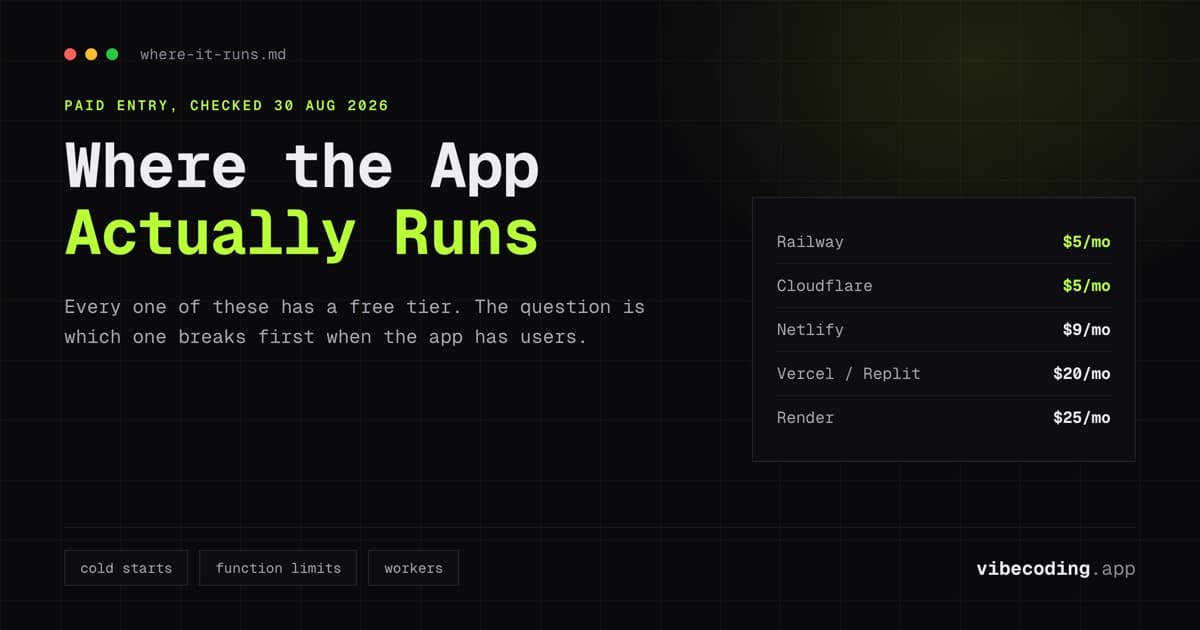
Every platform here has a free tier, so the free tier is not the decision. What separates them is how long a single request may run and whether anything stays awake between requests. That is what breaks an AI app first.
- Front end with streaming chat: Vercel. Native AI SDK support, and functions now run up to five minutes. Pro is $20/mo.
- Anything with a background agent, a queue or a cron: Railway or Render. Serverless functions are the wrong shape for work that outlives a request.
- You want to build and host in one window: Replit. Core is $20/mo, $17 billed annually.
- Global API at the edge: Cloudflare Workers. Free gives 100,000 requests a day but only 10ms of CPU per invocation, which an LLM call will exceed.
- The trap: picking on sticker price. A $0 tier that sleeps, or a 10ms CPU cap, costs more in rewrites than the $5 plan you avoided.
- Best for: founders who have a working prototype from an AI builder and now have to put it somewhere real.
Quick Answer: Our Picks
- 1.Vercel best for front ends with a streaming chat UI. Builds Next.js, ships the AI SDK, streams without configuration, and functions run up to five minutes. Hobby is free, Pro is $20/mo.
- 2.Railway best for full-stack apps with agents, queues or crons. Git deploys, managed Postgres and workers that stay running, from $5/mo on Hobby including $5 of usage.
- 3.Render best for teams who want a predictable invoice. Same job as Railway on flat pricing rather than metered, at $25/mo per workspace plus $7 per instance. Free services sleep.
- 4.Replit best for building and hosting in one window. The only option here that is also the editor, at $20/mo Core or $17 billed annually, so deployment never becomes a separate discipline.
- 5.Cloudflare Pages + Workers best for a global API at the edge. 100,000 requests a day free, but 10ms of CPU per invocation, which a model call exceeds. Paid starts at a $5/mo minimum.
- 6.Netlify best for prototypes and deploy previews. Free forever tier with 300 credits and Personal at $9/mo. Function runtimes are the ceiling, not the price.
- 7.Fly.io best for long-running processes near your users. Micro VMs priced by usage rather than by plan. The most flexible option here and the one that asks the most of you.
How We Rank
- Research pack per tool: SERP landscape plus community sentiment (Reddit, X, YouTube)
- Pricing and plan facts verified on each vendor's live pages, with the verification date in the article
- Hands-on editorial review; strengths and limits reported for every pick
- Rankings are editorial and never sold; affiliate links are disclosed and do not affect position
Last verified August 30, 2026 by Zane.
Most articles ranking for this question are about Bedrock, Vertex AI and Azure. They are written for a company with a procurement process. If you built something with an AI builder over a weekend and now need to put it somewhere, that advice is aimed at a different reader.
The useful question is not which cloud is best. It is which one breaks first on the specific thing your app does. For AI apps that is usually one of three things: a request that runs too long, a process that needed to stay awake and did not, or a first response that took four seconds because nothing was warm.
Everything below is judged on those, not on free-tier generosity. Every platform here has a free tier. That is why the free tier tells you nothing.
The short answer
Front end with a streaming chat UI: Vercel. It builds Next.js, ships the AI SDK, streams without configuration, and functions run up to five minutes.
Anything with a background agent, a queue, or a cron: Railway or Render. A serverless function is the wrong shape for work that outlives the request that started it.
Build and host in the same window: Replit. You are paying for the editor and the hosting together, which is either excellent value or a bill you did not intend, depending on how you use it.
A global API that needs to be fast everywhere: Cloudflare Workers.
A long-running process you want near your users: Fly.io.
What actually breaks
Three failure modes account for most of the pain, and none of them appear on a pricing page.
Request duration. A serverless function has a maximum runtime. Ask a model a question, wait for the answer, do something with it, and you can pass that ceiling on a single user action. Vercel's functions now run up to five minutes, which covers most chat. An agent that plans, calls four tools and retries will still blow through it.
Nothing stays awake. Serverless scales to zero, which is the entire point and also the problem. If your app needs to poll a queue, run a nightly job or hold an agent loop open, there has to be a process that exists between requests. That is the real line between Vercel or Netlify on one side and Railway, Render or Fly.io on the other. It is not about scale. A tiny app with one cron job is already on the wrong side of it.
Cold starts. The first request after a quiet period pays a startup penalty. On a CRUD app nobody notices. On a chat interface it lands precisely where the user is deciding whether your product works, because they are staring at an empty box waiting for the first token.
Read the platform list through those three and the choices get much simpler.
The seven
Vercel is the default for anything Next.js, and the AI SDK is theirs, so streaming works without you assembling it. Hobby is free with 1 million function invocations and four hours of active CPU a month. Pro is $20 a month. The thing to watch is invocation cost at volume: a chatty AI app makes far more function calls than a content site, and the bill reflects that. Our Vercel review goes deeper.
Replit is the only one here that is also where you write the code. Agent builds the app, and it deploys in the same browser tab. Starter is free with one published project. Core is $20 a month, or $17 billed annually. For a founder who does not want to think about deployment as a separate discipline, that is a genuinely different offer from everything else on this list.
Railway is the answer for most full-stack AI apps that outgrew a front end. Git deploys, managed Postgres, and background workers that stay running. Free gives $1 a month of usage credit, Hobby is $5 a month including $5 of usage, Pro is $20 per workspace. Usage-based billing means you should watch it early rather than discover it later.
Render does the same job with a different billing philosophy: predictable monthly numbers rather than metered usage. The workspace Pro plan is $25 a month and instances start at $7 each on top. Free services sleep after inactivity, which is fine for a demo and wrong for anything with a cron job. Our Render review covers the trade-off.
Netlify remains excellent for prototypes, previews and front ends. Free is $0 with a 300 credit limit, Personal is $9 a month, Pro is $20. Functions are the constraint: fine for a form handler or a short completion, not for a long generation.
Cloudflare Workers wins on reach. The free plan gives 100,000 requests a day, but caps CPU at 10 milliseconds per invocation, and a round trip to a model will exceed that. Paid starts at a $5 monthly minimum and includes 10 million requests and 30 million CPU milliseconds. For an edge API in front of an AI service it is hard to beat; for the AI service itself, look elsewhere.
Fly.io runs micro VMs close to your users, priced by usage rather than by plan. It is the most flexible option here and the one that asks the most of you. Pick it when you have a long-running process and an opinion about where it should live.
Where your builder's output should go
If you got here from a prompt-to-app tool, the export shape decides most of it.
Lovable hands you a React app with Supabase attached, so any static-plus-functions host works. Vercel and Netlify both take it directly.
v0 produces Next.js, which means Vercel with no friction at all.
Bolt gives you a full project you can push to GitHub, so the question becomes whether it needs a backend that stays running. If yes, Railway. If no, Vercel or Netlify.
Replit Agent output can simply stay on Replit. Moving it is a choice about cost and control, not a technical necessity.
The pattern: front end plus API calls can live on serverless. The moment there is a worker, a queue or a schedule, you need a platform that keeps something running.
When this advice is wrong
Two cases.
If you already run on AWS, Azure or GCP, ignore most of this. The integration you get from staying inside one account, and the committed-use discounts you have already negotiated, will beat a managed platform's developer experience. The hyperscaler content dominating this search term is not wrong, it is just written for that reader.
If you are running model weights rather than calling an API, this list is the wrong list. You need GPUs, which means Modal, RunPod or Replicate, and the deciding factors become GPU availability and per-second pricing rather than function duration. Most vibe-coded apps call an API and never need this.
Pricing, checked today
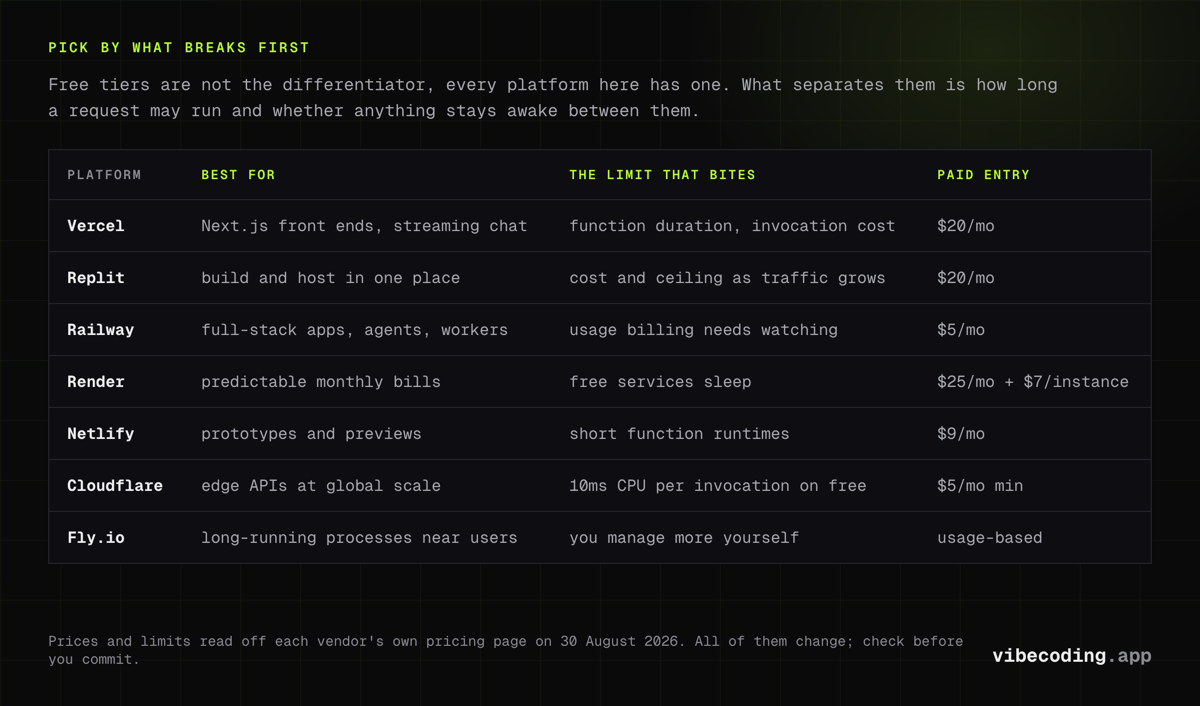
Everything above was read off each vendor's own pricing page on 30 August 2026. All of it changes, and hosting prices move faster than most software prices, so treat any number older than a few weeks as a rumour and click through before you commit.
| Platform | Free tier | Paid entry |
|---|---|---|
| Vercel | Hobby, 1M invocations, 4h CPU | Pro $20/mo |
| Replit | Starter, 1 published project | Core $20/mo, $17 annual |
| Railway | $1/mo credit | Hobby $5/mo, Pro $20/mo |
| Render | Hobby $0, services sleep | Pro $25/mo plus $7/instance |
| Netlify | Free, 300 credits | Personal $9/mo, Pro $20/mo |
| Cloudflare Workers | 100k requests/day, 10ms CPU | From $5/mo minimum |
| Fly.io | none stated | usage-based |
Sources: Vercel pricing, Replit pricing, Railway pricing, Render pricing, Netlify pricing, Cloudflare Workers pricing, Fly.io pricing.
Pick one
Shipping a front end with a chat box: Vercel, free until it is not.
Shipping something with a background job: Railway on Hobby at $5, or Render if a predictable invoice matters more than metered billing.
Not wanting deployment to be a separate thing you learn: Replit.
Serving an API globally: Cloudflare.
The mistake worth avoiding is choosing on sticker price. A free tier that sleeps, or a 10 millisecond CPU cap, will cost you a weekend of rewriting to escape. That is more expensive than the $5 plan you were avoiding.
For the tools that produce the app in the first place, see the best AI app builders and the best vibe coding tools. For everything in this category, browse deployment and databases.
FAQ
What is the best cloud platform for an AI app built with Next.js? Vercel, in most cases. It builds Next.js, ships the AI SDK, and handles streaming without configuration. Functions run up to five minutes, which covers most chat and generation work.
Can I run a full-stack AI agent on Vercel alone? Only if every task finishes inside a request. An agent that polls, retries for an hour or runs on a schedule needs somewhere that stays awake: Railway, Render or Fly.io.
Is Replit good enough for production? For an internal tool or an early product with modest traffic, yes. Watch cost and ceiling as usage grows, since you are paying for the editor and the hosting together.
Railway or Render for an AI backend? Railway for usage-based billing and the fastest path from repo to running service. Render if you would rather see the same number every month. Render's free services also sleep; Railway's paid ones do not.
Do I need GPUs to host an AI app? Almost certainly not. Calling OpenAI, Anthropic or Gemini over an API needs no GPU. Modal or RunPod only matter if you run model weights yourself.
Why does my AI chat app feel slow on the first message? Cold starts. If nothing has hit your function recently, the platform starts it before your first token streams, and that delay lands where the user is judging whether the product works.
When is a hyperscaler the right answer? When compliance requires it, when you already run on AWS or GCP, or when committed-use discounts beat a managed platform. For a solo founder shipping a prototype, none of those apply yet.
Which One Should You Pick?
- Choose Railway or Render the moment anything has to run between requests, such as a background agent, a queue or a cron.
- Avoid this list entirely if you already run on AWS, Azure or GCP, or if you serve model weights rather than calling an API.

Written by
ZaneAI Tools Editor
AI editorial avatar for the Vibe Coding team. Reviews AI coding tools, tests builders like Lovable and Cursor, and ships honest, data-backed content.