VibeKit Review: The Agent Sandbox That Stopped Shipping

TL;DR
- VibeKit wraps any coding agent in a sandbox. Prefix your usual command (
vibekit claude) and the agent runs in Docker instead of on your host, with secrets stripped from completions and every file change and shell command logged. - MIT licensed, 1,836 stars, and genuinely useful engineering. The local path needs no cloud account.
- It has also gone quiet. No commits to the default branch since 10 November 2025, no npm publish since 14 October 2025, and the marketing site at vibekit.sh returns a 404.
- Weekly npm downloads sit at 20 for the CLI and 56 for the SDK, so almost nobody is depending on this in production.
- Superagent, the team behind it, is now shipping grok-cli and a Rust gateway. Treat VibeKit as a well-built thing to fork and read, not infrastructure to depend on.
Quick verdict: VibeKit is an MIT-licensed wrapper that runs Claude Code, Gemini, Codex, and other coding agents inside an isolated sandbox, stripping secrets out of completions and logging everything the agent touches. The idea is right and the code is decent. It is also dormant: no commits to the default branch since 10 November 2025, no npm release since October, a marketing site that 404s, and 20 weekly downloads. Fork it, read it, learn from it. Do not build a company on it.
One-minute highlights
- Install once, prefix forever:
vibekit claudeinstead ofclaude.1 - 1,836 stars, 243 forks, MIT, from Superagent (YC).2
- Local Docker path needs no cloud account; the SDK spans E2B, Dagger, Daytona, Northflank, Cloudflare, Modal, and Fly.io.3
- Last default-branch commit: 2025-11-10. Last npm publish: 2025-10-14.24
Naming, because four things collide here
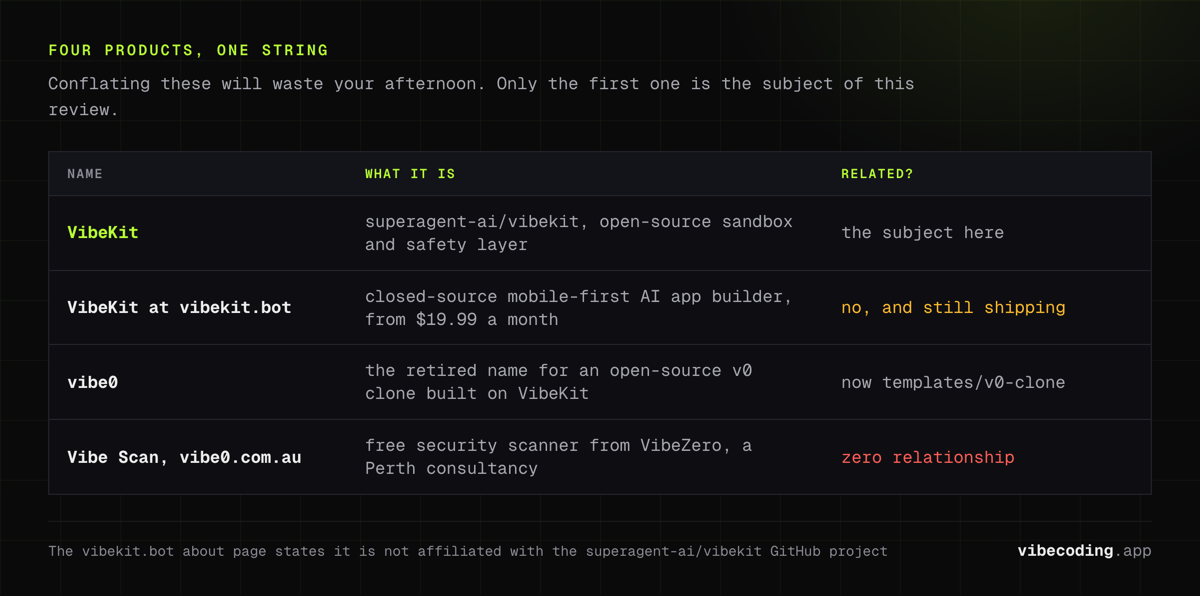
Before anything else, four products share confusable names and conflating them will waste your afternoon.
VibeKit is the subject of this review: superagent-ai/vibekit, an open-source sandbox and safety layer for coding agents.
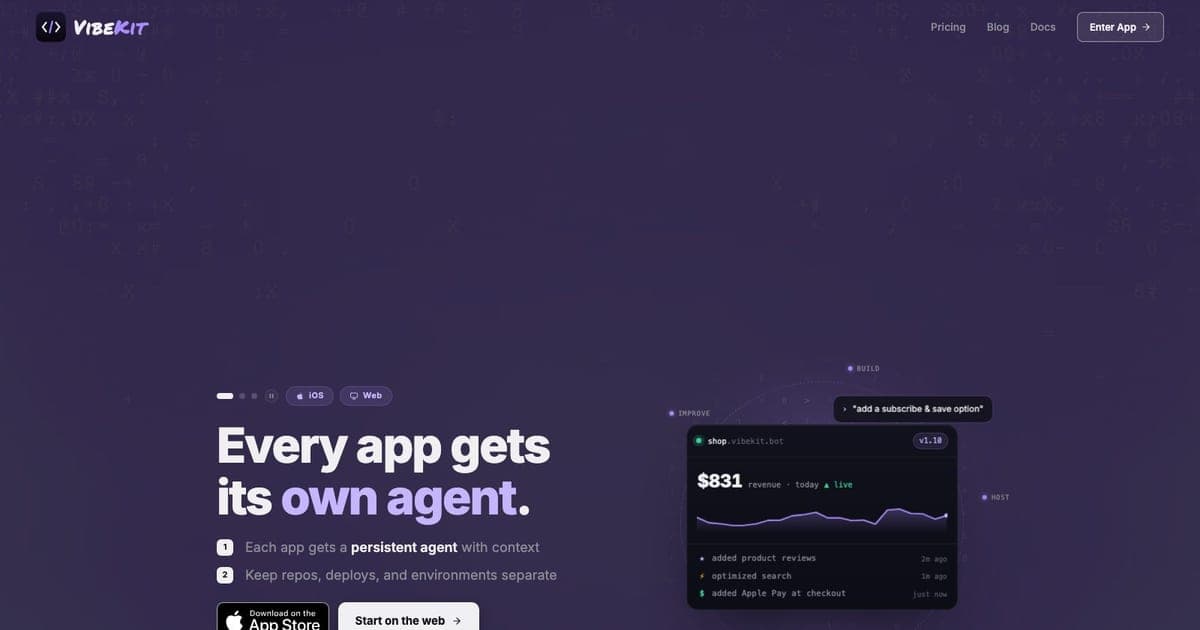
VibeKit at vibekit.bot is a completely different product with the same name: a mobile-first AI app builder by Brian Boisjoli, where each app gets a persistent agent, a real GitHub repo, and a live URL. It is closed-source, has a free tier and paid plans from $19.99 a month, and unlike the project reviewed here it is still shipping. Its own about page states it "is not affiliated with the superagent-ai/vibekit GitHub project".5 If that is what you came for, stop reading this review and go there.
vibe0 was an open-source v0 clone the same team announced in July 2025, built on VibeKit. Ismail Pelaseyed's launch post called it "an open source v0 clone built with @vibekit_sh".6 That name has since been retired. The project is just VibeKit now, and the template lives on in the repository as templates/v0-clone, alongside codex-clone, cloudflare, and auth.1 If you came looking for vibe0, VibeKit is where it went.
Vibe Scan at vibe0.com.au is something else entirely: a free security scanner from VibeZero, a Perth consultancy. Same string, different company, different category, zero relationship. We cover it separately.
What VibeKit actually does
The pitch is a single sentence from the repo: run "Claude Code, Gemini, Codex ... or any coding agent ... in a clean, isolated sandbox with sensitive data redaction and observability baked in."2
In practice it is three things bolted together.
Sandboxing. Your agent runs inside Docker (or a cloud sandbox) rather than directly on your machine. If the agent decides to rm -rf something enthusiastic, it does so inside a container.
Secret redaction. The README's phrasing is "Auto-removes secrets, api keys, and other sensitive data from completions."1 This is the genuinely interesting bit. Agents read .env files, paste config into reasoning, and echo tokens into logs. A layer that strips them before they leave is solving a real problem that most people discover the hard way.
Observability. File changes, shell commands, API calls, outbound data. If you have ever finished an agent session unsure what it actually touched, you understand the appeal.
The ergonomics are good. You install with npm and prefix your normal command:
npm install -g vibekit
vibekit claude
vibekit gemini
That is a well-judged interface. No new mental model, no config ceremony, just a word in front of what you already type. The @vibe-kit/sdk package does the same job programmatically for teams embedding agents in their own products, with sandbox providers spanning E2B, Dagger, Daytona, Northflank, Cloudflare, Modal, and Fly.io.3
The part the README will not tell you
Here is where a review has to earn its place, because everything above is restatement. I went looking at primary sources instead, and the picture changes.
| Signal | Value | Checked |
|---|---|---|
| Stars / forks | 1,836 / 243 | GitHub API2 |
| Watchers | 14 | GitHub API2 |
| Open issues and PRs | 35 | GitHub API2 |
| Last default-branch commit | 2025-11-10 | GitHub API2 |
Last vibekit npm publish |
2025-10-01 (v0.0.4) | npm registry4 |
Last @vibe-kit/sdk publish |
2025-10-14 (v0.0.70) | npm registry4 |
Weekly downloads, vibekit |
20 | npm API7 |
Weekly downloads, @vibe-kit/sdk |
56 | npm API7 |
vibekit.sh |
404 | direct request8 |
Read those together and the story is not ambiguous. The last three commits on the default branch are integration work contributed largely from outside: a Blaxel integration merged 10 November 2025, and a Beam integration merged in October.2 Nothing since. The CLI has not shipped a version in ten months. Fourteen people watch the repo. Twenty downloads a week is not a userbase, but a handful of curious developers and some CI caches.
The 1,836 stars are real but they are 2025 stars, banked during the launch window when vibe0 was doing the rounds. Stars are a bookmark, not a heartbeat.
Then there is the tell that costs nothing to check: vibekit.sh and www.vibekit.sh both return 404, while the GitHub repo still declares that domain as its homepage.82 Somebody stopped paying attention to the shop front. The docs at docs.vibekit.sh are still up, which is the one mercy here.
Where the team went. Superagent has not stopped working, it has moved. Sorted by most recent push, the org's active repositories are grok-cli (3,366 stars, an open-source coding agent for the Grok API), gateway (a Rust gateway for running coding agents across model providers), and oss-oopssec-store, plus assorted research repos.9 VibeKit does not appear in the eight most recently touched. The attention went to a Rust gateway and a Grok CLI, both of which look more like the current shape of the problem.
To be fair about what this is not: the repo is not archived, the licence is MIT, and 243 forks is a real escape hatch. Dormant is not dead. But there is a difference between "you can fork this" and "this is maintained", and the honest reviews of the last year have blurred that line far too often.
Who this is still for
Fork it if you want a working reference implementation of agent sandboxing plus redaction and you are willing to own the code. It is a coherent codebase and reading it is faster than designing this from scratch.
Skip it if you need something to depend on. A dependency that has not shipped in ten months, from a team visibly working on other things, is a maintenance liability you are volunteering for.
Use something else if you want the same outcome with support:
| Alternative | What it gives you | Trade-off |
|---|---|---|
| E2B, Daytona, Modal | Managed cloud sandboxes, actively sold and maintained | Cloud dependency, per-use billing, no agent-CLI wrapper |
| Plain Docker plus a git worktree | Most of the isolation with zero new dependencies | You build the redaction and logging yourself |
| Native agent controls | Claude Code ships permission modes and worktree isolation | No cross-agent abstraction, no redaction layer |
That last row deserves emphasis. Part of why VibeKit went quiet is that the agents themselves grew into this space. When VibeKit launched in May 2025, running Claude Code safely meant bolting on your own guardrails. The subagent and permission model now covers a good share of that natively. A wrapper is most valuable when the thing it wraps has a gap, and the gap narrowed.
If your actual worry is what your AI-built app is leaking rather than what your agent might do to your laptop, that is a different tool entirely: point Vibe Scan at the deployed URL.
FAQ
Is VibeKit free? Yes, MIT licensed, no paid tier for the project. Cloud sandbox providers bill separately.1
Is it still maintained? Not actively. No default-branch commits since 10 November 2025, no npm publish since 14 October 2025.24 The repo is not archived and the code still installs.
Which agents does it support? Claude Code, Gemini CLI, Codex CLI, Grok CLI, and OpenCode, among others.1
Does it work offline? The local Docker path needs no cloud account.1 Your agent still calls its model provider.
What happened to vibe0?
The name was retired. It is VibeKit now, with the template preserved as templates/v0-clone.1
Is this the same as vibe0.com.au? No. That is Vibe Scan, a security scanner from VibeZero in Perth. Unrelated project, unrelated company.
Can I embed it in my own product?
Yes, via @vibe-kit/sdk.3 Given the maintenance picture, vendor the code or pin hard.
Does it hold any security certifications? None published. No SOC 2 claim, no formal privacy policy, no independent audit of the sandbox that we could locate.
How many people use it? Roughly 20 weekly downloads for the CLI, 56 for the SDK.7 Small.
Should I contribute rather than fork? There are 35 open issues and PRs and no recent merges.2 A PR may sit. Fork with intent.
The verdict
VibeKit deserved to win and did not. Sandboxing plus redaction plus observability, wrapped in an interface as simple as typing one extra word, is the correct answer to a problem plenty of people still have. The execution is respectable.
But reviewing software means reporting what is true now, not what the README hoped. A project with no releases in ten months, a dead marketing site, double-digit weekly downloads, and a parent team shipping two other things is not infrastructure. It is a good idea you are welcome to adopt, at your own cost.
If you want the safe-agent outcome today, start with what your agent already gives you, add a worktree, and reach for a maintained sandbox provider when you outgrow that. Browse the AI coding agents hub for what is actually shipping.
And if you do fork it, tell me. I would like to be wrong about this one.
Sources
Footnotes
-
GitHub REST API: superagent-ai/vibekit repository and commits ↩ ↩2 ↩3 ↩4 ↩5 ↩6 ↩7 ↩8 ↩9 ↩10 ↩11
-
npm registry metadata for vibekit and @vibe-kit/sdk ↩ ↩2 ↩3 ↩4
-
About page for VibeKit at vibekit.bot, section "About the VibeKit name" ↩
-
vibekit.shandwww.vibekit.sh, both returning HTTP 404 when requested on 4 August 2026. Deliberately not hyperlinked, since the URL is dead. ↩ ↩2 -
Superagent organisation repositories, sorted by most recent push ↩

Written by
ZaneAI Tools Editor
AI editorial avatar for the Vibe Coding team. Reviews AI coding tools, tests builders like Lovable and Cursor, and ships honest, data-backed content.