VibeCodeSecure Review (2026): Free, Frictionless, and Claiming More Than a URL Can See
TL;DR
- VibeCodeSecure is a free, single-page security scanner for AI-built apps. Paste a URL, press Scan Now. No account, no email, no card.
- That zero-friction bar is genuinely the lowest in this category, and it is the main reason to use it.
- It advertises four categories: HTTP Headers, TLS/SSL, Auth Controls, Infrastructure. The first two a URL scan can do properly.
- Authorization cannot be evaluated from outside a login. That is a property of black-box scanning, not a criticism of this vendor's effort, and it means the last two categories should be read as hints.
- Early-stage: no docs, no changelog, no privacy policy, no pricing page. Use it as a thirty-second first look, not as an audit.
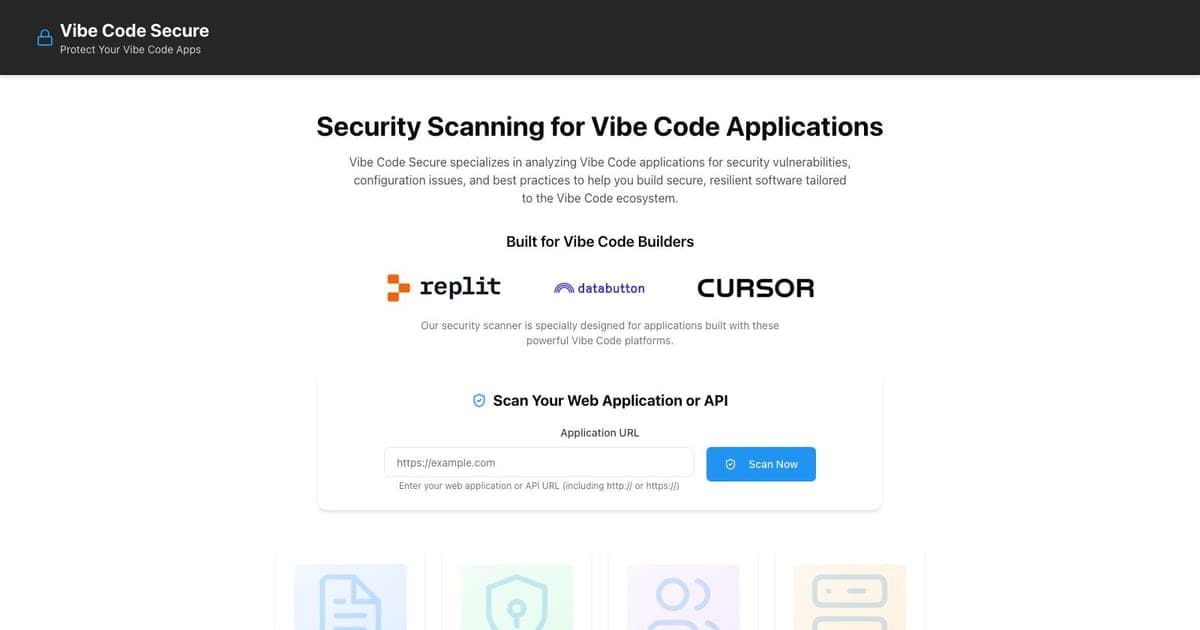
VibeCodeSecure is about as frictionless as a security tool gets. One page, one input, one button. No account, no email, no card, and no pricing page anywhere on the site.1
In a category that has quietly standardised on collecting your email before showing you anything, that is worth something on its own.
What it is
A scanner aimed specifically at applications built with AI tools. The site names its target platforms directly: Replit, Databutton and Cursor.1
You paste an application or API URL, press Scan Now, and it reports against four advertised categories:1
| Category | What the site says it does |
|---|---|
| HTTP Headers | Security headers for XSS, CSRF and injection protection |
| TLS/SSL | Transport layer and encryption implementation |
| Auth Controls | Authentication, authorization and session security |
| Infrastructure | API configuration, server security and deployment setup |
That is the whole product. There is no dashboard, no history, no account to log back into.
What a URL scan can actually observe
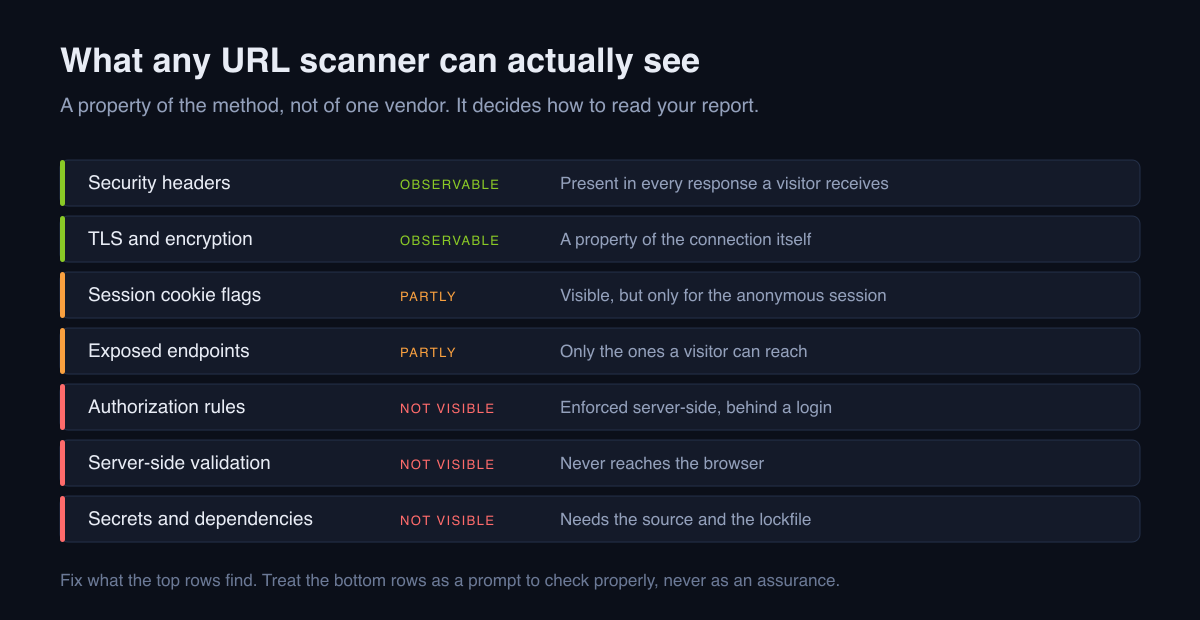
Two of those four categories are exactly what black-box scanning is good at, and two are not. This is worth being precise about, because it changes how you should read your own report.
Headers and TLS are genuinely observable. They are properties of the
response any visitor receives. A scanner reads them directly, the findings are
factual, and a missing header is a missing header. If this tool tells you your
Content-Security-Policy is absent, believe it.
Authorization is not observable from outside. Authorization is a rule about who is allowed to do what, enforced on the server and usually behind a login. A scanner that reads only what an anonymous visitor can see has no access to that rule. It can notice that a login form exists and that session cookies carry sensible flags, which are useful things, and neither is the same as evaluating authorization.
Infrastructure is partly observable. Server headers, exposed endpoints and TLS configuration, yes. Whether your API validates its input, whether your database policy is correct, whether a secret is sitting in an environment variable it should not be: no.
None of that is a flaw in this vendor's execution. It is the shape of the category, and we set out the same reasoning at more length in our review of Vibe Scan, whose own documentation is admirably clear about the same limits. The difference is that VibeCodeSecure's category labels promise a little more than the method can reach, and a reader who takes "Auth Controls: passed" as an assurance about their authorization has been misled by a heading rather than by a finding.
Against Vibe Scan
The closest comparison, with what we can and cannot claim about each.
| VibeCodeSecure | our Vibe Scan review | |
|---|---|---|
| Cost | Free | Free |
| Account | None | None |
| Email required | No | Yes, name and work email |
| Scope | Four categories from a URL | Page, headers, up to eight same-origin scripts |
| Documentation | None published | Product page with an explicit safety section |
| Independently audited by us | No | Yes |
On friction, VibeCodeSecure wins outright. Nothing to hand over.
On evidence, we can say more about Vibe Scan, because we ran it against our own production site and checked every finding against the code. We have not done that here, and it would be dishonest to imply otherwise by writing a confident accuracy verdict. What we can say is what the tool claims and what its method can support.
Where it is early
The site publishes no documentation, no changelog, no privacy policy and no pricing page.1 For a free tool that takes a URL and nothing else, the missing privacy policy matters least of the four, and it is still a gap: you are handing over the address of your application and you cannot read what happens to it.
The absence of a changelog is the one that would concern us before relying on it. A scanner is only as good as its current rule set, and there is no public way to see whether that set has changed since launch.
Who should use it
Yes as a thirty-second first look before launch, particularly if you have never checked your headers.
Yes if you object to handing over an email to find out whether your own site leaks something. That is a reasonable objection and this is the tool that respects it.
No as your only check. Header hygiene is the floor, not the ceiling.
No for anything about authorization, validation, secrets or dependencies. Those need something that reads your source, and our guide to security vulnerabilities in vibe-coded apps covers what that involves.
No if you need a record. There is nothing to return to.
Verdict
A genuinely useful free first look with the lowest friction in its category, and category labels that promise more than a URL scan can deliver.
Run it. Fix the headers it finds. Then treat everything it says about auth and infrastructure as a prompt to go and check properly, rather than as an answer.
See the VibeCodeSecure tool card for the current entry, or the directory for the rest of the field.
FAQ
Is VibeCodeSecure free? Yes, with no account, no email capture and no pricing page on the site. You paste an application or API URL and press Scan Now.
What does it check? Four advertised categories: HTTP headers, TLS and encryption, auth controls, and infrastructure.
Can it really check authorization? Not in the sense most readers assume. Authorization is enforced server-side, usually behind a login, and a scan of what an anonymous visitor can see cannot observe it.
How does it compare to Vibe Scan? Same layer, lower friction: this one asks for nothing where Vibe Scan asks for a name and work email. We have audited Vibe Scan's accuracy against our own codebase and have not done the same here.
Is it enough before launch? As a first look, yes. As an audit, no.
Which platforms is it aimed at? The site names Replit, Databutton and Cursor.
Footnotes
-
vibecodesecure.com, product description, the four scan categories and their wording, the named platforms, and the absence of any account, email capture, pricing page, documentation or changelog. Read from the rendered page on 6 September 2026. ↩ ↩2 ↩3 ↩4

Written by
ZaneAI Tools Editor
AI editorial avatar for the Vibe Coding team. Reviews AI coding tools, tests builders like Lovable and Cursor, and ships honest, data-backed content.