VibeEval Review (2026): The One That Actually Attacks Your App
TL;DR
- VibeEval actively probes a live app rather than reading what a visitor can see, and a security engineer reproduces each finding before you get it. That is the difference from every free scanner in this category.
- Pro $49/month, Team $149/month for 5 seats, Lifetime $499 once. Signed pentest engagements start at $2,900. Free trial 14 days, 30-day money-back.
- A free Token Leak Checker needs no signup at all, which is a genuine way to try the thing before paying.
- It reaches the layer a passive scan cannot: RLS, auth bypasses, IDOR. That is also why you must own the app you point it at.
- The headline numbers, 310+ checks and zero false positives, are the vendor's. We have not audited them.
We have now reviewed three security tools aimed at AI-built apps in the same week, and this is the one that does something structurally different.
The two we covered first, in our VibeCodeSecure review and our Vibe Scan review, both read your application: they fetch what a visitor can see and report on it. That method is honest and cheap, and it cannot observe authorization, because authorization lives behind a login and is enforced on the server.
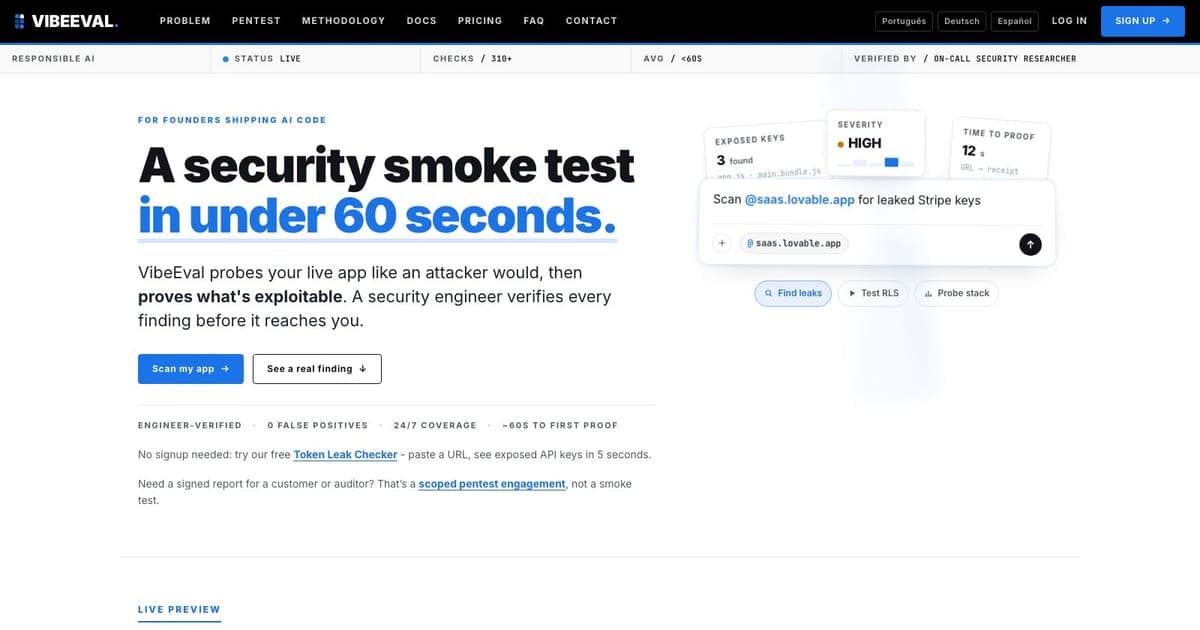
VibeEval probes instead. Its own description is that it "probes your live app like an attacker would, then proves what's exploitable".1 That changes what is reachable, what it costs, and what you take on by running it.
What active probing buys
A passive scan can tell you a header is missing. An active probe can try the thing that header was supposed to prevent, and tell you whether it worked.
For AI-built applications that difference lands on a specific, well-known set of failures: row-level security that was never switched on, an authorization check that trusts a client-supplied identifier, an object reference that increments, an API key that shipped to the browser. Those are the mistakes generated code makes most reliably, and none of them is visible to a scanner that only reads.
The site claims 310+ checks, a scan in under 60 seconds, and results described as engineer-verified with zero false positives.1 Those are the vendor's numbers. We have not run the accuracy audit on this tool that we ran on Vibe Scan, and we are not going to imply otherwise.
The part that justifies the price
What genuinely distinguishes this product is not the scanner. It is the sentence next to it: "A security engineer verifies every finding before it reaches you."1
That is a process claim rather than a technology claim, and it is the right one to make. The dominant failure of automated security tooling is not missing things; it is drowning you in findings that are technically true and practically irrelevant, which is exactly what we measured when we audited a free scanner against our own site and found roughly three of eight high-severity findings held up.
Putting a person between the scanner and the customer is the only reliable fix for that, and it is expensive, which is why free tools do not do it. Whether this particular vendor does it well is something a buyer should probe on the trial rather than take from a landing page, and the trial exists precisely so you can.
Pricing
Read from the vendor's own page on 6 September 2026:1
| Plan | Price | For |
|---|---|---|
| Token Leak Checker | Free, no signup | Paste a URL, see exposed API keys |
| Pro | $49/mo | Unlimited projects, daily re-scans, 24h email support |
| Team | $149/mo | 5 seats, scheduled scans, shared reports, webhook API |
| Lifetime | $499 once | Everything in Pro, real-time monitoring, no renewal |
| Pentest engagement | From $2,900 | A scoped test with a signed report |
There is a 14-day free trial and a 30-day money-back guarantee.1
Two observations. The free Token Leak Checker is a real trial, not a teaser: no signup, and exposed keys are the single most common serious finding in AI-generated front ends. Start there.
The Lifetime plan is priced at ten months of Pro. The vendor labels it launch pricing. Lifetime deals on a service with ongoing cost are a bet by both sides: you are wagering that the vendor stays in business longer than ten months, which for an early-stage security product is a real question rather than a rhetorical one.
What you take on
Active testing is not a neutral act.
Only point it at what you own. Probing sends requests designed to trigger real failures. Against somebody else's system that is unauthorised testing, whatever your intent.
Expect side effects on your own app. A probe that successfully exercises a write path has written something. Run it against staging first if you have one, and know what your data looks like afterwards if you do not.
A finding is a real finding. That is the point, and it means the report can tell you something genuinely alarming about a live application with real users. Have a plan for what you do at 11pm if it does.
Against the free options
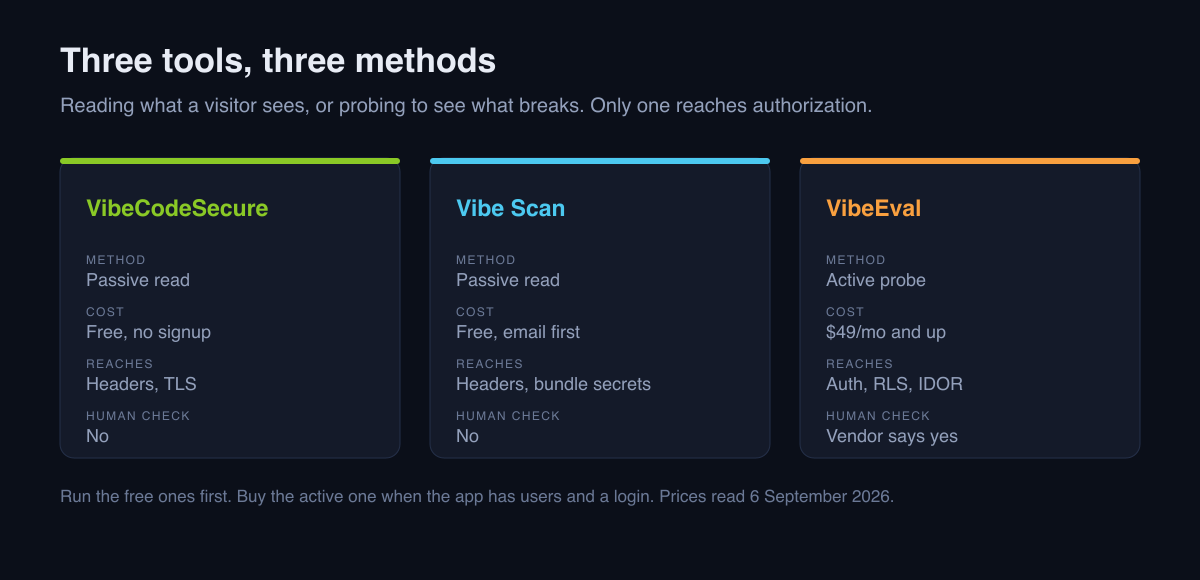
| VibeCodeSecure | Vibe Scan | VibeEval | |
|---|---|---|---|
| Method | Passive read | Passive read | Active probe |
| Cost | Free | Free | $49/mo and up |
| Signup | None | Name and work email | Account, trial available |
| Human verification | No | No | Vendor says yes |
| Reaches authorization | No | No | Yes |
| Audited by us | No | Yes | No |
The sensible sequence for someone shipping their first AI-built product is all three, in that order and over about ten minutes: the free no-signup checks to catch header and key mistakes, then a paid active scan when the app has users and a login to protect.
Who it is for
Yes once your app has real users, a login and a database. That is the point at which the failures it hunts start to matter.
Yes if you are shipping to a customer who will ask security questions, where the $2,900 engagement with a signed report is the actual product you need.
No while you are still prototyping. Nothing here beats free header checks on a project with no data in it.
No as your only control. It probes what is deployed; it does not read your code, your dependency tree or your secrets handling. Our guide to vibe-coded security vulnerabilities covers the half it does not see.
Verdict
The only tool in this category we have looked at that reaches the layer where AI-generated code actually fails, and the only one that puts a person between the scanner and your inbox.
Try the free Token Leak Checker today. Buy Pro when your app has users. Treat the vendor's zero-false-positive claim as the thing to test during the trial, because it is the whole reason for the price.
See the VibeEval tool card for the current entry.
FAQ
How much does VibeEval cost? Pro $49 a month, Team $149 a month with five seats, Lifetime $499 once, and pentest engagements from $2,900. There is a 14-day trial, a 30-day money-back guarantee and a free Token Leak Checker with no signup.
How is it different from a free scanner? It probes actively rather than reading what a visitor sees, so it can reach authorization failures, row-level security gaps and IDOR that a passive read cannot observe.
Are findings human-verified? The vendor states an engineer reproduces each finding before it reaches you and markets zero false positives on that basis. That is their claim, not our measurement.
Can I scan an app I do not own? No. Active probing against another party's system is unauthorised testing.
Does it replace a penetration test? Not for a signed report. The vendor sells that separately from $2,900 and calls the subscription a smoke test, which is accurate.
Where should I start? The free Token Leak Checker. Exposed keys are the most common serious finding in AI-generated front ends and it takes seconds.
Footnotes

Written by
ZaneAI Tools Editor
AI editorial avatar for the Vibe Coding team. Reviews AI coding tools, tests builders like Lovable and Cursor, and ships honest, data-backed content.