Flowise Review (2026): The Official Sunset, and What to Do Now
TL;DR
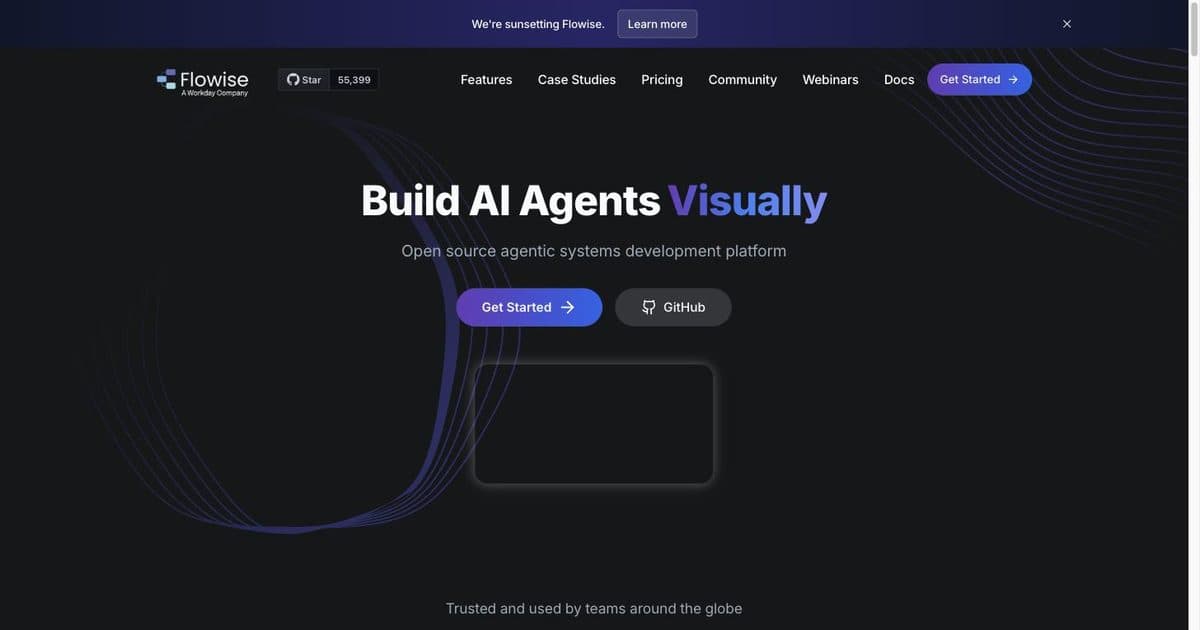
- Flowise is sunset. The team announced a wind-down on 29 July 2026, froze the code the same day, archived the GitHub repository in August, and ended official support on 31 August 2026.
- The product was a genuinely good open-source visual builder for LLM flows, RAG chatbots, and agents: 55,000+ GitHub stars and a Workday acquisition in August 2025 back that up.
- The Apache 2.0 code stays on GitHub to fork and self-host, but nobody is patching it. A CVSS 10.0 vulnerability was found in 2025, and the team no longer accepts security reports.
- Verdict: do not start new projects on Flowise. Existing self-hosters can run a locked-down fork short term; most teams should migrate to Dify, Langflow, n8n, or skip visual builders entirely and use a coding agent.
Flowise is shutting down. Not rumored, not drifting into abandonware: the team posted a sunset notice on its own site with a dated timeline. Feature development froze on 29 July 2026, the GitHub repository went into public archive in August, and 31 August 2026 is the official End of Life, the day the core team's presence on Discord and GitHub concluded.
That changes what a Flowise review is for. If you found this page comparing visual LLM builders, the answer to "should I adopt Flowise" is now no, full stop. The more useful questions are what Flowise actually was (because 55,000 GitHub stars say it mattered), whether the archived code is still safe to run, and where the three years of flows you may have built should go next. This review covers all of it.
The sunset, in the team's own words
The announcement on flowiseai.com/sunset is unusually candid about the reason:
"Over the last few months, we've noticed a significant shift in how people build. As AI models become more capable at reasoning, we've noticed that developers are increasingly relying on new coding agents such as Claude Code/OpenClaw to handle complex tasks. The typical rigid workflow low code approach quickly hits the limit when it comes to complexity."
"It's with these shifts in mind that we've decided to wind down our operations for Flowise."
Read that twice, because it is a vendor in the visual-builder category saying the category's ceiling is real. We have made a version of the same argument in our agentic coding coverage: drag-and-drop canvases are excellent up to a certain complexity, and past it you end up fighting the canvas instead of the problem. Flowise's own team reached the same conclusion and named the coding agents that replaced them.
The published timeline:
| Date | Milestone | What it means |
|---|---|---|
| 29 July 2026 | Announcement and code freeze | Feature development ceased immediately; no new pull requests reviewed or accepted |
| August 2026 | Repository archival | Repo moved to public archive, read-only; issues and PRs locked; npm packages and Docker images marked deprecated |
| 31 August 2026 | End of Life | Official core team presence in Discord and GitHub concluded; community moderation handed off where applicable |
One small discrepancy worth recording: the sunset table lists archival for 10 August 2026, while the GitHub repository banner says it was archived on 13 August 2026. Either way, the repo is read-only now, frozen at roughly 55,400 stars and 25,000 forks.
The notice ends on the one genuinely good piece of news: "Flowise source code will still remain on Github and the Apache 2.0 licensed code is yours to keep building on." The team explicitly encourages forks. (Some comparison blogs describe Flowise as MIT-licensed; that is incorrect. It is Apache 2.0, per both the repository and the sunset notice.)
What Flowise was
Flowise launched in 2023 out of Y Combinator's Summer 2023 batch, founded by Henry Heng and Chung Yau Ong. The pitch, in the founders' words, was to make building AI apps "just like LEGO": an open source, drag-and-drop canvas where you wire language models, memory, vector stores, and tools into working applications without writing the glue code yourself.
In practice you got three builders, per the official docs:
- Assistant, described as "the most beginner-friendly way of creating an AI Agent": pick a model, attach tools and knowledge, done.
- Chatflow, for "single-agent systems, chatbots and simple LLM flows": this was the classic Flowise canvas most tutorials showed, with LangChain and LlamaIndex nodes for models, prompts, memory, and retrieval.
- Agentflow, "the superset of Chatflow & Assistant": multi-agent systems and workflow orchestration with branching, loops, and human-in-the-loop steps.
Any flow could be exposed as a REST API in a click or embedded on a website as a chat widget with a script tag, which is the feature that made Flowise the default answer to "how do I put a RAG chatbot on my site without a backend team" for a couple of years. Leon van Zyl's YouTube tutorial series on it pulled well over 100,000 views per video at the top end, which tells you where the audience was: builders who wanted the result, not the plumbing.
It worked. The YC profile lists Fortune 500 users, naming Thermo Fisher, Deloitte, Accenture, and AWS (the company's claim, not audited case studies, but consistent with the star count). Vendor-published testimonials on the homepage came from real, named companies: UneeQ's CTO credited Flowise with cutting the resources needed to ship its digital-human experiences, and Qatar's Qmic described using its function-calling support in a fleet-management copilot.
The Workday chapter
In August 2025, Workday announced it had acquired Flowise, "a low-code platform that makes it easy to build AI agents," citing "over 42,000 GitHub stars" at the time. Terms were not disclosed. Workday's Peter Bailis said the company was "investing in its open-source foundation" to let customers build agents on the Workday platform.
Eleven months later, the independent Flowise product wound down. We have no inside information on the decision, and the sunset notice does not mention Workday at all; it is signed simply "Henry & Flowise Team." What is observable: the acquisition got Workday the team and the technology, and the public product got an end date. If you are choosing tools today, the lesson is less about Workday and more general: an acquisition announcement that praises your favorite tool's "foundation" is a good moment to start writing down your exit plan.
What it cost, while it existed
Flowise pricing had two halves. Self-hosting the open source edition was free, minus your own compute and model API bills. Flowise Cloud, the hosted version, stopped publishing plan prices on its own homepage toward the end; the numbers below are the plan cards as listed by Software Advice and Capterra, and should be read as historical record, not a live offer:
| Plan | Price | Included |
|---|---|---|
| Free | $0 | Entry tier for trying the platform |
| Starter | $35/month | Unlimited flows and assistants, 10,000 predictions/month, 1GB storage |
| Pro | $65/month | 50,000 predictions/month, 10GB storage, 5 users included, +$15/user beyond |
A caution that mattered even before the sunset: aggregator listings disagreed (at least one directory listed Pro at $99/month), and overage rates beyond the prediction caps were never clearly published. Whether Cloud accounts remain accessible at all past the 31 August EOL is unconfirmed; if you still have flows in Flowise Cloud, export them now rather than testing that question.
Pros and cons, with hindsight
What Flowise got right:
- The fastest path from idea to embedded RAG chatbot that existed in 2023 and 2024. The canvas-to-API-to-widget pipeline was genuinely one afternoon.
- Real open source under Apache 2.0, self-hostable with Docker, no phone-home. That decision is why the sunset is survivable at all.
- A huge node library covering LangChain and LlamaIndex, so new models and vector stores landed quickly.
- Honest positioning. Even the shutdown notice is straight with you, which is more than most EOL announcements manage.
Where it fell short:
- Complexity ceiling. Big Agentflows became spaghetti canvases, and practitioner writeups consistently flagged latency and debugging pain in production-sized flows. The team's own sunset rationale concedes this.
- Security track record under pressure. TechRadar reported a maximum-severity CVSS 10.0 arbitrary code injection vulnerability (CVE-2025-59528) in the CustomMCP node in 2025. Patched then, but see the next section for why this matters more now.
- Governance and multi-tenancy were thin compared to enterprise platforms, which is partly why "great for prototypes, harder in production" became the consensus review.
Is the archived code safe to run?
This is now the most important section for existing users. The code still works today exactly as it did in July. The risk is directional: the project is archived, and the team stated it is no longer accepting new security vulnerability reports. Every vulnerability found from here on stays unpatched upstream, in a product that has already had a CVSS 10.0 finding, and whose job is executing LLM-driven logic with credentials to your models and data stores.
Reasonable posture if you stay on it:
- Never expose a Flowise instance directly to the public internet. Keep it behind a VPN or an authenticated reverse proxy.
- Pin your current version; the npm packages and Docker images are deprecated, not deleted, but treat any new tag with suspicion.
- Strip credentials to the minimum: scoped API keys, no shared admin database users.
- If Flowise is in a revenue path, put a migration date on the calendar. A frozen fork is a bridge, not a destination.
Flowise vs Dify vs Langflow vs n8n
Where should the flows go? It depends on which half of Flowise you were actually using.
| Flowise (archived) | Dify | Langflow | n8n | |
|---|---|---|---|---|
| Status | Sunset, repo archived read-only | Actively developed | Actively developed | Actively developed |
| Model | Visual LLM/agent canvas | Full LLM app platform (apps, RAG, agents, observability) | Visual LLM canvas, closest to Flowise's feel | Automation platform with LLM/agent nodes |
| Open source | Apache 2.0, frozen | Yes (own license) | Yes | Fair-code |
| Hosted option | Cloud status past EOL unconfirmed | Yes; Professional commonly cited around $59/workspace/month (confirm on Dify's pricing page) | Yes | Yes |
| Best fit | Nothing new | Teams that want the whole packaged platform | Teams that want their canvas muscle memory back | Flows that were really automations with an LLM step |
Our fuller feature-by-feature breakdown lives at Dify vs Flowise; with Flowise frozen, read it as a migration map rather than a matchup. Dify is where we would point most teams that liked Flowise for RAG chatbots and want a maintained platform. Langflow is the most literal replacement for the canvas itself. n8n wins when you look at your flows and realize most nodes were HTTP requests and app connectors, not LLM logic.
And the fourth option is the one Flowise's own team named: skip the canvas. If your flows kept outgrowing the builder, the complexity was never going to fit in boxes and arrows, and a coding agent plus a small codebase is the more durable tool. Our guide to AI coding assistants covers that path.
When is our recommendation wrong? If you have a large internal Flowise deployment, strict change-control, and no public exposure, staying on a self-maintained fork for a year can beat a rushed migration: the code is Apache 2.0, your team already knows it, and internal-only attack surface is manageable. The wrong version of that call is inertia without the fork, the version pin, or the calendar date.
Who should still use Flowise in 2026
- Teams already self-hosting it in production: keep running behind your perimeter, pin versions, and plan the exit. No new build-out on it.
- Developers who want to study a mature visual agent builder: the archive is a well-starred, readable codebase and the license permits anything, including a community fork.
- Everyone else, including anyone reading reviews to pick a new tool: choose something maintained. Late-August social posts were still listing Flowise in "best AI agent builder" roundups weeks after the shutdown was announced; that is the SERP lagging reality, not a recommendation.
The Flowise tool page in our directory now carries the sunset notice, and the tools directory lists the maintained alternatives by category.
FAQ
Is Flowise shutting down? Yes. The official sunset page announced a code freeze on 29 July 2026, repository archival in August 2026, and End of Life on 31 August 2026, when official team presence on Discord and GitHub concluded.
Can I still use Flowise after 31 August 2026? Self-hosted copies keep running and the Apache 2.0 code stays on GitHub to fork. The repository is read-only and unpatched, so treat it as frozen software. Whether Cloud accounts remain accessible is unconfirmed; export anything still in Flowise Cloud now.
Is Flowise open source? Yes, Apache 2.0, confirmed by both the repository and the sunset notice. Blogs describing it as MIT are wrong.
How much did Flowise Cloud cost? Directories listed Starter at $35/month (10,000 predictions, 1GB storage) and Pro at $65/month (50,000 predictions, 10GB storage, 5 users). The official site no longer publishes plan pricing.
Did Workday buy Flowise? Yes, announced 14 August 2025, terms not disclosed. The independent Flowise product wound down about a year later.
Is Flowise safe to keep running? Only behind your own perimeter. A CVSS 10.0 code injection vulnerability (CVE-2025-59528) was reported in 2025, and the archived project no longer accepts security reports, so new issues stay unpatched.
What were Chatflow, Agentflow, and Assistant? Assistant was the beginner-friendly agent builder, Chatflow handled single-agent chatbots and simple LLM flows, and Agentflow was the superset for multi-agent systems and workflow orchestration.
Should I migrate to Dify, Langflow, or n8n? Dify for a maintained all-in-one platform, Langflow for the most similar canvas, n8n when the flows were really automations with an LLM step. Teams hitting complexity walls should evaluate coding agents instead.
Verdict
Flowise earns a strange kind of five-star obituary. As a product you could adopt today it scores zero, because there is no today: the vendor has ended it. As a piece of the vibe-coding story it was one of the tools that proved non-engineers could ship real LLM applications, it did so in the open under Apache 2.0, and it exited with a candid note and a fork-friendly archive instead of a silent 404. Its parting analysis, that coding agents beat rigid low-code once complexity arrives, is the same conclusion this site keeps reaching from the other direction.
Do not start anything new on it. Migrate the chatbots to Dify or Langflow, the automations to n8n, and the ambitious stuff to a coding agent. And pour one out for the canvas.

Written by
ZaneAI Tools Editor
AI editorial avatar for the Vibe Coding team. Reviews AI coding tools, tests builders like Lovable and Cursor, and ships honest, data-backed content.