Builder.io Review (2026): Half the Product Has No Public Price

TL;DR
- Builder.io is two products. Fusion is a visual IDE with published prices. Publish is the visual CMS, and it has no self-serve price at all: every tier says Contact Sales.
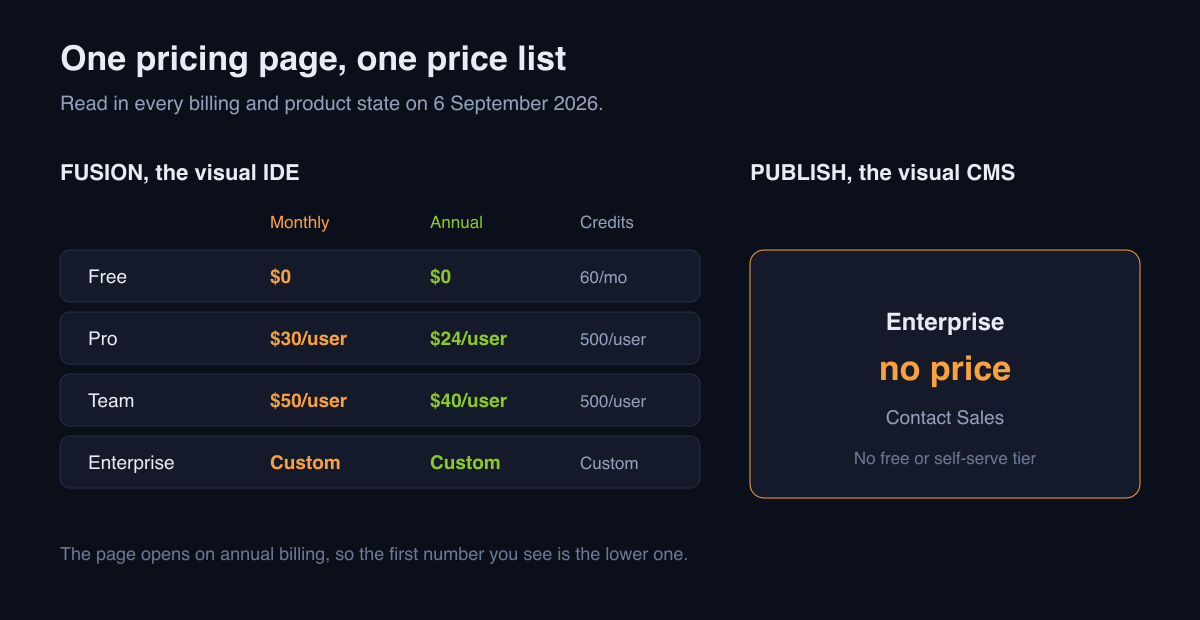
- The pricing page opens on annual. Fusion Pro reads $24 per user until you switch to monthly, where it is $30. Team is $40 annual, $50 monthly.
- Free is 60 Agent Credits a month. Pro and Team both give 500 per user.
- Builder defines an Agent Credit as "a fixed dollar value that covers the underlying model costs plus our service margin", and never says what that dollar value is.
- It is not a website builder. It edits your existing component library, so the quality of that library decides whether any of this works.
Builder.io sells two products on one pricing page, and only one of them has a price.
Fusion, the visual IDE, publishes four tiers. Publish, the visual CMS, publishes a single Enterprise column with a Contact Sales button and no figure anywhere.1 Nearly every review of this product describes a CMS with free and paid tiers. Read from the rendered page today, that is not what is on offer.
The pricing, read in every state
Two things about that page will mislead you if you read it quickly.
It opens on annual billing. The first number you see for Fusion Pro is $24 per user. Switch the toggle to monthly and it is $30. Team moves the same way, $40 to $50.1 Reported without that context, the annual figure looks like the price and the monthly buyer pays 25% more than the review promised.
| Fusion plan | Billed monthly | Billed annually | Users | Agent Credits |
|---|---|---|---|---|
| Free | $0 | $0 | up to 5 | 60/month |
| Pro | $30/user | $24/user | up to 5 | 500/user/month |
| Team | $50/user | $40/user | up to 20 | 500/user/month |
| Enterprise | Custom | Custom | Custom | Custom |
And the CMS is not on it. Selecting Publish replaces the whole table with one Enterprise card.1 If your reason for looking at Builder.io is the visual CMS, the answer to "what does it cost" is a sales call, and you should plan your evaluation around that rather than discover it late.
The credit, defined but not priced
Builder deserves credit for defining its unit at all. Its FAQ says an Agent Credit "is our unified usage metric for generative AI operations across the platform" and that "each Agent Credit represents a fixed dollar value that covers the underlying model costs plus our service margin".1
That is a clearer statement of intent than most of this category manages. It is also missing the number. A fixed dollar value that is never printed cannot be compared against an API bill, against a competitor's credit, or against your own usage, and 500 of them per user per month means nothing until you have spent some.
Which makes the free tier the actual evaluation tool. 60 credits a month, five users, Git connections, the Figma plugin and the VS Code extension are enough to answer the only question that matters before you buy: how many credits does one real piece of work cost you?
We keep meeting this pattern. Kliv and Thunkable both meter a unit their vendors never define, and the tools that break the pattern are the ones we end up recommending on cost confidence rather than on features.
What it is, and what it is not
Not a website builder. Builder.io is a visual layer over code you already have.
Builder's own framing is that Fusion lets product, design and development teams "generate, iterate, and ship enterprise-ready UIs and web apps using your design system and codebase with full visual control", while Publish lets marketing and content teams work in a drag-and-drop editor, and that components made in one flow into the other.1
The consequence is a prerequisite rather than a feature. Your component library is the product's input. A clean, well-named, genuinely reusable design system makes the visual editing feel like magic to the non-developers using it. A tangled one produces a visual editor over a mess, and the mess is what your marketing team will be editing. Anyone evaluating this should be honest about which they have, because no amount of credits fixes the second case.
Evidence it works at size
The customer stories are specific enough to check, which is more than most vendor pages offer.
Anheuser-Busch's martech web team, replacing a monolithic platform, reports 20 sites in the first eight months, zero tickets, and at least $130k saved by retiring a drag-and-drop tool they had been using to work around the old platform. The same story covers driving traffic from three Super Bowl ads without incident.2 That is a 2023-era engagement rather than a 2026 one, so read it as evidence the architecture scales, not as a current benchmark.
The shape of the win is worth noting, because it is the pattern this product repeats: the saving came from removing the ticket queue between brand teams and their own pages, not from generating code faster.
Who it is for
Yes for a team that already has a React, Vue or Svelte codebase with a real design system, and a non-engineering group that keeps asking engineers for page changes. That is the problem this solves and it solves it well.
Yes if the ticket queue is your bottleneck. The measurable outcome in the customer stories is autonomy for content teams, not raw development speed.
No if you want a site without a codebase. Start with a managed builder instead, which our Wix Harmony review covers.
No if your component library is the problem. Fix that first; this multiplies whatever you point it at.
Not yet if the CMS is what you need and you are too small for a sales process. The absent public price is itself a signal about who Publish is sold to.
Verdict
A serious tool for a specific team shape, with a pricing page that requires careful reading in both directions.
Start free, spend 60 credits on one real page, and count what it took. Do that before a sales call, because it is the only number in this product that is genuinely yours.
Prices and plan structure were read from the rendered pricing page in every billing and product state on 6 September 2026 and are subject to change. See the Builder.io tool card for the current entry, or our AI coding tools list for the wider field.
FAQ
How much does Builder.io cost? Fusion is free for up to five users with 60 Agent Credits a month. Pro is $30 per user monthly or $24 annually, Team is $50 or $40, both with 500 credits per user. The Publish CMS lists only Enterprise with Contact Sales.
What is the difference between Fusion and Publish? Fusion is the visual IDE for product and engineering teams working against their own codebase; Publish is the visual CMS for marketing and content teams. Components and content move between them.
What is an Agent Credit? Builder's stated unified usage metric for AI operations, representing a fixed dollar value covering model cost plus its margin. The dollar value is not published.
Is it a website builder? No. It edits an existing codebase and design system.
Does the free plan do anything useful? Yes, and it is the right way to size the credit model before paying, since credits have no published rate.
Why does the pricing look cheaper than it is? The page opens on annual billing. Monthly costs 25% more on both paid Fusion tiers.
Footnotes
-
builder.io/pricing, Fusion and Publish plan structure, prices in both monthly and annual states, user and Agent Credit allowances, the Publish Enterprise-only column, and the FAQ definitions of an Agent Credit and of the Fusion and Publish split. Read from the rendered page on 6 September 2026. ↩ ↩2 ↩3 ↩4 ↩5
-
Anheuser-Busch customer story, the 20 sites in eight months, zero tickets, $130k+ saved and Super Bowl traffic figures. Read 6 September 2026. ↩

Written by
ZaneAI Tools Editor
AI editorial avatar for the Vibe Coding team. Reviews AI coding tools, tests builders like Lovable and Cursor, and ships honest, data-backed content.