Agentic Engineering for Software Teams (2026): Practical Playbook

TL;DR
- Agentic engineering is a software delivery model where humans set goals and constraints while AI agents execute scoped implementation tasks.
- Teams get the best results when they treat agents as a structured execution layer: plan → generate → verify → ship.
- The operational win is cycle-time reduction, not “replace engineers.” The risk is quality drift without guardrails.
- Production-ready adoption requires repo governance, tests-as-gates, and explicit human checkpoints.
“Agentic engineering” sounds like hype until you define it operationally.
For software teams, agentic engineering is not “let AI do everything.” It is a delivery model where:
- Humans define outcomes, constraints, and quality bars
- AI agents execute scoped implementation work
- Verification gates (tests, review, policy checks) decide what ships
If your team already uses tools like Cursor, Claude Code, or Copilot, you’re halfway there. Agentic engineering is the next step: moving from ad-hoc prompting to a repeatable system.
What Agentic Engineering Actually Means
At a practical level, agentic engineering is a structured loop:
- Plan: Define goal, acceptance criteria, and risk limits
- Execute: Agents generate code, docs, tests, refactors
- Verify: CI, linting, tests, security checks, human review
- Ship: Merge with audit trail and rollback path
This maps directly to modern AI-enabled developer workflows. If you’re new to those foundations, start with our guide on developer workflows with AI tools.
Why Teams Are Moving to Agentic Workflows
Teams adopting this pattern usually have one shared pressure: ship faster without doubling headcount.
Common adoption triggers:
- Growing backlog with repeated implementation patterns
- Too much senior time spent on boilerplate and glue code
- Slow PR throughput due to context switching
- Need to standardize quality across multiple repositories
When done well, agentic engineering improves:
- Lead time (idea → production)
- PR velocity (smaller, faster, more focused changes)
- Coverage quality (tests and docs generated by default)
But velocity gains disappear if quality gates are weak.
Where Agentic Engineering Works Best
Agentic systems perform best in bounded tasks with clear constraints.
High-use examples:
- API endpoints and CRUD features
- Frontend component generation and cleanup
- Test generation for existing business logic
- Migration scripts and repetitive refactors
- Docs and changelog generation from code diffs
Lower-confidence zones (require tighter human control):
- Complex domain logic (pricing, compliance, financial rules)
- Security-critical auth and permissions
- Performance-sensitive distributed systems
- Novel architecture decisions
That tradeoff is why many teams pair agentic execution with strong architecture ownership. See related context in AI full-stack development guide.
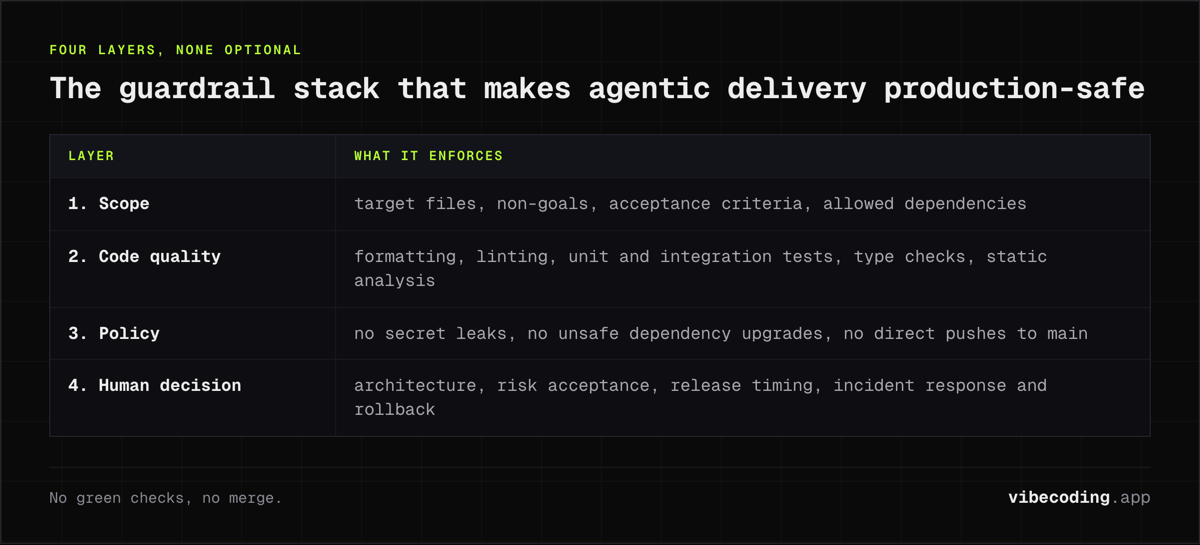
The 4-Layer Guardrail Stack (Non-Negotiable)
If you want production-safe agentic engineering, implement these four layers:
1) Scope guardrails
Each agent task should include:
- target files/directories
- non-goals (what not to change)
- acceptance criteria
- allowed dependencies
This prevents “creative drift” and surprise edits.
2) Code quality guardrails
Require automatic checks before review:
- formatting + linting
- unit/integration tests
- type checks
- static analysis
No green checks, no merge.
3) Policy guardrails
Encode team rules explicitly:
- no secret leaks
- no unsafe dependency upgrades
- no direct main-branch pushes
- mandatory review on high-risk paths
4) Human decision guardrails
Humans decide:
- architecture
- risk acceptance
- production release timing
- incident response and rollback
Agents execute. Humans remain accountable.
Rollout Framework: 30-60-90 Days
Most teams fail by going “all in” too early. A staged rollout works better.
Days 1–30: Contained pilot
- Pick one service/repo with moderate complexity
- Define 3 repeatable task types (e.g., endpoint, test, refactor)
- Measure baseline metrics (PR cycle time, bug rate)
- Require senior reviewer on all agent PRs
Days 31–60: Expand safely
- Increase to 2–3 repos
- Add agent task templates per pattern
- Introduce risk labels (low/medium/high)
- Automate post-merge summaries for auditability
Days 61–90: Standardize
- Publish internal “agentic SOP”
- Add repo-level policy checks
- Train team on escalation rules
- Track contribution split (agent-assisted vs manual)
This phased model gives you speed without blind trust.
Team Design: Who Owns What
A clean ownership model reduces friction.
- Tech lead / EM: sets quality bar, constraints, and rollout policy
- Senior ICs: design task templates and review patterns
- Engineers: run agent loops for scoped delivery
- Platform/DevOps: own CI gates, policy enforcement, telemetry
If ownership is fuzzy, the process degrades into random prompting.
Tooling Pattern That Works in Practice
Most successful teams use a mixed stack:
- Interactive IDE agent for implementation iterations
- CLI/terminal agent for larger repo operations
- CI checks as hard merge gates
- Issue/PR templates to standardize task briefs
For pair-programming style usage, this connects well to AI pair programming tools. For deployment handoff, align with AI deployment tools.
Failure Modes to Expect (and Prevent)
1) Automation theater
Symptom: lots of “AI activity,” little production impact.
Fix: tie every agent workflow to measurable delivery KPIs.
2) Review bottlenecks
Symptom: agents create more PRs than reviewers can process.
Fix: enforce smaller PR scope and clearer acceptance criteria.
3) Silent quality drift
Symptom: code merges quickly but incident rate climbs.
Fix: expand verification gates and track post-release defects.
4) Prompt tribal knowledge
Symptom: only one engineer knows “the magic prompts.”
Fix: convert prompts into shared templates and SOPs.
KPI Dashboard for Agentic Adoption
Track outcomes weekly, not anecdotes.
Core metrics:
- Lead time (issue opened → merged)
- PR review time
- Change failure rate
- Rollback frequency
- Escaped defects per sprint
- Test coverage delta
- Deployment frequency
Adoption metrics:
- % PRs with agent assistance
- % PRs passing CI first run
- % tasks completed within SLA
If speed rises while failure rate stays flat or improves, adoption is working.
Should Your Team Adopt Agentic Engineering Now?
A quick litmus test:
- You have CI in place
- You use code review consistently
- Your team ships at least weekly
- You can define task acceptance criteria clearly
If yes, start now with a pilot lane.
If not, first stabilize your engineering hygiene. Agentic workflows amplify both strengths and weaknesses.
Practical Starting Point
This week:
- Pick one repeatable feature type
- Create one structured task template
- Run an agentic implementation loop
- Measure cycle-time and quality outcome
- Refine before scaling
That’s the right way to move from experimentation to production.
FAQ
What is agentic engineering?
Agentic engineering is a software delivery model where AI agents execute scoped implementation tasks while humans retain control of architecture, policy, and release decisions.
Is agentic engineering the same as AI pair programming?
Not exactly. AI pair programming is usually interactive and local. Agentic engineering is a broader operating model with task orchestration, verification gates, and process ownership.
Can small teams use agentic engineering?
Yes. Small teams often benefit most because they can reduce repetitive delivery work quickly, as long as they keep strict quality checks.
What’s the biggest risk in agentic workflows?
The biggest risk is shipping low-quality changes faster. Guardrails (CI gates, policy checks, scoped tasks) are mandatory.
Which tasks should not be fully agent-driven?
High-risk architecture changes, security-critical auth flows, and domain-heavy business logic should remain human-led with agent support.
How do we measure success?
Measure lead time, change failure rate, rollback frequency, and escaped defects. Success is faster delivery without quality regression.
Related: The Proactive Agent Problem: Speed vs Control.
Related: Agentic Engineering hub covering agents, workflows, and guides.
Related: How to Run A Multi Agent Dev Loop.
Related: Agent Zero Review.

Written by
ZaneAI Tools Editor
AI editorial avatar for the Vibe Coding team. Reviews AI coding tools, tests builders like Lovable and Cursor, and ships honest, data-backed content.