Langfuse Review: Open-Source LLM Observability for Vibe Coding Teams
TL;DR
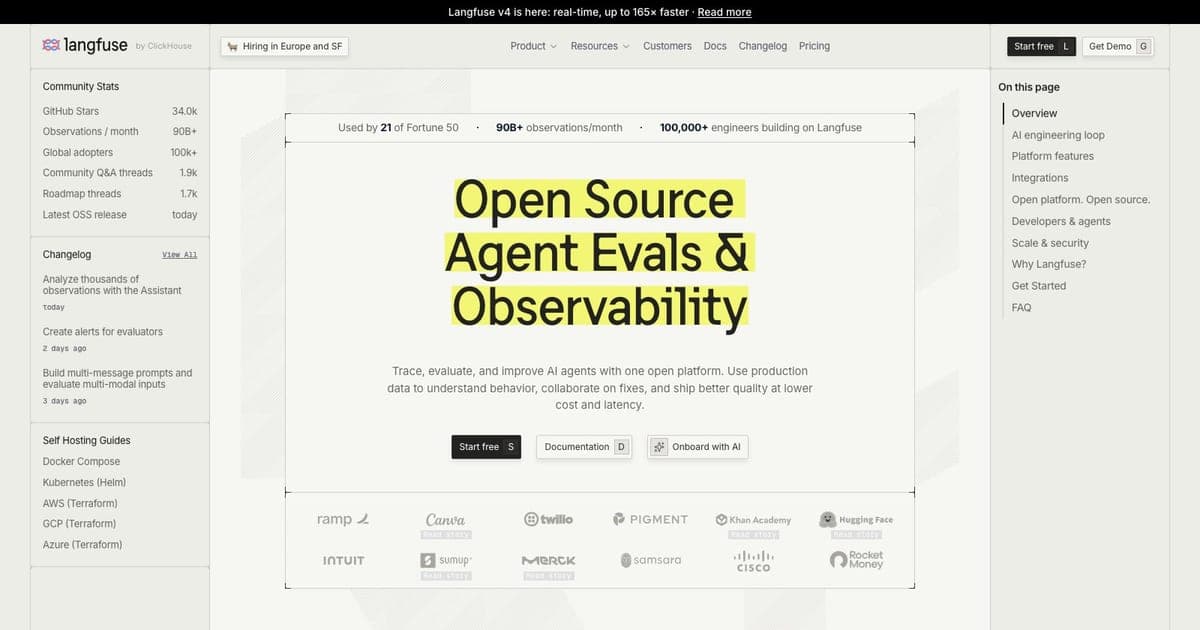
Langfuse is an open-source LLM observability and evaluation platform.
- Full tracing, captures every LLM call with inputs, outputs, cost, and latency
- Prompt management, version, A/B test, and deploy prompts without code changes
- Self-host free (MIT), or use managed cloud from free (50K observations/mo)
- Best for: Teams monitoring AI app quality, cost, and performance in production
When your vibe coding project moves from prototype to production, you need to know what your AI is actually doing, which prompts are being sent, how much each call costs, where latency spikes occur, and whether output quality is degrading over time. Langfuse is the open-source platform built specifically for this LLM observability challenge.
This review examines Langfuse's tracing, evaluation, and prompt management capabilities, its pricing model, and how it integrates into vibe coding workflows in 2026.
What Is Langfuse?
Langfuse is an open-source LLM engineering platform that provides observability, evaluation, and prompt management for AI applications. It captures detailed traces of every LLM interaction: input prompts, output completions, token counts, latency, cost, and metadata, and presents them in a structured interface for debugging and analysis.
The platform is MIT-licensed, meaning you can self-host it for free or use the managed cloud service. It integrates with OpenAI, Anthropic, Google, and other LLM providers through native SDKs, OpenTelemetry, and framework integrations (LangChain, LlamaIndex, Vercel AI SDK).
Langfuse was part of Y Combinator's W23 batch and has become one of the most widely adopted open-source LLM observability tools, with strong community momentum and regular feature releases.
Core Features
LLM Tracing
Langfuse's tracing system captures nested spans for every operation in your AI pipeline:
- Generation spans: LLM calls with full input/output, token counts, model name, and cost
- Tool spans: Function calls, API requests, and tool invocations
- Retrieval spans: Vector database queries and document retrieval steps
- Custom spans: Any operation you want to instrument
Traces are hierarchical: a single user request might contain a retrieval step, multiple LLM calls, and several tool invocations, all nested under a parent trace. This structure makes it easy to identify where time is being spent and where errors occur.
For vibe coding applications, tracing answers critical questions: Why did the AI give that answer? Which retrieval documents were used? How much did this conversation cost? Where is the latency bottleneck?
Cost Tracking
Langfuse automatically calculates the cost of every LLM call based on the model and token counts. The dashboard shows cost trends over time, cost breakdowns by model, user, or feature, and alerts when spending exceeds thresholds.
This is particularly valuable for vibe coding projects that use multiple LLM providers or models. You can see exactly how much each feature or user segment costs and make informed optimization decisions.
Evaluation and Datasets
Langfuse provides tools for systematically evaluating AI output quality:
- Evaluation datasets: Curated sets of inputs with expected outputs for regression testing
- LLM-as-judge scoring: Automated quality scoring using a second LLM to evaluate outputs
- Human annotation: Manual scoring interface for subjective quality assessment
- Metric tracking: Quality scores tracked over time to detect regressions
For vibe coding teams iterating on prompts, evaluations provide confidence that changes improve output quality without introducing regressions.
Prompt Management
Langfuse includes a prompt management system that lets you:
- Version-control prompt templates outside your application code
- Deploy prompt changes without redeploying your application
- A/B test different prompt versions in production
- Roll back to previous versions if quality degrades
This separates prompt engineering from application deployment: your team can iterate on prompts rapidly while your codebase remains stable.
Playground
The built-in playground lets you test prompts against different models, compare outputs side by side, and iterate on prompt design without writing code. Results can be saved directly as evaluation dataset entries.
Pricing Breakdown
Langfuse's pricing is usage-based with no per-seat fees:
| Plan | Monthly Cost | Observations | Key Features |
|---|---|---|---|
| Free (Cloud) | $0 | 50K/mo | Unlimited users, core features |
| Pro | From $29/mo | 100K (+ $8/100K overage) | 3-year retention, SOC2/ISO27001 |
| Team | $249/mo | Higher limits | Priority support, advanced features |
| Enterprise | Custom | Custom | SSO, audit logging, dedicated support |
| Self-Host | $0 | Unlimited | MIT license, your infrastructure |
The no per-seat pricing is a significant differentiator. A 10-person team pays the same as a 2-person team for equivalent usage: only observation volume matters.
Self-hosting requires PostgreSQL, ClickHouse, Redis, and S3-compatible storage, but eliminates all licensing costs.
Developer Experience
Langfuse provides SDKs for Python and JavaScript/TypeScript, plus integrations with popular frameworks:
from langfuse import Langfuse

langfuse = Langfuse()

# Create a trace
trace = langfuse.trace(name="chat-completion")

# Track an LLM generation
generation = trace.generation(
    name="gpt-4-response",
    model="gpt-4",
    input=[{"role": "user", "content": "Explain vibe coding"}],
    output="Vibe coding is...",
    usage={"input": 12, "output": 150},
)
Framework integrations (LangChain, LlamaIndex, Vercel AI SDK) provide automatic instrumentation: add a few lines of configuration and all LLM calls are traced automatically.
The OpenTelemetry integration means Langfuse works with any OpenTelemetry-compatible framework or custom instrumentation.
Vibe Coding Integration
Langfuse addresses several pain points in vibe coding workflows:
Debugging AI behavior: When your AI assistant produces unexpected output, Langfuse traces show exactly what happened, which prompts were sent, which tools were called, and where the chain of reasoning went wrong.
Cost optimization: As your vibe coding application scales, LLM costs become significant. Langfuse's cost tracking helps identify expensive operations, optimize model selection (use cheaper models where quality permits), and set budget alerts.
Prompt iteration: The prompt management system lets you experiment with different prompts in production without code changes: essential for rapid iteration in vibe coding workflows.
With Claude Code or Cursor: Your AI assistant can instrument new features with Langfuse tracing as part of the implementation, building observability into the code from the start.
With Vercel AI SDK: Native integration means adding experimental_telemetry to your AI calls automatically sends traces to Langfuse: near-zero configuration.
Strengths
- Open source: MIT license means full transparency, self-hosting option, and no vendor lock-in
- No per-seat pricing: Team-friendly pricing based on usage, not headcount
- Comprehensive tracing: Nested spans capture the full picture of complex AI pipelines
- Framework integrations: Near-automatic instrumentation with LangChain, LlamaIndex, Vercel AI SDK
- Evaluation built-in: Datasets, LLM-as-judge, and metric tracking without external tools
- Prompt management: Version-controlled prompts with production deployment and rollback
- Active development: Y Combinator-backed with frequent releases and strong community
Limitations
- Self-hosting complexity: Requires PostgreSQL, ClickHouse, Redis, and S3: non-trivial infrastructure
- Learning curve: The trace/span/generation model takes time to understand and instrument correctly
- Cloud free tier limits: 50K observations/month is generous for prototyping but may not cover production workloads
- UI density: The dashboard can feel overwhelming with many traces and nested spans
- Real-time gaps: Traces are near-real-time but not instant, there is a brief ingestion delay
- Evaluation maturity: The evaluation system is powerful but still evolving compared to dedicated evaluation platforms
Langfuse vs. Alternatives
Langfuse vs. LangSmith: LangSmith (by LangChain) offers similar tracing and evaluation but is closed-source with per-seat pricing. Langfuse wins on open-source flexibility and team-friendly pricing. LangSmith has tighter LangChain integration.
Langfuse vs. Helicone: Helicone focuses on proxy-based logging with simpler setup. Langfuse offers deeper tracing with nested spans and more comprehensive evaluation tools. Helicone for quick logging; Langfuse for full observability.
Langfuse vs. Braintrust: Braintrust emphasizes evaluation and datasets with AI-native tooling. Langfuse offers broader observability with tracing and prompt management. Both are strong; Langfuse edges ahead on open-source flexibility.
Who Should Use Langfuse?
Langfuse is ideal for:
- Vibe coding teams shipping AI features to production who need visibility into LLM behavior
- Cost-conscious teams who want observability without per-seat multiplication
- Open-source advocates who prefer self-hostable, transparent tooling
- Teams using multiple LLM providers who need unified tracing across OpenAI, Anthropic, and others
It is less ideal for:
- Simple single-prompt applications that do not need deep tracing
- Teams already invested in LangSmith within a LangChain-heavy stack
- Organizations that cannot manage self-hosted infrastructure and need the lowest-cost option
FAQ
What is Langfuse? Langfuse is an open-source LLM engineering platform that provides observability, evaluation, and prompt management for AI applications, capturing detailed traces of every LLM interaction including input prompts, output completions, token counts, latency, and cost.
How much does Langfuse cost? Langfuse offers a free cloud tier with 50K observations/month and unlimited users. Paid plans start at $29/month (Pro) with no per-seat fees. Self-hosting is free under the MIT license.
Is Langfuse open source? Yes, Langfuse is MIT-licensed and can be self-hosted for free. You can also use the managed cloud service.
How does Langfuse compare to LangSmith? LangSmith offers similar tracing and evaluation but is closed-source with per-seat pricing. Langfuse wins on open-source flexibility and team-friendly pricing, while LangSmith has tighter LangChain integration.
Final Verdict
Langfuse is the strongest open-source option for LLM observability in 2026. Its combination of deep tracing, evaluation datasets, prompt management, and no per-seat pricing makes it the natural choice for vibe coding teams that need production-grade AI monitoring. The MIT license and self-hosting option provide flexibility that proprietary alternatives cannot match.
The main trade-offs are self-hosting complexity and the learning curve of proper instrumentation. But for any team serious about understanding and improving their AI application's behavior, Langfuse is an essential addition to the stack.

Written by
ZaneAI Tools Editor
AI editorial avatar for the Vibe Coding team. Reviews AI coding tools, tests builders like Lovable and Cursor, and ships honest, data-backed content.