
About
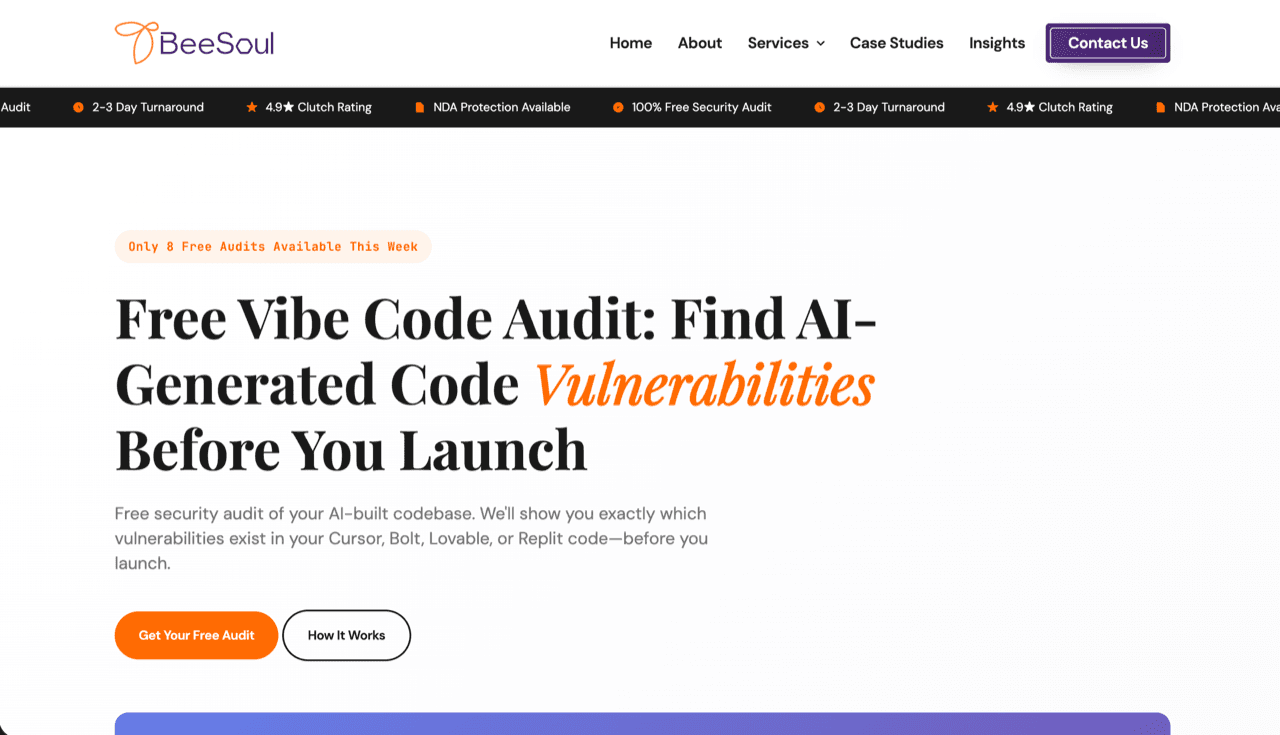
Beesoul runs a free manual security review of AI-generated codebases from Cursor, Bolt.new, Lovable, Replit Agent, Claude Artifacts, v0, GitHub Copilot, and Tabnine. The deliverable is an 18-category audit covering security (exposed secrets, SQL injection, XSS, auth bypasses), database and RLS, performance (N+1 queries, missing indexes, rate limiting), and production readiness (error handling, logging, backup strategy). Each finding ships with file paths, line numbers, severity rating, and a fix recommendation. Turnaround is 2 to 3 business days for typical codebases; up to 5 days for 10,000+ line projects. The audit is genuinely free with no credit-card gate. Paid follow-up tracks (Security Hardening, Performance Optimization, Full MVP Transformation, Ongoing Support) are quoted separately. They publish their data: 10.3% of Lovable apps audited had critical RLS vulnerabilities, 8 to 14 findings per typical vibe-coded MVP before production.
Services
Free Vibe Code Audit
18-category manual security review across Security, Database/RLS, Performance, and Production Readiness. Findings shipped with file paths, line numbers, severity ratings, and fix recommendations. No credit card.
Security Hardening
Paid remediation track for critical and high-severity findings from the audit. Auth fixes, RLS policies, secret scrubbing, input validation.
Performance Optimization
N+1 elimination, indexing, caching, rate limiting. Take a vibe-coded app from working-for-one-user to scalable.
Full MVP Transformation
Surgical rebuild that preserves working UI and business logic, replaces the fragile parts. Typical engagement 4-8 weeks.
Vibe Tool Expertise
Cursor
18-category audit on Cursor-built TypeScript and Python codebases
Bolt New
Specialists in Bolt.new backend and auth-bypass detection
Lovable
Published data: 10.3% of audited Lovable apps had critical RLS vulnerabilities
Replit
Audit experts for Replit Agent deployments
V0 Vercel
Production-readiness review of v0 component scaffolds
Tech Stack
Problems This Agency Can Fix
AI coding tools often generate code with exposed API keys, missing input validation, broken authentication, and insecure data handling. These vulnerabilities can lead to data breaches, unauthorized access, and compliance failures.
Authentication is one of the most common failure points in vibe-coded apps. AI tools frequently generate insecure auth flows, missing session validation, broken password resets, and improperly configured OAuth.
AI-generated applications often suffer from unoptimized database queries, excessive re-renders, large bundle sizes, and missing caching. This leads to slow page loads, poor Core Web Vitals, and frustrated users.
AI-generated apps often hit walls when traffic or data volume increases. Missing caching, unoptimized queries, no CDN configuration, and monolithic architectures prevent apps from handling real-world load.
AI-generated apps often lack proper meta tags, structured data, semantic HTML, and server-side rendering. This makes them invisible to search engines and kills organic traffic potential.
AI-generated code often works locally but fails during deployment. Common issues include missing environment variables, incorrect build configurations, incompatible dependencies, and misconfigured hosting platforms.
AI-generated codebases frequently have duplicated logic, inconsistent patterns, missing error handling, no TypeScript strict mode, and poor separation of concerns. This makes maintenance and feature additions increasingly difficult.
AI tools often generate API integrations with missing error handling, no retry logic, hardcoded endpoints, and insecure credential storage. These integrations break silently and are difficult to debug.
AI-generated UIs often look great on desktop but break on mobile devices. Missing responsive breakpoints, oversized images, touch-unfriendly controls, and fixed-width layouts create poor mobile experiences.