Generative Engine Optimization for Vibe Coders: Let the Agent Do the SEO
TL;DR
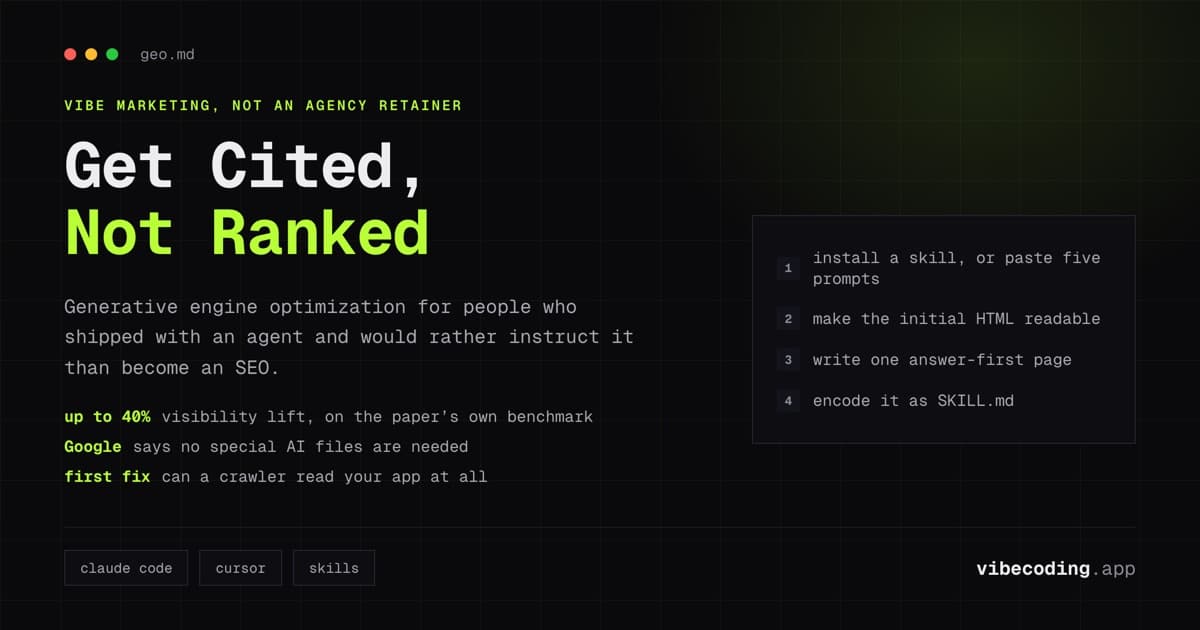
Generative engine optimization is getting your product named inside AI answers instead of ranked in a list of links. For vibe coders the job is not to become an SEO, it is to instruct the agent that already built the app.
- The term is from a paper, not an agency. Aggarwal et al., 2023, accepted to KDD 2024: adding citations, quotations and statistics lifted visibility "by up to 40%".
- Google says plain SEO is the work. Its own guide: "You don't need to create new machine readable files, AI text files, markup, or Markdown to appear in Google Search."
- Most vibe-coded apps fail earlier than any of this. If the first HTML response is an empty div, nothing is being cited because nothing is being read.
- Install a skill or paste five prompts.
claude-seoships a/seo geocommand; the prompts below do the same work in Cursor or Codex. - Then encode it as SKILL.md so the next session runs the same checks instead of improvising.
- Best for: founders who shipped with Claude Code, Cursor or Lovable and cannot work out why AI answers never mention them.
You shipped the app. It works. Nobody finds it, and when you ask ChatGPT to recommend a tool like yours, it names five competitors and not you.
Generative engine optimization is the name for fixing that. It is the marketing-side counterpart to everything in the state of vibe coding: the tools got good at shipping, and distribution did not follow automatically. Stripped of the acronym, it means being the thing an AI answer quotes rather than the thing buried in a list of links. The term comes from a 2023 paper by Pranjal Aggarwal and colleagues, accepted to KDD 2024, which introduced it as "the first novel paradigm to aid content creators in improving their content visibility in generative engine responses" and reported that it "can boost visibility by up to 40% in generative engine responses" (arXiv:2311.09735).
Here is the part nobody selling GEO leads with. You do not need to become an SEO to do this. You need to tell the agent that built your app what to check and what to fix, the same way you told it what to build. That is the whole trick. The instructions follow.
What GEO is, and what it is not
It is not a ranking exercise. Ranking gets you a position in a list. GEO is about being the source a generated answer draws on, which can happen without a click ever reaching you.
It is also not a replacement for SEO, and the clearest statement on that comes from Google. Its guide to AI features answers the question directly: "In short, yes! The best practices for SEO continue to be relevant because our generative AI features on Google Search are rooted in our core Search ranking and quality systems" (Google Search Central).
That sentence is worth more than most GEO articles, because it tells you the expensive half of the industry is optional. The unglamorous work still is the work.
Why vibe-coded apps stay invisible
Before any of the tactics, there is a failure mode specific to how we build.
A lot of AI-generated apps ship a single empty container in the initial HTML and fill it in with JavaScript once the page loads. In a browser this looks perfect. To anything that reads the raw response without executing your JavaScript, the page contains nothing to quote. Same story for titles and meta descriptions injected client-side, for a missing sitemap, and for canonicals that were never set because nobody asked for them.
This is not a moral failing of vibe coding. It is a default, and a well-documented one: our Lovable SEO guide covers the same problem on one specific builder. The generator optimised for the thing you asked for, which was a working app, and nobody asked for the thing you did not know to ask for.
It is also the cheapest thing on this page to fix, and until it is fixed everything below is theory. There is a whole category of skill packs that exists purely because of it: seo-skills-for-agents exists so coding agents stop shipping un-crawlable HTML in the first place.
What the research actually found
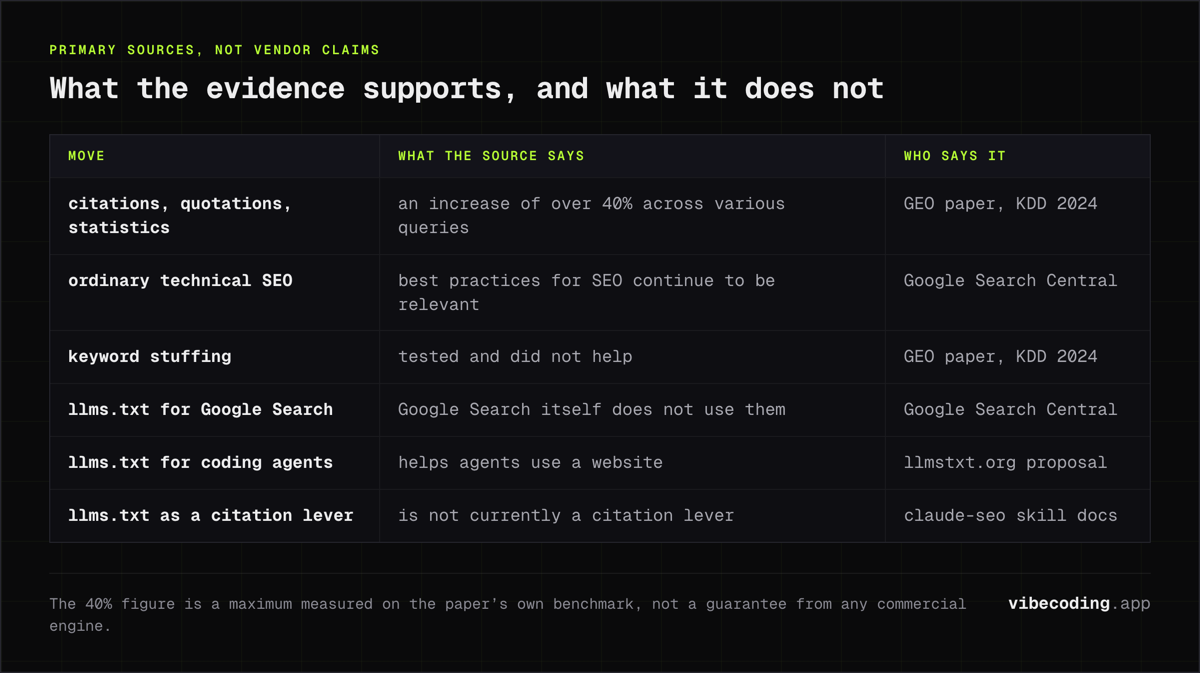
The paper is more specific than the summaries of it. Across their benchmark, the methods that moved visibility were adding citations, quotations from relevant sources, and statistics, which produced "an increase of over 40% across various queries".
Read that as a content instruction rather than a growth hack. A paragraph that says "most teams see faster onboarding" is not citable. A paragraph that says "onboarding dropped from four days to one, measured across our last eleven customers" is, because a generated answer can lift it and attribute it.
Two honest caveats. That 40% is a maximum on the authors' own benchmark, not a service level from OpenAI or Google. And keyword stuffing was tested and did not help, which is worth knowing before somebody sells it back to you.
What Google says you can skip
Google's guide is unusually blunt about the tactics that have grown up around the acronym, and the most useful line concerns the file everybody argues about:
You don't need to create new machine readable files, AI text files, markup, or Markdown to appear in Google Search (including its generative AI capabilities), as Google Search itself doesn't use them.
That covers llms.txt for Google Search. It does not mean the file is pointless: llmstxt.org proposes it as a way "to provide information to help agents use a website", and the labs publish one for their own developer docs. If you have documentation and you want coding agents to read it well, it earns its place. If you are adding it because a thread told you it gets you into AI Overviews, you have been sold something.
You do not have to take my word for the split. The claude-seo skill pack, which is a GEO tool with every commercial reason to say otherwise, states in its own documentation that llms.txt "is not currently a citation lever".
The vibe marketing playbook
This is the part you can act on today. Same workflow as vibe coding: describe the outcome, let the agent execute, review the diff.
Option A: install a skill
The fastest path is a published skill pack. claude-seo describes itself as a "Universal SEO skill for Claude Code. 25 sub-skills + 18 sub-agents covering technical SEO, E-E-A-T, schema, GEO/AEO, backlinks, local SEO, maps intelligence, semantic clustering, e-commerce SEO, international SEO, Google APIs, and PDF/Excel reporting."
Install and run its GEO audit:
/plugin marketplace add AgriciDaniel/claude-seo
/plugin install claude-seo@agricidaniel-claude-seo
/seo setup
/seo geo https://yourapp.com
If your product is developer-facing and the surface that matters is your docs, dev-gtm-claude-skills is aimed at exactly that: "Open-source Claude skills for GEO, AI discoverability, and developer GTM."
Skill repos move fast and README claims are marketing. Check the repo before you install, and treat the counts as of the day you read them.
Option B: five prompts, no install
If you use Cursor or Codex, or you would rather not add a 25-command plugin to learn one thing, paste these instead. They are ordered, and the first one is the one that matters.
1. Find out whether you are readable at all.
Fetch the raw HTML of this production URL without executing JavaScript. Tell me whether the main content, the title, and the meta description are present in that initial response, or whether they are injected client-side. Show me the first 40 lines of what a crawler actually receives.
2. Fix what that finds.
Add server-rendered titles, meta descriptions and canonical URLs for these routes, and make the main content present in the initial HTML. Do not report this as done until view-source on the deployed URL shows the tags without JavaScript running.
3. Make one page genuinely citable.
Draft a page answering [the question a buyer actually types]. Open with a one-sentence definition in the first 40 words. Include two statistics with their sources linked, one quotation from a named primary source, and an FAQ of five questions. Do not include a claim we cannot source.
4. Check the answer-first structure across the site.
For each main section of these pages, check whether the first 60 words answer a question directly. List the sections that bury the answer under context, and rewrite the worst five.
5. Only if you have docs worth reading.
Generate /llms.txt for our documentation site, linking the markdown versions of our API and guide pages. Note in the commit message that this is for coding agents reading our docs, not a Google ranking lever.
Option C: turn this into your own skill
The prompts above are a checklist, and a checklist you retype is a checklist you eventually skip. Encode it once:
Write a SKILL.md that encodes the GEO checklist we just ran. Structure it as: when to use this skill, the procedure step by step, how to verify each step actually worked, and the failure modes to watch for. Put it in .claude/skills/geo-audit/ so future sessions run the same steps instead of improvising.
That is the difference between doing GEO once and having it. It is also the same move as AGENTS.md and the anti-drift workflows: write the instruction down where the agent reads it, and stop relying on remembering.
A cheat sheet per surface
| Surface | How it finds you | One thing to do |
|---|---|---|
| Google AI Overviews and AI Mode | Retrieval-augmented generation over the normal Search index, plus query fan-out | Ordinary technical SEO; Google says no special files are needed |
| ChatGPT | Web results plus what the model absorbed in training | Get named in third-party comparison and "best X" pages |
| Perplexity | Live retrieval, cites sources visibly | Answer-first pages with sourced numbers it can quote |
| Coding agents reading your docs | Fetch your documentation directly | Markdown docs, and llms.txt if you have real docs |
Google describes its own retrieval as relying "on our core Search ranking systems to retrieve relevant, up-to-date web pages from our Search index", with query fan-out being "a set of concurrent, related queries generated by the model". That is why the boring work keeps mattering: if you are not in the index, there is nothing to fan out to.
Measuring it without a marketing team
You do not need a subscription to know whether this worked, and the tools that sell you an AI visibility dashboard are answering a question you can answer yourself for the first six months.
Write down ten questions a real buyer would type. Run them once a month in ChatGPT, Perplexity and Google AI Mode. Record two things: were you named, and what did it cite instead. That second column is the useful one, because it tells you exactly which pages you are losing to and whether they are winning on substance or on being on a list you are not on.
Analytics will not show you this. A citation without a click leaves no trace in your traffic, which is the part that makes GEO genuinely different from SEO rather than just differently branded.
Where this advice is wrong
If you are pre-launch with no product and no users, none of this helps. GEO makes an existing thing findable; it does not manufacture something worth finding, and a citable page needs a number or an experience you actually have.
If your buyers do not use AI search, this is a distraction. Plenty of markets still run on referrals, communities and direct sales, and an afternoon of technical fixes will do more for you as basic hygiene than as a citation strategy.
And if you are choosing between shipping the feature that makes people stay and optimising for being quoted, ship the feature. The paper's 40% is a lift on visibility, not on a product nobody wants.
FAQ
Does GEO replace SEO? No. Google's own guidance answers it directly: "In short, yes!" to the question of whether SEO best practices still matter, because its generative features are "rooted in our core Search ranking and quality systems".
Does adding llms.txt get me into Google? No. Google states that Google Search "doesn't use them". Even the claude-seo skill pack says llms.txt "is not currently a citation lever". It is a docs affordance for agents, which is a real but different job.
Can my coding agent do this for me? Most of it. The technical half is exactly what agents are good at. What it cannot do is invent the original numbers that make a page worth quoting.
How much does it actually lift visibility? The paper reports "up to 40%" on its own benchmark. That is a measured maximum, not a promise from any commercial engine.
Why do vibe-coded apps struggle specifically? Because many serve an empty container to a crawler. If the first HTML response is a div that JavaScript fills in later, there is nothing to quote.
How do I measure it without a marketing suite? Ten buyer questions, run monthly in ChatGPT, Perplexity and Google AI Mode, recording whether you were named and what was cited instead. A spreadsheet, not a subscription.
Is GEO just a buzzword? Partly. The research and Google's guidance are real. The one-magic-file industry around the acronym mostly is not.
Where to start
One afternoon, in this order. Run prompt one and find out whether a crawler can read your app at all. Fix what it finds. Write one page that answers your single most important buyer question with two sourced numbers in it. Then write the SKILL.md so you never have to remember any of this again.
Everything else on this page is optimisation. That list is the part that changes whether you exist to an answer engine.
If you are still choosing the stack underneath all this, our tool directory and the AI dev workflows hub are the two places to start.

Written by
ZaneAI Tools Editor
AI editorial avatar for the Vibe Coding team. Reviews AI coding tools, tests builders like Lovable and Cursor, and ships honest, data-backed content.