Claude Code Adoption Statistics 2026: Which Tool Should You Learn?
TL;DR
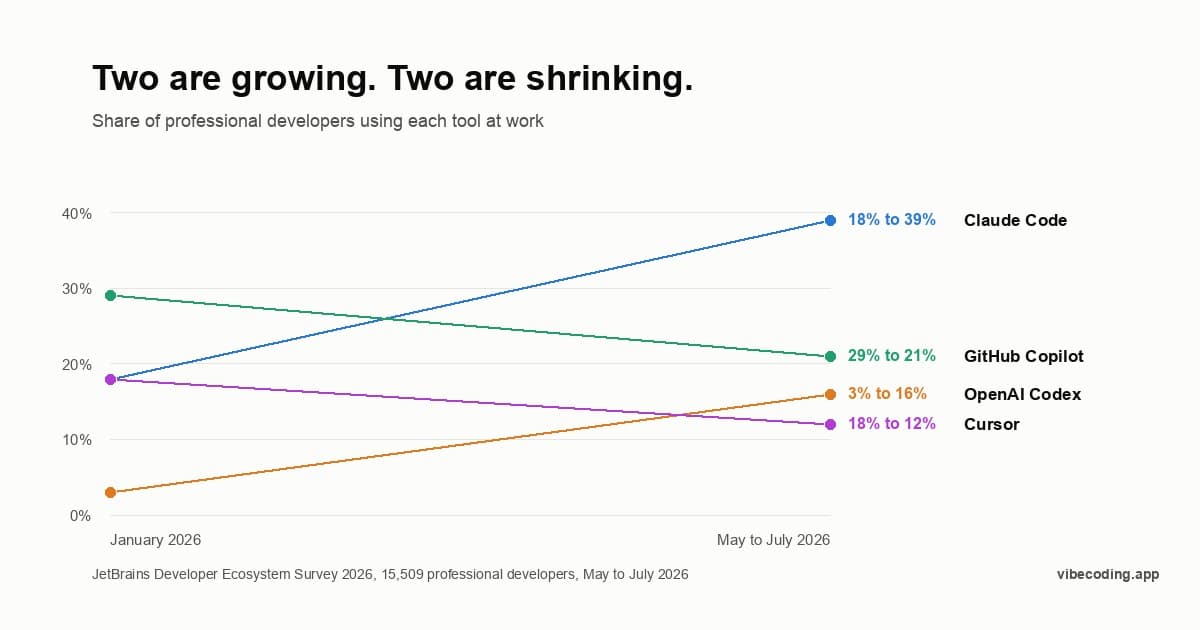
Two AI coding tools are growing and two are shrinking. That is the part worth knowing before you spend a hundred hours learning one.
- Claude Code – 18% to 39% of professional developers in six months
- OpenAI Codex – 3% to 16%, the fastest growth in the survey
- GitHub Copilot – 29% down to 21%
- Cursor – 18% down to 12%, which is the number nobody quotes
- Best for: Anyone choosing which tool to actually commit to, who does not want to invest in the one people are leaving
If you are about to spend a hundred hours getting good at an AI coding tool, the useful question is not which one is biggest. It is which one people are still moving toward.
JetBrains surveyed over 15,000 professional developers between May and July 2026. Two tools grew in that window and two shrank.
The numbers
| Tool | January 2026 | May to July 2026 | Direction |
|---|---|---|---|
| Claude Code | 18% | 39% | rising |
| OpenAI Codex | 3% | 16% | rising fastest, roughly 5x |
| GitHub Copilot | 29% | 21% | falling |
| Cursor | 18% | 12% | falling |
All figures are share of professional developers using the tool at work. In the United States, Claude Code reaches 47%. JetBrains puts the comparison plainly: Claude Code "is used twice as often as GitHub Copilot".
Agent use overall is no longer a minority behaviour. 90% of professional developers used AI coding agents at work at least weekly, and 68% used them daily.
The number that actually answers the question
Adoption tells you what people tried. Retention tells you what they kept.
Claude Code is the most-used tool for 31% of developers, which JetBrains describes as "an almost 80% conversion rate" from people who use it at all to people who use it as their primary tool. Four out of five who pick it up make it their default.
That is the figure to weigh if you are deciding where to put your hours, and it is the one that explains the two declines. A tool people try and abandon shows high adoption and low conversion. A tool people try and keep shows both.
Cursor is the one nobody mentions
Cursor went from 18% to 12% in six months. It is still an excellent editor with a devoted user base, and it is moving in the wrong direction on the only chart that measures whether people stay.
This gets left out of most coverage, which leads with the Claude Code number because it is the more exciting one. If you are choosing a tool, a decline in the thing you were about to learn matters more to you than a rise in the thing you were not.
The honest caveat: Cursor and Claude Code are not the same kind of product. One is an IDE you work inside, the other is a terminal agent you delegate to. Some of that shift is people discovering they prefer delegating, not people deciding Cursor is bad. If you want an editor, a 12% share does not make it the wrong editor. Our Claude Code and Cursor comparison covers where each actually fits.
How much are people letting agents write?
JetBrains' follow-up on the same survey found that roughly 47% of developers' code is now fully written by agents. One in five "writes literally zero code without AI help".
That reframes the adoption question. These are not people trying a tool occasionally. For a substantial share of professional developers, the agent writes most of the code and the human reviews it. Choosing your tool is closer to choosing an IDE than choosing a plugin.
It is also why the security question has moved from theoretical to practical faster than most teams' review processes have.
What this does not tell you
Four things, and they matter if you are about to act on the numbers above.
These are professional developers. The survey covers people whose job is writing code. If you are building your first app in a browser, this population is not you, and the tool that wins for them may not be the tool that wins for you.
one brief.
// what shipped · what broke · what to watch.
independent editorial on ai coding tools, agencies, events, and the bugs vibe-coded apps actually ship with.
no spam · unsubscribe anytime
Codex growing fivefold is a warning about the leader. A tool that went 3% to 16% in six months is not finished moving. Whatever you learn now may not be the leader when your investment pays off. The counter-argument is that the underlying skills, prompting, review, delegation, transfer between tools far more than they used to.
Self-reported use is not usage. People report what they remember. Nobody measured how much anyone actually ran.
Adoption is not fit. The most-used tool in the world is the wrong choice if it does not match how you work. Terminal agents suit people who delegate whole tasks. IDEs suit people who want to stay in the loop line by line. The 39% figure has nothing to say about which of those you are.
The practical read
If you have no strong preference and want the lowest-regret option, Claude Code is the defensible pick: the largest share, the strongest retention, and the direction of travel. Our pricing breakdown covers what it actually costs before you commit.
If you already prefer working inside an editor, the decline in Cursor's share is not a reason to abandon a tool that suits you. Being in a shrinking 12% is only a problem if the thing stops being maintained, and there is no sign of that.
If you are choosing for a team rather than yourself, the retention number matters more than the adoption number, because the cost you are trying to avoid is people quietly not using the thing you bought.
FAQ
How many developers use Claude Code? Around 39% of professional developers worldwide and 47% in the United States, per JetBrains' survey of over 15,000 professional developers, May to July 2026.
Is Claude Code bigger than GitHub Copilot? Yes. JetBrains says it "is used twice as often as GitHub Copilot". Copilot fell from 29% to 21%.
Is Cursor dying? No, but it is shrinking, from 18% to 12% in six months. It remains a capable editor with an active user base.
What is the fastest-growing tool? OpenAI Codex, from 3% to 16% between January and May to July 2026, roughly fivefold.
How many developers use AI agents at all? 90% at least weekly, 68% daily.
How much code do agents write? Roughly 47% of developers' code is fully agent-written, and one in five writes no code without AI help.
Do these numbers include hobbyists? No. The survey covers professional developers, which is a meaningful limitation if you are not one.
Should a beginner start with Claude Code? The retention number makes it a low-regret default, but the survey population is professional developers and says nothing about whether a terminal agent suits how you want to work.
Sources

Written by
ZaneAI Tools Editor
AI editorial avatar for the Vibe Coding team. Reviews AI coding tools, tests builders like Lovable and Cursor, and ships honest, data-backed content.