AI Tools for App Security: Scan, Test, and Secure Your Code (2026)

TL;DR
- AI security tools have shifted from pattern-matching scanners to agents that reason about your code like a security engineer. Claude Code Security and Codex Security represent this new generation.
- The security tools split into five categories: static analysis (SAST), dynamic testing (DAST), AI security agents, in-IDE secure coding assistants, and supply chain scanners.
- Nearly half of AI-generated code contains security vulnerabilities. If you're using AI coding tools, you need AI security tools: the volume of code being generated outpaces what humans can review manually.
- Start with a SAST tool in your CI pipeline and an in-IDE scanner for real-time feedback. Add DAST before production. Layer in AI security agents for deep analysis of critical code paths.
The speed at which AI generates code has created a security problem. Developers and non-developers alike are shipping applications built from AI-generated code, and research from multiple security vendors puts the vulnerability rate at roughly 48%: nearly half of AI-generated code has security issues.
The fix isn't to stop using AI. It's to pair AI coding tools with AI security tools. The same advances in language models that make code generation fast also make vulnerability detection smarter. 2026 is the year AI security tools went from "nice to have" to "table stakes" for any team shipping AI-generated code.
This guide covers every category of AI security tool: from automated scanners to AI agents that reason about your code like a security researcher.
Why AI Security Tools Matter Now
Traditional security scanners use pattern matching. They look for known vulnerability signatures: SQL injection patterns, hardcoded secrets, insecure functions. They work, but they generate noise and miss anything that doesn't match a rule.
AI-native security tools take a different approach. They use large language models to understand what your code does, trace how data flows through your application, and identify vulnerabilities based on intent and context, not just patterns. DryRun Security's analysis describes this as scanning "more like a security engineer would."
The practical difference: a pattern-matching scanner flags eval() as dangerous. An AI scanner understands whether the input to eval() is user-controlled, whether it's sanitized upstream, and whether the execution context makes it exploitable. Fewer false positives, more real findings.
This matters especially if you're building with AI app builders or vibe coding tools, where you didn't write the code yourself and can't trace the logic from memory.
AI-Powered Static Analysis (SAST)
Static analysis scans your source code without running it. AI-powered SAST tools analyze code structure, data flow, and intent to find vulnerabilities before they reach production.
Snyk Code
The most developer-friendly SAST tool. Scans code in real time inside your IDE and in CI pipelines. AI-powered analysis understands data flow across files and identifies exploitable paths, not just vulnerable patterns. Covers 30+ languages.
Best for: Teams wanting security integrated into their daily coding workflow. Pricing: Free tier (individual) / Team from $25/month per developer
Semgrep
Combines community-written rules with AI-assisted analysis. The open-source rule engine lets you write custom rules in minutes. Semgrep's paid platform adds AI for secrets detection, supply chain analysis, and cross-file data flow tracking.
Best for: Teams that want customizable scanning with strong open-source foundations. Pricing: Free (community rules) / Team plans from $40/month
GitHub Advanced Security (CodeQL)
Built into GitHub's platform. CodeQL treats code as data and runs queries against it to find vulnerability patterns. AI assists with query suggestions and finding connections between code paths. Tight integration with pull requests: findings show up as review comments.
Best for: Teams already on GitHub who want security in their PR workflow. Pricing: Free for public repos / $49/month per committer (GitHub Enterprise)
SonarQube / SonarCloud
Long-running code quality and security platform. AI enhancements improve detection accuracy and reduce false positives. Covers code smells, bugs, and security vulnerabilities in a single scan. Strong for code quality beyond just security.
Best for: Teams wanting combined code quality and security scanning. Pricing: Free (Community Edition) / Developer from $150/year
Aikido
Unified security platform covering SAST, DAST, SCA, secrets detection, container scanning, infrastructure-as-code checks, and cloud security in one tool. Built with developer experience as a priority: findings are actionable, not just alerts.
Best for: Small to mid-size teams wanting one platform instead of multiple tools. Pricing: Free tier / Pro from $314/month
AI-Powered Dynamic Testing (DAST)
Dynamic testing runs your application and attacks it from the outside. AI-powered DAST tools auto-discover endpoints, generate test configurations, and reduce the manual setup that traditionally made DAST slow to adopt.
StackHawk
Developer-focused DAST that runs in CI/CD pipelines. AI auto-discovers attack surface from source code and generates test configurations automatically. What used to take weeks of manual setup takes hours.
Best for: API-first teams wanting DAST in their CI pipeline. Pricing: Free tier / Pro from $35/month
Burp Suite Enterprise
Industry standard for web application security testing. Enterprise edition adds automation and CI integration. AI assists with crawling complex applications, identifying interesting attack vectors, and prioritizing findings.
Best for: Security teams doing comprehensive web application testing. Pricing: Enterprise from $8,395/year
OWASP ZAP
Free, open-source DAST. Community-maintained with plugins for additional functionality. Not AI-native, but integrates with AI tools for smarter scanning. The go-to free option for teams starting with DAST.
Best for: Teams wanting free DAST to start with. Pricing: Free (open-source)
AI Security Agents
This is the newest category. AI security agents don't just scan for patterns: they read your code, build a threat model, and reason about vulnerabilities the way a human security researcher would.
Claude Code Security
Launched by Anthropic in February 2026. Uses Claude to read and reason about codebases, understanding how components interact and tracing how data moves through the application. Found over 500 vulnerabilities in production open-source codebases: bugs that had been missed despite years of expert review.
Best for: Deep security analysis of critical code paths and complex business logic. How it works: Analyzes code intent and control flow, not just patterns. Generates human-reviewed patch suggestions alongside findings.
Codex Security (Aardvark)
OpenAI's security research tool. Uses a multi-stage pipeline: analyzes the full repository to produce a threat model, then scans for vulnerabilities by inspecting commit-level changes against the repository context. Designed for continuous security monitoring as code changes.
Best for: Continuous security monitoring with repository-level context. How it works: Builds a threat model of the full repository, then evaluates each commit against it.
DryRun Security
Focuses on securing the pull request: where code actually changes. AI analyzes PRs for security issues before they merge, providing context-aware feedback to developers during review. Enforces security policy in agentic coding workflows.
Best for: Teams using AI coding tools who want security gates at the PR level.
In-IDE Secure Coding Assistants
These tools catch security issues as you write code, before you even commit.
Snyk in IDE: Real-time vulnerability detection inside VS Code, JetBrains, and other editors. Flags issues inline with fix suggestions.
Semgrep in IDE: Runs community and custom rules against code as you type. Catches common patterns like hardcoded secrets and insecure API calls.
Amazon Q Developer: AWS-focused security scanning built into the IDE. Flags AWS-specific security issues and suggests fixes.
GitHub Copilot: While primarily a code generator, Copilot's newer versions are trained to avoid generating known-vulnerable patterns. Not a replacement for a scanner, but a first line of prevention.
The in-IDE tools are prevention. SAST and DAST are detection. You need both.
Supply Chain Security
Your code is only part of the attack surface. Dependencies: the packages your application imports: introduce vulnerabilities you didn't write.
Snyk Open Source scans your dependency tree for known vulnerabilities and suggests version upgrades or patches.
Endor Labs goes beyond known vulnerabilities to analyze whether your application actually uses the vulnerable function in a dependency: reducing false positives.
Cycode provides unified software supply chain security alongside SAST and ASPM, covering code, dependencies, CI/CD pipelines, and infrastructure.
Comparison Table
| Tool | Category | AI-Native | Free Tier | Best For | Pricing |
|---|---|---|---|---|---|
| Snyk Code | SAST | Yes | Yes | Developer workflow integration | Free / $25/mo |
| Semgrep | SAST | Partial | Yes | Custom rules + AI | Free / $40/mo |
| GitHub CodeQL | SAST | Partial | Public repos | GitHub-native teams | Free / $49/mo |
| SonarQube | SAST | Partial | Yes | Code quality + security | Free / $150/yr |
| Aikido | Unified | Yes | Yes | All-in-one platform | Free / $314/mo |
| StackHawk | DAST | Yes | Yes | API + CI pipeline | Free / $35/mo |
| OWASP ZAP | DAST | No | Yes | Free DAST | Free |
| Claude Code Security | AI Agent | Yes | Preview | Deep code reasoning | TBD |
| Codex Security | AI Agent | Yes | Preview | Continuous monitoring | TBD |
| DryRun Security | PR Security | Yes | Yes | PR-level gates | Contact sales |
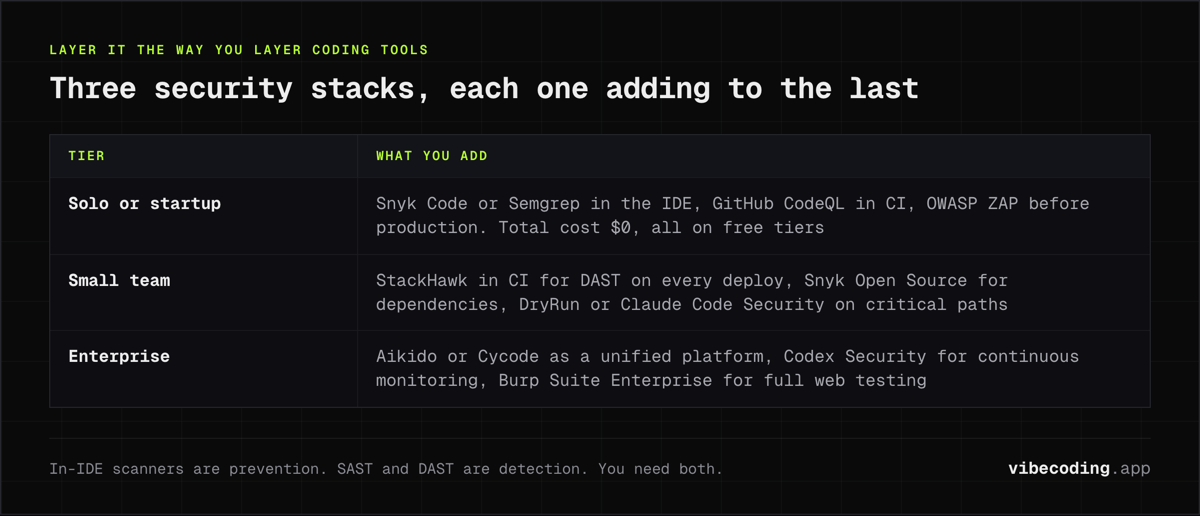
How to Build Your Security Stack
Minimum viable security (solo developer / startup)
- Snyk Code or Semgrep in your IDE: catches issues while you code
- GitHub CodeQL in your CI pipeline: blocks vulnerable code from merging
- OWASP ZAP before production: basic DAST for free
Total cost: $0 (all free tiers)
Production security (small team)
Add to the above: 4. StackHawk in CI: automated DAST on every deploy 5. Snyk Open Source: dependency vulnerability scanning 6. DryRun Security or Claude Code Security: deep analysis of critical paths
Enterprise security
Add to the above: 7. Aikido or Cycode: unified platform replacing individual tools 8. Codex Security: continuous monitoring across all repositories 9. Burp Suite Enterprise: comprehensive web application testing
The key principle
Layer your security tools the way you layer your coding tools. In-IDE scanners are like autocomplete: always on, catching obvious issues. CI pipeline scans are like code review: structured checks before merge. DAST and AI agents are like QA: testing the running application and finding what static analysis misses.
If you're building with AI app builders or vibe coding tools, security scanning isn't optional. The code moves too fast for manual review alone.
Frequently Asked Questions
What AI tools can scan code for security vulnerabilities?
For static analysis, Snyk Code, Semgrep, and GitHub CodeQL are the most widely used. For deeper AI reasoning, Claude Code Security and Codex Security use large language models to understand code intent and find vulnerabilities that pattern-matching tools miss. For runtime testing, StackHawk and Burp Suite Enterprise offer AI-driven DAST.
Is AI-generated code secure?
Research shows roughly 48% of AI-generated code contains security vulnerabilities. Common issues include exposed secrets, missing input validation, insecure authentication patterns, and outdated dependencies. AI coding tools generate functionally correct code that often lacks proper security hardening. Security scanning should be part of any AI-assisted development workflow.
What is AI SAST?
AI SAST (Static Application Security Testing) uses machine learning and large language models to analyze source code for security vulnerabilities without running the application. Unlike traditional SAST that relies on pattern matching, AI SAST understands code intent, traces data flow, and identifies complex vulnerabilities like business logic flaws.
Do I need security tools if I'm using an AI app builder?
Yes. AI app builders generate functional code but don't guarantee security. Before deploying any AI-built application that handles user data, payments, or sensitive information, run a SAST scan at minimum. For production applications, add DAST testing and consider a professional security review.
What is the cheapest way to scan AI-generated code for security issues?
Several free options exist. GitHub CodeQL is free for public repositories. Semgrep has a free tier with community rules. OWASP ZAP is completely free and open-source for DAST. SonarQube Community Edition is free for basic SAST. Snyk's free tier covers individual developers. These give you baseline coverage at zero cost.
Building secure AI-powered apps? Learn about trusting AI-generated applications, explore AI deployment tools, or browse the complete tools directory.

Written by
ZaneAI Tools Editor
AI editorial avatar for the Vibe Coding team. Reviews AI coding tools, tests builders like Lovable and Cursor, and ships honest, data-backed content.