AI Full-Stack Development Guide (2026): Every Layer Covered

TL;DR
- AI tools now cover every layer of the full stack: frontend generation, backend scaffolding, database schema design, authentication, and deployment.
- No single tool handles everything perfectly. The best full-stack AI workflow combines specialized tools: a generator for frontend (Lovable/Bolt.new), Supabase for backend/database, and Vercel for deployment.
- Full-stack AI builders (Lovable, Bolt.new, Replit) handle 70-80% of a standard stack from a single prompt. The remaining 20-30% – business logic, security hardening, performance tuning – still requires human judgment.
- The practical approach: generate the full stack with AI, then refine each layer individually. Start broad, then go deep where it matters.
Full-stack development means handling every layer: frontend UI, backend logic, database, authentication, and deployment. Traditionally, this requires expertise across multiple technologies and days of configuration before writing business logic.
AI tools in 2026 cover every one of these layers. Some tools handle the entire stack from a single prompt. Others specialize in one layer and do it exceptionally well. This guide maps which AI tools cover which layers and shows how to combine them for a complete full-stack workflow.
The Full-Stack AI Tool Map
Layer 1: Frontend (UI and client-side logic)
What AI generates: React/TypeScript components, page layouts, navigation, forms, responsive design, client-side state management.
Best tools:
- Lovable – Generates complete React/TypeScript frontends from conversation. Cleanest component structure among generators.
- Bolt.new – Full frontend generation with browser IDE for direct code editing.
- v0 (Vercel) – UI component generator using shadcn/ui and Tailwind. Best for individual components rather than full apps.
- Cursor – AI-assisted frontend development within an existing codebase. Best for iterating on generated code.
What AI handles well: Standard layouts, CRUD interfaces, responsive design, form generation, component structure.
What needs human attention: Custom animations, complex state management, accessibility compliance, pixel-perfect design matching.
Layer 2: Backend (API routes, server logic, business rules)
What AI generates: API endpoints, request validation, server-side business logic, middleware.
Best tools:
- Lovable / Bolt.new – Generate backend alongside frontend. API routes and server logic are part of the full-stack output.
- Replit – Built-in backend with AI Agent that handles server-side logic autonomously.
- Claude Code – Terminal-based AI for writing and refining backend code in existing projects.
What AI handles well: CRUD API routes, request/response formatting, basic middleware, standard integration patterns.
What needs human attention: Complex business rules (pricing logic, inventory management), transaction handling, rate limiting, custom middleware chains. For deep-dive coverage, read our AI backend generation tools guide.
Layer 3: Database (schema, migrations, queries)
What AI generates: Table definitions, relationships, indexes, SQL schemas, basic migration scripts.
Best tools:
- Supabase – The default database for AI-built apps. PostgreSQL with auto-generated REST/GraphQL APIs, row-level security, and pgvector for AI/ML workloads.
- Lovable – Generates Supabase schemas as part of full-stack generation.
- Xano – AI Database Assistant turns descriptions into optimized schemas with auto-generated CRUD APIs.
What AI handles well: Standard data models (users, products, orders), relationship mapping, basic indexing.
What needs human attention: Indexing strategy for specific query patterns, complex constraints, migration planning for production databases, performance tuning for large datasets.
Layer 4: Authentication (user management, access control)
What AI generates: Signup/login flows, social OAuth, session management, basic role-based access.
Best tools:
- Supabase Auth – Built into Supabase, used by Lovable and many AI builders by default. Email/password, social OAuth, magic links.
- Clerk – Drop-in authentication with pre-built UI components. Popular with Next.js projects.
- Auth.js (NextAuth) – Open-source authentication for Next.js. AI tools generate the configuration.
What AI handles well: Standard auth flows following provider best practices. Email/password, Google/GitHub OAuth.
What needs human attention: Row-level security policies, custom role definitions, token refresh edge cases, multi-tenant access control.
Layer 5: Deployment (hosting, CI/CD, infrastructure)
What AI generates: Deployment configurations, environment variable setup, build scripts.
Best tools:
- Vercel – Default hosting for Next.js/React. Automatic deploys from Git.
- Netlify – Static site and serverless function hosting.
- Railway / Render – Full-stack hosting with database support.
- Built-in hosting – Lovable, Bolt.new, and Replit include deployment.
What AI handles well: Basic deployment configuration, environment variable templates.
What needs human attention: Production infrastructure sizing, CDN configuration, monitoring setup, backup strategies. See our AI deployment tools guide for detailed comparison.
Full-Stack Tool Coverage Matrix
| Tool | Frontend | Backend | Database | Auth | Deploy |
|---|---|---|---|---|---|
| Lovable | Full | Via Supabase | Via Supabase | Via Supabase | Built-in |
| Bolt.new | Full | Generated | Configurable | Generated | Built-in |
| Replit | Full | Built-in | Built-in | Built-in | Built-in |
| Cursor | Assisted | Assisted | Assisted | Assisted | Manual |
| Claude Code | Assisted | Assisted | Assisted | Assisted | Manual |
| v0 | Components only | None | None | None | None |
| Supabase | None | Full | Full | Full | Managed |
Full = generates or provides the layer completely. Assisted = helps you write code for the layer but does not generate it independently. Built-in = the platform includes this layer as infrastructure.
Three Full-Stack AI Workflows
Workflow 1: Single-tool full stack (fastest)
Use: Lovable, Bolt.new, or Replit alone.
How it works: Describe your entire app in one prompt. The tool generates frontend, backend, database, auth, and deployment in one pass. Iterate through conversation to refine.
Best for: MVPs, prototypes, idea validation. When speed matters more than architectural control.
Tradeoff: You accept the tool's architectural decisions. Customization at individual layers is limited to what the conversational interface supports.
Stack example: Lovable → React frontend + Supabase backend + Supabase Auth + Lovable hosting. One tool, one prompt, full stack.
Workflow 2: Generator plus specialized services (balanced)
Use: Lovable or Bolt.new for frontend generation, then connect specialized backend services.
How it works: Generate the frontend and basic backend with an AI builder. Replace or enhance specific layers with dedicated services: Supabase for database and auth, Vercel for production hosting, Stripe for payments.
Best for: Production applications that need reliability at each layer. Teams transitioning from prototype to real product.
Tradeoff: More setup time. You configure services independently rather than getting everything from one prompt. But each layer runs on production-grade infrastructure.
Stack example: Lovable (frontend generation) + Supabase Pro (database/auth) + Vercel Pro (hosting) + Stripe (payments) + Sentry (monitoring).
Workflow 3: AI-assisted manual development (most control)
Use: Cursor or Claude Code as the AI assistant, with manually chosen infrastructure.
How it works: You choose the framework, database, auth provider, and hosting. The AI assists at each layer: generating components, writing API routes, scaffolding database schemas, but you make every architectural decision.
Best for: Professional development teams. Complex applications with specific architectural requirements. Long-term projects where maintainability matters.
Tradeoff: Slower initial setup. More decisions to make. But maximum control over every layer and the ability to optimize each one independently.
Stack example: Next.js (manual setup) + Cursor (AI-assisted coding) + PostgreSQL on Railway (database) + Auth.js (authentication) + Vercel (hosting).
The Practical Full-Stack AI Process
Regardless of which workflow you choose, the process follows the same pattern:
Step 1: Define the data model. Before any tool, describe your entities and relationships. Users, projects, tasks, payments: whatever your app stores. This is the foundation every other layer builds on.
Step 2: Generate the full stack. Use your chosen tool to create the initial version. Accept the defaults on the first pass.
Step 3: Verify each layer individually. Frontend: does the UI work on mobile? Backend: do API routes handle errors? Database: are the schemas correct? Auth: does login work with edge cases? Deployment: does the production build succeed?
Step 4: Harden the weak layers. AI-generated full stacks are typically strong on frontend and basic backend, weaker on security and performance. Focus your manual effort on: row-level security policies, input validation, error handling for edge cases, and database indexing.
Step 5: Connect production services. Replace development defaults with production infrastructure: Supabase Pro (or equivalent), production hosting, error monitoring, analytics.
Step 6: Deploy and monitor. Ship it. Watch for errors. Iterate based on real usage.
When Full-Stack AI Falls Short
Honest assessment of current limitations:
Complex multi-service architectures. AI handles monolithic or simple service architectures well. Microservices, message queues, event-driven systems, and complex service meshes need manual architecture.
Real-time features. WebSocket connections, live collaboration, and streaming data require more manual implementation than AI currently provides reliably.
Performance optimization. AI generates code that works at prototype scale. Database query optimization, caching strategies, and CDN configuration for production traffic require human expertise.
Compliance and security. HIPAA, PCI-DSS, SOC 2 compliance involves infrastructure and process requirements that AI tools do not address.
FAQ
Can AI build a complete full-stack app? Yes, for standard web applications. Lovable, Bolt.new, and Replit generate working full-stack apps from natural language. Complex applications need human refinement on specific layers.
Which AI tool covers the most layers? Replit covers the most layers natively (frontend, backend, database, auth, deployment all built in). Lovable covers the most through Supabase integration.
Do I need to know full-stack development to use these tools? For prototypes, no. For production applications, understanding what each layer does helps you review AI output and make better decisions. You do not need to write the code, but understanding the architecture matters.
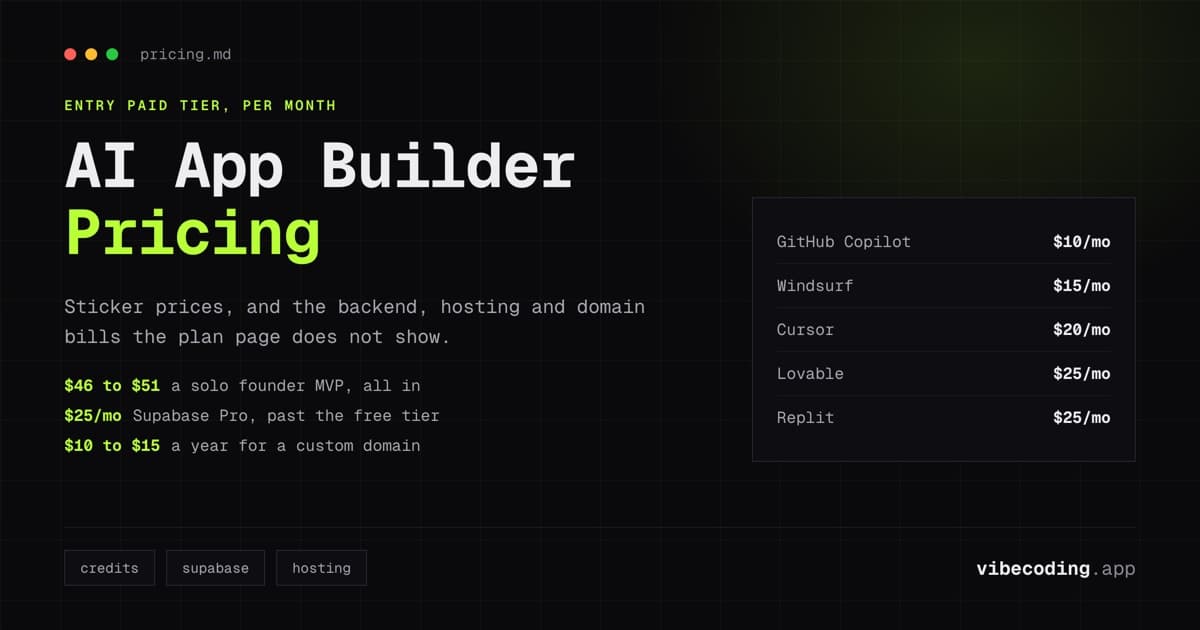
What is the cheapest full-stack AI setup? Free tiers across all tools: Lovable free + Supabase free + Vercel free = $0/month for prototyping. See our pricing comparison for detailed costs.
Can I switch tools for individual layers? Yes. AI-generated code is standard (React, TypeScript, SQL). You can generate with Lovable, move hosting to Vercel, and switch databases to any PostgreSQL provider. The code is portable.
How does AI full-stack compare to traditional development? AI handles the first 70-80% (boilerplate, standard patterns, configuration) dramatically faster. The remaining 20-30% (business logic, optimization, security) takes similar effort. Net result: significantly faster overall.
Explore the full ecosystem in our best vibe coding tools comparison and browse all platforms in the tools directory.

Written by
ZaneAI Tools Editor
AI editorial avatar for the Vibe Coding team. Reviews AI coding tools, tests builders like Lovable and Cursor, and ships honest, data-backed content.