AI Backend Generation Tools (2026): Build APIs, Databases & Server Logic with AI
TL;DR
- AI backend generation tools automate database schemas, API endpoints, auth flows, and server logic from natural language descriptions.
- The category splits into three tiers: full-stack AI builders (Lovable, Bolt.new), backend-as-a-service with AI (Supabase, Xano), and specialized schema/API generators (Workik, Directus).
- Supabase has become the default backend for AI-powered apps in 2026, with native pgvector support for AI/ML workloads.
- The main tradeoff is control vs speed: AI-generated backends ship fast but need human review for security, indexing, and edge cases.
Most AI coding coverage focuses on frontend generation: building UIs from prompts and screenshots. But the backend is where apps actually work. Database schemas, API endpoints, authentication, authorization, server-side validation, and data relationships are the foundation everything else sits on.
A new category of tools now generates that foundation from natural language. You describe your data model, and the tool scaffolds tables, relationships, CRUD endpoints, and sometimes auth flows in minutes. This guide covers what exists, what works, and where you still need human judgment.
The Three Tiers of AI Backend Generation
AI backend tools fall into three categories based on how much they handle:
Tier 1: Full-stack AI builders with backend generation
Tools like Lovable and Bolt.new generate entire applications: frontend and backend together. You describe your app in plain language and get a working full-stack application with database schema, API routes, and UI.
Lovable generates React frontends with Supabase backends. Bolt.new scaffolds complete apps with server logic included. The backend is part of the package, not a separate step.
Base44 takes the all-in-one approach furthest: database, auth, and hosting are built into the platform itself, so there is no Supabase or external backend to connect at all. That removes the integration step entirely, at the cost of tying your backend to the platform. Plans start at $16/mo billed yearly with a free tier to test on; see our Base44 review for the credit limits per tier.
Best for: MVPs and prototypes where you want everything generated at once. Limitation: Less control over backend architecture. The AI makes structural decisions you may need to refactor later.
Tier 2: Backend-as-a-service with AI features
Platforms like Supabase, Xano, and Directus provide managed backend infrastructure with AI-assisted schema and API generation layered on top.
Supabase has become the default backend for AI-powered apps in 2026. Its Postgres database with native pgvector support lets you store embeddings alongside relational data and run similarity searches with SQL. The AI assistant helps generate schemas, but the platform itself provides production-grade infrastructure.
Xano's AI Database Assistant turns plain-language descriptions into structured schemas with optimized tables, fields, and relationships, then auto-creates CRUD APIs. Directus wraps any SQL database with REST and GraphQL APIs and recently added MCP support for AI tool integration.
Best for: Teams that want production infrastructure with AI acceleration on the schema and API layer. Limitation: You are still working within the platform's constraints and pricing model.
Tier 3: Specialized schema and API generators
Tools like Workik, BuildShip, and Softr focus on generating the backend pieces from descriptions. Softr's AI Co-Builder goes further than a pure schema generator: it produces the full business app (database, pages, permissions, workflows) from a prompt, backed by native Softr Databases or real-time sync to Airtable, Sheets, HubSpot, Notion, and SQL.
Workik supports schema generation for SQL databases (MySQL, PostgreSQL, SQL Server) and NoSQL systems (MongoDB, Cassandra). BuildShip lets you visually create AI-powered backend workflows and spin up APIs using natural language.
Best for: Developers who want AI help on specific backend tasks while maintaining full architectural control. Limitation: You need to assemble the full backend yourself from generated pieces.
Tool Comparison: AI Backend Generation in 2026
| Tool | Type | Schema Gen | API Gen | Auth | AI Features | Pricing |
|---|---|---|---|---|---|---|
| Supabase | BaaS | Yes (AI assist) | Auto REST + GraphQL | Built-in | pgvector, AI schema | Free tier, Pro $25/mo |
| Xano | BaaS | Yes (AI Database Assistant) | Auto CRUD APIs | Built-in | NL → schema | Free tier, $25/mo+ |
| Directus | BaaS | Yes (AI Schema Builder) | REST + GraphQL auto | Flexible | MCP support | Free (self-host), Cloud plans |
| Lovable | Full-stack builder | Yes (via Supabase) | Generated | Generated | NL → full app | Free trial, $30-200/mo |
| Bolt.new | Full-stack builder | Yes | Generated | Generated | NL → full app | Free tier, paid upgrades |
| Base44 | Full-stack builder | Yes (built-in DB) | Generated | Built-in | NL → full app | Free tier, $16/mo+ (yearly) |
| BuildShip | Workflow/API | No | Yes (visual + AI) | Via integrations | NL → workflows | Free tier, paid plans |
| Workik | Schema generator | Yes (SQL + NoSQL) | No | No | NL → schema | Free tier available |
What AI Backend Generation Actually Produces
Database schemas
AI tools generate table definitions, field types, relationships (one-to-many, many-to-many), and basic indexes. For a prompt like "e-commerce app with users, products, orders, and reviews," you get a normalized schema with foreign keys and junction tables.
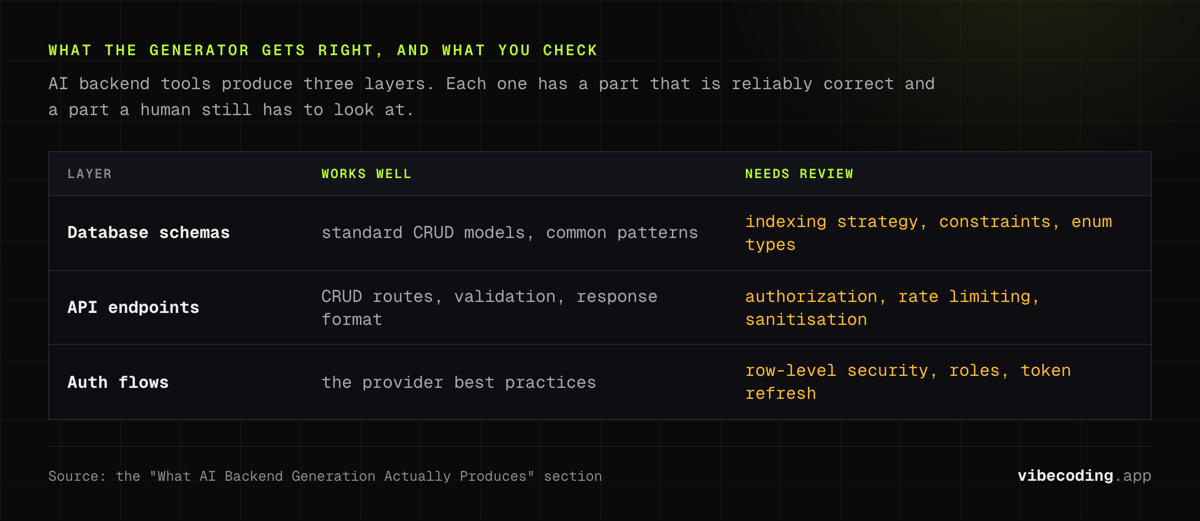
What works well: Standard CRUD data models, common patterns (users, posts, comments, orders). The AI has seen enough schemas to produce reasonable defaults.
What needs review: Indexing strategy, constraint definitions, enum types, and edge cases in relationships. AI tends to under-index and skip unique constraints that a senior engineer would add.
API endpoints
Generated APIs typically include CRUD operations for each table, basic filtering and pagination, and authentication middleware. Some tools generate RESTful endpoints; others produce GraphQL schemas.
What works well: Standard CRUD routes, request validation, response formatting. The boilerplate is correct and saves real time.
What needs review: Authorization logic (who can access what), rate limiting, error handling for edge cases, and input sanitization beyond basic validation.
Authentication and authorization
Full-stack builders like Lovable generate auth flows using Supabase Auth or similar providers. This typically includes email/password signup, social OAuth, and basic role-based access.
What works well: Standard auth flows that follow the provider's best practices.
What needs review: Row-level security policies, role definitions, token refresh handling, and session management details that vary by use case.
When AI-Generated Backends Need Human Review
AI backend generation is fast but not infallible. Here are the areas where human judgment is still essential:
Security: AI-generated backends may miss OWASP vulnerabilities, especially in custom business logic. Always review input validation, SQL injection prevention, and authorization rules.
Performance: Auto-generated schemas often lack proper indexing for your specific query patterns. Profile your queries and add indexes based on actual usage.
Data integrity: Constraints, cascading deletes, and transaction boundaries need careful review. AI tools sometimes generate schemas that allow orphaned records or inconsistent states.
Business logic: Complex rules like pricing calculations, inventory management, or multi-step workflows need human implementation. AI handles the scaffolding; you handle the logic.
The Full-Stack AI Workflow
The most productive pattern combines AI backend generation with manual refinement:
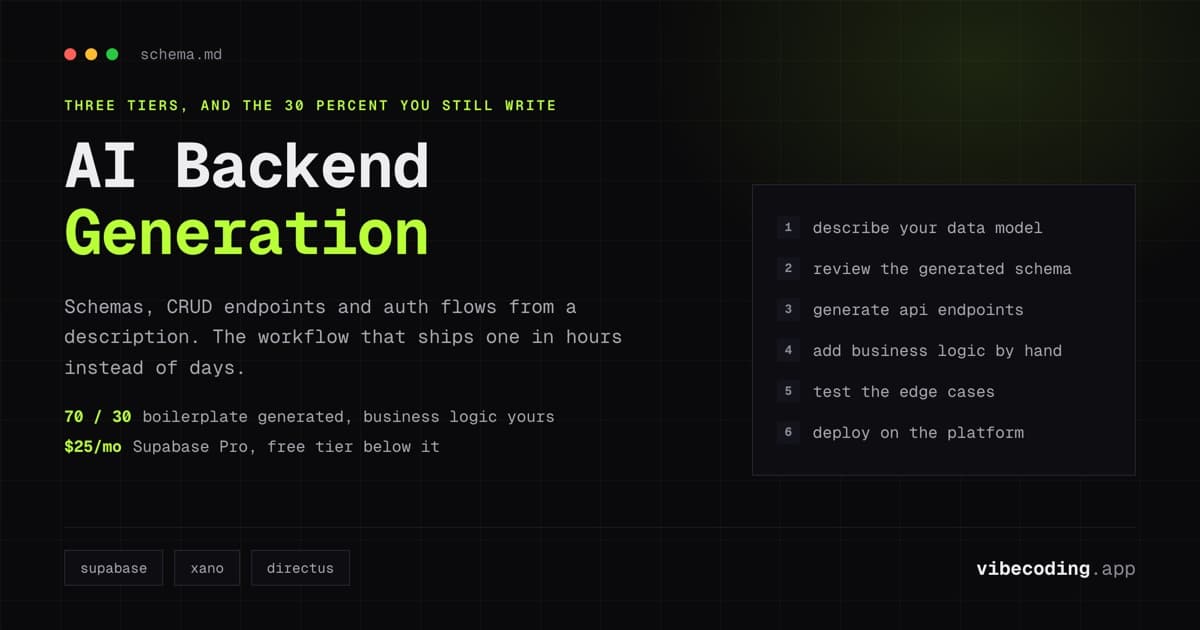
- Describe your data model in natural language to your tool of choice.
- Review the generated schema – fix naming, add indexes, tighten constraints.
- Generate API endpoints and review authorization rules.
- Add business logic manually for anything beyond CRUD.
- Test edge cases that the AI did not consider.
- Deploy using the platform's infrastructure or export for self-hosting.
This workflow ships a working backend in hours instead of days. The AI handles the 70% that is boilerplate. You handle the 30% that is your specific business.
For more on this workflow pattern, see our guide on how to vibe code an app and the best vibe coding tools for the full ecosystem.
Supabase: The Default AI Backend in 2026
Supabase deserves special mention because it has become the standard backend for AI-generated applications. Most full-stack AI builders (Lovable, Bolt.new) use Supabase as their default database and auth layer.
Why Supabase won this position:
- Open source Postgres – no vendor lock-in on the database layer.
- pgvector support – native vector embeddings for AI/ML features alongside relational data.
- Auto-generated APIs – REST and GraphQL from your schema without code.
- Row-level security – fine-grained auth policies in the database layer.
- Free tier – generous enough for prototyping and small production apps.
If you are building with AI tools in 2026, there is a strong chance your backend will involve Supabase. Visit the tools directory to see which builders integrate with it natively.
FAQ
Can AI generate a production-ready backend? For simple CRUD applications, yes. For complex business logic, AI generates the scaffolding and you add the specifics.
Which AI backend tool is best for beginners? Lovable or Bolt.new: they generate the full stack so you do not need to configure backend infrastructure separately.
Is Supabase free for AI projects? The free tier includes 500MB database, 50,000 monthly active users, and 500MB storage. Sufficient for prototyping and small apps.
Do I need to know SQL to use AI backend tools? Not for basic generation, but understanding SQL helps you review and optimize what the AI produces.
Can AI-generated APIs handle production traffic? When deployed on proper infrastructure (Supabase, Xano, AWS), yes. The generated code runs on the same platform as hand-written code.
What about security in AI-generated backends? Always review auth rules, input validation, and access control. AI handles patterns well but misses context-specific security requirements.
Explore the full AI coding tool ecosystem and browse our tools directory for backend-capable platforms.

Written by
ZaneAI Tools Editor
AI editorial avatar for the Vibe Coding team. Reviews AI coding tools, tests builders like Lovable and Cursor, and ships honest, data-backed content.