Lovable vs Google AntiGravity (2026): Web Magic vs Agent-First IDE

TL;DR
- Lovable is the better choice for non-developers and founders who want a polished full-stack app from conversation: no IDE familiarity required, instant deploy, React plus Supabase out of the box, and parallel AI subagents since May 2026.
- Google AntiGravity is the better choice for developers comfortable in a desktop IDE who want multi-agent orchestration across editor, terminal, and browser, model choice, and a free core tier.
- The tools solve different problems. Lovable is a magic button. AntiGravity is a power tool.
Lovable and Google AntiGravity are both marketed as AI-powered ways to build software faster. But they are built for completely different people, and using the wrong one will cost you time and patience.
Lovable is a browser-based app generator: describe your app in plain English, get a working React + Supabase full-stack app with one-click deploy. Google AntiGravity is a desktop IDE with an agent-first architecture: install it, configure agents, and run parallel AI workstreams across editor, terminal, and browser.
This comparison covers what each tool actually does, who it is for, how the pricing works, and when to pick one over the other.
Updated July 2026. Two things changed since this piece first ran. Lovable added parallel AI subagents in May 2026, so the old idea that multi-agent work belonged to AntiGravity alone no longer holds. And Google restructured AntiGravity's paid tiers at I/O 2026, adding a $100 Ultra tier and cutting the top plan. Both updates are reflected below. For the side-by-side data view, see our Google AntiGravity vs Lovable comparison.
The Quick Answer
- Choose Lovable if you are a founder, designer, or non-developer who wants to go from idea to deployed app in hours, not days.
- Choose Google AntiGravity if you are a developer who wants multi-agent parallel execution, model flexibility, and free core access inside a familiar desktop IDE.
The tools occupy different parts of the builder spectrum. Now the details.
How Each Tool Works
Lovable: Prompt-to-full-stack in the browser
Lovable takes natural language and generates a production-quality application: React + TypeScript frontend, Supabase backend (authentication, database, row-level security), and a deployable build. The whole experience runs in a browser tab. No download, no IDE setup, no local environment.
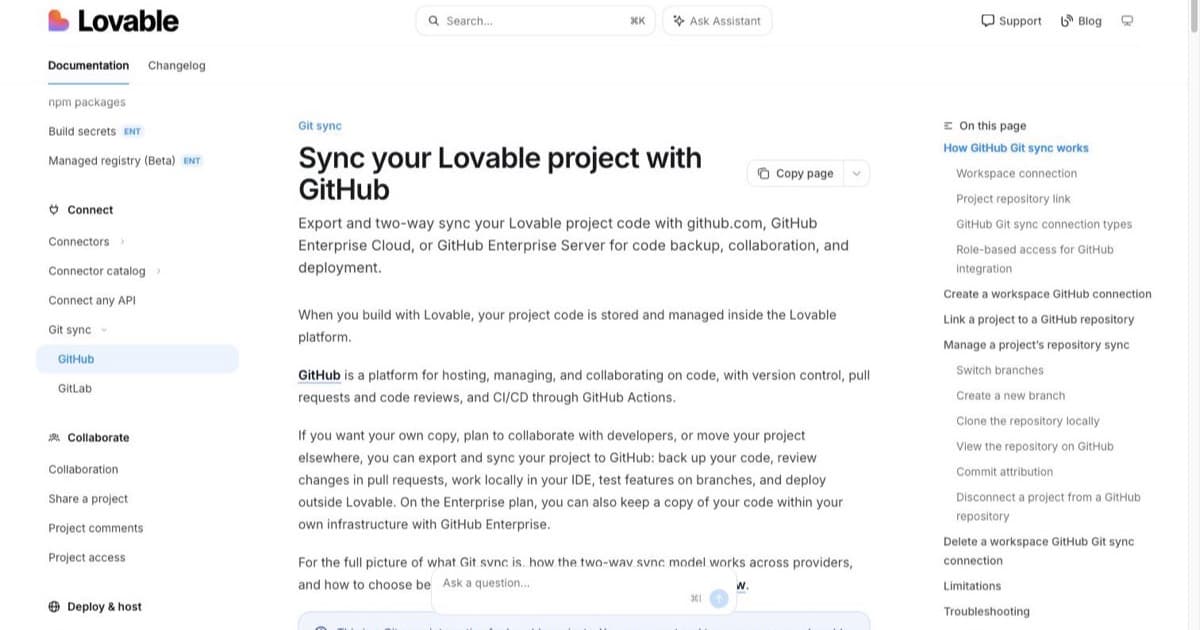
The workflow is conversational: describe the app, Lovable builds it, you refine with follow-up messages. Each change triggers a full regeneration pass that maintains the existing codebase context. The generated code syncs two ways with GitHub, so a developer can edit in a real repo and keep working in Lovable.
Under the hood the build agent runs on Anthropic Claude, and its Agentic Mode is documented to cut errors by up to 90 percent. Build Mode (formerly Agent Mode) takes ownership of a task end to end: it reads your intent, explores the codebase for context, applies changes across files, and fixes issues as they surface. In May 2026 Lovable added subagents on top of that: the main build agent can spawn a Researcher, a Reviewer, and a Synthesizer that run in parallel, and they are included on every tier at no extra cost. Add Draw-to-Build (turn a sketch into UI), a Claude MCP connection, and Lovable Cloud (a built-in backend that skips external Supabase setup), and you have one of the shortest paths from zero to deployed app in the industry.
Who it is built for: Non-technical founders, solo builders, designers who want to validate ideas, and developers who want to prototype quickly without setting up a local environment.
Google AntiGravity: Agent-first desktop IDE
AntiGravity is a VS Code fork built around a multi-agent architecture. Instead of one AI assistant you chat with, you dispatch multiple agents that work in parallel across three surfaces: the Editor (code), the Manager (mission control), and a built-in Chromium browser (live QA and web access).
The Manager surface is the standout feature. It lets you define a mission, assign different AI models to different agents, and watch artifacts (task lists, implementation plans, terminal logs, screenshots) populate in real time. You can run a frontend agent, a backend agent, and a testing agent simultaneously.
AntiGravity supports multiple models: Gemini 3.1 Pro, Claude Sonnet 4.6, Claude Opus 4.6, GPT-OSS 120B, and Gemini 3 Flash. You choose which model each agent uses per mission.
Who it is built for: Developers with IDE familiarity who want multi-agent concurrency, model choice, and free access to powerful models for complex projects.
Feature Comparison
| Feature | Lovable | Google AntiGravity |
|---|---|---|
| Platform | Web browser | Desktop app (VS Code fork) |
| Full-stack generation from prompt | Yes | Yes (via agents) |
| UI / IDE | Conversational chat + preview | Full VS Code IDE |
| Multi-agent parallel execution | Yes (build subagents) | Yes (editor, terminal, browser) |
| Built-in browser for QA | No | Yes (Chromium) |
| Model choice | Claude build agent (fixed) | Gemini 3.1, Claude, GPT-OSS |
| GitHub sync | Two-way, built-in | Manual (Git) |
| One-click deploy | Yes | No (manual deploy) |
| Built-in hosting | Yes (Lovable subdomain) | No |
| Auth generation | Yes (Supabase Auth) | Via agent prompt |
| MCP support | Yes (Claude MCP) | Yes (full) |
| Compliance certs | No | No (preview) |
| Artifact trail / audit log | Minimal | Yes (full) |
| Free tier | 5 build credits/day | Rate-limited, all models |
Pricing
Lovable
| Plan | Price | What you get |
|---|---|---|
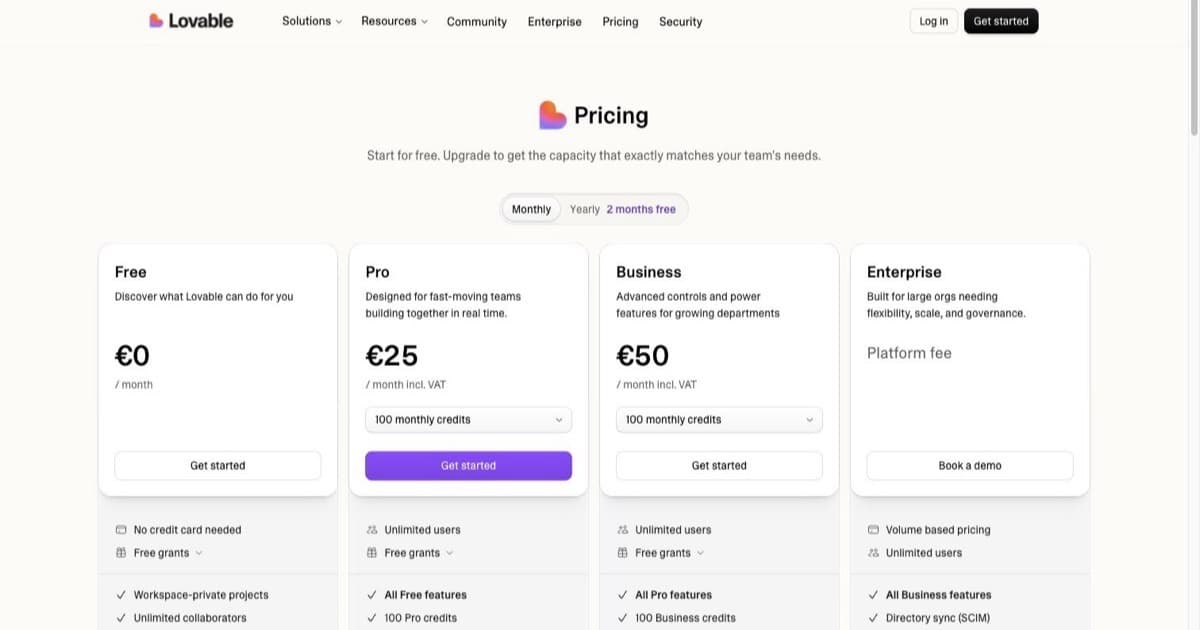
| Free | $0/month | 5 build credits/day (up to ~30/mo) + 20 Cloud credits |
| Pro | $25/month | 100 monthly credits, rollover, custom domains, unlimited collaborators |
| Business | $50/month | Higher credit allowance, unlimited collaborators |
| Enterprise | Custom | Volume pricing, org controls |
Lovable uses a credit system. Each AI action consumes credits, unused credits roll over each month, and both paid tiers price for unlimited collaborators rather than per seat. Billed annually, Pro drops to about $21/month and Business to about $42/month. The free tier is usable for quick experiments but too limited for sustained building. Source: lovable.dev/pricing. See our full Lovable pricing breakdown for credit math and our Lovable review for the hands-on take.
Google AntiGravity
| Plan | Price | What you get |
|---|---|---|
| Free | $0/month | All models, rate limits refresh every ~5 hours |
| AI Pro | $20/month | Higher limits, built-in AI credits |
| AI Ultra | $100/month | New mid-tier, roughly 5x Pro quotas |
| AI Ultra Max | $200/month | Roughly 20x Pro quotas (cut from $249.99) |
| Credits | $25 per 2,500 | On-demand top-up |
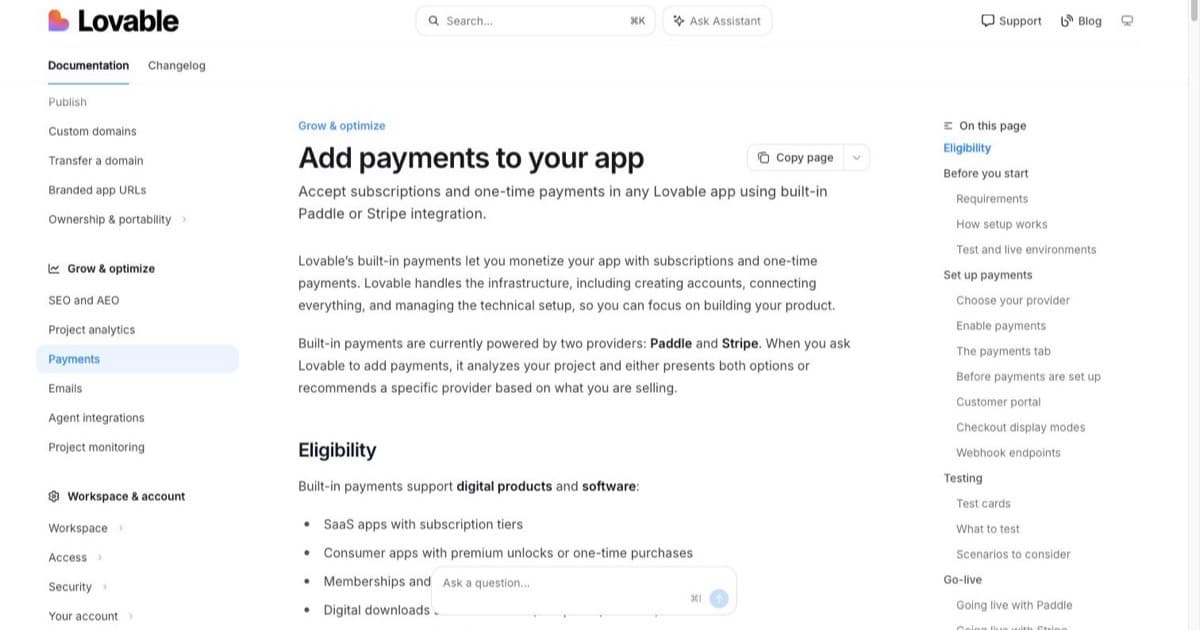
At Google I/O 2026 the Ultra tier was restructured. Google added a new $100/month Ultra with roughly 5x the Pro quotas and cut the old top plan to $200/month as Ultra Max. AntiGravity's pricing advantage is still real at the entry point: the free tier gives access to every model (including Claude Opus 4.6 and Gemini 3.1 Pro) with rate limits that are meant to reset every few hours. For developers who pace their usage, the free tier is genuinely useful. Source: antigravity.google/pricing. See our full AntiGravity pricing breakdown for credit math and the lockout controversy, and the AntiGravity review for the hands-on take.
Important caveat: AntiGravity has faced significant community backlash over rate limit enforcement. Users on the Google AI Developers Forum report that complex-model sessions (Gemini 3 Pro, Claude Opus) get throttled more aggressively than advertised, and a single Claude Opus 4.6 session can burn over 600 credits. The legacy Gemini CLI was also retired on 18 June 2026, so old CLI quotas now draw from the same credit pool. If you need consistent high-volume access, budget for Pro or Ultra rather than the free tier. See The Register's coverage for context.
True cost comparison
Lovable's cost includes hosting and deployment. AntiGravity's base cost is the IDE only: you still need to handle deployment yourself (Vercel, Netlify, Cloud Run).
If you factor in hosting costs alongside IDE pricing:
- Lovable Pro ($25/month): Covers generation + hosting + deploy pipeline
- AntiGravity Pro ($20/month) + Vercel Pro ($20/month): $40/month for full production setup
For simple hosted apps, Lovable is more cost-effective. For developers deploying to their own infrastructure, AntiGravity's lower base cost wins.
Code Quality
Lovable: Opinionated, high-quality defaults
Lovable generates React + TypeScript that consistently follows documented best practices. Components are well-structured, Supabase integration is clean, and the output is directly deployable. Independent benchmarks score Lovable around 8.5/10 on code quality metrics.
Strengths: Consistent naming conventions, proper TypeScript types, clean component decomposition, Supabase RLS policies generated automatically.
Weaknesses: Complex state management can produce over-nested trees. The opinionated stack (React + Supabase) means you cannot choose a different backend. You get what Lovable decides, not what you would architect.
Google AntiGravity: Configurable quality
AntiGravity's code quality depends on the model you assign and the guardrails you set. With Gemini 3.1 Pro or Claude Opus 4.6 and a well-specified mission, the output is strong. With weaker prompts or model downgrades due to rate limits, quality drops noticeably.
Strengths: No stack constraints: you can target any language, framework, or backend. Artifact trails let you audit generated code and catch problems before they land. Multi-agent execution means frontend and backend code can be generated in parallel.
Weaknesses: Quality is variable. The model switch mid-session (forced by rate limits) is a real problem. Community reports of inconsistent output quality are credible and worth weighing.
Speed to Working App
For most use cases:
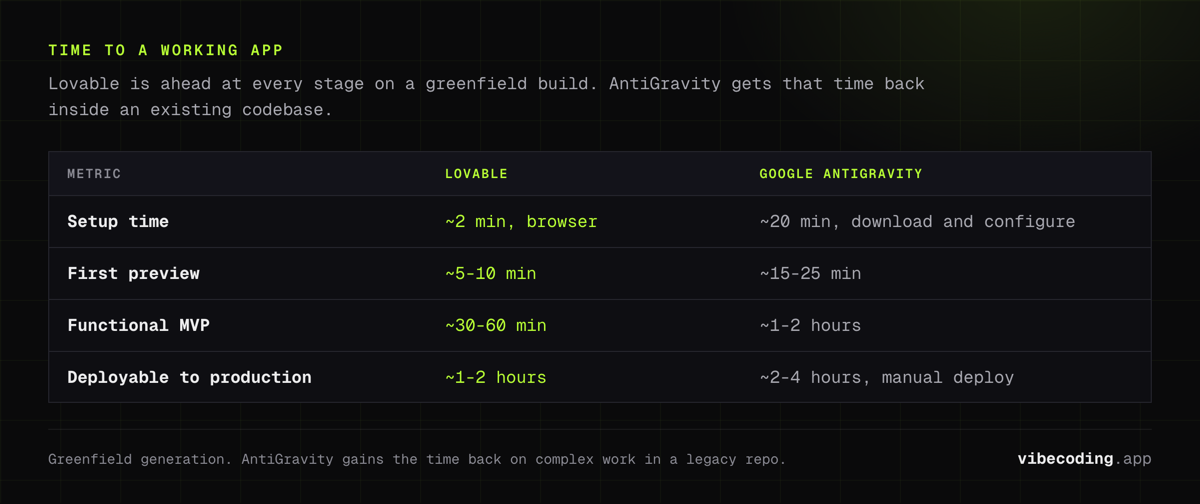
| Metric | Lovable | Google AntiGravity |
|---|---|---|
| Setup time | ~2 minutes (browser, no download) | ~20 minutes (download, install, configure) |
| First preview | ~5-10 minutes | ~15-25 minutes |
| Functional MVP | ~30-60 minutes | ~1-2 hours |
| Deployable to production | ~1-2 hours | ~2-4 hours (manual deploy) |
Lovable is faster for initial generation, especially for non-developers, and its build subagents now parallelize research, review, and synthesis behind a single prompt. AntiGravity gains back time on complex work inside an existing codebase, where its agents run across the editor, terminal, and live browser at once. For a checkout flow that touches a legacy repo and needs simultaneous refactor, test, and doc passes, AntiGravity's orchestration has room to stretch that Lovable's greenfield generation does not.
When to Choose Lovable
Lovable wins when:
- You are a founder or designer without deep developer experience
- You need something deployed and shareable quickly
- The React + Supabase stack fits your project
- You value polish over configurability
- You want two-way GitHub sync and hosting without additional setup
- You want parallel build subagents without leaving a browser tab
- You are iterating on an MVP and want clean handoff code for developers
Real example: a solo founder building a B2B SaaS waitlist with email capture, Supabase Auth, and a simple dashboard. Lovable can produce a deployable version of that in under an hour from a prompt.
When to Choose Google AntiGravity
AntiGravity wins when:
- You are a developer comfortable in VS Code
- Your project needs agents working across a live editor, terminal, and browser at once (e.g., refactor auth + write tests + update docs simultaneously)
- You want model choice: particularly Gemini 3.1 Pro or Claude Opus 4.6 for complex reasoning tasks
- Your deployment targets are not the standard Vercel/Supabase stack
- The free tier works for your usage pattern
- You want auditable artifacts for sensitive or compliance-adjacent projects
Real example: a developer refactoring a legacy Node.js API who wants to run a documentation agent, a refactoring agent, and a test-writing agent simultaneously without paying Lovable credits for each pass.
What Neither Tool Does Well
Lovable limitations:
- No way to change the underlying tech stack
- Supabase RLS policies need manual review for production security
- Complex state management (Redux, Zustand) requires manual intervention
- Not suited for large existing codebases
AntiGravity limitations:
- Rate limit enforcement makes intensive daily use unreliable on the free tier
- No built-in hosting: deployment is your problem
- Still in public preview, so expect rough edges and occasional platform-specific bugs
- Setup friction is real for non-developers
- The opacity of the credit system makes cost planning difficult
Head-to-Head: Key Scenarios
Scenario 1: Non-developer building a first SaaS MVP → Lovable wins. AntiGravity requires VS Code familiarity, local environment setup, and manual deployment. Lovable does all of that for you.
Scenario 2: Developer building on a large existing codebase → AntiGravity wins. Lovable is a generator, not an IDE. It syncs two ways with GitHub, but it is built to create apps, not to operate deep inside a large existing repository. AntiGravity is.
Scenario 3: Startup team prototyping quickly with tight budget → AntiGravity wins on budget (free tier). Lovable wins on speed. Pick based on whether time or money is the tighter constraint.
Scenario 4: Developer who wants to pick the model per task → AntiGravity wins on flexibility. Lovable runs on an Anthropic Claude build agent by default and does not expose per-agent model choice. AntiGravity lets you assign Gemini 3.1 Pro, Claude Opus 4.6, or GPT-OSS to specific agents in a mission.
Scenario 5: Designer who wants to ship an idea this weekend → Lovable wins. No downloads, no config, no deployment setup.
Alternatives Worth Knowing
If neither tool fits, other options to consider:
- Bolt.new, Browser IDE with AI generation. Falls between Lovable (magic) and AntiGravity (developer control). More flexibility than Lovable, easier setup than AntiGravity.
- Cursor, Best daily driver IDE for developers who want AI coding assistance without the agent orchestration overhead.
- Replit, Full development environment with built-in database and hosting. Good for long-term development beyond initial prototyping.
- v0 (Vercel), UI component generator only. Excellent for React component iteration.
For the full field, see our best AI app builders guide.
The Bottom Line
Lovable and Google AntiGravity are not competing for the same user. They solve different problems at different skill levels.
Lovable is the right tool when you want an idea to become a deployed, shareable app as fast as possible, without needing to know what a VS Code fork is.
Google AntiGravity is the right tool when you are a developer who wants agent-first architecture, model choice, and multi-workstream parallelism, and you are willing to handle deployment yourself and navigate the current rate limit friction.
The choice usually comes down to one question: are you a builder who codes, or a coder who builds? Lovable serves the former; AntiGravity serves the latter.
FAQ
Is Google AntiGravity free? Yes: AntiGravity has a free tier that includes all models (Gemini 3.1 Pro, Gemini 3 Flash, Claude Sonnet 4.6, Claude Opus 4.6, GPT-OSS 120B) with rate limits that are meant to refresh approximately every 5 hours up to a weekly ceiling. The free tier is useful for moderate usage. Intensive daily coding sessions will hit limits and require upgrading to AI Pro ($20/month), AI Ultra ($100/month), or AI Ultra Max ($200/month), or buying credits at $25 per 2,500.
Is Lovable free? Lovable has a free tier with 5 build credits a day (up to about 30 a month) plus 20 monthly Cloud credits. That is enough to test a simple idea, but not to build a full product. Most active users move to the Pro plan at $25/month, which adds 100 rolling monthly credits and unlimited collaborators.
Can I switch from Lovable to AntiGravity? Yes. Lovable exports standard React + TypeScript code that you can open in any IDE, including AntiGravity. The reverse is also true: code from AntiGravity is standard and can be imported anywhere.
Which one has better code quality? Lovable produces more consistent output because it operates in a controlled opinionated stack. AntiGravity's quality depends on model and prompt quality: it can match or exceed Lovable with the right setup, but varies more.
Does AntiGravity work without technical knowledge? Not really. AntiGravity requires downloading a desktop IDE, understanding agents, configuring models, and managing deployment. It is designed for developers. Lovable is the better fit for non-developers.
Which is better for large codebases? AntiGravity. Lovable is a generator: it works best on greenfield projects. AntiGravity can work inside existing repositories, navigate file trees, and run agents against code that already exists.
Does Lovable have parallel AI agents like AntiGravity? Yes, since May 2026. Lovable's Claude build agent can spawn Researcher, Reviewer, and Synthesizer subagents that run in parallel during a build, and they are included on every tier at no extra cost. AntiGravity takes a different route, orchestrating agents across a local editor, terminal, and browser, so it suits deep work inside an existing codebase while Lovable's subagents speed up prompt-driven generation.
What is the “paperweight” controversy with AntiGravity? A vocal portion of the AntiGravity community has described the tool as a “paperweight” after Google introduced stricter rate limits and a credit system in early 2026. The complaint is that high-reasoning models get throttled to the point of being unusable for sustained work on the free tier. Google restructured the paid Ultra tiers at I/O 2026, adding a $100 Ultra and cutting the top plan to $200, but the transparency complaints about credit costs persist as of July 2026.

Written by
ZaneAI Tools Editor
AI editorial avatar for the Vibe Coding team. Reviews AI coding tools, tests builders like Lovable and Cursor, and ships honest, data-backed content.