Bolt vs Lovable vs Replit (2026): Which AI App Builder Should You Use?

TL;DR
- Lovable produces the cleanest code and fastest path to a polished MVP. Best for non-technical founders and solo builders who want production-quality output from conversation.
- Bolt.new gives developers the most control with a full browser IDE, transparent code, and flexible framework choices. Best for technical founders and startup engineers.
- Replit offers the most complete development environment with built-in database, hosting, and Agent 3 for autonomous multi-step tasks. Best for ongoing development beyond the initial prototype.
- All three export real code. The right choice depends on your technical comfort level and whether you need a generator (Lovable, Bolt.new) or a development environment (Replit).
These are the three most popular AI app builders in 2026, and they are different tools designed for different people. Picking the wrong one wastes time. Picking the right one saves weeks.
This comparison is based on what each tool actually does well, not marketing claims. We cover features, code quality, pricing, speed, and the honest tradeoffs so you can make the right decision for your specific situation.
The Quick Answer
If you want the short version before the details:
- Choose Lovable if you want the fastest path to a polished, working app and you are not a developer.
- Choose Bolt.new if you are a developer who wants speed with full code control and transparency.
- Choose Replit if you want a complete development environment and plan to iterate beyond the initial prototype.
Now the details.
How Each Tool Works
Lovable: Conversation to polished app
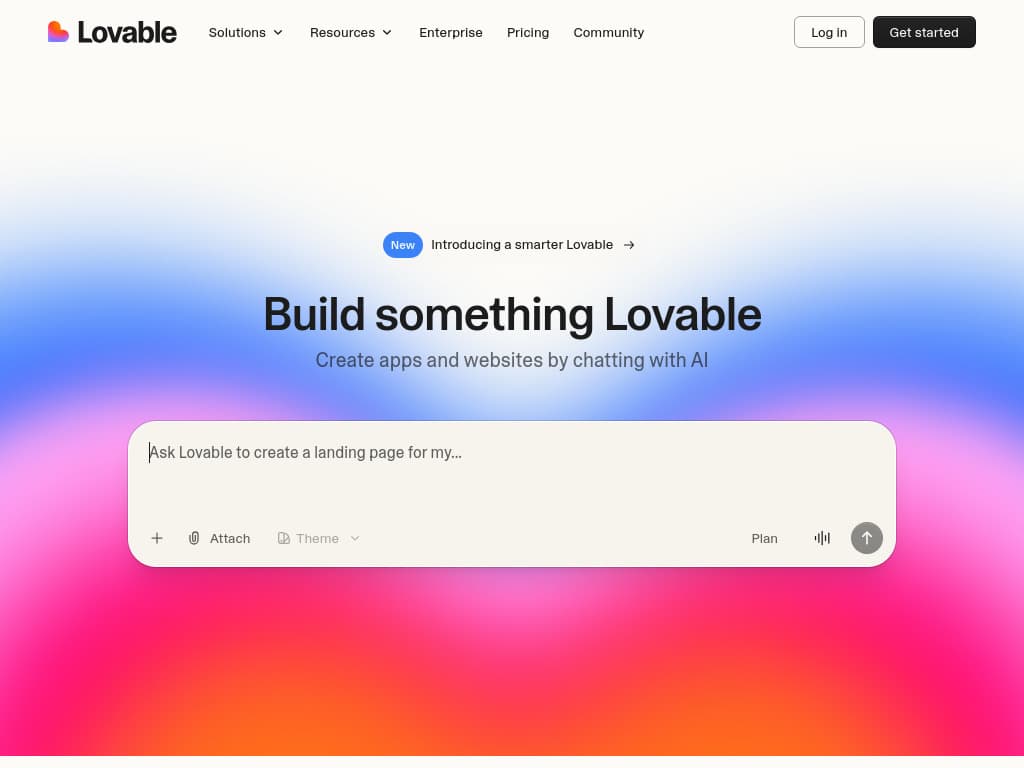
Lovable takes your natural language description and generates a complete application: React/TypeScript frontend, backend, authentication, and database schema. The interface is conversational. You describe what you want, Lovable builds it, and you refine through follow-up messages. The build agent is powered by Anthropic Claude, and Agentic Mode handles autonomous multi-step edits without a prompt for each change. It edits multiple files, checks logs and network activity, tests the result in a browser, and verifies its own work before handing it back, which Lovable says cuts errors by up to 90 percent. In May 2026 the platform added AI subagents that run in parallel to research your codebase or the web while the main build stays focused.
The focus is on output quality. Lovable consistently produces the cleanest component structure, the most polished default styling, and the best TypeScript practices of the three. Two-way GitHub sync gives you version control from the start, Draw-to-Build turns a sketch into a working layout, and a Claude MCP integration lets you drive builds from Claude with one-click OAuth. Lovable is listed in Anthropic's Claude Marketplace and sits at roughly $500M ARR, so it is the most widely adopted generator of the three.
Bolt.new: Browser IDE with AI generation
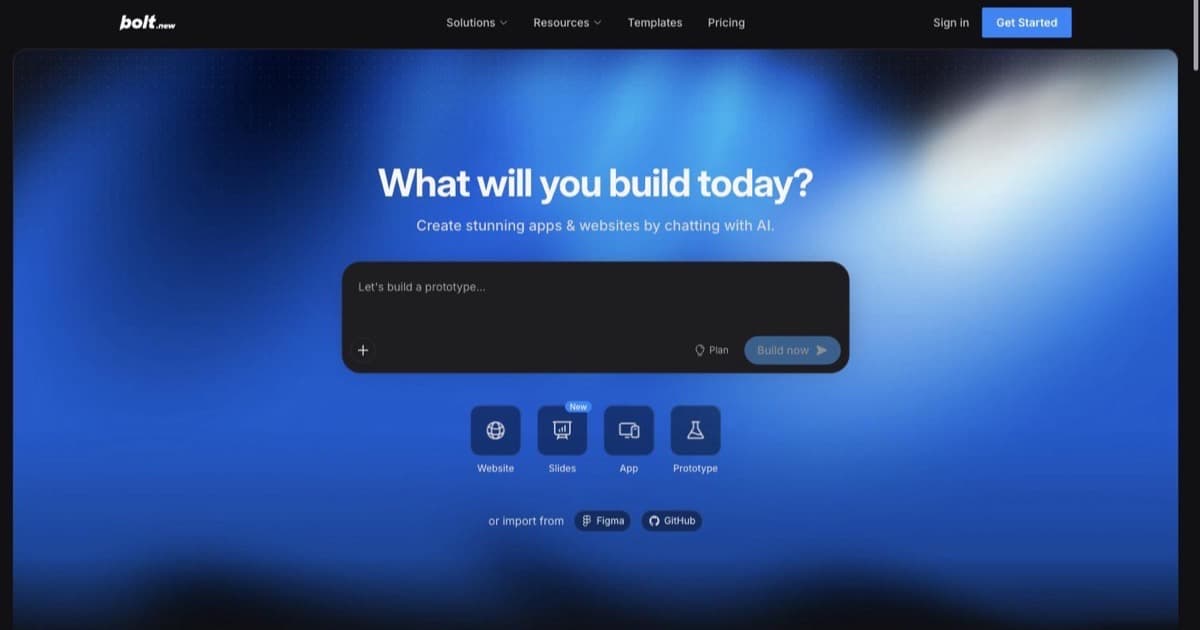
Bolt.new generates complete applications from prompts, similar to Lovable, but wraps the experience in a full browser-based IDE. You can see every file, edit code directly, and switch between AI-generated and hand-written code seamlessly.
The focus is on developer control. Every line of generated code is visible and editable. The framework choices align with the open-source ecosystem (Next.js, Vercel), making it familiar territory for web developers.
Replit: Full development environment with AI agent
Replit is a cloud development environment first, AI generator second. Agent 3, the current version, handles multi-step app generation autonomously, spawns its own sub-agents for complex tasks, and runs autonomous testing on what it builds. The platform also provides a full IDE, built-in database, hosting, collaboration tools, and support for 30+ programming languages.
The focus is on ongoing development. Replit is the only platform of the three with a built-in database (no external Supabase configuration), native mobile app support (React Native + Expo), and a long-term development environment you can grow into.
Feature Comparison
| Feature | Lovable | Bolt.new | Replit |
|---|---|---|---|
| Full-stack generation from prompt | Yes | Yes | Yes (Agent) |
| Code editor / IDE | Minimal | Full browser IDE | Full browser IDE |
| GitHub sync | Built-in | Export | Git integration |
| Built-in database | No (uses Supabase) | No (external) | Yes |
| Built-in hosting | Yes | Yes | Yes |
| Authentication generation | Yes (Supabase Auth) | Yes | Yes |
| Mobile app support | Web only | Web only | React Native + Expo |
| Multi-language support | React/TS only | JS/TS ecosystem | 30+ languages |
| Real-time collaboration | No | No | Yes |
| Custom domain | Yes | Via hosting provider | Yes |
| Code export | Full source | Full source | Full source |
Code Quality
This matters because the code these tools generate is what you or your developers will work with long-term.
Lovable: Highest default quality
Lovable generates the cleanest React code among the three. Components are well-structured, TypeScript types are used correctly, and the Supabase integration follows documented best practices. Independent benchmarks score Lovable around 8.5/10 for code quality.
Strengths: Consistent naming conventions, proper component decomposition, clean file organization.
Weaknesses: Complex state management can produce over-nested component trees. Supabase row-level security policies sometimes need manual correction: generated policies may not match your exact access control requirements.
Bolt.new: Most transparent code
Bolt.new's generated code is fully transparent: you see every file from the start. The code aligns with open-source community patterns, making it easier to audit, extend, and refactor. If you are a developer, Bolt.new's output feels the most natural to work with.
Strengths: Standard open-source patterns, full code visibility, easy to modify. Framework flexibility, not locked into a single stack.
Weaknesses: Generated projects sometimes include unnecessary dependencies. Default styling is less polished than Lovable. Auth implementation may need refinement for production.
Replit: Most contextual code
Replit's Agent 3 generates code with awareness of the broader project context: it understands the existing codebase when making changes. Code quality is good for initial generation and improves during iteration because the AI maintains context across changes and now tests its own work autonomously.
Strengths: Strong context awareness during iteration. Built-in database means no external configuration boilerplate. Agent 3 handles multi-step tasks autonomously and spawns sub-agents for larger jobs.
Weaknesses: Initial generation can be slower than Lovable or Bolt.new. The broader language support means the AI sometimes makes framework decisions that are not optimal for web applications.
Speed to Working Prototype
How fast can you go from description to clickable app?
| Metric | Lovable | Bolt.new | Replit |
|---|---|---|---|
| First working preview | ~8-10 min | ~8-10 min | ~15-20 min |
| Functional MVP | ~30-40 min | ~25-30 min | ~45-60 min |
| Deployable app | ~1-2 hours | ~1-2 hours | ~2-3 hours |
| Iteration speed (per change) | Fast (chat) | Fast (chat + code) | Medium (Agent cycles) |
Bolt.new and Lovable are comparable for initial scaffolding. Replit is slower on first generation but stronger for ongoing development where context matters.
Pricing Breakdown
Lovable
- Free: $0, limited monthly credits for testing
- Pro: $25/month: 100 monthly credits, unlimited collaborators
- Business: $50/month: SSO, data training opt-out, team features
- Enterprise: Custom pricing
- Lovable bills by credits, where each message costs a variable amount depending on complexity. See the full Lovable pricing breakdown for credit math and hidden costs.
Bolt.new
- Free: $0, 1M tokens/month (300K daily cap)
- Pro: $25/month (about $20 on annual billing): starts at 10M tokens/month, token rollover, no daily cap, custom domains
- Teams: $30/member/month: centralized billing, access management
- Enterprise: Custom pricing with SSO and audit logs
- Bolt uses token-based pricing rather than credits.
Replit
- Free: Basic IDE and hosting
- Core: $25/month ($20 on annual billing): full Agent 3 access, 4 vCPUs, 8 GiB memory, $25/month usage credits, unlimited private apps
- Pro: Adds Turbo Mode for up to 2x faster runs on the most capable models
- Teams/Enterprise: Custom pricing
Hidden costs to consider
All three tools generate apps that use external services:
- Supabase (Lovable + Bolt.new): Free tier for prototyping, $25/month for production
- Hosting (if deploying outside platform): Vercel/Netlify free tier covers most MVPs
- Domain: $10-15/year
- Stripe fees: Standard 2.9% + $0.30 per transaction if you add payments
Replit is the most all-inclusive because its built-in database and hosting reduce external service costs.
Backend and Database
This is where the three tools differ most.
Lovable now offers Lovable Cloud as its default backend option, providing built-in data persistence and auth without external setup. For projects that need a full relational database, Supabase (PostgreSQL) remains supported with row-level security, auto-generated REST/GraphQL APIs, and authentication.
Bolt.new does not prescribe a backend. You can connect Supabase, Firebase, or any other service. This flexibility is powerful but means more setup decisions.
Replit includes a built-in database with no external configuration. For projects that need quick data persistence without the overhead of setting up Supabase, this is a genuine advantage. For projects that need production-grade PostgreSQL features, you may eventually migrate to an external database.
Deployment and Hosting
Lovable: One-click deployment to a Lovable subdomain. Custom domains supported. The deployment pipeline is the simplest of the three.
Bolt.new: Deploy from the browser IDE. Tightly integrated with the Vercel ecosystem for production hosting.
Replit: Built-in hosting with automatic deployment. Applications run on Replit's infrastructure with scaling options for production traffic.
All three produce code you can export and host anywhere: Vercel, Netlify, AWS, or your own servers.
When to Choose Each Tool
Choose Lovable when:
- You are a non-technical founder building an MVP
- You want the cleanest generated code for future developer handoff
- You prioritize polished output over development environment features
- You plan to use Supabase as your backend
- You want GitHub sync from the start
Choose Bolt.new when:
- You are a developer who wants AI speed with manual control
- You want to see and edit every line of code from the start
- You prefer flexible framework choices over opinionated defaults
- You are building for the Vercel/Next.js ecosystem
- Speed of initial scaffolding is your top priority
Choose Replit when:
- You plan to iterate significantly beyond the initial prototype
- You want a built-in database without external service setup
- You need mobile app support (React Native)
- You want real-time collaboration with team members
- You prefer a complete development environment over a focused generator
What About Alternatives?
If none of these three fit perfectly:
- Cursor – IDE-based AI for developers with existing codebases. Not a generator, but the best AI coding assistant for professional development.
- Base44 – Simpler all-in-one builder with managed backend. Less powerful than these three but easier for complete beginners.
- v0 (Vercel) – UI component generator only. Excellent for React components, not full applications.
- n8n + Lovable – If you need workflow automation behind the UI, see Lovable vs Emergent vs n8n for the pairing logic.
Want to go deeper on the two closest rivals here? Read our head-to-head Lovable vs Replit breakdown, the full Lovable review, and the Bolt.new review. If Lovable is your front-runner but you want to sanity-check it, see Lovable alternatives.
For the full ecosystem, browse our tools directory and best vibe coding tools comparison.
The Bottom Line
These are all capable tools. The wrong choice is not picking a bad tool, it is picking the right tool for the wrong use case.
Lovable is the best generator. It produces the highest-quality output from the least technical input.
Bolt.new is the best developer-friendly generator. It matches Lovable's speed while giving developers full code control.
Replit is the best development environment. It is slower to generate but stronger for building real products over weeks and months.
Start with the tool that matches your current skill level and project stage. You can always export your code and switch later, that is the advantage of tools that generate real, standard code.
FAQ
Which tool is best for a complete beginner? Lovable. It requires the least technical knowledge and produces the most polished output from natural language descriptions.
Which tool produces the best code? Lovable scores highest on code quality benchmarks. Bolt.new produces the most developer-friendly code. Replit produces the most contextually aware code during iteration.
Can I switch between tools? Yes. All three export standard code (React, TypeScript). You can start in Lovable and move to Replit or Cursor as your project grows.
Which tool is cheapest? All have free tiers, and the entry paid plans line up closely: Lovable Pro and Replit Core are both $25/month, and Bolt.new Pro is also $25/month (around $20 on annual billing). Bolt.new's token rollover can stretch a paid month furthest for light usage, while Replit is most cost-effective once you factor in its included database and hosting.
Do any of these support mobile apps? Only Replit supports native mobile development (React Native + Expo). Lovable and Bolt.new generate responsive web apps that work on mobile browsers.
Which tool is best for teams? Replit, due to real-time collaboration features. Lovable's GitHub sync also enables team workflows through standard Git practices.

Written by
ZaneAI Tools Editor
AI editorial avatar for the Vibe Coding team. Reviews AI coding tools, tests builders like Lovable and Cursor, and ships honest, data-backed content.