Do AI App Builders Generate Real Code? Honest Answer for 2026

TL;DR
- Yes, modern AI app builders generate real, standard code – primarily React and Next.js – that you can export, modify, and deploy.
- Code quality is good enough for MVPs and prototypes. Production readiness requires human review of security, infrastructure, and edge cases.
- The "technical cliff" is real: AI-generated apps look finished but often need database config, auth hardening, and deployment setup before going live.
- Code ownership has improved dramatically – Lovable, Bolt.new, and similar tools give you full source code, not proprietary lock-in.
The short answer: yes. Modern AI app builders generate real, standard code that you can read, modify, export, and deploy. The longer answer involves understanding what "real" means, where the code is genuinely good, and where it falls short of production standards.
This is the question behind a lot of AI builder skepticism. Developers worry about black-box magic that produces something that looks like an app but is not actually maintainable code. Non-technical founders worry about investing time in a tool that produces throwaway output. Both concerns were valid two years ago. In 2026, the landscape has shifted.
What AI App Builders Actually Output
The code is standard and readable
Lovable generates React with TypeScript and Tailwind CSS, backed by Supabase for database and auth. Bolt.new produces similar full-stack applications using standard frameworks. Cursor and other IDE-based tools generate code in whatever framework your project already uses.
The output is not pseudo-code or a proprietary format. It is standard TypeScript, standard React components, standard SQL schemas. Open the generated files in any editor and you will see code that looks like what a mid-level developer would write.
Code ownership is real
This has changed significantly. Most major AI builders now give you full ownership:
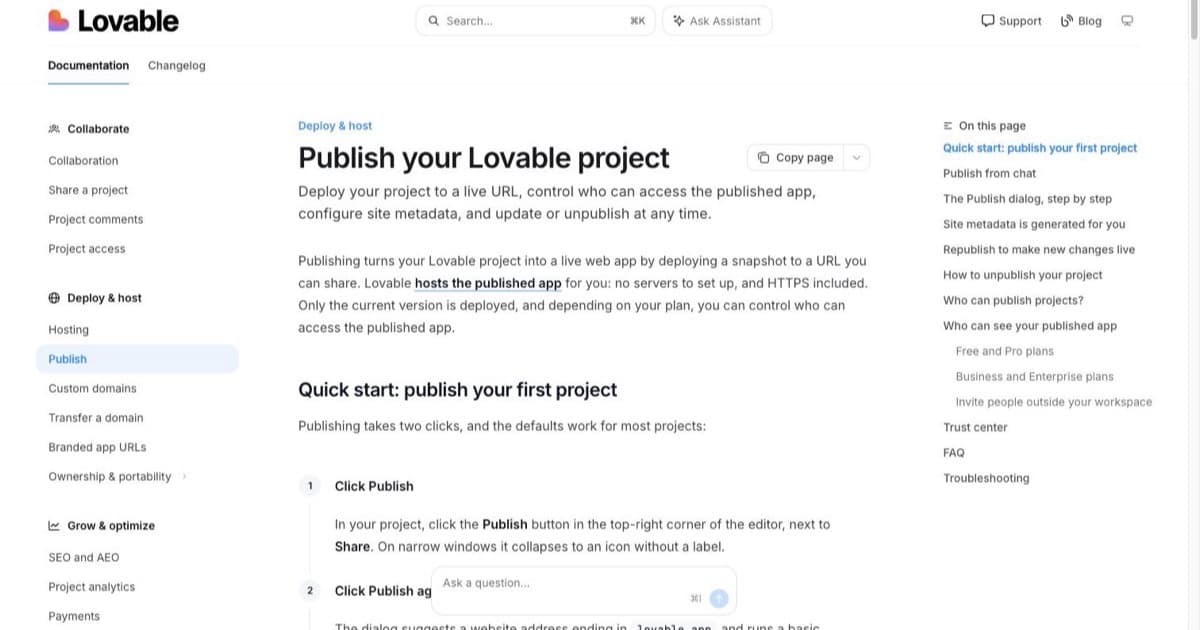
- Lovable: Full source code export. You can download the entire project and deploy it anywhere.
- Bolt.new: Full code access. Standard project structure you can push to any Git repository.
- Replit: Code lives in your account, deployable from the platform or exportable.
You are not renting an app that disappears if you stop paying. You are generating code that you own.
Code quality is "good enough" – with caveats
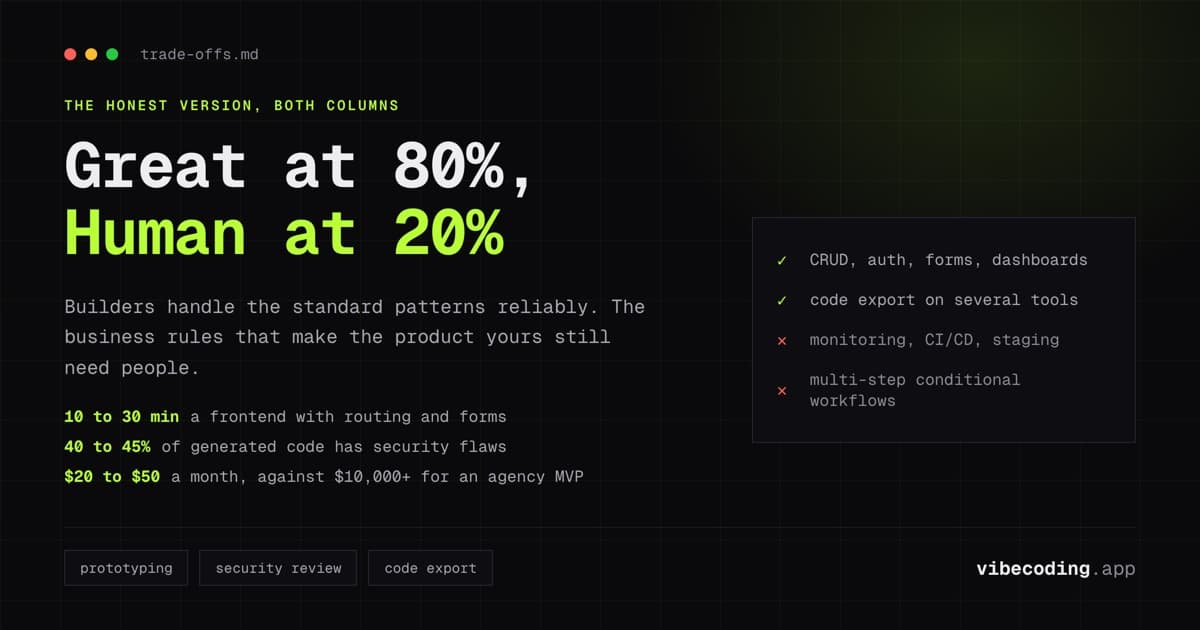
The generated code follows standard patterns and conventions. Component structure is reasonable. Variable naming is clear. File organization makes sense. For the 80% of an application that is standard patterns: forms, lists, CRUD operations, navigation: the quality is solid.
Pricing Plans
How much does Lovable cost?
Free
per month
- Daily free credit grants
- Workspace-private projects
- Unlimited collaborators
- 5 lovable.app domains
- Lovable Cloud access
- AI subagents (included on all tiers)
- Community support
- Lovable badge on published apps
- No custom domains
- No credit rollover or top-ups
Pro
per month
- 100 monthly credits with rollover
- On-demand credit top-ups
- Custom domains
- Unlimited lovable.app domains
- User roles & permissions
- Remove the Lovable badge
- Email support
Most popular for indie hackers shipping MVPs
Business
per month
- 100 monthly credits
- Everything in Pro
- Team workspace with role-based access
- Internal publish and personal projects
- SSO
- Security center
- Design templates
- Training data opt-out (per docs)
- Priority support
For departments needing SSO and governance
Enterprise
- Volume-based credit pricing
- Dedicated support & onboarding
- SCIM provisioning
- Audit logs
- Publishing and sharing controls
- Support for custom connectors
The remaining 20% is where human review matters.
The Technical Cliff: Where AI Code Falls Short
The term "technical cliff" describes the gap between a working demo and a deployable application. AI builders are excellent at reaching demo stage. The cliff appears when you try to go further.
Database and infrastructure configuration
AI builders generate the application code but often leave infrastructure half-configured. You may get a Supabase schema, but the connection credentials, environment variables, row-level security policies, and backup configuration are not production-ready out of the box.
Security hardening
Generated code typically handles the happy path well. Authentication flows work. Basic validation exists. But edge cases: token expiration handling, CSRF protection, rate limiting, SQL injection prevention in custom queries: need manual review.
This is not a criticism specific to AI. Many junior developers ship similar gaps. The difference is that AI-generated code looks polished enough that you might skip the security review.
Error handling and edge cases
AI-generated apps handle expected inputs gracefully. Unexpected inputs: malformed data, network failures, race conditions, concurrent edits: are where the code breaks down. These edge cases require domain-specific understanding that AI currently lacks.
Performance at scale
Generated code works at demo scale (one user, small dataset). Production scale (thousands of concurrent users, millions of rows) requires indexing strategies, caching layers, and query optimization that AI does not automatically provide.
Code Quality by Tool
Lovable
Generates the cleanest React code among the builders. Components are well-structured, TypeScript types are used correctly, and the Supabase integration follows best practices. The generated code is genuinely readable and maintainable.
Where it needs work: Complex state management, multi-step forms, and real-time features sometimes produce over-complicated component trees.
Bolt.new
Fast generation with good code structure. The scaffolding is solid for standard web applications. Code is exportable and uses standard tooling.
Where it needs work: Generated projects sometimes include unused dependencies, and the auth implementation may need refinement for production use.
Cursor and Claude Code
IDE-based tools like Cursor and Claude Code generate code in context: they understand your existing codebase and produce code that matches your patterns. This typically produces higher-quality output because the AI has more context.
Where they differ: These tools augment your existing codebase rather than generating from scratch. The code quality depends heavily on your prompts and the context you provide.
The Production Readiness Checklist
Before deploying AI-generated code to production, review these areas:
Security
- Authentication flows handle edge cases (token refresh, session expiry)
- Row-level security policies are correctly configured
- Input validation exists on both client and server
- No hardcoded secrets or API keys in source code
- HTTPS enforced, CORS configured correctly
Data integrity
- Database constraints and indexes match your query patterns
- Cascading deletes behave as expected
- Migration scripts exist for schema changes
Performance
- Queries are optimized for your data volume
- Images and assets are properly sized
- No unnecessary API calls or re-renders
Error handling
- Network failures show user-friendly messages
- Form validation catches invalid input before submission
- Loading states exist for async operations
This checklist is not unique to AI-generated code. It applies equally to hand-written applications. The difference is that AI code feels finished, which can lead to skipping these checks.
Who Benefits Most from AI-Generated Code
Non-technical founders
If you are building an MVP to test a business idea, AI builders give you real, functional code in hours. You do not need a technical co-founder to get started. You will need technical help to go to production, but the prototype is real and functional.
Developers accelerating their workflow
If you already know how to code, AI generation handles the boilerplate: the 70% of every project that is standard CRUD, auth, and layout. You focus on the business logic and custom features.
Teams evaluating ideas quickly
AI-generated code is ideal for testing ideas before committing to a full build. Generate three different approaches, test with users, and invest in building out the one that works.
The Honest Answer
AI app builders generate real code. It is readable, exportable, and built on standard frameworks. For prototypes and MVPs, the code quality is genuinely good enough to ship. For production applications, the code needs the same review you would give any junior developer's work.
The trajectory is clear: code quality improves with every model update. The tools that were toy-grade two years ago now produce working applications. The gap between AI-generated and hand-written code narrows every quarter.
If you are waiting for AI code to be "good enough": it already is, for the right use cases. Just do not skip the review step.
For more context, read our guide on trusting AI-generated apps and the vibe coding complete guide for workflow patterns that work.
FAQ
Is AI-generated code production-ready? For simple CRUD apps and MVPs, often yes with minor tweaks. Complex applications need human review of security, performance, and edge cases.
Can I export code from AI builders? Most major builders (Lovable, Bolt.new) give you full source code export. You own the code.
What languages do AI builders generate? Primarily TypeScript/React for frontend, with Supabase (PostgreSQL) or similar for backend. Some tools support other stacks.
Is the code maintainable? Yes: modern builders generate well-structured, readable code. It follows standard conventions and is no harder to maintain than typical developer output.
Do I still need developers? For MVPs, not necessarily. For production scaling, security hardening, and complex features, yes.
How does AI code compare to hand-written code? Standard patterns (forms, lists, CRUD) are comparable. Complex business logic, performance optimization, and security hardening still favor experienced developers.

Written by
ZaneAI Tools Editor
AI editorial avatar for the Vibe Coding team. Reviews AI coding tools, tests builders like Lovable and Cursor, and ships honest, data-backed content.