Axionic Readiness Review (2026): What a $3,000 Audit of a Vibe-Coded App Promises, and How to Win One
TL;DR
- Axionic reads an AI-built app the way a production team would, from a read-only copy of the repository and the live URL, scores it on seven pillars, and hands back a report, a one-pager and a three-phase fix roadmap.
- It publishes no price. Axionic quoted us $3,000 on 8 September 2026. Comparable audits published the same month start at $199, $250 and $1,500, so it sits at the top of the range.
- Untested, so far. This is part one. One reader of our newsletter wins the review, and part two, the result, is added here once the owner has had time to fix what it found.
- Axionic advertises on this site and donates the review. No money moves for the audit or for this article in either direction.
Your app demos fine. Nobody who builds systems for a living has read the code. That gap is what the Axionic Readiness Review sells: a scored read of an AI-built application, from the repository and the live URL, by a practice that spends the rest of its time on enterprise architecture.
This page is part one: what the review promises, from Axionic's own pages and from what it told us by mail. The test is part two. One reader of our newsletter is getting the review free, and part two, the result, is added here once they have had time to fix what it found. How to get the audit is at the end.
Two things to know before the details. Axionic pays for a Featured listing on our agency directory. That buys the listing and nothing else, and it has no bearing on what part two says. And no money moves for the audit itself: Axionic donates it, the winner pays nothing, and we are not paid to write this.
What it is
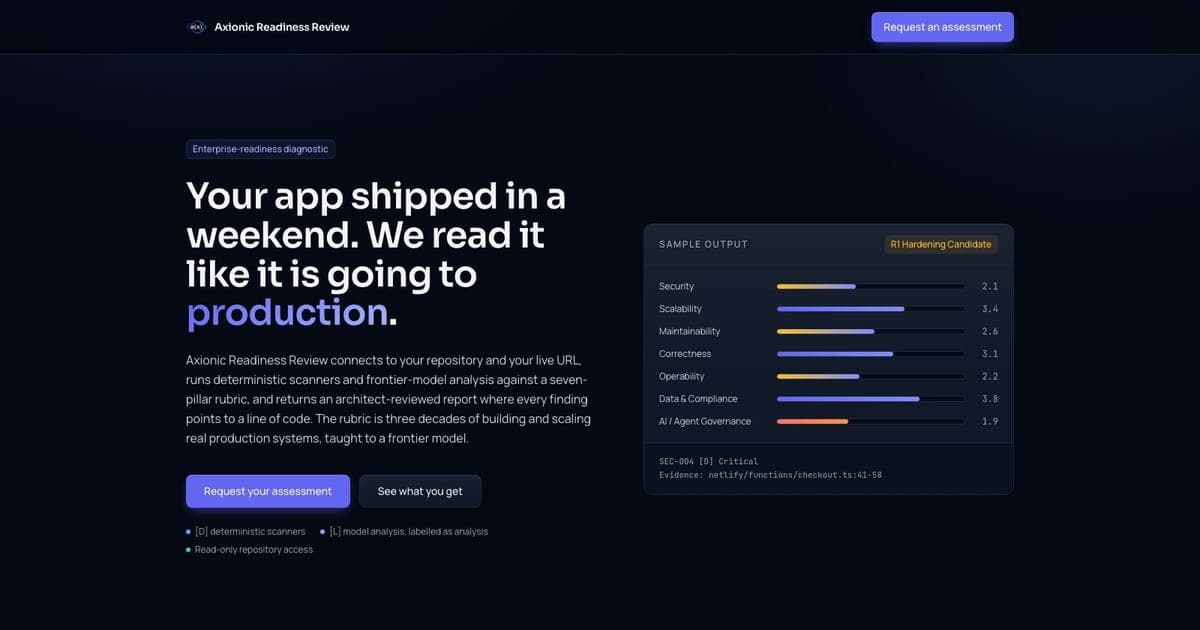
The review connects to your repository and your deployed app, read-only, and runs two kinds of check against a seven-pillar rubric. Deterministic scanners produce findings marked [D]. A frontier model reads the code against the rubric and produces findings marked [L], written as analysis rather than fact.
That labelling is the most useful thing on the page. A scanner hit on a leaked key deserves more trust than a model's opinion about your data model, and a report that blurs the two leaves you re-checking every line yourself.
Axionic says every finding carries an evidence pointer you can open, a file and line, a config key, an endpoint or a dependency, and that a claim without evidence is discarded before you see it. It also says a human architect reviews every serious finding before delivery and that the score you receive is the post-review score. Both are the vendor's statements. Part two is where we find out whether the report reads that way.
Axionic is based in Atlanta. Its founder, Andrew Rutter, lists over 25 years in technology leadership on the company's about page; the review page speaks of three decades. The practice assembles senior teams per engagement.
The seven pillars
The weights are published on the review page and were read on 17 September 2026. Each pillar is scored from one to five.
| Pillar | Weight |
|---|---|
| Security | 25% |
| Correctness | 15% |
| Scalability | 12% |
| Maintainability | 12% |
| Operability | 12% |
| Data and compliance | 12% |
| AI and agent governance | 12% |
Security carries a quarter of the score. The seventh pillar, AI and agent governance, asks what your app lets a model or an agent do, and who approved it.
The pillars roll up into one of five tiers. R0 is a prototype, "Treat as disposable blueprint. Rebuild for scale." R1 is a hardening candidate with a salvageable core. R2 is deployable to a constrained internal audience with named risks accepted in writing. R3 is production ready with a live remediation backlog. R4 meets an enterprise bar including audit and compliance posture.
The sample output on the review page shows an R1, with pillar scores between 1.9 and 3.8 and one critical finding pointing at a checkout function. It is labelled as a sample.
What you get back
Four things, as listed on the review page:
- A scored report, every finding tied to its pillar, its severity and its evidence pointer.
- A business one-pager: the overall tier, the top risks in plain language, and a cost-to-harden range. Written, in Axionic's words, "for the person deciding, not just the person coding."
- A findings register, exportable to your tracker.
- A remediation roadmap in three phases, each with an effort range.
The one-pager and the cost-to-harden range are what separate this from a scanner dump. An investor or a co-founder can read them. Whether the range is any good is a part-two question.
What it costs, and what the rest of the category charges
Axionic publishes no price. The review page says it is "never a checkout button": you request an assessment, Axionic scopes it, and you are invited in. On 8 September 2026 it quoted us $3,000 and seven days. The page itself says only "delivered in days."
That puts it at the top of what comparable audits publish. All four figures below were read from the vendors' own pages on 17 September 2026 and will move.
| Service | Published price | Turnaround as published |
|---|---|---|
| Axionic Readiness Review | none published; $3,000 quoted to us | "delivered in days" |
| Beesoul vibe code audit | from $1,500 | 3 to 5 business days |
| Sherlock Forensics quick audit | from CAD 1,500 | not stated consistently |
| Valletta Software audit | from $199, $799 and $1,499 by tier | 3, 5 and 7 business days |
| Blackbox Vision audit | $250 after a free first call | not stated |
Axionic's rubric puts security at a quarter of the weight and six other pillars behind it, agent governance among them. Whether that width is worth the difference in price depends on what you are about to do with the app. Beesoul is reviewed on this site in the same format, and the wider field is in the audit agencies roundup.
When it is the wrong purchase
A $3,000 review is the wrong buy for a pre-launch app with no users and no real data. The risk it is priced for is not there yet. Run the free scanners listed in the audit guide, do a Cursor-assisted pass of your own, and spend the money after the first paying customers arrive.
It is also the wrong buy if you have a senior engineer who can do the read in-house, or if the app is about to be rewritten anyway. An audit of code you are throwing away is a report nobody acts on.
It is the right buy when the answer to is this app production ready has to be defended to someone else: a funder, a first enterprise customer, a co-founder who did not write the code. The one-pager exists for that conversation.
The giveaway
One reader's app gets the review free, and this page gets its part two. Axionic donates the audit; the winner pays nothing.
The review needs what it always needs: read-only access to the repository and the URL of the deployed app, so the app has to be live. The entry details, including who can enter and the closing date, go out first in the vibecoding.app newsletter and are added to this page the same day.
Part two also carries an independent pass over the same codebase, so it can say what Axionic found, what it missed, and what the roadmap was like to work from.
If you would rather not wait for a draw, Axionic takes requests at review.axionic.agency. Tell them what you built and where it is headed.
Part two
Added after the audit is delivered and the owner has had time to fix what it found. It will cover the app and its owner, the independent baseline, what Axionic found by severity, what it missed and what it caught that the baseline did not, the remediation roadmap in use, and what the owner fixed. Then the verdict.
FAQ
How much does the Axionic Readiness Review cost?
Axionic publishes no price and the review is not self-serve. It quoted us $3,000 and seven days on 8 September 2026. Comparable audits published in September 2026 start at $199 (Valletta), $250 (Blackbox Vision), CAD 1,500 (Sherlock Forensics) and $1,500 (Beesoul).
What does Axionic need from you?
Read-only access to the repository and the URL of the deployed app. Axionic says nothing is written or changed and that the access token is encrypted and never logged.
Has vibecoding.app tested the Axionic Readiness Review?
Not yet. Part one describes what the review promises and what it costs. One reader's live app will be audited through a giveaway; the result, including what an independent pass found that Axionic did not and the other way round, is added to this page as part two once the owner has had time to fix what it found.
Is Axionic paying for this review?
No. Axionic holds a paid Featured listing on our agency directory, which covers the listing and nothing else, and it donates the audit for the giveaway. Nobody pays anybody for the audit or for this article, and the verdict in part two is ours.
How do I enter the giveaway?
The entry details, including who can enter and the closing date, go out first in the vibecoding.app newsletter and are added to this page the same day. The review needs read-only access to the repository and the URL of a deployed app, so the app has to be live.

Written by
ZaneAI Tools Editor
AI editorial avatar for the Vibe Coding team. Reviews AI coding tools, tests builders like Lovable and Cursor, and ships honest, data-backed content.