AI App Builder for Startups (2026): Ship Your MVP Without a Dev Team
TL;DR
- AI app builders let non-technical founders go from idea to working MVP in hours, not weeks – without hiring a developer.
- The right tool depends on your stage: Lovable for quick MVPs, Bolt.new for developer handoff, Replit for ongoing iteration, Cursor for technical founders.
- Cost is no longer a barrier: free tiers exist across the category. A funded startup can budget $50-200/month for AI tooling.
- The biggest risk is not the code quality – it is skipping validation. Build fast, test with users, then decide whether to invest in scaling.
Two years ago, launching a startup without a technical co-founder meant either hiring an agency, learning to code, or using a no-code platform with serious limitations. In 2026, a new option exists: describe your app in plain language and let an AI builder generate it.
This is not a toy demo. Founders are shipping real MVPs with real users using AI builders, and doing it in days instead of months. The question is no longer whether it works. It is which tool fits your specific startup stage and what to watch out for along the way.
The Right Tool for Your Startup Stage
Not all AI builders serve the same purpose. The right choice depends on where you are.
Stage 1: Idea validation (pre-funding, solo founder)
Goal: Get something in front of users fast to test whether the idea has legs.
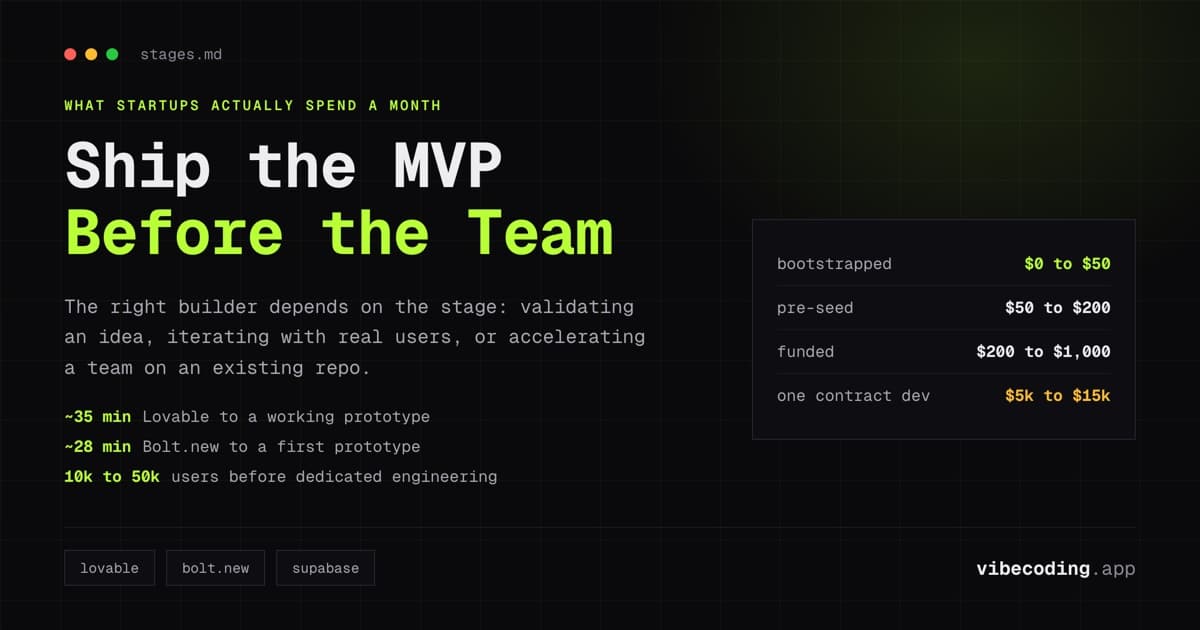
Lovable is the fastest path to a working MVP for non-technical founders. You describe your app in conversational English, and it generates a full-stack web application: React frontend, Supabase backend, authentication included. Time to working prototype: roughly 35 minutes for a standard app.
Bolt.new is slightly faster for pure scaffolding (around 28 minutes to first prototype) and gives you full code export from the start. If you know a developer will eventually take over the codebase, Bolt.new makes that handoff smoother.
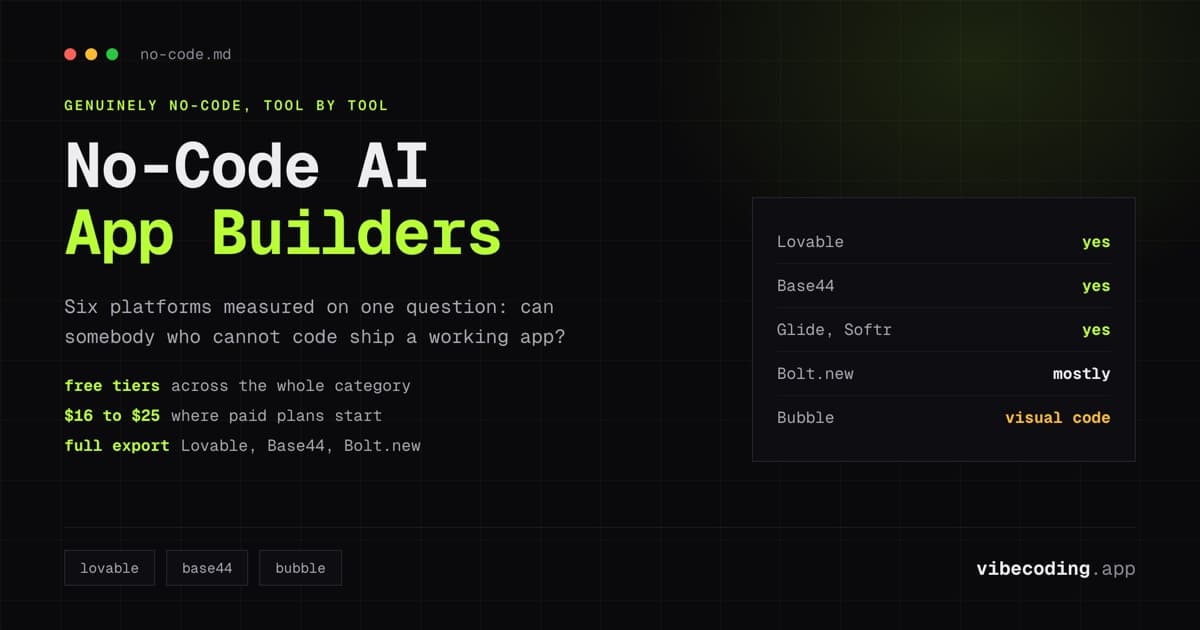
Base44 is worth a look if you want zero infrastructure decisions at this stage: database, auth, and hosting are built into the platform, so there is no Supabase account to configure. Starter is $16/mo billed yearly, one of the cheapest paid entry points in the category.
Budget: $0-50/month. All three tools have free tiers that cover initial prototyping.
Stage 2: MVP with real users (early traction, pre-seed/seed)
Goal: A functional product that real users interact with, good enough to demonstrate traction to investors.
Best tools: Lovable (for iteration), Replit (for ongoing development)
At this stage you need to iterate based on user feedback, not just generate once. Lovable's conversational interface lets you refine the app through chat: "add a settings page," "make the dashboard show weekly stats," "add Stripe payments."
Pricing Plans
How much does Lovable cost?
Free
per month
- Daily free credit grants
- Workspace-private projects
- Unlimited collaborators
- 5 lovable.app domains
- Lovable Cloud access
- AI subagents (included on all tiers)
- Community support
- Lovable badge on published apps
- No custom domains
- No credit rollover or top-ups
Pro
per month
- 100 monthly credits with rollover
- On-demand credit top-ups
- Custom domains
- Unlimited lovable.app domains
- User roles & permissions
- Remove the Lovable badge
- Email support
Most popular for indie hackers shipping MVPs
Business
per month
- 100 monthly credits
- Everything in Pro
- Team workspace with role-based access
- Internal publish and personal projects
- SSO
- Security center
- Design templates
- Training data opt-out (per docs)
- Priority support
For departments needing SSO and governance
Enterprise
- Volume-based credit pricing
- Dedicated support & onboarding
- SCIM provisioning
- Audit logs
- Publishing and sharing controls
- Support for custom connectors
Replit is stronger if you want a full development environment with 30+ integrations and the ability to mix AI generation with manual coding. The Agent feature handles complex tasks while you maintain control.
Budget: $25-100/month for tooling, plus Supabase ($25/month) or similar backend.
Stage 3: Growth and scaling (post-seed, team forming)
Goal: A stable product with proper infrastructure, ready for a growing user base.
Best tools: Cursor, Claude Code
Once you have product-market fit and a small team, you shift from generating entire apps to accelerating development on an existing codebase. Cursor and Claude Code integrate with your repo and help developers ship features faster.
This is where you transition from "AI built the app" to "AI accelerates the team."
The same shift happens on the marketing side: agent-drafted copy and basic SEO are fine for launch, but growth-stage distribution usually needs specialist humans — an in-house growth hire, or an agency such as Silkdrive if you're expanding internationally.
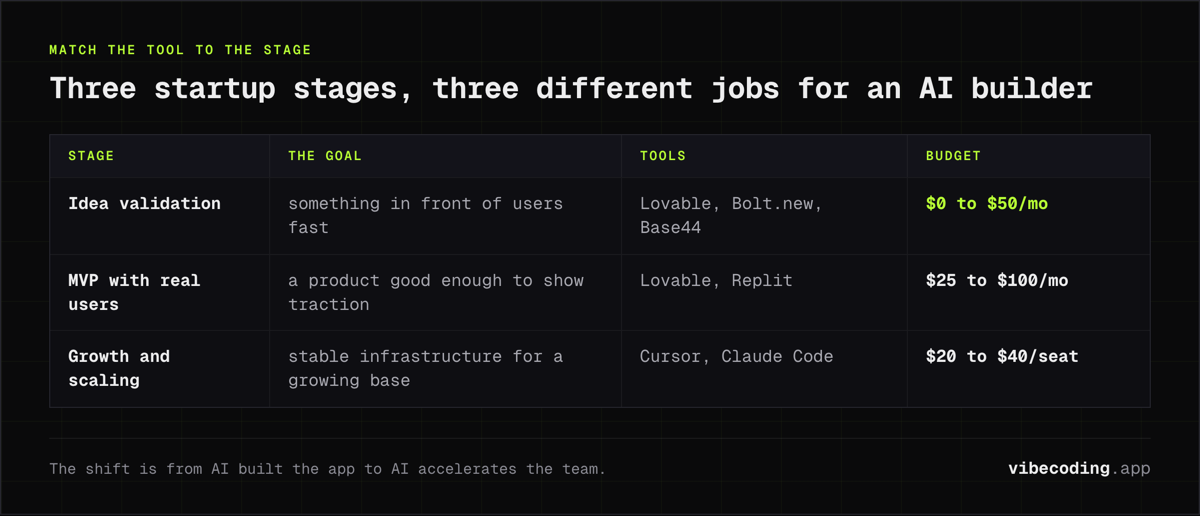
Budget: $20-40/seat/month for developer tools, plus infrastructure costs.
Tool Comparison for Startup Founders
| Tool | Best stage | Speed to MVP | Code export | Backend | Monthly cost |
|---|---|---|---|---|---|
| Lovable | Idea → MVP | ~35 min | Full source | Supabase | Free-$200 |
| Bolt.new | Idea → MVP | ~28 min | Full source | Flexible | Free-$50 |
| Base44 | Idea → MVP | Minutes to first draft | GitHub sync (paid) | Built-in | Free-$160 |
| Replit | MVP → Growth | ~45 min | Full source | Built-in | Free-$25 |
| Cursor | Growth → Scale | N/A (IDE) | Your code | Your stack | $20/seat |
| v0 | UI prototyping | Minutes | React code | None | Free-$20 |
Cost Analysis: What Startups Actually Spend
Bootstrapped founder ($0-50/month)
Free tiers are genuinely usable. Lovable's free plan lets you build and test. Supabase's free tier handles 50,000 monthly active users. You can validate an idea at zero cost and only start paying when users show up.
Pre-seed startup ($50-200/month)
A typical AI-built stack for an early startup:
- Lovable or Bolt.new Pro: $25-50/month
- Supabase Pro: $25/month
- Domain and DNS: $15/year
- Vercel or Netlify hosting: free tier
Total: roughly $50-75/month for a production-ready MVP. Compare this to the $5,000-15,000/month cost of even a single contract developer.
Funded startup ($200-1,000/month)
Post-funding, you might add:
- Cursor for developers: $20/seat/month
- Upgraded hosting: $25-100/month
- Monitoring (Sentry, analytics): $30-50/month
- Upgraded database: $50-100/month
Still a fraction of traditional development costs.
What Investors Think About AI-Built Products
A common concern: will investors take an AI-built product seriously?
The honest answer: investors care about traction, not technology choices. A working product with 500 active users built with Lovable is more impressive than a technical architecture document with zero users.
That said, investors will ask about scalability. Be ready to explain:
- The code is standard React/TypeScript – any developer can work on it.
- The backend runs on Supabase (PostgreSQL) – a production-grade database.
- You can migrate off the builder – the code exports fully.
- Your first hire will be an engineer – who will work on the existing codebase, not rewrite it.
The narrative is not "we used AI instead of developers." It is "we validated faster and smarter by using AI, and now we are ready to build a team."
Scalability: Can You Grow Past the Builder?
This is the right question to ask early. The answer depends on the tool.
Lovable and Bolt.new generate standard React code with standard backends. When you outgrow the builder's iteration speed, you export the code and hand it to developers. The transition is not painless, developers need time to understand generated code, but it is not a rewrite either.
Replit lets you mix AI generation with manual coding, so the transition is gradual rather than a hard cutoff.
The rule of thumb: AI builders are excellent up to about 10,000-50,000 users. Beyond that, you need dedicated engineering for performance optimization, custom infrastructure, and complex feature development. By that point, you should have the revenue or funding to hire.
Common Mistakes Startup Founders Make with AI Builders
Building too much before validating
AI makes building fast. That is dangerous if it means you spend two weeks building a full product nobody wants. Build the minimum viable version: a landing page, one core feature, a signup form, and test it before going further.
Ignoring security until it matters
AI-generated authentication works for demos. Before putting real user data behind it, review the security setup. Row-level security policies, input validation, and HTTPS are not optional for production.
Not understanding the code at all
You do not need to be a developer. But you should understand at a high level what the AI built: what framework it uses, where the data lives, how authentication works. This helps you make better decisions and communicate with future developers.
Choosing the wrong tool for the stage
Using Cursor when you need Lovable (too complex for idea validation) or using Lovable when you need Cursor (too constrained for a growing product) wastes time. Match the tool to the stage.
The Startup AI Builder Workflow
Here is a practical workflow for going from zero to MVP:
- Write your idea in one paragraph. Be specific about who uses it and what they do.
- Generate the first version using Lovable or Bolt.new. Accept the defaults.
- Test it yourself – click every button, fill every form, try to break it.
- Share with 5 people who match your target user. Watch them use it. Take notes.
- Iterate based on feedback – use the builder's chat to make changes.
- Add real infrastructure – Supabase for database, Stripe for payments, a real domain.
- Launch publicly – even if it is rough. Real users teach you what to build next.
This entire workflow can happen in a weekend. For a detailed guide, read our vibe coder's guide to shipping an MVP in 4 hours.
FAQ
Which AI builder is best for a non-technical founder? Lovable: it requires zero technical knowledge and generates the full stack from conversation.
Can I build a mobile app with AI builders? Most builders generate web apps. For mobile, wrap the web app with a tool like Capacitor, or use Replit which supports mobile output.
Will my AI-built app scale? To 10,000-50,000 users, typically yes. Beyond that, you need engineering investment.
How long does it take to build an MVP? A basic MVP takes 1-3 days with AI builders. A polished one with payments and auth takes 1-2 weeks.
Do I need a technical co-founder? Not for validation. You need technical help for scaling, but you can validate and raise a pre-seed round without one.
Can investors tell the app was AI-built? The output uses standard frameworks (React, TypeScript). There is no visible difference to end users.
Explore the full ecosystem in our best AI app builders comparison and browse our tools directory for all available platforms.

Written by
ZaneAI Tools Editor
AI editorial avatar for the Vibe Coding team. Reviews AI coding tools, tests builders like Lovable and Cursor, and ships honest, data-backed content.