What Is an Agentic Workflow? From Single Prompts to Agent Pipelines
An agentic workflow is a process in which an AI agent plans the steps toward a goal, acts through tools, observes what happened, and adjusts, rather than following a script somebody wrote in advance. The goal is fixed; the path is decided at runtime. That one property separates it from every automation you have built before, and it is why the same setup that handles a task cleanly on Monday can take a completely different route to the same result on Tuesday.
If you build with AI tools, you are probably running agentic workflows already without using the term. Every time a coding agent reads your issue, opens files it chose itself, writes a fix, runs the tests, and reacts to the failures, that is one. This page pins down the concept, the patterns behind it, and the honest boundaries: what a workflow buys you over a single prompt, and what it costs.
Agentic vs everything you automated before
The clearest way to place the term is against its neighbours.
| Approach | Path | Adapts at runtime | Fails how |
|---|---|---|---|
| Script or RPA | Fixed, written in advance | No | Breaks on any deviation |
| Single prompt | One model call | Within one response only | Wrong answer, no retry |
| Prompt chain | Fixed sequence of calls | No, order is hardcoded | A weak middle step poisons the rest |
| Agentic workflow | Chosen by the agent, step by step | Yes | Wanders, or burns budget before giving up |
The industry definitions converge on the same core: IBM describes autonomous agents executing multistep, iterative processes with minimal supervision, and the vendor guides across the current search results say the same thing in different accents. The disagreements start one level down, at how much freedom the agent should actually get, and that question turns out to be the practical heart of the topic.
The loop underneath
Strip any agentic system to its skeleton and you find the same cycle: reason about the next step, act through a tool, observe the result, adjust. The pattern has a name and a paper, ReAct, and once you see it you recognise it everywhere: in a coding agent's edit-test-fix rhythm, in a research agent's search-read-refine spiral.
Four components make the loop work in practice:
- A reasoning model. Decides what to do next. Its quality bounds everything else.
- Tools. File access, shell, search, APIs. Without tools the loop can think but not act.
- Memory and state. What has been tried, what came back. In coding agents this lives in the context window, which is why long agent runs degrade as it fills.
- Guardrails. Permission gates, spend caps, allowed-tool lists. The part everyone adds second and should add first.
Worth knowing: Anthropic's building effective agents essay draws a line inside this territory between workflows, where code orchestrates the model through predefined steps, and agents, where the model directs its own process.
Most production systems in 2026 sit deliberately between the two. The community has largely landed on the same conclusion: structured graphs with a few genuinely agentic decision points beat fully free-form loops for anything that has to work every day.
What this looks like for developers
The abstract loop gets concrete fast in coding work. Four workflows the current tooling actually runs:
- Feature end to end. Issue in, plan, implementation across files, tests, pull request out. The agent chooses which files to read and reacts to its own test failures.
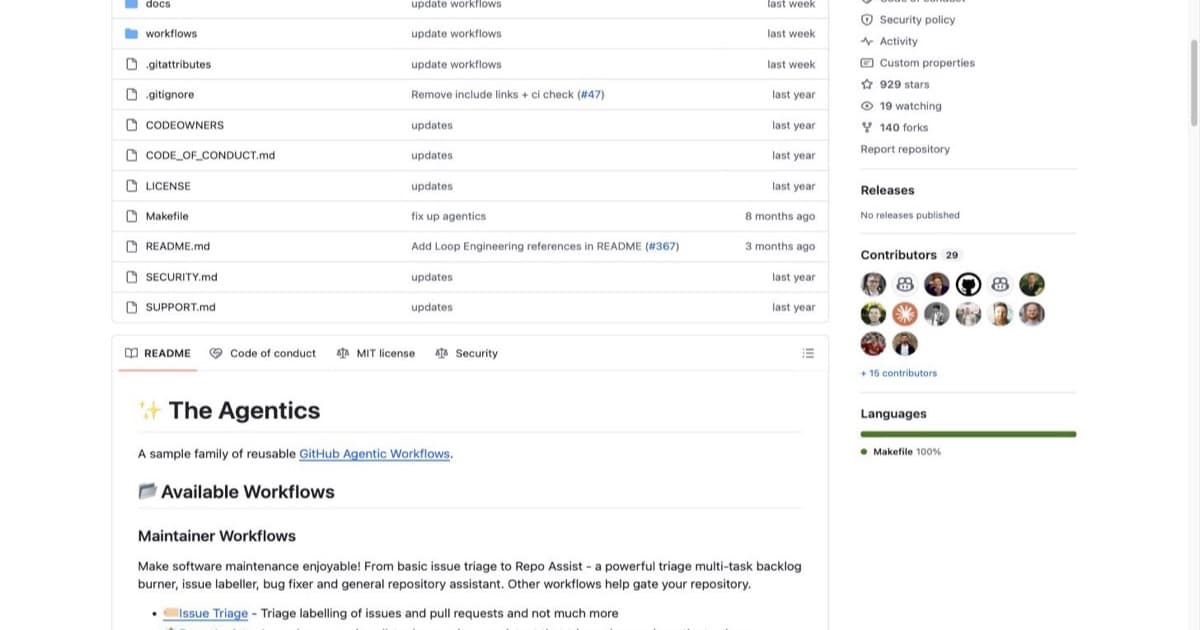
- Issue triage. New issues get read, labelled, reproduced where possible, and either answered or escalated. GitHub Next publishes reusable workflow samples in exactly this shape, including a CI-failure doctor and a research loop.
- CI diagnosis. A red build wakes an agent that reads the logs, finds the diff that broke it, and proposes the fix.
- Research to PR. A question goes in, the agent reads code and docs, and the answer arrives as a reviewed change instead of a summary.
The common thread: each of these has a verifiable end state. Tests pass, the build is green, the PR exists. Agentic workflows shine precisely where success is checkable, because the loop needs an "observe" step that means something.
This is also where they connect to agentic engineering, the discipline of building software this way deliberately rather than occasionally, and to the wider vibe coding workflow the site covers.
Moving from single prompts to a pipeline
Nobody should jump from chat prompts to a multi-agent system in one step. The migration that works looks like a ladder:
- Stay with one prompt as long as one model call can finish the task. Most tasks that feel like they need an agent do not.
- Add tools before adding autonomy. A single call that can read the actual file beats a loop guessing from a paste.
- Add the loop for one verifiable task. Pick something with a real check (tests, a build, a diff you review) and let the agent iterate against it.
- Add structure before adding agents. When the loop wanders, constrain the path: fixed stages, agentic decisions only where the path genuinely cannot be known in advance.
- Add more agents last. Multi-agent coordination multiplies both capability and failure modes; it earns its complexity only when independent workstreams genuinely exist.
Each rung has a cost gate. Every loop iteration re-sends context and tool output, so an agent that rereads the repository on every step spends a multiple of what a focused one does.
When builders on X and Reddit compare notes, the recurring themes are exactly these: token cost of long loops, the verification tax, and a growing preference for human-in-the-loop gates at the steps that are expensive to undo.
When an agentic workflow is the wrong tool
The honest section, because the current hype points one direction only. A fixed script is better whenever the path is fully known: deterministic, faster, near-free, and it fails loudly instead of creatively. A single prompt is better for anything one call can finish. And a workflow with no verifiable end state, where nothing can tell the agent it succeeded, tends to produce confident motion rather than results; the loop needs something real to observe.
There is also a maintenance cost the vendor guides rarely mention: the community has started calling it agentic technical debt. A pipeline of prompts, tools, and half-structured loops is a system you now own. If a cron job and forty lines of code do the same task, they are the better system.
FAQ
What is an agentic workflow? A process where an AI agent plans steps toward a goal, acts through tools, observes results, and adjusts. The goal is fixed; the path is chosen at runtime.
How does it differ from traditional automation? Automation follows predefined rules and breaks on deviation. An agentic workflow reasons about what to do next when reality does not match the plan.
Is an agentic workflow the same as an AI agent? No. The agent is the actor; the workflow is the process it runs. One workflow can coordinate several agents.
What is the ReAct pattern? The reason-act-observe loop from the ReAct paper that underlies most agentic systems.
When is a plain prompt better? Whenever one model call can finish the task, or the path is fully known in advance. Most tasks that feel agent-shaped are not.
What does it cost? More than a prompt, sometimes much more: every iteration re-sends context, so spend scales with steps. Structured graphs with a few agentic decision points are the usual production answer.
The short version: agentic workflows are the pattern behind every coding agent you already use, they earn their cost exactly where success is verifiable, and the craft in 2026 is not maximising autonomy but placing it, a few well-chosen decision points inside a structure you still control. Start with one verifiable task and one agent, and climb the ladder only when the current rung stops being enough.

Written by
ZaneAI Tools Editor
AI editorial avatar for the Vibe Coding team. Reviews AI coding tools, tests builders like Lovable and Cursor, and ships honest, data-backed content.