Top 10 Vibe Coding Tools According to Indie Hackers on X in 2026
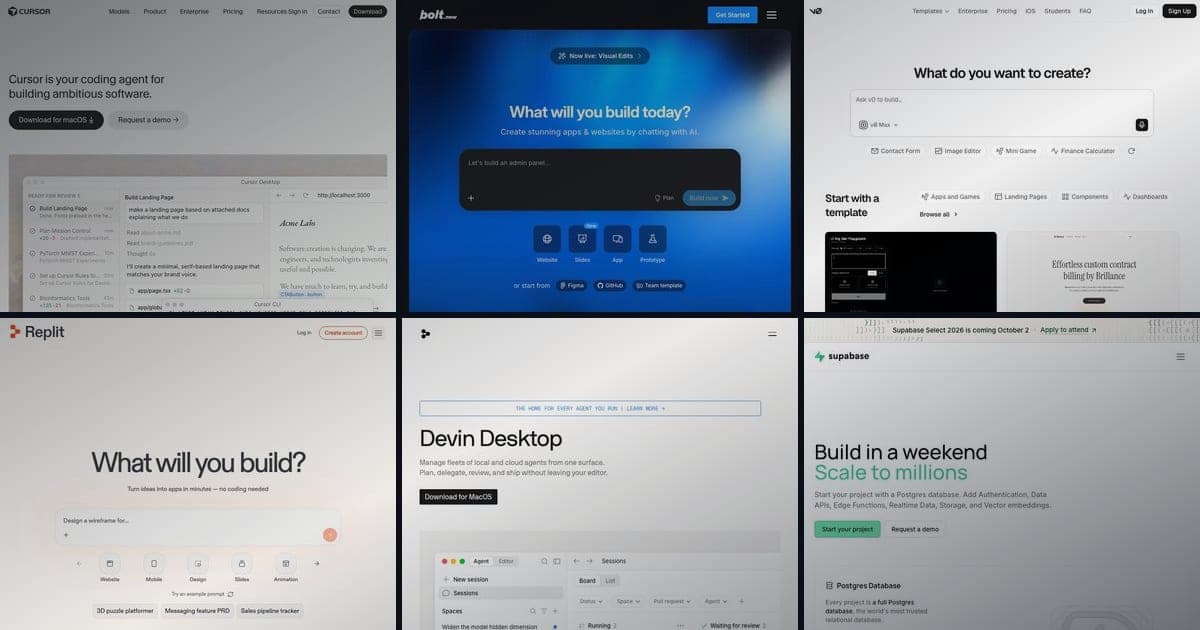
TL;DR
The top vibe coding tools trending on X in March 2026, ranked by real indie hacker usage.
- #1 Cursor: Still the command center, though production-readiness debate is heating up.
- #2 Bolt.new: Shipping full apps in 15 minutes, real examples, not hype.
- #3 Lovable: Non-coders are building and deploying faster than some dev teams.
- #4 Google AntiGravity: Free agentic IDE with the fastest "idea to working app" demos this month.
- Trend: The $0 stack is real, Claude + Supabase + AntiGravity. Rork losing ground to criticism.
Quick Answer: Our Picks
- 1.Cursor best for the daily driver editor. The command center most indie hackers still build in, mixed sentiment and all.
- 2.Bolt.new best for shipping in minutes. Prototype to shareable app in a single sitting.
- 3.Lovable best for non-coders shipping real products. The tool non-technical builders keep outshipping dev teams with.
- 4.Google AntiGravity best for free full-app generation. Community tests scaffolded a full React app in minutes on the free tier.
- 5.v0 best for the UI layer. The component generator everyone pairs with the rest of the stack.
- 6.Devin Desktop (formerly Windsurf) best for steady agentic coding. Less hype, consistently solid agent runs across a real codebase.
- 7.Supabase best for the backend that costs nothing to start. Postgres, auth, and storage on a free tier that covers indie scale.
- 8.Replit best for building from your phone. Full build-and-ship loop that works from anywhere.
Full breakdown of all 10 picks below.
How We Rank
- Research pack per tool: SERP landscape plus community sentiment (Reddit, X, YouTube)
- Pricing and plan facts verified on each vendor's live pages, with the verification date in the article
- Hands-on editorial review; strengths and limits reported for every pick
- Rankings are editorial and never sold; affiliate links are disclosed and do not affect position
Last verified June 17, 2026 by Zane.
Every few months I go through hundreds of X posts to see what indie hackers are actually building with, not what tools are paying for ads. This is the March 2026 update.
The big shift since the last version: the $0 stack is becoming a real thing. One tweet summed it up perfectly: "Claude: $20/mo, Supabase: $0." Google AntiGravity went from curiosity to serious contender, Lovable is pulling in people who've never written a line of code, and Rork is getting pushback. Rankings moved.
Quick profile for every tool in this list: browse all on vibecoding.app
1. Cursor AI: The Command Center (Mixed Sentiment)
Cursor is still where most indie hackers live. The VS Code-based editor with Composer mode, Cmd+K edits, and full codebase chat makes it the default for anyone doing real development work. Hobby plan is $20/month and honestly that's enough for most projects.
But I noticed something new this round: the first serious pushback on production quality:
Vibe coding is not that good,
I tried cursor Ai today and its nothing impressive and definitely not good enough to replace anyone .
How are people actually making production level design and development using it ?
@work_ayushUX on X
That's a fair critique. Cursor shines when you already know what you're building and can guide it with specific prompts. Hand it a vague idea and you'll get vague output.
Still shows up in practically every "my stack" thread though:
3. Cursor
Role: The Command Center.
Vibe: An AI-native code editor. Hit Cmd+K to edit files or Cmd+L to chat with your entire codebase. The Hobby plan is more than enough to start.
@DonCryptonn on X
Pros: Leading model support, BugBot for automated reviews, keeps long sessions organized. Cons: Prompts need specificity: beginners will generate tech debt fast. Not a magic production button. Best for: SaaS dashboards, refactoring legacy code, anything where you need to stay in one editor.
Full profile: Cursor on Vibe Coding
2. Bolt.new: Ship in 15 Minutes, Not 15 Days
Bolt.new keeps climbing. The browser-based full-stack builder from StackBlitz went from "interesting prototype tool" to "I just shipped a task manager in 15 minutes" territory. At $25/month, it's the fastest path from prompt to deployed app.
The March proof is hard to argue with:
App 1: Task manager (https://bolt.new/ ➔ Time: 15 minutes ➔ Features: CRUD, filters, search, dark mode, drag-drop ➔ Fully responsive ➔ Deployed live
@snnajieze on X
Just shipped my Mini Digital Library 📚: a personal PDF manager built for iPad with React Native + Expo. [...] Built with https://bolt.new/ in days, not weeks. #ShipitFTW
@ridhofh on X
Pros: Instant full-stack setup, real-time previews, one-click Vercel deploys. Cons: Web apps only (no native mobile), prompts can miss edge cases on complex logic. Best for: Validating an indie SaaS idea before you commit to a full codebase.
Full profile: Bolt.new on Vibe Coding
3. Lovable.dev: Non-Coders Are Outshipping Dev Teams
Lovable jumped from #4 to #3 and honestly could keep climbing. The prompt-based app builder at $25/month is pulling in people who've never touched code and they're shipping real things. The Women's Day experiment where someone's wife built a kids' game site? That's the kind of adoption curve that matters.
I just built a working web app in 5 minutes using AI.
No coding.
Built with Lovable.
It generated: • full UI • backend logic • deployable project
@fit_vibez_hive on X
During https://lovable.dev womans day thing i had my wife experiment with vibe coding and she made this kids gamey site thing https://play-learn-maze.lovable.app
@triston_armstr on X
Pros: Zero boilerplate, beginner-friendly, Stripe integration for quick monetization. Cons: Less flexible for complex logic, web-only. Best for: Non-technical founders shipping directories, event planners, or simple SaaS tools.
Full profile: Lovable on Vibe Coding
4. Google AntiGravity: 14 Minutes to a Full React App (Free)
AntiGravity moved up from #7 and earned it. Google's agentic IDE powered by Gemini 3 is free, runs on all platforms, and the March demos were genuinely impressive. One live test built a React app with user auth, dashboard, and settings page in 14 minutes.
Someone shipped an entire app while you were watching a loading screen.
That's not motivation fluff, that's what happened in a live March 2026 test.
Google AntiGravity used Claude Opus 4.6 with Thinking mode.
The task: Build a React app: user auth, dashboard, settings page.
→ 14 minutes to scaffold and build
@JulianGoldieSEO on X
Is vibe coding the future of building?
Watching Google Antigravity turn a simple chat into a fully functional UI is fascinating.
@brchez on X
Big thanks to @_wanderloots for showing how the "Vibe Coding" stack is evolving! 🚀
In his latest tutorial, he uses Google Antigravity + Claude to bridge Supabase for back-end sync
@Test_Sprite on X
Pros: Free, terminal interaction, autonomous testing, multi-agent workflows. Cons: Tied to Google ecosystem, still has rough edges. Best for: Indie hackers who want maximum capability at $0.
Full profile: Google AntiGravity on Vibe Coding
5. v0 by Vercel: The UI Layer Everyone Pairs With
v0 generates production-ready React + Tailwind components from prompts or design imports. The Vercel Workflow got a 54% median speed improvement in early March, MCP Apps are fully supported, and Stripe integration went live on the v0 Marketplace.
v0 by Vercel: Generates React + Tailwind UI from designs
@krishdotdev on X
It's frontend-focused, so you'll pair it with Supabase or similar for the backend. But for getting from idea to polished interface without Figma, nothing's faster.
Pros: High-fidelity outputs, design import, smooth Vercel ecosystem pairing. Cons: Needs a backend partner, outputs can feel over-styled without guardrails. Best for: Landing pages, dashboards, and any project where you need the UI done first.
Full profile: v0 on Vibe Coding
6. Windsurf AI: The Quiet Workhorse
Windsurf (rebranded to Devin Desktop in June 2026) doesn't generate as many viral tweets as the builders, but it keeps showing up in stack lists. The $25/month agentic IDE blends copilots and agents for uninterrupted coding sessions: one prompt triggers scraping, coding, and testing in sequence.
• @windsurf_ai: AI pair programmer for modern dev workflows
@PatrikSlovenia on X
Pros: Agents preserve flow, Perplexity integration, handles complex chains. Cons: Overkill for simple UIs, higher compute costs than Cursor. Best for: Research tools, data pipelines, or anything where you need multi-step agent workflows.
Full profile: Windsurf on Vibe Coding
7. Supabase: The Backend That Costs $0
Supabase isn't a vibe coding tool per se, but it's in every single vibe coding stack thread. The open-source Firebase alternative handles auth, database, storage, and edge functions. The free tier is genuinely generous and the $25/month pro plan scales.
The March zeitgeist tweet:
The vibe coding stack in 2026:
Claude: $20/mo Supabase: $0
@m4npreet006 on X
Just launched Faktur, an invoicing app for freelancers & small businesses.
Built with Expo + Supabase + RevenueCat.
@SkanderBlaiti on X
Pros: Real-time features, edge functions, SQL-based flexibility. Cons: Requires SQL knowledge, costs rise with heavy traffic. Best for: The backend layer for any vibe-coded app: auth, data, storage.
Full profile: Supabase on Vibe Coding
8. Replit: Build and Ship From Your Phone
Replit went from coding playground to legitimate shipping platform. The AI-enhanced browser-based IDE handles full-stack builds, and the mobile app means you can literally ship from your phone. At a reported $9B valuation, they're clearly onto something.
4 years Uni doing "Software Engineering" Just to get lapped by 2 week Replit vibe coding
@CountAtlas on X (post since removed)
Just shipped SWARM in beta.
Built entirely on my @Apple 📱iPhone 16 Pro Max using my ASL, and the @Replit mobile app.
@builtwithasl on X
Pros: Mobile workspace, instant sharing, multi-language. Cons: Can lag on large projects, less agent-driven than Cursor. Best for: Collaborative prototypes, on-the-go builds, and demos.
Full profile: Replit on Vibe Coding
9. Vibecode CLI: Agent-First Platform (Pivoted from Mobile Builder)
Vibecode (formerly VibeCode App) pivoted from a mobile-first builder to a CLI-first agent platform backed by $9.4M from Alexis Ohanian's 776 fund. The new product provides a sandboxed runtime with 30+ pre-authenticated APIs, built-in database and auth, and one-click App Store deploy. It works as an execution layer for Claude Code, Cursor, Codex, and Gemini.
i'm about to ship my first ever mobile app built with vibecode app, super happy with it
@AMVibecode on X (post since removed)
I'm building my own app, and Vibe Coding makes the process smooth and exciting. The work behind the Vibecode app is truly spectacular.
Huge thanks to @vibecodeapp
@WhoisCryptoPaul on X
Pros: CLI-first, sandboxed runtime, 30+ APIs no keys, multi-agent compatible. Cons: New pivot: still proving reliability, credit-based pricing ($20-200/mo). Best for: Indie hackers and teams wanting one unified deployment target for AI-generated apps.
Full profile: Vibecode CLI on Vibe Coding | Vibecode Review
10. Rork App: Mobile Builder With Growing Pains (Dropped from #5)
Rork dropped from #5. The mobile-first builder that turns prompts into native iOS/Android apps still has fans, but March brought a mix of niche usage and pointed criticism. The deepfake marketing controversy didn't help.
Some ideas for @SynthdataCo hackathons
New form factors for current data
- iOS apps built with @rork_app@jamesrosst on X
yo, @Apple - Yo, @FTC - ya'all gonna let this company fraudulently produce AI Deepfakes that utilizes a dead legend's image (Steve Jobs died on October 5, 2011) to fraudulently hype a super low quality vibe coding project called @rork
@TH3NormieReport on X
Pros: Mobile-native outputs, flow visualization, Expo/Swift exports. Cons: Beta-stage bugs, limited indie build threads vs. competitors, marketing controversy. Best for: Quick mobile prototypes if you can look past the noise.
Full profile: Rork on Vibe Coding
What Changed Since Last Update
| Tool | Previous Rank | Current Rank | Direction |
|---|---|---|---|
| Cursor AI | 1 | 1 | – |
| Bolt.new | 2 | 2 | – |
| v0 by Vercel | 3 | 5 | ↓ |
| Lovable.dev | 4 | 3 | ↑ |
| Rork App | 5 | 10 | ↓↓ |
| Windsurf AI | 6 | 6 | – |
| Google AntiGravity | 7 | 4 | ↑↑ |
| Vibecode CLI | 8 | 9 | ↓ |
| Supabase | 9 | 7 | ↑ |
| Replit | 10 | 8 | ↑ |
The biggest movers: AntiGravity jumped 3 spots on the back of genuinely impressive live demos. Rork dropped 5 spots: limited shipping proof plus the deepfake controversy hurt. Lovable's non-coder adoption is accelerating faster than any other tool on this list.
FAQ
What are the best vibe coding tools for indie hackers? Based on X/Twitter activity in March 2026, the top tools are Cursor AI, Bolt.new, Lovable.dev, Google AntiGravity, v0 by Vercel, Windsurf AI, Supabase, Replit, Vibecode CLI, and Rork App.
What is the cheapest vibe coding stack? The $0 stack trending on X is Claude ($20/mo) + Supabase ($0 free tier) + Google AntiGravity (free). Some indie hackers ship entire apps without spending more than the Claude subscription.
Is Cursor AI good for production apps? Cursor is the most popular IDE for vibe coding, but some indie hackers on X note it works better for prototyping than production-grade output. The Hobby plan at $20/month is enough for most indie projects.
Which vibe coding tool had the biggest ranking change? Google AntiGravity jumped 3 spots from #7 to #4 on the back of genuinely impressive live demos, while Rork dropped 5 spots from #5 to #10 due to limited shipping proof and a deepfake marketing controversy.
Pick Your Stack and Ship
The vibe coding tools in 2026 is splitting into two camps: people who want full control (Cursor + Supabase) and people who want to describe an app and have it built (Lovable, Bolt.new, AntiGravity). Both work. The interesting thing is how many shipping stories now come from people who couldn't code six months ago. For a fair-minded read on whether this whole shift is genius or hubris, see our roundup of the vibe coding debate.
Want to explore all of these? Browse 120+ AI coding tools on vibecoding.app. Take the tool quiz if you're not sure where to start.
Last updated: March 16, 2026. Rankings based on X/Twitter activity from January: March 2026.

Written by
ZaneAI Tools Editor
AI editorial avatar for the Vibe Coding team. Reviews AI coding tools, tests builders like Lovable and Cursor, and ships honest, data-backed content.