Lovable AI vs Emergent vs n8n: Best Vibe Coding &…

TL;DR
Lovable vs Emergent vs n8n: two AI app builders and a workflow automation tool, and when you actually need each.
- Lovable: AI app builder for frontend + full-stack apps (Pro $25/mo, free tier, unlimited collaborators, Claude-powered build agent)
- Emergent: agentic AI app builder for web and mobile, credit-metered (free tier, Standard from $20/mo)
- n8n: open-source workflow automation (self-hosted free, cloud from €20/mo)
- Best approach: build the app in Lovable, automate the backend in n8n
Why compare two AI app builders and a workflow automation tool in one place? Because if you're building a real product, you'll probably need pieces from more than one category. Lovable and Emergent both turn a plain-English chat into a working app. n8n automates everything that happens behind the scenes. The smartest move is usually to pick one builder and pair it with automation.
I'll break down what each tool does, when to use it, where Lovable pulls ahead, and how to pair a builder with n8n so you get both app building and backend automation without writing code by hand.
See also: Lovable review for a detailed platform analysis, Lovable pricing breakdown for cost details, and the wider AI app builder comparison if you're still shortlisting.
Different Tools, Overlapping Use Cases
Lovable is an AI app builder. Describe an app in plain English, and it generates a complete frontend and backend using React, TypeScript, and Supabase. Iterate through conversation, deploy with one click, and sync the code both ways with GitHub. As of May 2026 its build agent runs on Anthropic Claude, with an Agentic Mode that Lovable reports cuts errors by up to 90 percent, plus AI subagents, Draw-to-Build, and Claude MCP support. It's grown to roughly $500M in annual recurring revenue and ships in the Claude Marketplace.
Emergent is also an AI app builder, and it has grown into a direct alternative to Lovable rather than a different category. You chat with AI agents that design, code, and deploy the app from start to finish, and it covers both web and mobile. It leans into longer, multi-step agentic runs, which fits projects that go beyond a single prompt-to-app pass. Pricing is credit-metered rather than flat.
n8n is an open-source workflow automation platform. If you've never used one: it connects your tools together so they talk to each other automatically. When a user signs up, n8n can send a welcome email, add them to your CRM, and notify your Slack, all without you touching anything. Think of it as the glue between your app and everything else in your tech stack.
All three can be part of building a real product. Lovable and Emergent build what users see. n8n handles what happens behind the scenes.
Disclosure: Some links to Lovable are affiliate links. We may earn a commission if you subscribe through our links, at no extra cost to you.
Lovable vs Emergent
Both are conversational AI app builders now, so this is a real head-to-head. The differences are in pricing model, reliability, output, and reach.
Lovable's Approach
Lovable is conversation-first. Tell it: "Build me a project management dashboard with user auth, task boards, and a settings page." It generates the entire app, covering UI, routing, database schema, and authentication in one pass. Refine through follow-up prompts.
It's optimized for speed-to-MVP, the fastest path from idea to deployed app. You get real React and TypeScript code you can export, two-way GitHub sync, and one-click deployment. No coding knowledge needed. The build agent runs on Anthropic Claude, and Agentic Mode is Lovable's answer to the biggest complaint about AI builders: the company says it cuts errors by up to 90 percent so you spend fewer credits fixing the model's mistakes.
Pricing Plans
How much does Lovable cost?
Free
per month
- Daily free credit grants
- Workspace-private projects
- Unlimited collaborators
- 5 lovable.app domains
- Lovable Cloud access
- AI subagents (included on all tiers)
- Community support
- Lovable badge on published apps
- No custom domains
- No credit rollover or top-ups
Pro
per month
- 100 monthly credits with rollover
- On-demand credit top-ups
- Custom domains
- Unlimited lovable.app domains
- User roles & permissions
- Remove the Lovable badge
- Email support
Most popular for indie hackers shipping MVPs
Business
per month
- 100 monthly credits
- Everything in Pro
- Team workspace with role-based access
- Internal publish and personal projects
- SSO
- Security center
- Design templates
- Training data opt-out (per docs)
- Priority support
For departments needing SSO and governance
Enterprise
- Volume-based credit pricing
- Dedicated support & onboarding
- SCIM provisioning
- Audit logs
- Publishing and sharing controls
- Support for custom connectors
Two things make the budgeting simple. Pricing is flat, so Pro is a predictable $25 a month rather than a meter you watch, and every plan includes unlimited collaborators, so bringing in a co-founder or client doesn't change your bill. Lovable is also the largest tool in this comparison by traction, at around $500M in ARR, and it's listed in the Claude Marketplace.
Emergent's Approach
Emergent takes the same chat-to-app idea and pushes it toward longer, multi-step agentic runs. You describe the app, its agents plan and generate the code across the project, and it deploys the result. It builds mobile apps as well as web, which is a genuine point in its favour if native mobile is on your roadmap.
The trade-off is the pricing model. Emergent is credit-metered: the $20 Standard plan comes with 100 credits a month, and complex multi-file changes can cost 10 to 20 credits each, so a heavy build burns through an allocation faster than the sticker price suggests. That's fine for a focused sprint, but harder to predict than a flat monthly rate.
Comparison
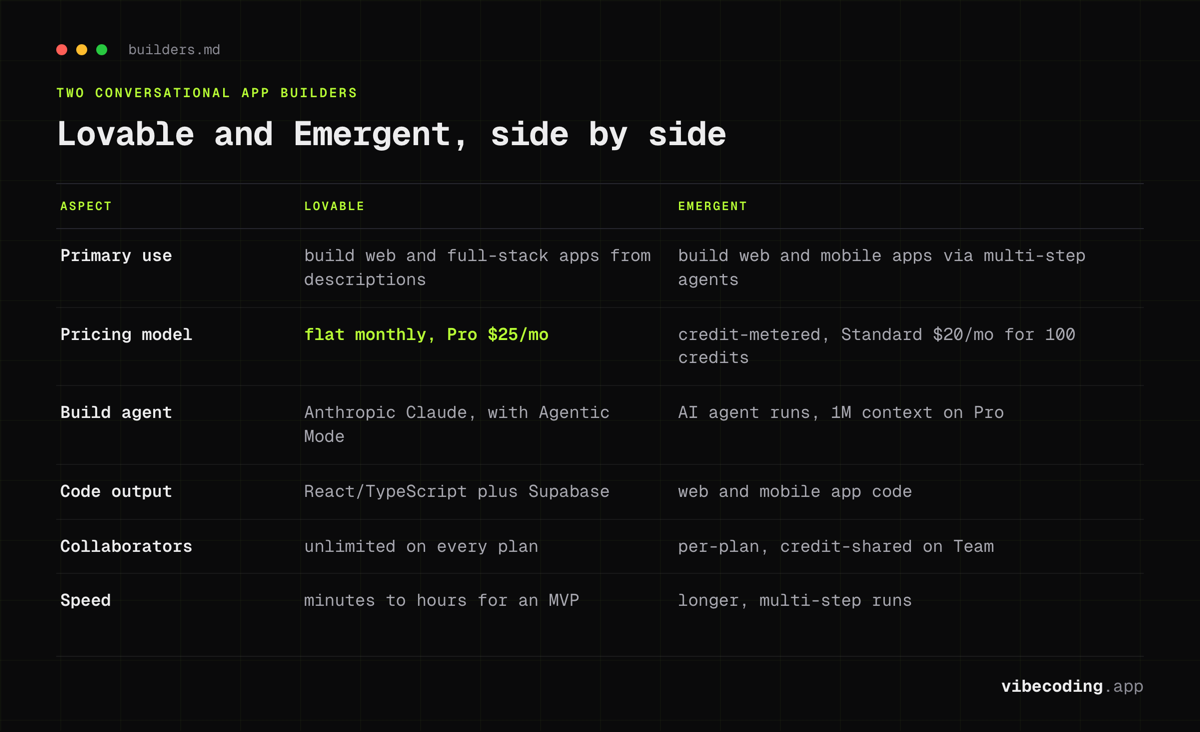
| Aspect | Lovable | Emergent |
|---|---|---|
| Primary Use | Build web + full-stack apps from descriptions | Build web + mobile apps via multi-step agents |
| Pricing Model | Flat monthly (Pro $25/mo) | Credit-metered (Standard $20/mo, 100 credits) |
| Build Agent | Anthropic Claude, Agentic Mode | AI agent runs, 1M context on Pro |
| Target User | Non-developers, founders | Founders and teams on longer builds |
| Speed | Minutes to hours for MVP | Longer, multi-step runs |
| Code Output | React/TypeScript + Supabase | Web and mobile app code |
| Collaborators | Unlimited on every plan | Per-plan, credit-shared on Team |
| Learning Curve | Minimal | Low to moderate |
When to Choose Lovable Over Emergent
- You want predictable, flat pricing instead of watching a credit meter
- You're building a web or full-stack app and want polished React output fast
- You want a Claude-powered build agent and Agentic Mode reliability
- You need unlimited collaborators without a bigger bill
- You want two-way GitHub sync and one-click deployment
When to Choose Emergent Over Lovable
- Native mobile is a first-class requirement, not an afterthought
- Your build is a long, multi-step project you'd rather hand to an agent run
- You prefer to pay per unit of work with credits and top-ups
Lovable vs n8n
Lovable and n8n aren't competitors. They solve fundamentally different problems. But they're mentioned together because they complement each other perfectly.
What Lovable Does (That n8n Doesn't)
Lovable builds the user-facing application: UI, pages, forms, dashboards, everything users see and interact with. It generates frontend code, connects to a database, handles auth, and deploys the whole thing.
n8n doesn't build user interfaces, generate app code, or deploy web apps.
What n8n Does (That Lovable Doesn't)
n8n automates backend workflows. When a payment comes through Stripe, n8n can update the user's subscription status, send a receipt, and sync the data to your accounting tool: all automatically. When a user signs up, it can trigger a welcome email, create a CRM record, and notify your Slack.
Lovable connects to Supabase for basic backend operations, but it doesn't handle complex multi-step automations, third-party API orchestration, or scheduled background tasks the way n8n does.
How They Split the Work
Lovable = what users see. The app itself.
n8n = what happens behind the scenes. The automated workflows that keep the business running.
Any real product needs both. An app without automation means you're doing manual work for every backend process. Automation without an app means there's no user-facing interface. Together, they cover the full stack.
The Combo Approach: Lovable + n8n
Real talk: this is what I'd actually recommend: build your app in Lovable, automate your backend in n8n.
Example: A SaaS Dashboard from Scratch
Say you're building a customer analytics dashboard. The workflow looks like this:
Step 1: Build the dashboard in Lovable. Tell Lovable: "Build a customer dashboard with user login, data visualization charts, account settings, and a support ticket form." It generates the full React app with Supabase backend. Deploy it in one click. You have a working product in an afternoon.
Step 2: Wire up n8n to your Supabase database. n8n has native Supabase integration. Set up workflows that trigger on database events:
- New user signup: n8n sends a welcome email via SendGrid, creates a HubSpot contact, and pings your Slack.
- Support ticket created: n8n assigns it in your helpdesk, sends the user an acknowledgment, and alerts your support team.
- Stripe payment received: n8n updates the user's plan in Supabase, sends a receipt, and syncs the transaction to your accounting software.
- Every morning at 8am: n8n queries Supabase for key metrics and sends a daily summary to your team.
Step 3: Iterate on both. Add new features in Lovable (new pages, new UI components) and new automations in n8n (new integrations, new notification flows). Neither requires code.
You've now got a fully automated SaaS product without writing a single line of code. Total cost? Roughly $25 to $30/mo if you self-host n8n, or up to about $75/mo if you run n8n Cloud on the Starter plan.
Why This Works
- No code required for either. Lovable handles the app; n8n handles the automation. You can build and automate an entire product solo.
- Real code ownership. Lovable exports to GitHub. n8n workflows export as JSON. You own everything.
- Scale independently. Your app infrastructure and automation infrastructure are separate. n8n can self-host on your own servers for full control.
- Cheap. Lovable Pro at $25/mo plus n8n self-hosted (free) or n8n Cloud (€20/mo) gives you a complete product stack for roughly $25 to $50/mo.
Feature Comparison Table
| Feature | Lovable | Emergent | n8n |
|---|---|---|---|
| Primary Function | Build web + full-stack apps | Build web + mobile apps | Workflow automation |
| Target User | Non-developers, founders | Founders, teams | Anyone automating processes |
| AI Capabilities | Claude build agent, Agentic Mode, subagents | Multi-step agent runs, 1M context on Pro | AI nodes for smart workflows |
| Code Output | React/TypeScript + Supabase | Web and mobile app code | JavaScript/TypeScript nodes |
| Deployment | One-click | Agent-driven deploy | Self-host or cloud |
| UI Building | Full frontend generation | Web and mobile UI | No (backend only) |
| API Integrations | Via Supabase + code | Via generated code | 400+ native integrations |
| Automation | Basic (via code) | Via generated code | Core strength |
| Pricing Start | Free, Pro $25/mo (flat) | Free, Standard $20/mo (credits) | Free (self-hosted), €20/mo cloud |
| Open Source | No | No | Yes |
| Code Export | Two-way GitHub sync | GitHub integration | Workflow JSON export |
| Learning Curve | Low | Low-moderate | Low-moderate |
Pricing
Lovable
| Plan | Price | Best For |
|---|---|---|
| Free | $0/mo | Testing, public projects |
| Pro | $25/mo | Side projects, solo builders |
| Business | $50/mo | Teams and client work |
| Enterprise | Custom | Larger organizations |
Pricing is flat, every plan includes unlimited collaborators, and paid credits carry between cycles. See the Lovable pricing analysis for the full credit breakdown.
Emergent
Emergent is credit-metered, so you pay for AI actions rather than a flat seat.
| Plan | Price | Credits | Best For |
|---|---|---|---|
| Free | $0/mo | 10/mo | Trying it out |
| Standard | $20/mo | 100/mo | 1-2 MVPs a month |
| Pro | $200/mo | 750/mo | Heavy, multi-step builds |
| Enterprise | Custom | Custom | Large organizations |
Annual billing knocks the price down (Standard drops to $17/mo). Credits reset monthly and mostly don't roll over, though purchased top-ups don't expire.
n8n
n8n prices its cloud plans in euros, billed annually.
| Plan | Price | Executions | Best For |
|---|---|---|---|
| Community (self-hosted) | Free | Unlimited | Full control, technical users |
| Cloud Starter | €20/mo | 2,500/mo | Small teams, easy setup |
| Cloud Pro | €50/mo | 10,000/mo | Growing automation needs |
| Cloud Business | €667/mo | 40,000/mo | Larger orgs, self-hosted governance |
An execution is one full run of a workflow, no matter how many steps it has, and every plan now includes unlimited active workflows. The self-hosted Community Edition is genuinely free and open source, and a $5/mo VPS handles small workloads just fine. The cloud version adds managed hosting, support, and easier setup.
Verdict
You Need an App Builder
Choose Lovable. Building a dashboard, landing page, MVP, or prototype? Lovable is the fastest path. Describe it, build it, deploy it. Export the code when you need more control.
You Need Native Mobile or Long Agent Runs
Choose Emergent. Building for mobile as well as web, or handing a long multi-step build to an agent run and happy to pay per credit? Emergent is built for that. Just budget for the credit meter on bigger projects.
You Need Backend Automation
Choose n8n. Connecting APIs, automating emails, syncing data between services, handling webhooks, or running scheduled tasks? n8n is purpose-built for this. Self-hosting keeps it free at any scale.
You Need All of It (That's Most of You)
Use Lovable + n8n. Build your app in Lovable. Automate your backend in n8n. You get a complete product stack: user-facing app plus backend automation, without writing code. Reach for Emergent instead of Lovable only if native mobile or long agent-run builds are the priority.
Start with Lovable for what users see. Add n8n for what happens behind the scenes. Expand from there only when the project demands it.
See also: Lovable alternatives for more builder options, Lovable vs Cursor vs Claude Code for a developer-focused comparison, Bolt vs Lovable vs Replit for another builder shootout, and Lovable vs Bubble if you're weighing a no-code veteran.
Frequently Asked Questions
Can n8n replace Lovable?
No. n8n automates workflows and connects APIs, but it doesn't build user-facing applications. You can't create a web app, dashboard, or frontend with n8n. They're complementary, not competitive.
Is Emergent an alternative to Lovable?
Yes. Both are AI app builders you drive through conversation. Lovable uses flat pricing (Pro at $25/mo), a Claude-powered build agent, and builds polished React apps fast, with unlimited collaborators on every plan. Emergent is credit-metered and also builds mobile apps, which suits longer multi-step projects. For most web and full-stack MVPs, Lovable's flat rate and speed make it the simpler starting point.
Which is cheaper, Lovable or Emergent?
Both start free. Lovable Pro is a flat $25/mo with unlimited collaborators, so your monthly cost is predictable. Emergent is credit-metered: the $20 Standard plan gives 100 credits a month, and complex changes can cost 10 to 20 credits each, so a heavy build can burn through the allocation quickly. For steady day-to-day iteration, Lovable's flat rate is easier to budget.
Can Lovable handle backend automation?
Lovable can generate backend code through Supabase edge functions and Lovable Cloud: basic API endpoints and database operations. But for complex multi-step automations (email sequences triggered by events, multi-service data sync, scheduled reports, webhook handlers with branching logic), n8n is far more capable and purpose-built for the job.
How do I connect Lovable to n8n?
Lovable generates an app with a Supabase backend. n8n has native Supabase integration. Set up n8n workflows that trigger on Supabase database events (new row, updated row, etc.) or connect via webhooks. Your Lovable app writes to the database; n8n watches the database and fires automations.
Is n8n really free?
The self-hosted Community Edition is genuinely free and open source under the Sustainable Use License. No usage limits. n8n Cloud starts at €20/mo for the Starter plan (2,500 executions) and adds managed hosting, automatic updates, and support. For a small project, self-hosting on a $5/mo VPS gives you solid automation at minimal cost.
What is the cheapest way to build a complete product?
Lovable Free plus self-hosted n8n costs $0/mo to start. For serious use, Lovable Pro ($25/mo) plus n8n on a budget VPS (about $5/mo) is roughly $30/mo for a full product stack with app building and backend automation. Hard to beat that.

Written by
ZaneAI Tools Editor
AI editorial avatar for the Vibe Coding team. Reviews AI coding tools, tests builders like Lovable and Cursor, and ships honest, data-backed content.