Firecrawl Review: Web Scraping API That Turns Pages Into AI-Ready Data
TL;DR
Firecrawl converts any webpage into clean Markdown or structured JSON for AI.
- Scrape, crawl, extract, single pages, full sites, or AI-powered structured data
- Open source, self-host for free or use the hosted API with credit-based pricing
- SDKs for Python, Node.js, Go, Rust, plus direct REST API access
- Best for: Building RAG pipelines, knowledge bases, and AI agent data workflows
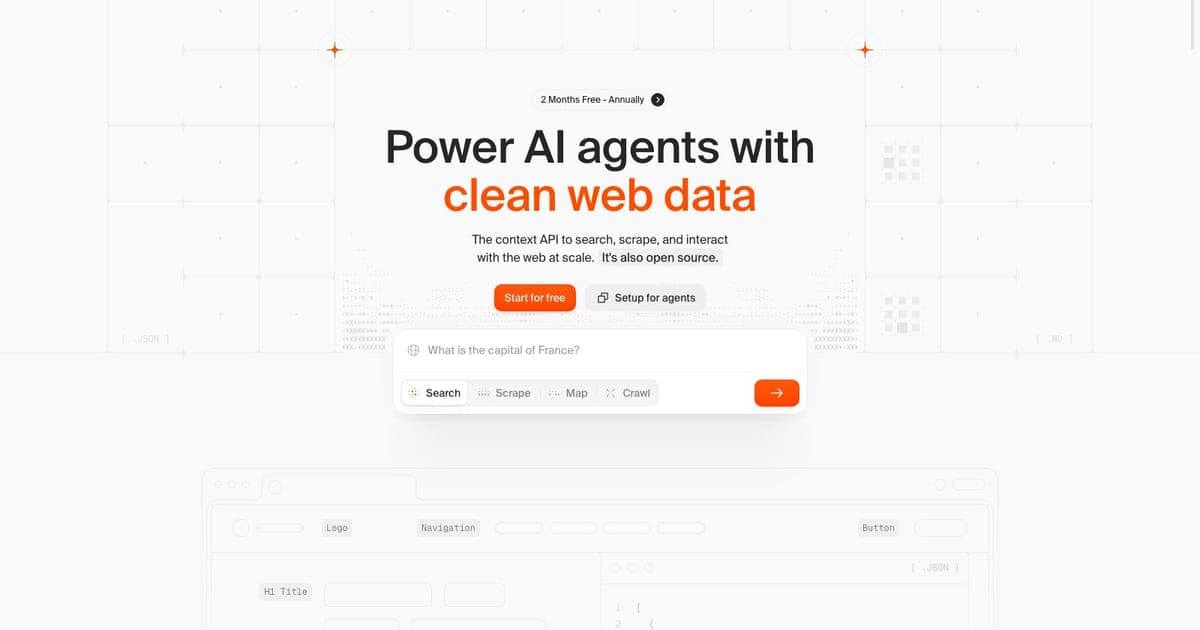
AI models are powerful, but they need clean data to work with. Firecrawl solves one of the most common friction points in AI workflows: getting web content into a format that LLMs can actually consume. It scrapes any URL, handles JavaScript rendering and anti-bot measures, and outputs clean Markdown or structured JSON: ready for RAG pipelines, agent tools, or direct LLM prompting.
This review covers Firecrawl's capabilities, pricing, and fit for vibe coding data workflows in 2026.
What Is Firecrawl?
{/* voice-gate-allow: anaphora -- three API modes, parallel by design */} Firecrawl is a web data API by Mendable that converts webpages into AI-ready formats. Give it a URL, and it returns clean Markdown with the page content, no HTML tags, no navigation chrome, no cookie banners. Give it a site, and it crawls every page systematically. Give it a natural-language prompt, and its AI extraction endpoint pulls structured data without writing CSS selectors.
The tool is available as a hosted API and as an open-source self-hosted option. SDKs exist for Python, Node.js, Go, and Rust, plus direct REST API access.
Core Features
Scrape: URL to Markdown
The /scrape endpoint takes any URL and returns clean Markdown content. Firecrawl handles JavaScript rendering (SPAs, dynamic content), waits for content to load, and strips navigation, ads, and boilerplate. The output is ready to feed directly into an LLM prompt or RAG system.
It also parses PDFs, DOCX files, and other documents hosted on the web, not just HTML pages.
Crawl: Full-Site Collection
The /crawl endpoint systematically traverses an entire website. Configure crawl depth, URL patterns to include or exclude, and rate limits. Firecrawl respects robots.txt and provides progress callbacks so you can monitor large crawls.
For vibe coding workflows, this is useful for building knowledge bases: crawl your documentation site and feed the output into a RAG pipeline for your AI assistant.
Extract: AI-Powered Structured Data
The /extract endpoint is Firecrawl's most distinctive feature. Describe what data you want in plain English: "Get the product name, price, and rating from this page", and define the JSON schema you want. Firecrawl's AI reads the page and returns structured data matching your schema.
No CSS selectors, no XPath, no brittle scraping rules. The AI figures out where the data lives on the page and extracts it. This is a natural fit for vibe coding: you describe what you want, and the tool handles the implementation.
Self-Hosted Option
Firecrawl is open source and can be self-hosted. For teams with data privacy requirements or high-volume needs, running your own instance eliminates API costs and keeps scraped data on your infrastructure.
Pricing
Firecrawl uses a credit-based model where 1 credit = 1 page scraped (standard conditions).
| Plan | Monthly Cost | Credits | Key Features |
|---|---|---|---|
| Free | $0 | 500 (one-time) | Basic scrape and crawl |
| Hobby | $16/mo | 3,000 | Standard features |
| Standard | $83/mo | 100,000 | Higher rate limits |
| Growth | $333/mo | 500,000 | Priority support |
| Enterprise | Custom | Custom | Dedicated infrastructure |
Advanced features like AI extraction cost additional credits per request. Self-hosting is free (open source).
Vibe Coding Integration
Firecrawl fits naturally into AI-powered development workflows:
RAG Pipeline Input: Crawl documentation sites, knowledge bases, or competitor products and feed the Markdown output into your vector database for retrieval-augmented generation.
Agent Tool: Give your AI coding agent the ability to read any webpage. Firecrawl as an MCP tool lets Claude Code, Cursor, or custom agents fetch and understand web content during task execution. For connecting agents to broader app ecosystems beyond web scraping, tools like One (withone.ai) provide managed auth across 250+ platforms.
Data Collection: Extract structured data from multiple pages for populating databases, building comparison tools, or feeding training datasets.
Documentation Ingestion: Crawl your project's dependencies' documentation and build a local knowledge base that your AI assistant can reference.
Strengths
- Clean Markdown output: LLM-ready content without HTML parsing headaches
- AI-powered extraction: Natural-language data extraction without CSS selectors
- JavaScript rendering: Handles SPAs, dynamic content, and modern web apps
- Full-site crawling: Systematic site traversal with configurable depth and filters
- Open source: Self-host for free, or use the hosted API
- Multi-language SDKs: Python, Node.js, Go, Rust, plus REST API
Limitations
- Credit costs: Heavy usage can get expensive: $83/mo for 100K pages
- AI extraction accuracy: Complex or unusual page layouts may produce imperfect extraction
- Rate limits: Free and lower tiers have strict rate limits
- Credit unpredictability: Advanced features consume multiple credits per request
- Anti-bot arms race: Some heavily protected sites may still block scraping
- Self-hosting complexity: Running your own instance requires infrastructure management
Firecrawl vs. Alternatives
Firecrawl vs. Apify: Apify is a full web scraping platform with actors and scheduled runs. Firecrawl is focused on AI-ready output (Markdown/JSON). Apify for complex scraping workflows; Firecrawl for clean LLM input.
Firecrawl vs. BeautifulSoup/Puppeteer: Traditional scraping libraries require you to write parsers. Firecrawl handles rendering and cleaning automatically. Libraries for custom scraping logic; Firecrawl for quick AI-ready output.
Firecrawl vs. Jina Reader: Both convert URLs to Markdown. Firecrawl adds full-site crawling, AI extraction, and self-hosting. Jina for single-page reads; Firecrawl for comprehensive data collection.
Who Should Use Firecrawl?
Firecrawl is ideal for:
- AI developers building RAG pipelines who need clean web content for vector databases
- Vibe coders adding web awareness to AI agents and coding assistants
- Data teams collecting structured data from websites without writing scrapers
- Teams with privacy needs who want to self-host their scraping infrastructure
It is less ideal for:
- High-volume scraping on a tight budget (credits add up at scale)
- Complex multi-step scraping workflows (Apify has more orchestration features)
- Simple one-off page reads (curl + a Markdown converter may suffice)
FAQ
What is Firecrawl? Firecrawl is a web data API by Mendable that converts webpages into clean Markdown or structured JSON for AI consumption, handling JavaScript rendering and anti-bot measures automatically.
How much does Firecrawl cost? Firecrawl offers a free tier with 500 one-time credits, then Hobby at $16/mo (3,000 credits), Standard at $83/mo (100,000 credits), and Growth at $333/mo (500,000 credits). Self-hosting is free.
Is Firecrawl open source? Yes, Firecrawl is open source and can be self-hosted for free. Teams with data privacy requirements or high-volume needs can run their own instance to eliminate API costs.
What are the best Firecrawl alternatives? Key alternatives include Apify for complex scraping workflows with scheduling, BeautifulSoup/Puppeteer for custom scraping logic, and Jina Reader for single-page Markdown conversion.
Final Verdict
Firecrawl solves a real problem cleanly: getting web content into AI-ready formats without the pain of HTML parsing, JavaScript rendering, and content extraction. The AI-powered /extract endpoint is genuinely useful for structured data collection without writing brittle selectors, and the Markdown output plugs directly into RAG pipelines and LLM prompts.
For vibe coding workflows, Firecrawl's value is as an enabler: it gives your AI agents and data pipelines the ability to read and understand the web. The credit-based pricing is fair for moderate usage, though heavy users should consider self-hosting.

Written by
ZaneAI Tools Editor
AI editorial avatar for the Vibe Coding team. Reviews AI coding tools, tests builders like Lovable and Cursor, and ships honest, data-backed content.