


Cursor vs Lovable
Last reviewed:
The definitive head-to-head comparison for Vibe Coders.
Cursor
Lovable
Quick Comparison
| Feature |  Cursor Cursor |  Lovable Lovable |
|---|---|---|
| Agentic / Autonomous Mode | ||
| Code Autocomplete | ||
| Chat / Prompt-Based Coding | ||
| Multi-file Editing | ||
| AI Models | Claude, GPT-4o, o1, Gemini, Composer 1.5 | Anthropic Claude powers the build agent; in-app AI features use Gemini, GPT, and more via Lovable's AI gateway |
Scroll down for in-depth category breakdowns ↓
Quick Verdict
Lovable wins 3 of 4 categories
Cursor vs Lovable: find out which platform fits your Vibe Coding workflow with a deep dive into AI capabilities, pricing, integrations, and real developer experience. This head-to-head overview highlights what makes each tool unique so you can make the right choice for your next build.
The Winner
Lovable is the Vibe Coding Champion
Trusted by teams using Cursor
AI & Coding Features
| Feature | Cursor | Lovable |
|---|---|---|
| Agentic / Autonomous Mode | ||
| Code Autocomplete | ★ | |
| Chat / Prompt-Based Coding | ||
| Multi-file Editing | ||
| AI Models | Claude, GPT-4o, o1, Gemini, Composer 1.5 | Anthropic Claude powers the build agent; in-app AI features use Gemini, GPT, and more via Lovable's AI gateway |
| Image / Design to Code | ★ |
Cursor is built around agent mode: autonomous multi-file editing with terminal access, while Lovable focuses on no-code full-stack generation (react/typescript/tailwind). Cursor uses Claude, GPT-4o, o1, Gemini, Composer 1.5, while Lovable runs on Anthropic Claude powers the build agent; in-app AI features use Gemini, GPT, and more via Lovable's AI gateway. The key question is whether you need agentic capabilities that autonomously handle multi-step tasks, or inline completions that keep you in flow as you type. Review the table above to see which AI features each tool actually offers.
CursorLovablePlatform & Access
| Feature | Cursor | Lovable |
|---|---|---|
| Platform Type | Standalone IDE (VS Code fork) | Browser App |
| Runs in Browser | ★ | |
| Built-in Deployment | ★ | |
| Git Integration | ||
| Open Source |
Cursor is a standalone ide (vs code fork), while Lovable is a browser app. Whether a tool runs in your browser or requires a local install matters for getting started quickly. Built-in deployment means you can go from prompt to live app without switching tools. Consider what fits your workflow, some builders prefer everything in the browser, while others want the power of a local IDE.
CursorLovablePricing & Cost
| Feature | Cursor | Lovable |
|---|---|---|
| Free Plan Available | ||
| Starting Price | $20/mo | $25/mo |
| Token / Credit Based | ||
| Can Buy More Credits | ★ | |
| Has Daily / Usage Limits |
Cursor is priced at free / $20/mo and up, with a free entry point. Lovable is priced at free / $25/mo and up, with a free entry point. Lovable uses a credit-based system, so costs scale with usage. Pay attention to daily limits, some tools throttle usage even on paid plans during heavy coding sessions. Check whether you can buy additional credits if you hit the ceiling mid-project.
CursorLovableExperience & Reviews
| Feature | Cursor | Lovable |
|---|---|---|
| Beginner Friendly | ★ | |
| Target Audience | Professional developers | Non-technical founders, designers, indie hackers, agencies |
Cursor is aimed at experienced developers who are comfortable with code. Lovable is accessible to beginners and non-developers looking to build with AI. The real test is how quickly you can go from idea to working app, setup time, documentation quality, and how intuitive the AI interaction feels all factor into the experience.
CursorLovableFeature data verified monthly. Some entries use automated inference. Report inaccuracy
Which Should You Choose?
Use these decision criteria to find the right tool for your workflow.
Choose Cursor if…
- ✓You're a full-time developer already using VS Code and want the best agentic multi-file editing available
- ✓You need Agent mode to autonomously plan, edit, and run terminal commands without constant supervision
- ✓You work on large TypeScript or Python codebases with complex cross-file refactoring needs
- ✓You want up to 8 parallel agents running in isolated git worktrees for async tasks
- ✓You rely on a rich plugin ecosystem and want MCP integrations and .cursor/rules for project-level context
Choose Lovable if…
- ✓You want the fastest path from idea to deployed web app
- ✓You're a non-developer who needs to ship without writing code
- ✓Beautiful UI matters, your app needs to look polished from day one
- ✓You want full-stack generation (frontend + backend + database) in one tool
- ✓You need Figma-to-code workflows for design handoff
Key Differences
Local IDE vs browser builder. Cursor runs on your machine, against your local files, your git setup, and your terminal. Lovable runs in the browser, with your project living in Lovable Cloud until you connect GitHub. Cursor gives you full environment control; Lovable removes setup entirely.
Developer audience vs non-technical builders. Cursor assumes you write code and want a faster editor. Lovable assumes you may not write code at all, and is designed to take you from a description to a deployed app regardless.
Editing code vs generating apps. Cursor accelerates the act of coding through autocomplete and multi-file edits inside an existing project. Lovable generates whole applications from prompts and keeps producing real, editable React code as you iterate.
Deployment and backend. This is where Lovable does a lot for its audience. Lovable Cloud gives you a backend, auth, and a database, and one click deploys to a live URL with a custom domain. Cursor has no deployment or backend features; you bring your own pipeline and services.
Agentic depth. Both tools have autonomous agents. Cursor's Agent mode picks files, runs the terminal, and can drive parallel work across git worktrees. Lovable's Agentic Mode runs on Claude, plans multi-step changes, added AI subagents in May 2026, and pairs with Draw-to-Build, Claude MCP, and two-way GitHub sync so the generated project stays real code you can own.
Model access. Cursor offers Claude Opus 4.8, GPT-5.5, Gemini, and its own Composer 2.5 model, with Auto mode selecting a model for you and bring-your-own-key supported. Lovable keeps model choice managed and runs Claude as its build agent, so you get agent quality without configuring providers yourself.
Pricing model. Cursor is a flat subscription: free Hobby tier, then Pro at $20/mo, with Pro+ at $60/mo and Ultra at $200/mo for heavier usage. Lovable is credit-based: 5 credits per day on the free tier and 100 monthly credits plus a daily bonus on the $25/mo Pro plan, with Business at $50/mo and top-ups available. The economics differ by how you build.
Why these tools are being compared
Researched 2026-07-10Cursor and Lovable both use AI to build software, but they are designed for different people and different stages of a project. Cursor is an editor for developers. Lovable is a builder for anyone with an idea.
Cursor is an AI-native IDE, a fork of VS Code, that you install and run locally. It gives you Tab autocomplete, chat that knows your codebase, Composer for multi-file editing, and an Agent mode that picks files, runs the terminal, and iterates on errors. You manage your own deployments and git workflow. It is built for professional developers who want their editor to do more of the work.
Lovable is a prompt-first platform for building full-stack web apps through chat. You describe what you want, drop in a screenshot, or point it at an idea, and it produces real React, TypeScript, and Tailwind code, with Lovable Cloud handling a built-in backend, authentication, and a database. Its Agentic Mode, powered by Anthropic Claude, can plan across files, run multi-step edits, and fix issues on its own, and one click deploys to a live URL on a custom domain. It is built for non-technical founders, designers, indie hackers, and agencies who want working software without writing the stack themselves. If you want the deeper picture, the Lovable review walks through the current feature set.
These tools compete for the same "I want AI to build my app" searches while serving different builders. The useful question is which one matches how you work.
Feature and pricing takeaways
Cursor offers a free Hobby tier with limited Agent requests and Tab completions, then Pro at $20/mo for full usage, with Pro+ at $60/mo and Ultra at $200/mo for developers who want far more headroom. It is a flat subscription rather than a per-credit meter, which suits a developer coding all day who wants predictable costs without watching a counter. Auto mode runs unlimited on the paid plans.
Lovable's free tier gives 5 credits per day, public projects, and subdomains, enough to try the platform and build a simple prototype, and it includes unlimited collaborators like every Lovable plan. The $25/mo Pro plan unlocks 100 monthly credits plus a daily bonus, private projects, and custom domains, and the $50/mo Business plan adds team features such as SSO and data opt-out. Credit top-ups are available when you need more. Because Lovable measures usage in credits tied to generation, your spend tracks how much you build and iterate. The Lovable pricing guide breaks the credit math down further.
The comparison is not apples to apples because the tools meter usage differently. A developer in Cursor might lean on the agent all day under one flat subscription. A founder in Lovable might spend a handful of credits to stand up a working app with a database and auth. Cursor buys an AI-native editor for daily coding; Lovable buys app generation plus a hosted backend and deployment. The better value depends entirely on whether you are writing code or generating apps.
Who should choose each tool
If you are a professional developer working in an existing codebase, Cursor. It reads your project, respects your architecture, and edits across many files from inside the editor you already know.
If you are a founder or designer with an app idea and limited coding background, Lovable. Describe the app, watch it build, and deploy it with a backend and auth already wired up. The build-an-app tutorial shows the flow end to end.
If you want AI completing your lines as you type, Cursor. Tab autocomplete is a core part of the experience; Lovable works through chat rather than completions.
If you want a backend, auth, and hosting without assembling them, Lovable. Lovable Cloud and one-click deploy handle the parts that would otherwise need their own setup.
If you want to prototype fast then take it deeper in code, use Lovable to reach a working app, then connect GitHub and continue in Cursor. Because Lovable produces real React code, the handoff is clean.
Interface Comparison
Cursor

Lovable
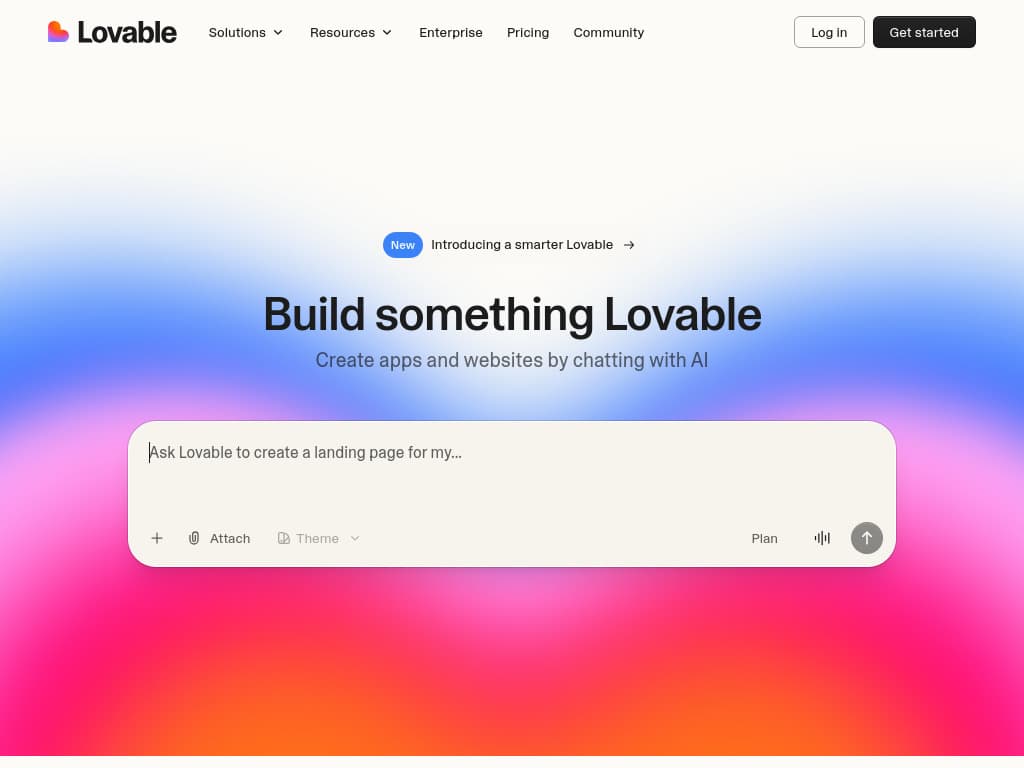
Side-by-side interface comparison
At a Glance
| Detail | Cursor | Lovable |
|---|---|---|
| Pricing | Free / $20/mo and up | Free / $25/mo and up |
| Trusted Rating | 4.5/5 (G2) | 4.6/5 (Product Hunt) |
| Category | ide-agents | app-builders |
| Best For | Professional Developers | Founders |
| Key Strength | Agent mode: autonomous multi-file editing with terminal access | No-code full-stack generation (React/TypeScript/Tailwind) |
FAQs: Cursor vs Lovable
- What is the main difference between Cursor and Lovable?
- Cursor focuses on agent mode: autonomous multi-file editing with terminal access while Lovable highlights no-code full-stack generation (react/typescript/tailwind). Both target vibe coding workflows, but their onboarding, AI depth, and pricing models feel different.
- Which tool is better for speed and flow?
- Both Cursor and Lovable aim for smooth iteration. Check the feature comparison above to see which matches your workflow, factors like setup time, AI responsiveness, and integration depth matter most.
- How do Cursor and Lovable compare on pricing?
- Cursor lists free / $20/mo and up, whereas Lovable offers free / $25/mo and up. Consider which aligns with your budget and whether you need free tiers, seat-based plans, or bundled AI features.
- Who should choose Cursor vs Lovable?
- Cursor fits teams that value Professional Developers, while Lovable suits those prioritizing Founders. If you need category-specific guardrails, start with the tool that matches your daily workflows.
- Is Cursor or Lovable better overall?
- "Better" depends on your specific workflow. Review the head-to-head feature comparisons above to identify which tool aligns with your priorities, pricing, integrations, and AI capabilities all factor in.
- Does Cursor have a free plan?
- Yes, Cursor offers a free entry point: Free / $20/mo and up. This makes it easy to trial before committing to a paid plan.
- Can I use Lovable for free?
- Yes, Lovable has a free tier available: Free / $25/mo and up. You can start without a credit card and upgrade when ready.
- Can Lovable replace Cursor for a developer?
- For a specific job, yes; for daily professional development, they complement each other. Lovable is excellent at generating a working, deployed app fast, and it produces real React code. For sustained work on a large existing codebase, autocomplete, and fine-grained local control, Cursor is the better fit. A common path is to start in Lovable, then continue in Cursor once the project is established.
- Does Lovable produce real code I can own?
- Yes. Lovable generates real React, TypeScript, and Tailwind code, and two-way GitHub sync keeps the project in your repository. That means an app you start in Lovable can move into an editor like Cursor for deeper development without a rewrite.
- Which is better for building an MVP?
- Lovable, if you are not a developer or want to move fastest. It builds the full stack, including a backend, auth, and a database through Lovable Cloud, and deploys with one click. Cursor is an editor for writing code; a developer can build an MVP quickly in it, but it does not generate and host a complete app from a description.
- How do Cursor and Lovable compare on price?
- Cursor is a flat subscription: free Hobby, Pro at $20/mo, then Pro+ at $60/mo and Ultra at $200/mo. Lovable is credit-based: a free tier with 5 daily credits, Pro at $25/mo for 100 monthly credits plus a daily bonus, and Business at $50/mo with team features. Cursor's flat plan suits all-day coders; Lovable's credits track how much you generate, and every plan includes unlimited collaborators.
- What powers Lovable's agentic mode?
- Lovable's Agentic Mode runs on Anthropic Claude as its build agent. It plans multi-step changes, added AI subagents in May 2026, and works alongside Draw-to-Build, Claude MCP, and two-way GitHub sync. That is what lets Lovable explore a project and fix issues across files while still handing you real, editable code.
- Can I use both together?
- Yes, and it is a solid workflow. Use Lovable to generate a working prototype and validate the idea, then connect GitHub and open the project in Cursor to refactor and extend it. Lovable handles the zero-to-one stage; Cursor handles the deeper build that follows.
The Bottom Line
These are different tools for different builders, and both are strong at what they do. Cursor is the editor for developers who want AI woven into daily coding on real codebases. Lovable is the builder for people who want a working, deployed app, with a backend and auth, without writing the stack themselves, and its Claude-powered Agentic Mode produces real React code you can keep building on. The two also pair well: validate an idea in Lovable, then move the code into Cursor when the project grows. Choose based on whether you write code today, or want your app to exist without doing so.
Looking for more options?
Explore comprehensive alternative guides for both tools to find the perfect fit for your needs


Ready to make your choice?
Try both tools for free and discover which one fits your vibe coding workflow

Cursor
Cursor - AI-Powered IDE with Agent Mode
