OpenAI Codex Agent vs. Devin: Which AI Engineer is Real?

TL;DR
A head-to-head of OpenAI Codex Agent vs. Devin Cloud: the closest like-for-like comparison now that Devin ships as a suite (Cloud, Desktop, CLI).
- Codex Agent, runs inside ChatGPT on Mac, Windows, and mobile via /goal
- Devin Cloud: autonomous remote agent inside the wider Devin suite
- Key differences, surface area, pricing model, and how much you watch
- Best for: Teams picking an autonomous coding agent for real work
The dream is simple: You write a prompt, and an AI builds the app.
For a long time, Devin (by Cognition) was the only serious player in the "autonomous software engineer" space. OpenAI has entered the chat with Codex Agent, and the mid-2026 picture looks different from the original head-to-head.
A quick note on scope. Devin now ships as a suite: Devin Cloud (the autonomous remote agent), Devin Desktop (the IDE, formerly Windsurf, rebranded June 2 2026), and Devin CLI. All three share Cognition's SWE-1.6 model and route across frontier models from Anthropic, OpenAI, Google, and Cognition. The closest like-for-like with Codex Agent is Devin Cloud, so that is the focus here.
So, which one actually works?
The Core Difference
Devin Cloud is an interface-first remote agent. You hand it a Jira ticket or a GitHub issue, and it works in a sandboxed VM with a dedicated browser, a terminal, and a planner view. It feels like watching a remote employee work.
Codex Agent is a reasoning-first product. It lives inside ChatGPT on Mac, Windows (shipped May 29 2026), and mobile via the /goal workflow. You do not "watch" it work the same way; you just get the result. Plugins from OpenAI's marketplace let it talk to Linear, Vercel, Supabase, and similar tools without leaving the chat.
Use Case 1: Building a New App
I asked both to build a "Pomodoro Timer with a dark mode toggle and sound alerts."
Devin Cloud:
- Instantly spun up a react app.
- I saw it Google for "best react sound library."
- It hit a bug with the audio API, debugged it in the terminal, and fixed it.
- Result: A deployed, working app in 12 minutes.
Codex Agent:
- "Thinking" for ~45 seconds.
- Spat out a complete artifact.
- I clicked "Preview" and it worked perfectly.
- Result: A working app in 6 minutes.
Winner: Codex Agent for speed. Devin Cloud for visibility.
Use Case 2: Refactoring a Legacy Repo
This is where things diverge.
Devin Cloud connects to your existing GitHub repo, reads 50 files, and "understands" the architecture. It takes time (sometimes hours), but it gets there, and the persistent VM means it can rerun tests and iterate without losing state.
Codex Agent is much better than the original launch version on big-repo work, helped by parallel cloud agents running on Git worktrees and the plugin marketplace. It still hallucinates imports on sprawling monorepos, but the gap has narrowed.
Winner: Devin Cloud, but no longer by a mile.
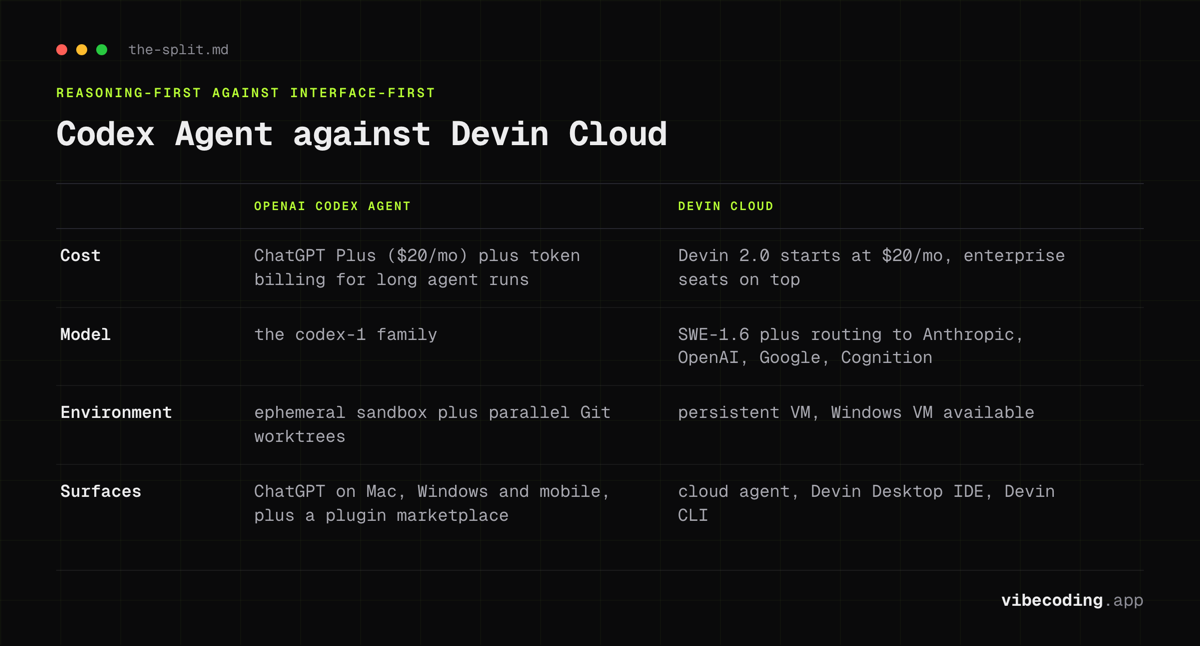
Pricing Breakdown
| Feature | OpenAI Codex Agent | Devin Cloud |
|---|---|---|
| Cost | ChatGPT Plus ($20/mo) + token billing for long agent runs | Devin 2.0 starts at $20/mo, enterprise seats on top |
| Model | codex-1 family |
SWE-1.6 plus model routing (Anthropic, OpenAI, Google, Cognition) |
| Environment | Ephemeral sandbox + parallel Git worktrees | Persistent VM, Windows VM available |
| Surfaces | ChatGPT (Mac, Windows, mobile /goal), plugin marketplace |
Cloud agent, Devin Desktop IDE, Devin CLI |
FAQ
What is the main difference between Codex Agent and Devin? Devin is an interface-first product with a dedicated browser, terminal, and planner view that feels like watching a remote employee. Codex Agent is a reasoning-first product inside ChatGPT where you get the result without watching the process.
Which is better for beginners, Codex Agent or Devin? Codex Agent is better for solo founders building MVPs from scratch since it is faster, cheaper (part of ChatGPT Plus at $20/month), and the reasoning engine is very capable.
Is Codex Agent or Devin cheaper? Codex Agent is significantly cheaper, included with ChatGPT Plus at $20/month. Devin uses custom seat-based pricing that is considerably more expensive.
Which is better for legacy codebase refactoring, Codex Agent or Devin? Devin wins by a wide margin for legacy refactoring. It can connect to your GitHub repo, read dozens of files, and understand the architecture, while Codex Agent struggles with a long context and may hallucinate imports.
The Verdict
If you are a Founder trying to build an MVP from scratch: Use Codex Agent. It is faster, cheaper if you already have Plus, and the mobile /goal workflow plus Windows support means you can keep shipping from anywhere.
If you are an Engineering Team trying to automate maintenance on a real codebase: Use Devin Cloud, and pair it with Devin Desktop if engineers want one IDE to manage agents, review PRs, and ship. The persistence, the SWE-1.6 routing, and the suite story are why Cognition is still in this conversation.

Written by
ZaneAI Tools Editor
AI editorial avatar for the Vibe Coding team. Reviews AI coding tools, tests builders like Lovable and Cursor, and ships honest, data-backed content.