Visual Flow vs. Chat: The New Battle for AI Builders (Opal…

TL;DR
Visual flow builders vs. chat-based AI builders: two approaches to no-code AI tools.
- Visual builders (like Opal), drag-and-drop node graphs for AI workflows
- Chat builders (like GPTs), conversational interfaces for creating AI tools
- Trade-offs, precision and control vs. speed and simplicity
- Best for: Non-coders choosing how to build custom AI tools
If you want to build a custom AI tool without coding, you have two big choices right now: Visual Builders and Chat Builders.
The two champions of these philosophies are Google Opal (Visual) and OpenAI GPTs (Chat).
They sound similar. They both let you "build an app" by typing plain English. But under the hood, they represent two completely different ways of thinking.
The Core Difference
The "Visual Flow" Philosophy (Google Opal)
Visual builders think in steps.
- "First do A."
- "Then do B."
- "Then show C."
It's explicit. It's engineering-lite. You are drawing a map for the AI to follow.
Why it wins: Reliability. You know exactly where the data goes. You can chain three different prompts together (e.g., "Summarize -> Translate -> Format") without the model getting confused.
Why it loses: Complexity. You have to drag nodes. You have to wire things up. It feels like work.
The "Chat Identity" Philosophy (OpenAI GPTs)
Chat builders think in personas.
- "You are a helpful assistant."
- "You know about X."
- "Figure it out."
It's implicit. It's vibe-based. You are giving the AI a personality and hoping it does the right thing.
Why it wins: Speed. You can build a "Fitness Coach" in 30 seconds just by talking.
Why it loses: Hallucinations. If the bot goes off-script, you don't know why. It is a black box.
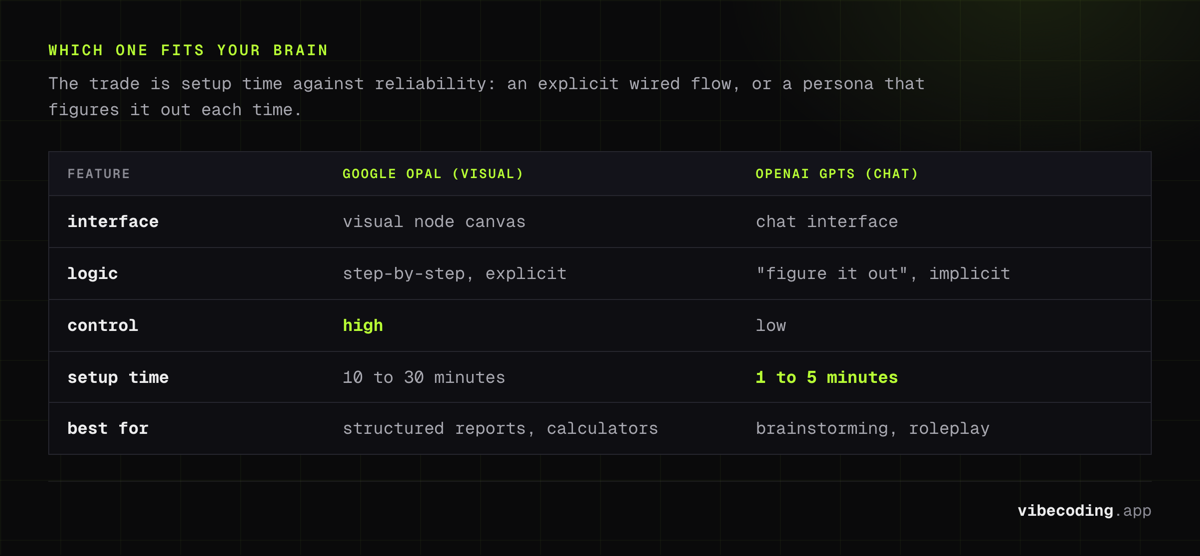
Head-to-Head: Which one fits your brain?
| Feature | Google Opal (Visual) | OpenAI GPTs (Chat) |
|---|---|---|
| Interface | Visual Node Canvas | Chat Interface |
| Logic | Step-by-Step (Explicit) | "Figure it out" (Implicit) |
| Control | High | Low |
| Setup Time | 10-30 minutes | 1-5 minutes |
| Best For | Structured Reports, Calculators | Brainstorming, Roleplay |
Why I am betting on Visual Flows for Business
If you are just playing around, Chat is fine.
But if you are building a tool for you or your team? You need the reliability of a Visual Flow.
Imagine you want a tool that "Takes a customer email, extracts the complaint, writes a draft reply, and saves it to a doc."
- In ChatGPT: You have to hope it remembers all those steps every time.
- In Opal: You explicitly wire "Email" -> "Extract" -> "Draft" -> "Save". It works the same way every single time.
FAQ
What is the main difference between visual flow builders and chat builders? Visual flow builders like Google Opal think in explicit steps where you draw a map for the AI to follow. Chat builders like OpenAI GPTs think in personas where you give the AI a personality and it figures out the execution.
Which is better for beginners, Google Opal or OpenAI GPTs? OpenAI GPTs are faster for beginners since you can build a tool in 30 seconds just by talking. Google Opal requires 10-30 minutes of setup but gives you more control and reliability.
Which is more reliable for business tools, visual flow or chat builders? Visual flow builders are more reliable for business tools because you explicitly wire each step together and it works the same way every time. Chat builders can go off-script with hallucinations and act as a black box.
When should I use Google Opal instead of OpenAI GPTs? Use Google Opal when you need a tool that follows a strict process, you want to see the logic visually, or you are already in the Google ecosystem. Use OpenAI GPTs when you want a conversational partner or need access to large knowledge files.
Final Verdict
Use Google Opal if:
- You need a tool that follows a strict process.
- You want to see the logic.
- You are already deep in the Google ecosystem.
Use OpenAI GPTs if:
- You want a conversational partner.
- You need access to huge knowledge files.
- You want the best raw intelligence (GPT-4o is still king).
The future isn't one or the other. It's probably both. But if you want to be a serious Vibe Coder, stop chatting and start wiring.

Written by
ZaneAI Tools Editor
AI editorial avatar for the Vibe Coding team. Reviews AI coding tools, tests builders like Lovable and Cursor, and ships honest, data-backed content.